
The short answer
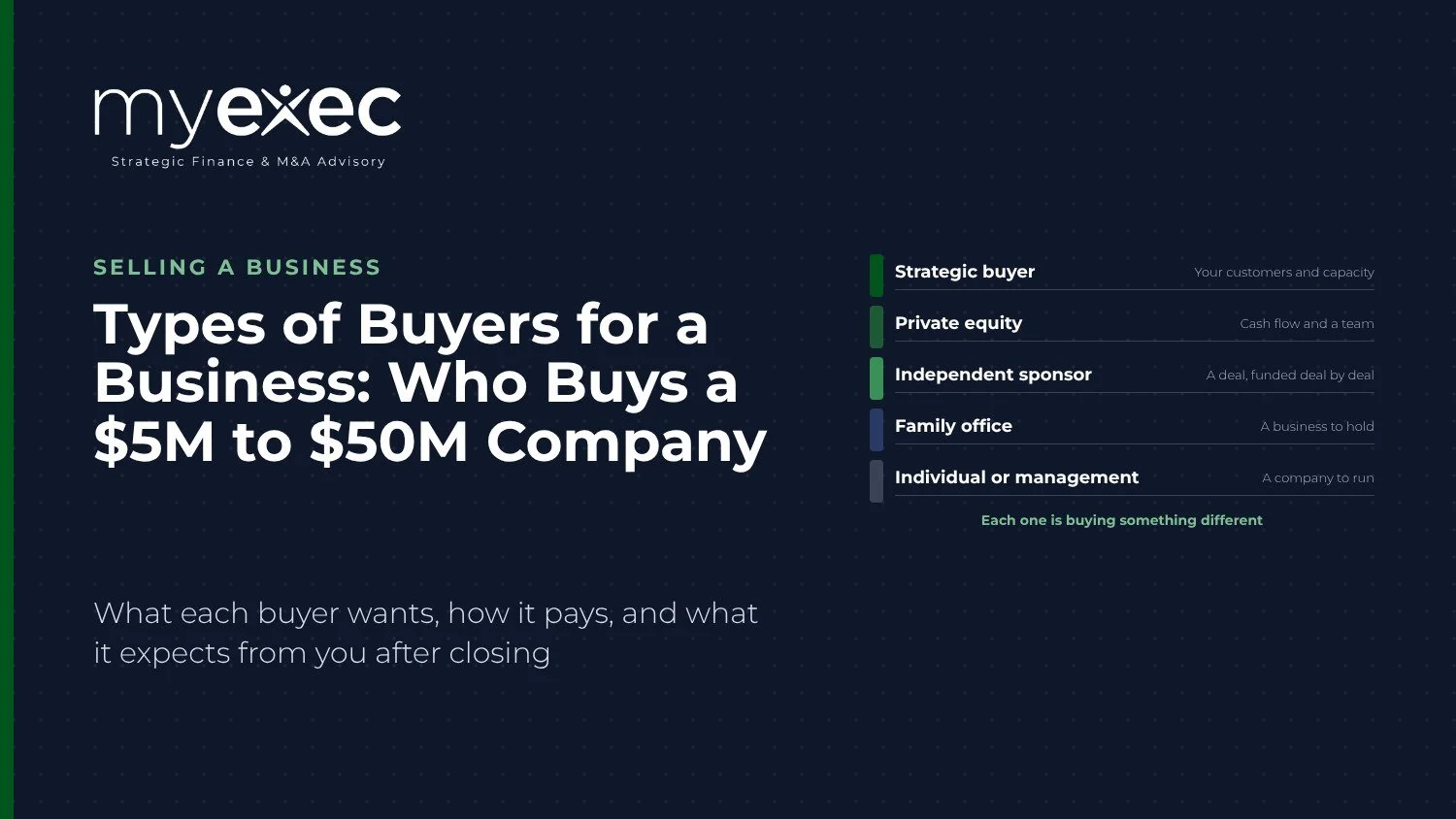
The main types of buyers for a company with $5M to $50M in revenue are strategic buyers in the same or a related industry, private equity firms, independent sponsors, family offices and individual buyers, and the company's own managers. They value the business differently, finance deals differently, and expect different things from the owner after closing, so the right buyer depends on what you want from the sale as much as on the price.
Most owners picture one buyer: a bigger competitor who writes a check. That buyer exists, and in a lot of deals they're the right answer. But a company this size usually has four or five kinds of buyer who could own it, and they're looking for different things. One is buying your customers. One is buying your cash flow and your management team. One is buying a platform to add other companies to. One is buying a job. Knowing which is which before the first conversation changes how you run the process and what you ask for.
This guide covers who buys companies of this size, what each buyer type wants and how it pays, how the buyer's financing shapes the deal, how to match the buyer to your own goals, the questions to ask any buyer, and how a sale process reaches several types at once. It's written for an owner at the start of the thinking, before an advisor is hired. If you're further along, start with how to prepare your business for sale.
What types of buyers buy a $5M to $50M business?
| Buyer type | What they're looking for | How they usually pay | Your role after closing |
|---|---|---|---|
| Strategic buyer | Customers, capacity, a territory, a product line or a capability they'd otherwise build | Mostly cash at closing from their own balance sheet or credit line; sometimes some stock | Short transition, often months; the business is folded into theirs |
| Private equity firm | Stable cash flow, a management team, and a business they can grow and sell again in several years | Equity from their fund plus bank or private credit debt; often asks the owner to roll over a stake | Often stays one to three years; a strong second-in-command matters |
| Independent sponsor | The same as private equity, but they raise the money deal by deal | Investor equity raised for this deal, plus debt and often a seller note | Stays through a transition; the sponsor usually runs or oversees the business |
| Family office | A durable business to hold for a long time, with less pressure to resell | Their own capital, usually less debt than private equity | Varies; often values continuity and keeps the team and the name |
| Individual buyer | A business to own and run, usually at the smaller end of the range | Personal equity, a bank or government-guaranteed loan, and a seller note | Hands-on training for months; the buyer becomes the new owner-operator |
| Management or employees | To own the company they already run | Mostly debt and a seller note; the owner is often paid over time | Gradual handoff; the owner often holds a note and stays involved |
Strategic buyers
A strategic buyer is an operating company: a competitor, a customer, a supplier, or a company in a nearby market that wants what you have. They're buying something specific, and the price they'll pay depends on what your business is worth to them once it's inside theirs. A strategic buyer that picks up your customers and drops most of your overhead can pay more than any other type, because they're pricing the combined business.
The trade-off is what happens after closing. Your company becomes part of theirs. The name may go, the back office usually goes, and some of the team may not be needed. Strategic buyers also tend to want a short transition, which suits an owner who wants out. If you care about the business staying as it is, ask early what their plan for it looks like, and listen to the specifics.
Private equity firms
A private equity firm buys companies with money raised from investors and sells them again, usually in three to seven years, after growing them. For a company your size they buy in one of two ways. As a platform, your company is the first in a new line of business and they'll add smaller acquisitions to it. As an add-on, your company is bought by a platform they already own, which makes them behave a lot like a strategic buyer.
Private equity buyers pay for cash flow and for a management team that can run the business without you. They finance part of the price with debt, and they usually ask the owner to roll over a piece of the proceeds into the new company, so you keep a stake and get a second payment when they sell. That second payment can be meaningful, and it also means your money is tied up and your role continues. Most expect the owner to stay one to three years, and the quality of your second-in-command is one of the first things they'll test.
Independent sponsors and family offices
An independent sponsor is a person or small team that does what a private equity firm does without a standing fund. They find the company, agree the deal, and then raise the money for that deal from investors, often with a seller note as part of the structure. The good ones are experienced operators or former private equity people, and they tend to be hands-on after closing. The question to ask is how firm the money is: whether the investors are committed or still being gathered. Capital for this model has grown; one investor closed a $685 million fund in October to back independent sponsors buying US lower middle market companies (The Middle Market, October 23, 2026).
A family office invests a family's own capital. They can hold a business for a long time, use less debt, and care more about continuity than a fund with a resale date. They're harder to find, because they don't advertise, and they can be slower to decide. For an owner who wants the business kept intact and the team looked after, a family office is often the best fit.
Individual buyers
At the smaller end of the range, an individual buyer, often someone leaving a corporate career, buys the business to run it. They pay with their own equity, a bank loan, sometimes with a government guarantee behind it, and a seller note. They need a longer handover than any other buyer, and they'll look closely at how much of the business depends on you personally, because they're about to be you. Our post on owner dependence covers what that buyer is testing.
Management and employee buyers
The people who run the business can buy it, as a management buyout or through an employee ownership plan. The advantage is continuity: the team, the customers and the name all stay. The challenge is money. Managers rarely have the equity, so the deal leans on bank debt and on the owner being paid over time, which means you're financing part of your own sale and your proceeds depend on the business continuing to perform. An employee ownership plan has its own rules and tax treatment, which your CPA and attorney should walk you through before it's on the table.
How the buyer's financing shapes the deal
Where the money comes from decides more than owners expect: how much arrives at closing, how much is deferred, and how long the deal takes. The main tools are bank or private credit debt, a seller note (you lend part of the price and get paid over time), an earnout (part of the price depends on results after closing), and rollover equity (you keep a stake). Every buyer type uses a different mix, and the lender's terms can shape the price and the timing as much as the buyer's own view of the business.
That matters more this year. Fitch Ratings put the default rate on US private credit, which funds a large share of private equity deals for companies this size, at a record 6.3% for the twelve months through the third quarter (reported by Forbes, October 29, 2026). Lenders under that kind of pressure look harder at every new loan. For a seller, the practical point is to ask early how a buyer will finance the deal and how committed that financing is, because a buyer whose lender pulls back in diligence will come back with a lower price, more deferred payment, or no deal. Our guide to the working capital target covers one of the other terms that moves what you take home.
Matching the buyer to your goals
Price is one of five things a sale can give you, and the buyer types trade them off differently. Decide what matters most before you talk to anyone, because the answer points at the buyers to spend time on.
| If what you want most is | Buyers that usually fit | What to expect in return |
|---|---|---|
| The highest price | A strategic buyer with real overlap; a private equity platform in a competitive process | Less say over what happens to the business afterward |
| Speed and certainty | A strategic buyer paying cash; a private equity firm with committed capital | A sharper diligence process |
| Your role ending at closing | A strategic buyer; an add-on to a private equity platform with its own management | A short transition, then you're done |
| The team, the name and the location kept | A family office; management; some independent sponsors | Often a lower price or more deferred payment |
| A second payday | A private equity platform with rollover equity | Staying one to three years and keeping money in the business |
Rank what matters to you below and see which buyers line up.
Which buyers fit what you want
Check up to three.
Check what matters most to see which buyer types usually fit.
Whichever buyers fit, they'll all test the same things first. The free Sale Readiness Assessment scores those six areas in about five minutes.
Questions to ask any buyer
- How will you finance the deal, and how committed is the money? Equity from a fund, investors still being raised, a bank that has seen the numbers, or a term sheet in hand.
- What role do you expect from me, and for how long? Get it in months, with what the role involves.
- What are your plans for the team, the name and the location? Listen for specifics rather than reassurance.
- How much of the price is cash at closing? And how much is a note, an earnout or rollover equity, and on what terms.
- What have you bought before, and can I talk to those owners? A buyer who has done this will say yes.
- What would make you walk away in diligence? The answer tells you what they're really buying.
How a sale process reaches several buyer types at once
You don't have to choose a buyer type before you start. A managed sale process is built to reach several at once and let the offers show you the trade-offs. It starts with a targeted buyer list across strategic and financial buyers, then reaches them in planned rounds, with a short teaser first, an NDA, and the full information only to buyers who qualify. In our current sell-side work, outreach runs in rounds, and reaching back to buyers who showed interest earlier in the process brought new conversations in later. The point of a process is that the owner ends up choosing between offers that differ on price, structure and what happens afterward, rather than negotiating with the one buyer who called.
Running that process is the advisor's job. Our guide to choosing an M&A advisor covers what to expect from one, and our post on pricing your business for sale covers how to set expectations before the offers arrive.
Common mistakes
- Talking to the one buyer who called. Without other offers you have no way to know what the business is worth to the market.
- Comparing headline prices. $20M with $6M in an earnout and $18M in cash are different deals. Compare what arrives at closing and what has to be true for the rest.
- Not asking about the financing. A buyer whose lender hasn't seen the numbers has an offer that can change in diligence.
- Deciding your goals after the offers. Know whether price, speed, your exit or the team matters most before the first call.
- Assuming private equity wants you gone. Most want you for a year or more, and they want your second-in-command even more.
- Taking reassurance about the team. Ask for the plan. A buyer with one will tell you.
Frequently asked questions
What is the difference between a strategic buyer and a financial buyer?
A strategic buyer is an operating company that wants your customers, capacity or capabilities and folds your business into its own; it can pay for the savings the combination creates. A financial buyer, such as a private equity firm, family office or independent sponsor, buys the business for its cash flow, keeps it running on its own, and usually wants you and your team to stay a while.
What is an independent sponsor?
An individual or small team that finds and negotiates an acquisition first and raises the money afterward, from investors who commit deal by deal rather than from a standing fund. Many are experienced operators or former private equity professionals and are hands-on after closing. The question for a seller is how committed the capital is: ask who the investors are and whether they have signed on before you grant exclusivity.
Will a private equity buyer want me to stay after the sale?
Usually, for one to three years, often with a stake rolled over into the new company so you share in the next sale. They are buying cash flow and a management team, and the owner's relationships are part of the price. If you want to leave at closing, say so early; the fit is better with a strategic buyer or an add-on to a platform with its own management.
Can my management team buy the business?
Yes, through a management buyout or an employee ownership plan. The team stays and the business continues as it is, which is the appeal. Money is the hard part: managers rarely have the equity, so the deal leans on bank debt and a seller note, and your proceeds depend on the business performing after you hand it over. Your CPA and attorney should explain an employee ownership plan's rules first.
Which type of buyer pays the most?
Often a strategic buyer with real overlap, because it can pay for savings and cross-selling no one else gets, or a private equity platform in a competitive process. The highest headline price is not always the most money: a lower cash offer can beat a higher one with a large earnout, and committed financing can beat an offer whose lender has not seen the numbers. Compare what arrives at closing.
How do I find the right buyer for my business?
Decide what you want from the sale beyond price, then run a process that reaches several buyer types at once: a targeted list, outreach in rounds, a short teaser, NDAs, and full information only to buyers who qualify. The offers that come back show the trade-offs between price, structure and what happens to the business, and you choose among them. Building and running that list is the advisor's main job.
See how ready your business is for a buyer
Every buyer on this list will test the same things first: earnings a buyer can rely on, customer spread, a team that runs without you, records, and a clear estimate of value. Our free Sale Readiness Assessment scores those areas in about five minutes and sends a prep plan by email. If you'd rather start with the finance function behind the numbers, the Strategic Finance Assessment covers that side.
Ready to talk it through? See how we approach selling your business, with the right buyer and your attorney and CPA on the team.