How Should You Price a Business for Sale?

Getting the price right before you go to market can shape every conversation that follows. A well-supported value range helps you set realistic expectations, protect your negotiating position, and decide whether a listed asking price makes sense.
To price your business for sale, start with an estimate of value built on normalized earnings and current market evidence. Treat it as a range, then decide with your advisor whether to list a price or invite buyer offers. Many sales of companies with $5M to $50M in revenue run without a listed price so buyers can establish value through competition.
Value Range Versus Asking Price
A valuation range and an asking price for a business serve distinct strategic roles. An objective valuation establishes what a company is worth based on verified historical earnings, asset quality, and comparable transactions. In contrast, an asking price is a tactical benchmark set by a seller to initiate deal conversations.
Successful exits center on finding the right buyer who sees the value in what the owner built. Buyers evaluate acquisition targets through future cash flows, debt capacity, and return on invested capital. Setting an asking price that ignores valuation fundamentals signals unrealistic expectations to prospective acquirers. Grounding negotiations in data protects your leverage and ensures discussions reflect commercial reality.
Establishing this baseline early prevents emotional decisions when prospective buyers submit initial indications of interest. It gives your deal team a defensible foundation to justify why your company warrants a premium exit valuation.
| Measure | Purpose | Methodology | Flexibility |
|---|---|---|---|
| Fair Market Valuation | Establish an objective benchmark | Financial analysis and market evidence | Analytical range |
| Asking Price | Set an initial offer position | Seller strategy informed by valuation | Room to negotiate |
| Final Transaction Value | Reflect the agreed deal | Negotiation and due diligence | Subject to closing adjustments |
Having an analytical range provides a firm floor below which you won't transact. It also equips you to evaluate whether contingent consideration, such as earnouts or seller notes, represents a sound trade-off.
Start with an Estimate of Value
Before taking your company to market, obtain a formal valuation based on verifiable financial performance. For companies generating $5M to $50M in revenue, professional buyers scrutinize earnings sustainability, customer concentration, and operating margins. Understanding what a valuation calculator can and cannot tell you helps you prepare for institutional scrutiny.
Our valuation professionals prepare calculations and conclusions of value performed to NACVA professional standards.
Normalized Earnings
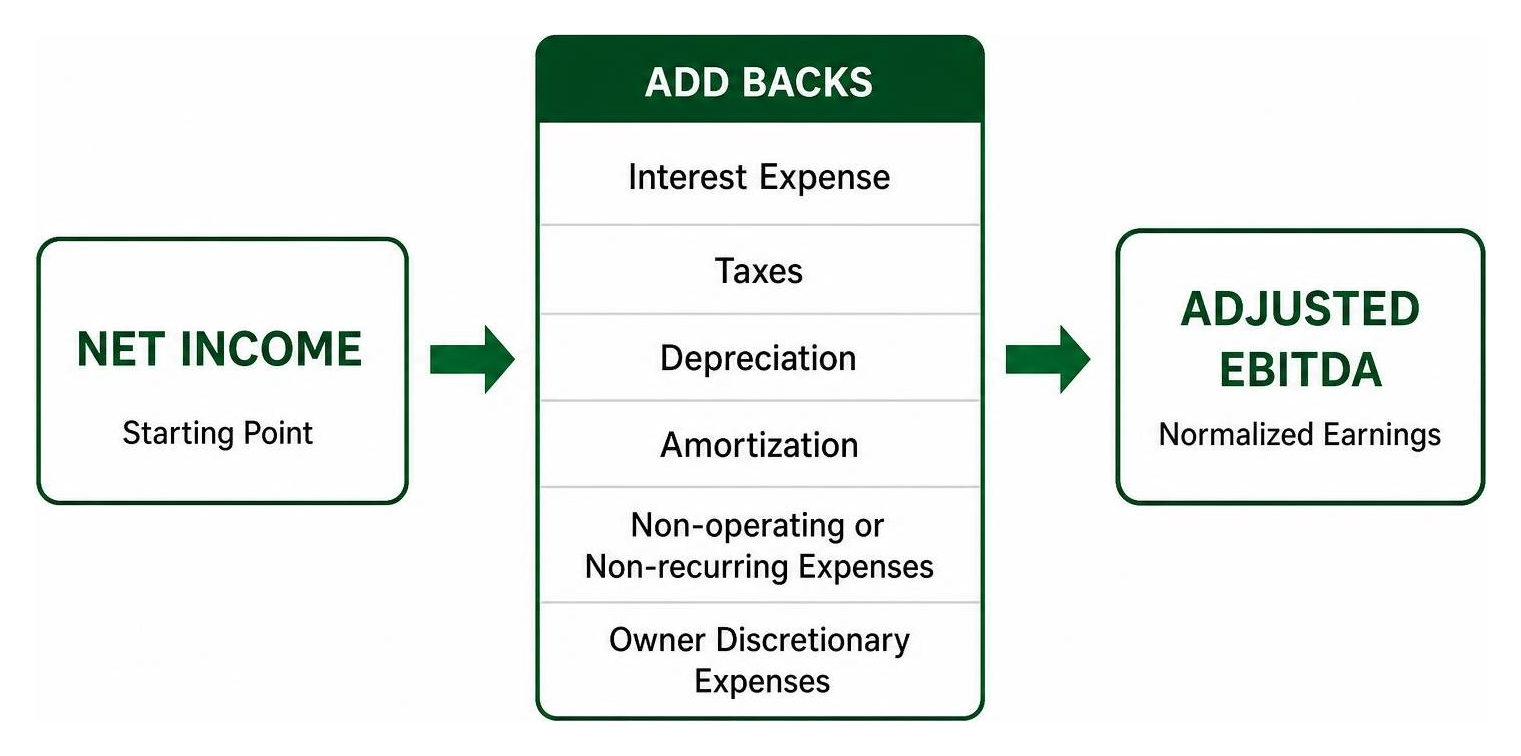
Valuing a business for sale begins with calculating normalized adjusted EBITDA. Historical financials often contain discretionary, non-operating, or non-recurring expenses that distort underlying operational profitability. Documenting every adjustment with supporting invoices and payroll records creates a defensible earnings baseline.
Common adjustments include standardizing owner compensation to market replacement rates and removing discretionary personal expenses. They also involve backing out one-time legal settlements, facility moves, and non-operating assets held on the balance sheet. Our team has helped clients improve the quality and speed of monthly reporting while establishing cash flow forecasts and rolling 13-month P&L forecasts.
Market Multiples for Your Size and Industry
Once earnings are normalized, advisors apply enterprise valuation multiples drawn from documented transactions involving comparable peer companies. Valuation multiples reflect industry expansion rates, margin consistency, customer retention, and operational risk across the lower middle market. Companies with predictable recurring revenue and strong gross margins trade toward the top of their peer category.
Consider a hypothetical industrial services firm with $15M in revenue and $3M in normalized adjusted EBITDA. Its estimated value would be expressed as a range, with the final position within that range shaped by factors such as customer concentration, reliance on the owner, the quality of financial records, recurring revenue, margins, and credible growth prospects. A buyer may place greater weight on the lower end when earnings depend heavily on a few customers or on the owner's day-to-day involvement. Clear reporting, a capable management team, and well-supported growth plans can strengthen the case for the higher end of the range.
Our team has helped multiple clients improve enterprise value through planning, forecasting, and dynamic scenario modeling. Defensible models prove financial resilience to prospective buyers.
Cash, Debt and Working Capital After Closing
Most middle-market transactions close on a cash-free, debt-free basis. The seller retains accumulated cash and clears all interest-bearing debt, while delivering enough working capital to maintain ordinary operations. The deal team establishes the working capital target to govern balance sheet adjustments at closing.
If delivered working capital exceeds the agreed target, the purchase price increases dollar for dollar. Conversely, a shortfall results in a post-closing purchase price reduction. Planning these metrics early prevents contentious adjustments during final deal funding.
List a Price or Let Buyers Bid?
Deciding whether to list a public asking price or run an unpriced competitive bidding process depends on your company size. For smaller businesses, a published asking price offers clarity to individual buyers using pre-packaged loans. In contrast, businesses generating $5M to $50M in revenue benefit from unpriced processes that avoid setting an artificial ceiling on enterprise value.
When choosing an M&A advisor, evaluate which process matches your scale and sector. An unpriced auction lets strategic and institutional bidders compete against each other, driving valuations upward based on their proprietary synergies and operational goals. Valuation professionals on our team can help you build a defensible valuation foundation before you decide how to run your process.
How Buyers Treat Growth That Has Not Happened Yet
Sellers often wonder how much their business is worth to a buyer when major growth initiatives are underway. Strategic buyers may value your sales pipeline, but institutional acquirers rarely pay full historical multiples on projected numbers that carry execution risk. Buyers typically apply pipeline discounts or bridge value gaps through performance-based earnouts and seller financing notes.
MyExec has performed sensitivity and scenario analysis that helped client leadership make better decisions and improve cash flow and value over time. We have provided advanced analysis, decision support, and margin optimization, including building integrated three-statement models for new product launches and mergers and acquisitions. MyExec also has capital allocation expertise and has implemented critical KPI scorecards tracking customer acquisition cost, average revenue per customer, and net revenue retention to validate projected expansion.
What Overpricing Costs
Setting an unrealistically high price creates serious friction across the transaction process. Experienced buyers recognize when an asking price exceeds market benchmarks and quickly pass on the opportunity. Overpriced companies spend extended time on the market, which leads the buyer pool to suspect hidden operational or financial problems.
Aggressive pricing also invites retrading during due diligence. According to the BizBuySell Q3 2026 Insight Report (released Oct 20, 2026), the median sale price rose 17% from a year earlier while closed sales fell 7%, and seller confidence fell to 47. BizBuySell covers smaller Main Street businesses, but broader market discipline applies across all transaction tiers.
How the Price Can Change Between the Letter of Intent and Closing
Signing a letter of intent does not guarantee the exact proceeds received at the closing table. The LOI establishes an agreed framework, but definitive purchase terms remain subject to confirmatory diligence findings. Third-party Quality of Earnings reviews may challenge specific add-backs, reducing your baseline adjusted EBITDA.
Transaction value can also shift if customer concentration worsens or key contracts experience volume reductions during diligence. Working capital true-ups and indemnity escrow holdbacks can further affect the amount paid at closing.
The definitive purchase agreement controls what the buyer will pay, how the consideration will be disbursed, and when payments are due. The headline purchase price is also not the same as the cash a seller ultimately receives. Taxes, transaction expenses, escrow or holdback amounts, seller financing, and earnout terms can all affect the timing and amount of proceeds. Your attorney should advise on the purchase agreement, and your CPA should advise on the tax treatment of proceeds. Maintaining clean accounting systems and verifiable financial models helps reduce avoidable price renegotiations before closing.
Frequently Asked Questions
Should I list an asking price or let buyers make offers?
For businesses generating $5M to $50M in revenue, running an unpriced competitive bidding process is standard practice. This approach encourages strategic and private equity buyers to compete aggressively on valuation and terms rather than treating a listed number as an artificial ceiling on your enterprise value.
What happens if I price my business too high?
Pricing significantly above market value deters qualified acquirers and increases time on the market. Stale listings lose market momentum, and buyers who submit offers often retrade the purchase price aggressively during confirmatory due diligence after identifying discrepancies in initial financial representations.
How is an estimate of value different from an asking price?
An estimate of value is an objective range built on normalized earnings, balance sheet strength, and comparable market transactions. In contrast, an asking price is a tactical figure chosen by a seller to start deal conversations or signal value expectations to prospective buyers.
Will buyers pay for growth that has not happened yet?
Buyers rarely pay full enterprise value multiples for projected growth that carries execution risk. Acquirers prefer bridging valuation gaps with earnouts, seller notes, or rollover equity structures that share future performance risk while rewarding the seller if financial targets are achieved.
When should I get a valuation before selling?
Obtain a business valuation one to two years before going to market. This timeline provides adequate runway to optimize profit margins, document normalized adjustments, build rolling financial forecasts, and correct operational weaknesses that could negatively affect your transaction multiple.
Talk with Our Team Before You Go to Market
Before you go to market, MyExec helps owners build a clear, defensible view of value and prepare the financial story buyers will evaluate. Our valuation professionals develop formal valuations performed to NACVA professional standards, while our M&A readiness support strengthens normalized earnings, working capital planning, financial reporting, forecasts, and transaction analysis.
We provide fractional CFO and FP&A services that are flexible and scalable, with analyst support, senior CFO leadership, or a blend of both based on your business needs and transaction readiness. That support helps you enter buyer conversations with realistic price expectations, well-supported assumptions, and a stronger foundation for negotiation.
Our team has worked across organizations ranging from a few million in revenue to roughly $2B, including closely held, private equity-owned, nonprofit, and publicly traded entities. If you are preparing for an exit, talk with our team about selling and book a 30-minute consultation to review your price expectations.