Why Growth Needs Working Capital Funding

Growth can leave a profitable company short of cash if not properly managed and forecasted. Working capital funding starts with estimating that gap in your forecast, then deciding how to cover it through cash from operations, customer and vendor terms, a bank line of credit, or outside capital. Test the funding plan before approving the growth plan.
We've used scenario analysis to help leadership teams see how growth could affect cash and make better decisions over time. This guide focuses on sizing the cash your 2027 plan may need and choosing how to fund it. For the daily practices behind that plan, see managing working capital day to day.
Why Growth Uses Cash
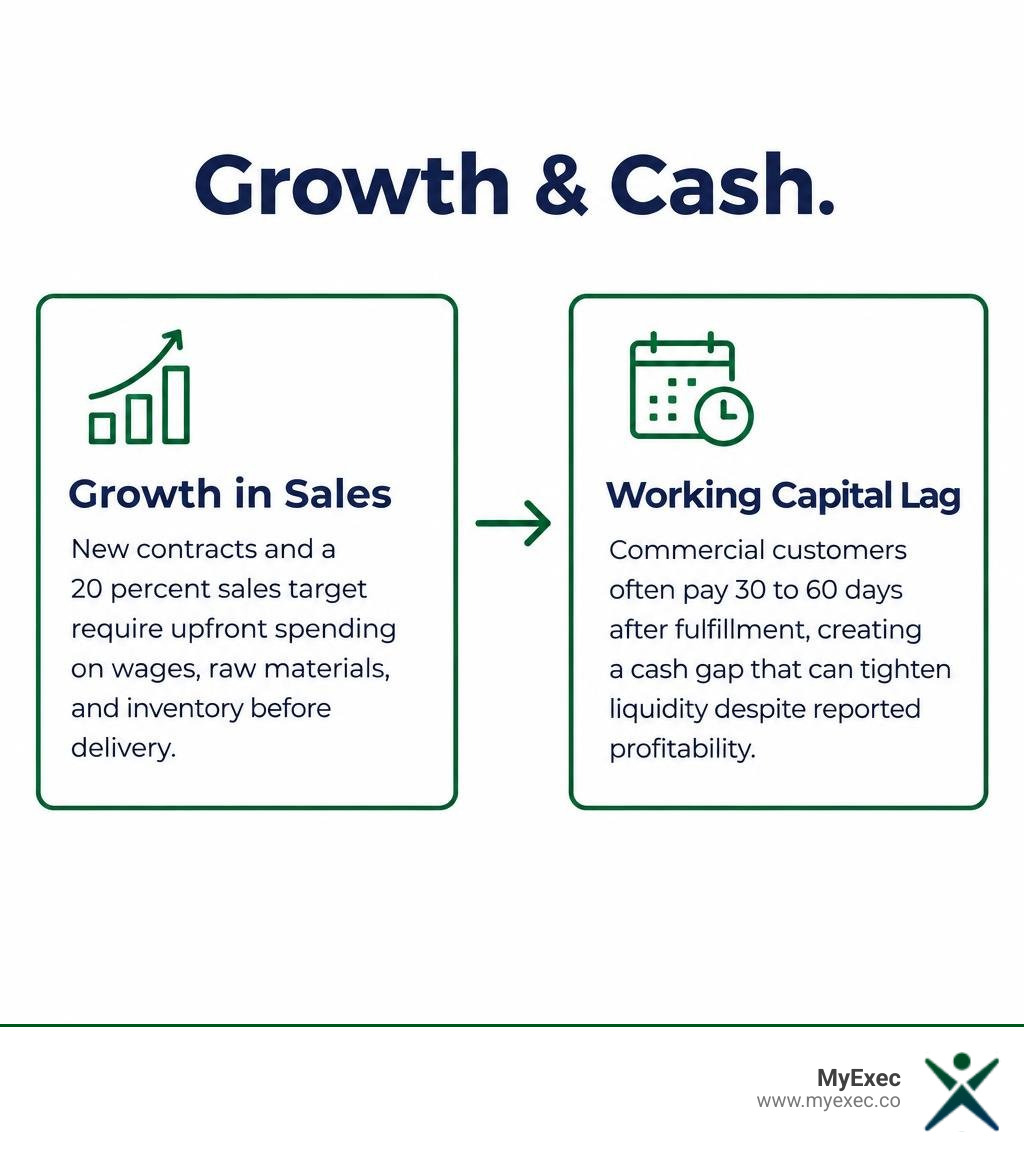
Profit is an accounting concept, while cash is reality. When your business wins a new contract or targets a 20 percent increase in sales, you must spend money long before you collect revenue.
You pay wages every Friday or every other week. You order raw materials or finished goods 30 to 60 days before delivery. Meanwhile, commercial customers often take 30, 45, or 60 days after fulfillment to settle invoices. This timing gap creates a working capital lag that drains your liquidity reserves. The cash conversion cycle measures that gap by tracking the days cash is tied up from paying suppliers through collecting customer invoices.
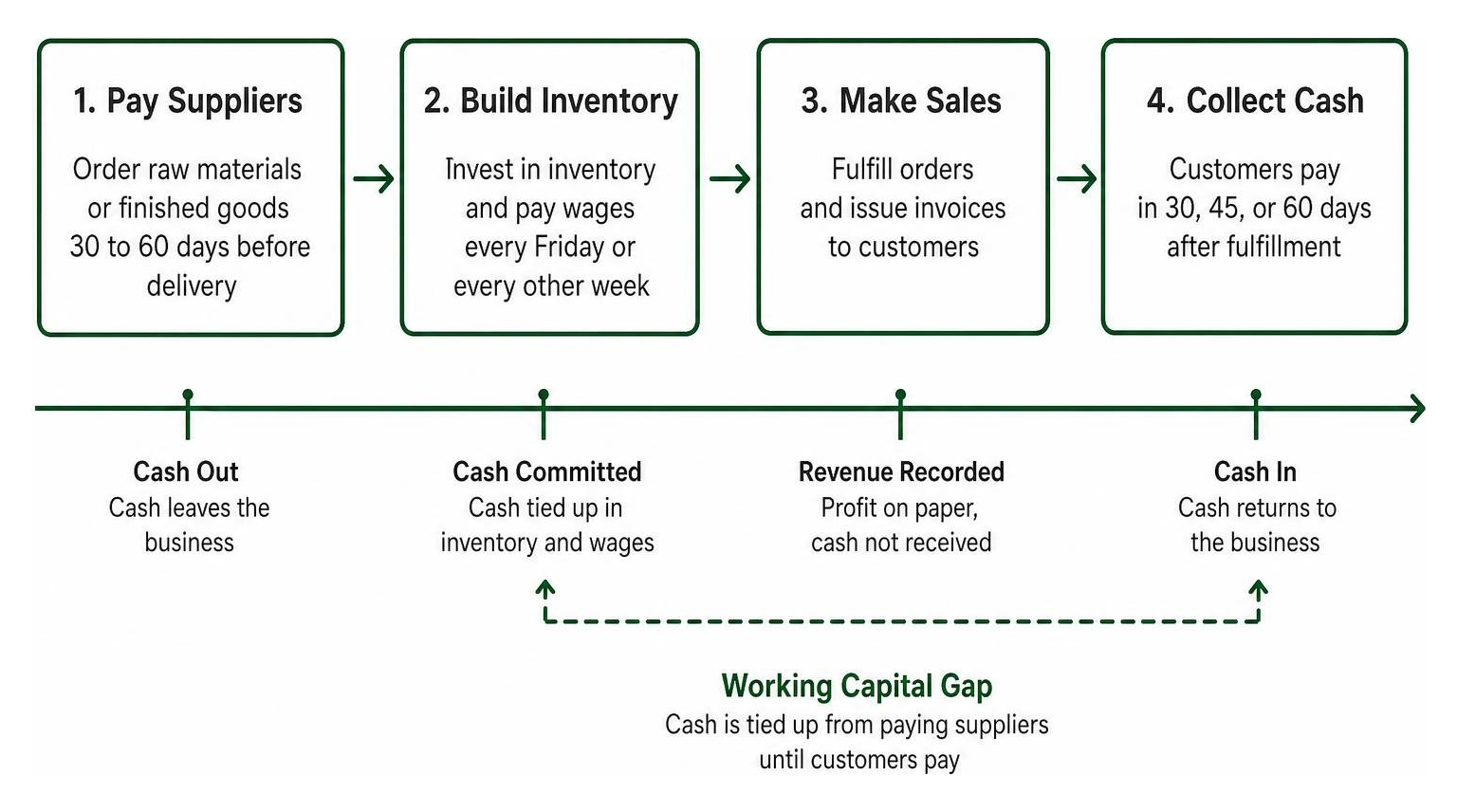
Without deliberate planning, faster growth creates larger cash deficits. If your monthly revenue jumps from $500,000 to $750,000, your receivables balance increases immediately. Because you have already paid for inventory and labor to generate those sales, the cash required to support operations expands rapidly.
How to Estimate the Working Capital Your Growth Plan Needs
Sizing your working capital requirement prevents unforeseen cash shortages. To model this accurately, look at your balance sheet through the operating cycle rather than relying on instinct or projections that aren't grounded in historical reality.
Your working capital requirement equals current assets (excluding surplus cash) minus current liabilities (excluding short-term debt). When revenue grows, receivables and inventory expand, while accounts payable provides a partial offset.
Days Sales Outstanding, Days of Inventory, and Days Payable in Plain Terms
Three metrics define your cash conversion cycle:
- Days Sales Outstanding (DSO): The average number of days it takes to collect cash after making a sale. Divide accounts receivable by total credit sales and multiply by 365.
- Days of Inventory on Hand (DIO): The average number of days inventory sits before being sold. Divide average inventory by cost of goods sold and multiply by 365.
- Days Payable Outstanding (DPO): The average number of days you take to pay trade suppliers. Divide accounts payable by cost of goods sold and multiply by 365.
Your cash conversion cycle equals DSO plus DIO minus DPO. The resulting number represents the exact window of days your business must self-fund or bridge with credit.
A Worked Example for a Twenty Percent Growth Target
Consider a hypothetical wholesale distributor generating $10,000,000 in annual revenue that plans to grow 20 percent to $12,000,000 in 2027.
Assume cost of goods sold is 70 percent of revenue ($7,000,000 in the base year and $8,400,000 in the growth year). Operating metrics remain constant: DSO is 45 days, DIO is 60 days, and DPO is 30 days.
| Financial Metric | Base Year ($10M Revenue) | 20% Growth Plan ($12M Revenue) | Incremental Cash Impact |
|---|---|---|---|
| Accounts Receivable (45 days DSO) | $1,232,877 | $1,479,452 | -$246,575 |
| Inventory (60 days DIO) | $1,150,685 | $1,380,822 | -$230,137 |
| Accounts Payable (30 days DPO) | $575,342 | $690,411 | +$115,069 |
| Net Working Capital Required | $1,808,220 | $2,169,863 | -$361,643 |
Growing 20 percent requires $361,643 in additional operating cash simply to support higher receivables and inventory balances. If your bottom-line net profit on that additional $2,000,000 of sales is 10 percent ($200,000), profits alone cannot fund the balance sheet expansion. You must secure a funding mechanism before executing the plan.
Funding Options for Scaling Companies
Every funding option carries trade-offs between cost, speed, flexibility, and control.
| Funding Source | Relative Cost | Access Speed | Key Requirement |
|---|---|---|---|
| Operating Cash Flow | Lowest (Zero interest) | Immediate | Sufficient existing operating margins |
| Customer & Vendor Terms | Low to Moderate | 2 to 4 weeks | Commercial leverage and contract negotiation |
| Bank Line of Credit | Moderate (Base + spread) | 4 to 8 weeks | Clean financial statements and debt service coverage |
| Outside Capital | Highest (Dilution / yield) | 8 to 16 weeks | Growth narrative, governance, and reporting readiness |
Internal Funding from Operations and Trade Terms
Before seeking debt, optimize internal capital cycles. Shaving five days off DSO and negotiating an extra ten days on vendor payables can free up six figures of cash without interest costs.
- Customer Terms: Restructure contracts to require 20 to 50 percent upfront deposits upon signing. Use progress billing at specific project milestones instead of invoicing entirely at completion.
- Collections Discipline: Enforce strict credit checks on new accounts and send automated payment reminders before invoices mature.
- Supplier Negotiations: In an economic environment where 77% of US respondents in a Q3 2026 ACCA and IMA survey reported rising operational expenses, as covered in Accounting Today's survey analysis, suppliers also want predictable cash flow. Ask critical vendors for extended 45-day or 60-day terms in exchange for volume commitments.
Securing Debt and Credit Facilities
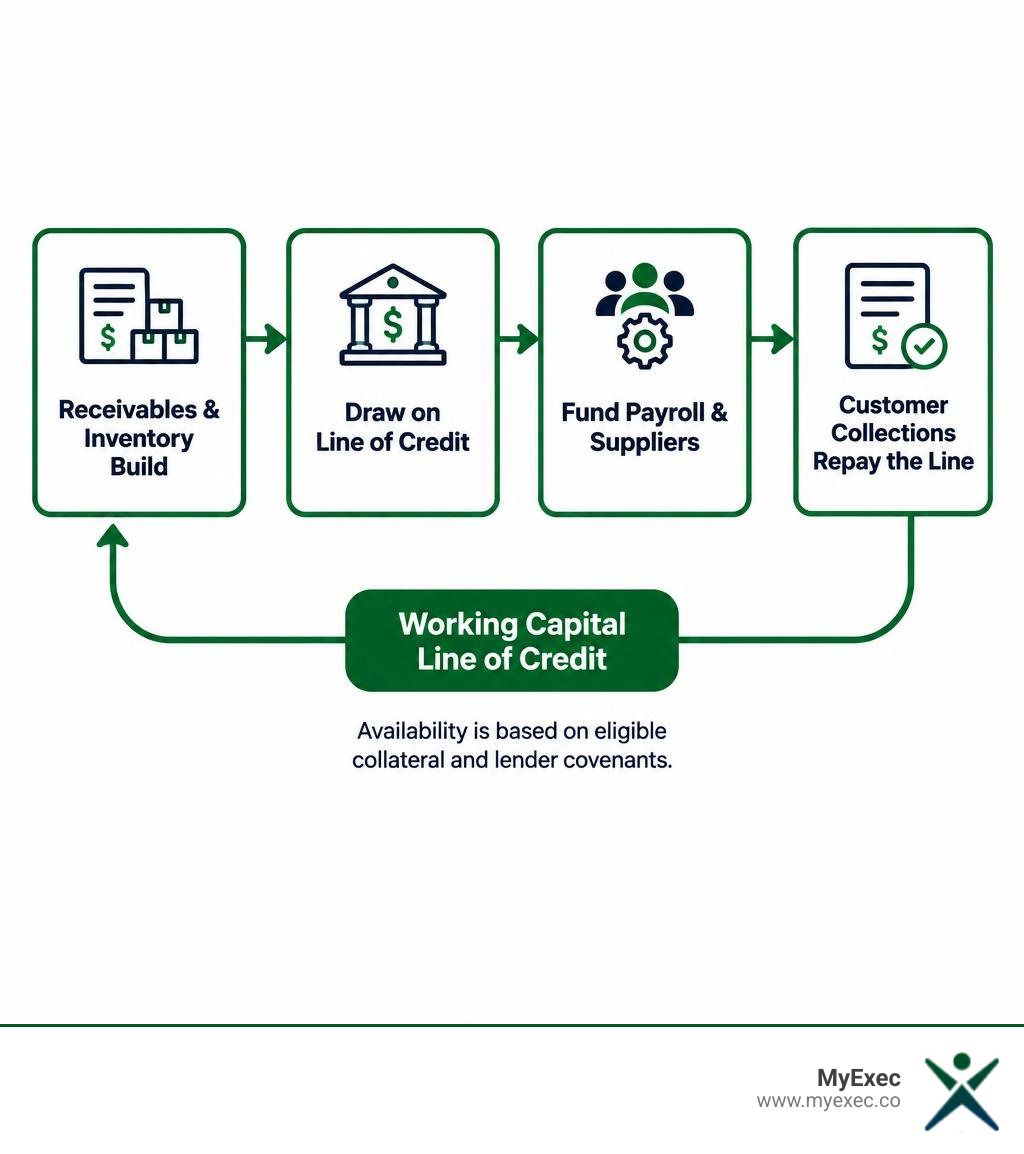
A revolving bank line of credit remains the most common external tool for operating needs. Unlike a fixed-term loan, a line of credit allows you to draw down funds as receivables build and pay down balances as customers settle invoices.
Banks evaluate specific metrics before issuing a line of credit. Review what banks look for before lending to prepare your disclosures.
Lenders typically tie available credit to a borrowing base calculation. This often permits borrowing up to 80 percent of eligible accounts receivable under 90 days and 50 percent of finished goods inventory. You must also maintain covenants, such as a minimum Debt Service Coverage Ratio (DSCR) of 1.25x and funded debt-to-EBITDA limits.
Outside Capital and Structured Financing Solutions
When banks cannot provide enough capacity due to rapid growth or limited historical collateral, non-bank structures can bridge the difference:
- Asset-Based Lending (ABL): Focuses on collateral quality rather than strict cash flow covenants, providing higher advance rates against inventory and receivables.
- Revenue-Based Financing: Delivers growth capital repaid as a fixed percentage of monthly revenue, avoiding equity dilution while aligning payments with sales cycles.
- Mezzanine Debt or Minority Equity: Brings permanent or patient capital to the balance sheet for large expansion projects, though it requires giving up a share of returns or board governance rights.
How Higher Interest Rates Change the Funding Decision
Interest rates alter the cost of carrying inventory and uncollected invoices. The prime rate stood at 7.00% heading into the Federal Reserve's October 28, 2026 meeting, unchanged since September 17, according to Federal Reserve interest rate data. Economists surveyed by Reuters ahead of that meeting expected rates to rise further, with Pimco and Pantheon forecasting the next move in December.
When borrowing costs are higher, holding excess safety stock or tolerating slow-paying customers directly erodes operating profit.
- Higher Hurdle Rates: Growth projects must generate sufficient gross margin to absorb credit facility carrying costs.
- Line Utilization Discipline: Companies must draw on credit lines only for immediate fulfillment requirements and sweep excess cash against the outstanding balance daily to minimize interest expense.
- Pricing Adjustments: Offer prompt-pay discounts for rapid customer payment (such as 1.5% 10, Net 30) and pass finance costs along by adding interest penalties to late accounts.
Building the Funding Plan into Your 2027 Budget
Do not approve a revenue growth target without testing it against a fully modeled balance sheet and cash flow projection. Building a cash flow forecast reveals the exact month your expansion plans will require external liquidity.
We build integrated dynamic financial models that link the income statement, balance sheet, and rolling 13-month cash flow forecast. This lets management run sensitivity analyses on key working capital drivers:
- Stress-Test DSO: What happens to cash reserves if key customers extend payment from 40 to 65 days?
- Model Inventory Lead Times: How much extra cash is required if supply chain delays force you to carry an extra 30 days of buffer stock?
- Evaluate Covenant Compliance: Will the projected borrowing base violate bank leverage or debt service coverage thresholds during peak expansion months?
Testing these variables ahead of time gives your team the lead time required to secure credit lines or adjust payment terms before entering a cash crunch.
Frequently Asked Questions
Why does a growing company run short of cash even when it is profitable?
Growth demands upfront cash for raw materials, inventory, and labor to deliver larger customer orders. Because accounting profit is recognized upon delivery but customer cash collections often lag by 30 to 60 days, working capital balances consume available liquidity faster than net income replenishes it.
How much working capital do I need to grow 20 percent?
Your required capital depends on your cash conversion cycle. Calculate the incremental accounts receivable and inventory required to generate the higher sales volume, then subtract the expected increase in accounts payable. A company with a 75-day cycle will require significantly more cash than one operating on a 25-day cycle.
When does a line of credit make sense for working capital?
A revolving line of credit makes sense when your business experiences predictable timing gaps between fulfillment expenses and customer payments, seasonal inventory builds, or temporary volume spikes. It provides a flexible backstop that ensures payroll and supplier obligations are met without giving up business equity.
Which customer and vendor terms free up the most cash?
Securing 20 to 50 percent upfront deposits or milestone-based progress billing generates immediate non-debt cash flow. On the supplier side, extending payment terms from Net 30 to Net 45 or Net 60 provides interest-free trade credit that offsets your accounts receivable balance.
How do higher interest rates change how I fund growth?
Higher interest rates increase the carrying cost of debt-funded receivables and inventory. This makes strict collections, lower inventory holding periods, and internal cash generation far more valuable than drawing heavily on variable-rate credit facilities.
Plan Your Growth with Confidence
Planning for sustainable expansion requires active financial modeling, margin optimization, and capital allocation discipline. At MyExec, we deliver scalable strategic finance leadership through fractional CFO and FP&A services tailored for businesses with $5M to $50M in revenue.
Our team provides flexible support ranging from senior CFO leadership to detailed financial analyst modeling. We help business owners implement rolling 13-month P&L forecasts, build integrated three-statement financial models, and establish KPI scorecards tracking customer acquisition cost, average revenue per customer, and net revenue retention. Whether you need scenario modeling to size your next credit facility or a formal valuation performed to NACVA professional standards by valuation professionals on our team, we provide the clarity needed to scale.
To evaluate your working capital needs, download the strategic finance guide or talk with our team today.