Why Owner Dependence Lowers Business Value

When customers, pricing, key relationships, and decisions run through the owner, a buyer sees the risk that the business will not perform as it has once the owner leaves. That risk lowers what they will pay or changes how they pay through earnouts and longer transition periods. Reducing owner dependence allows founders to protect their valuation before entering the market.
Owner dependence is one of several core business value drivers an owner can actively change before a sale. You can start by delegating routine approvals to department leaders and documenting critical daily processes. Reviewing other ways to make your business more valuable helps identify additional operational improvements across your organization.
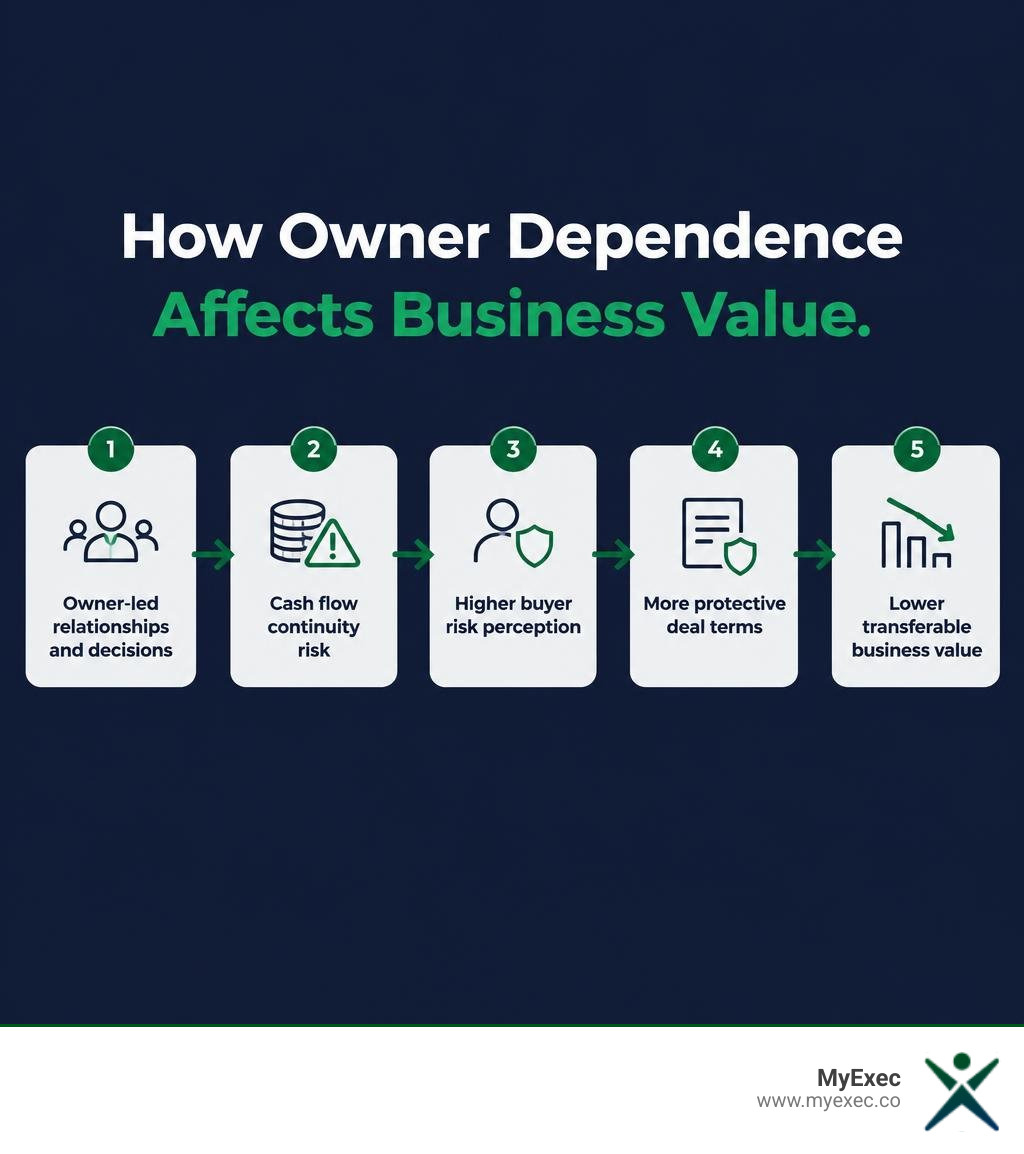
When an acquirer evaluates a business, they purchase the future stream of predictable cash flow. If those earnings disappear when you leave, the business holds personal goodwill rather than transferable business value. Buyers seek reliable businesses with well-integrated systems that continue generating cash flows under new stewardship.
Buyers adjust for key person risk by increasing the discount rate applied to projected earnings or restructuring their offers. When buyers see heavy reliance on a single founder, they build safety buffers directly into their offers. These contractual buffers protect acquirers against client departures, operational disruption, and lost technical knowledge.
| Operational Area | Owner-Dependent Company | Enterprise-Driven Company |
|---|---|---|
| Sales & Business Development | Founder closes all major deals, and clients buy the person | Dedicated sales team uses structured pipeline and CRM |
| Pricing & Quoting | Founder prices deals using instinct and unwritten rules | Standardized rate cards and clear margin models |
| Daily Management | All decisions flow through the founder's desk | Empowered management layer with clear authority |
| Financial Visibility | Cash-basis tax returns reviewed once a year | Monthly accrual closes with forward-looking forecasts |
Where Owner Dependence Shows Up Across Operations
Founder dependence rarely exists in isolated business functions. It often begins as a practical response when a company is small: the owner knows the customers, approves exceptions, and solves problems quickly. As revenue grows from $5M to $50M, those informal habits can become the default operating model, leaving the business dependent on the owner even when capable people are in place.
The first step is to identify where decisions, relationships, and knowledge still converge around one person. The areas below are common places for that dependence to take hold.
Customer Relationships and Concentration Risk
If your top five customer accounts call your personal phone for orders, your company carries significant customer risk. Acquirers evaluate customer rosters to determine whether recurring revenue relies on founder relationships. When paired with high customer concentration, losing the founder often triggers immediate revenue contraction.

Transferring direct account management to a structured client success team shows buyers that accounts belong to the enterprise. This commercial delegation builds defensible enterprise value that endures through ownership transitions. Buyers also look for evidence that account managers understand each client's operating priorities, open issues, and renewal timeline. A documented account plan makes the relationship easier for a new owner to evaluate and support.
Sales and Pricing Decisions
A common bottleneck in growing firms occurs when the founder remains the only person authorized to approve pricing. When quoting logic lives entirely in your head, the business cannot scale sales volume without your manual labor.
Establishing standard rate cards, gross margin floors, and discount boundaries allows sales reps to bid work independently. This operational structure protects margins while keeping sales moving forward when the owner is away from the office. It also creates a record of how the company evaluates exceptions, which helps buyers assess whether commercial discipline can continue after a transition. Clear approval limits reduce delays without giving up control of important commercial decisions.
Vendor and Banking Relationships
Suppliers and lenders frequently extend favorable terms based on personal trust built with the owner over decades. When key supplier discounts or commercial credit facilities require personal signatures, buyers face terms that could reset after closing.
Institutionalizing vendor management requires establishing formal corporate credit profiles and documenting commercial supplier agreements. This step decouples critical supply chains and banking arrangements from personal founder guarantees. Buyers will want to know who can renew terms, resolve service issues, and manage lender communication after closing. Written relationship histories and defined contacts help demonstrate that these arrangements can continue under new ownership.
Know-How That Is Not Written Down
Unwritten institutional knowledge creates hidden operational fragility. When core production scheduling, service delivery, or quality control rely on unwritten habits, new team members cannot execute tasks without ongoing founder supervision.
Writing practical standard operating procedures turns individual expertise into tangible corporate assets. Documented workflows allow managers to train, audit, and scale frontline staff efficiently. They also give buyers a clearer view of how the company maintains quality when experienced employees leave or responsibilities change. Regularly updating those procedures shows that the operating model is actively managed rather than dependent on memory.
How Buyers Detect and Measure Owner Dependence
Acquirers and valuation teams review operational continuity during initial management meetings and formal due diligence. They analyze your organizational chart to see if an autonomous second layer of leadership handles daily execution.
During quality of earnings reviews and operational audits, buyers check communication logs, approval thresholds, and pipeline ownership. Acquirers uncover owner dependence quickly when asking simple questions about who resolves client escalations or directs strategic planning. The Harvard Business Review has explored how founders can build companies that outlast their personal involvement, and the same principle applies to owner-led middle-market companies.
How Founder Dependency Reshapes Deal Structure and Terms
When buyers detect high key person risk, they protect their capital by adjusting deal terms. These structural safeguards shift risk back to the seller through several contractual mechanisms, with no fixed percentage adjustment.
- Earnout Contingencies: A meaningful portion of the final purchase price depends on meeting future performance targets.
- Extended Seller Notes: Sellers are asked to carry subordinated notes, leaving seller capital at risk after closing.
- Escrow Holdbacks: Acquirers require larger indemnity reserves retained in escrow for longer timeframes.
- Extended Transition Agreements: Founders must commit to lengthy operational transitions to hand off accounts.
How to Build Transferable Business Value
Building a company that operates smoothly without you requires a structured operational handoff. You can begin implementing these practical actions this quarter to make your business less dependent on you.

- Map What Runs Through You: Track daily activities for two weeks to identify every decision and approval requiring your direct input.
- Hand Off Commercial Relationships: Introduce dedicated account managers as primary customer contacts while shifting yourself to high-level executive sponsorship.
- Build a Management Layer: Hire or promote functional department heads and grant them clear operating authority.
- Document Core Workflows: Create simple operational playbooks for customer onboarding, project delivery, and pricing.
- Establish Team-Owned Financial Reporting: Transition to accrual accounting where the finance team independently owns monthly reporting, rolling forecasts, and tracking for recurring revenue.
In our sell-side work, we commonly see that demonstrating the depth of the team and the client relationships beyond the owner helps prospective acquirers recognize sustainable enterprise value.
A Self-Check: How Dependent Is Your Business on You?
Review these seven questions to evaluate how well your company functions without your daily involvement. This checklist identifies operational bottlenecks that could affect your exit valuation.
- Can you take an uninterrupted month-long vacation without checking email or answering operational calls?
- Do team members make customer-facing operational decisions without asking for your approval?
- Does your company generate new leads and close sales through a documented team process rather than your personal network?
- Are standard operating procedures written down and actively used by your staff?
- Do your top three customers have primary relationships with account managers rather than you?
- Can your finance team produce accurate, accrual-basis monthly financial statements without your manual adjustments?
- Is there a clear second-in-command who can manage daily operations if an emergency occurs?
If you answered no to several of these questions, your company carries founder concentration risk. Addressing these operational areas strengthens your transferable business value before speaking with buyers.
Frequently Asked Questions
How do buyers tell how dependent a business is on its owner?
Buyers review organizational charts, approval matrices, and customer communication records during due diligence. They conduct management interviews and examine who quotes new work, resolves client complaints, and directs daily operations. These operational audits show whether the company functions independently of founder involvement or requires daily oversight.
Will a buyer require me to stay on after the sale?
When daily operations and key accounts rely heavily on the founder, buyers often structure deals with mandatory employment agreements or extended consulting arrangements. Owners should consult their attorney regarding the specific legal terms of these transition agreements. Developing an independent management team and delegating key responsibilities allows founders to negotiate shorter transition commitments and secure cleaner closing terms.
Which relationships should I hand off first?
Start by transitioning your top revenue-generating customer accounts to dedicated account managers. Introduce team members as primary points of contact for daily execution, technical support, and billing questions. Hand off supplier negotiations and routine vendor management next to build operational redundancy across your supply chain.
How long does it take to reduce owner dependence?
Systematically delegating responsibilities and customer accounts requires deliberate operational planning over several quarters. This timeframe gives your management team sufficient runway to demonstrate consistent execution, sustain customer retention, and establish a verifiable track record of running the company without founder intervention.
How does owner dependence show up in a business valuation?
Valuation professionals incorporate company-specific risk into discount rates when evaluating future cash flows. Key person dependency increases overall risk premia, which directly affects the capitalization rate applied to earnings. This operational risk reduces the resulting value in a formal valuation.
Estimate What Your Business Is Worth
Understanding what drives your company value provides the clarity needed to make sound strategic decisions. Our team provides fractional CFO and FP&A services for companies with $5M to $50M in revenue, offering scalable finance support ranging from analyst-level modeling to senior strategic leadership. MyExec has helped clients improve the quality and speed of monthly reporting while strengthening operational visibility.
Valuation professionals on our team deliver formal valuations performed to NACVA professional standards. We evaluate key operational factors, cash flow stability, and leadership depth across every engagement.
Use our free business valuation calculator to estimate what your company is worth. The calculator asks how your business runs and shows where it sits in its industry range.