A Guide to Increasing Business Valuation
What Makes a Business Truly Valuable to Prospective Buyers?

When buyers look at your business, they're not paying for what you did yesterday. They're buying your future cash flow and weighing the risk that those cash flows might drop off after you leave.
Making your business more valuable requires driving up your normalized earnings while expanding the valuation multiple applied to those earnings. Normalized earnings are typically measured as EBITDA (Earnings Before Interest, Taxes, Depreciation, and Amortization) or SDE (Seller's Discretionary Earnings). Your valuation multiple reflects the buyer's risk assessment. High risk means a low multiple. Low risk means a high multiple.
It helps to separate pre-sale preparation from true value-building. Preparation is cleanup work. It includes organizing financial records, verifying tax filings, and clearing up legal risks so you don't lose value during due diligence. Value-building is transformational. It involves transitioning transactional revenue into subscription models, building middle management, and building defensible market positioning that forces buyers to compete for your asset.
Data from market surveys shows that the vast majority of small-to-midsize business owners don't know their company's actual market worth. Without an accurate baseline, owners focus on top-line sales growth while ignoring risk factors that compress their multiple.
Understanding valuation leverage reveals why fixing operational and financial vulnerabilities matters so much:
- Scenario A (EBITDA Expansion): Increasing normalized EBITDA from $1,000,000 to $1,250,000 at a constant 5.0x multiple creates $1,250,000 in new enterprise value ($6,250,000 total).
- Scenario B (Multiple Expansion): Keeping EBITDA at $1,000,000 but removing key risks to expand your multiple from 5.0x to 6.25x creates the exact same $1,250,000 in new enterprise value ($6,250,000 total).
- Scenario C (Compounded Growth): Achieving both an EBITDA increase to $1,250,000 and a multiple expansion to 6.25x increases your business value to $7,812,500. That's a $2,812,500 value creation from two focused value improvement initiatives.
The Mathematical Drivers of Enterprise Value
Valuation begins with your baseline financial metrics. For smaller owner-operated businesses, buyers often look at SDE. SDE adds back the owner's salary, discretionary perks, and non-recurring expenses to net profit. For growth firms in the $5,000,000 to $50,000,000 revenue range, institutional buyers and private equity sponsors typically use EBITDA as the standard benchmark.
While top-line revenue scale determines whether your business meets a buyer's minimum filter, EBITDA is the figure the multiple is applied to. The size of that multiple reflects the buyer's view of risk and future upside, not profit margin alone. Buyers weigh owner involvement, customer concentration, growth potential, industry dynamics, macroeconomic conditions, operating systems, documented processes, competitive advantage, and margin stability together.
For example, a business with $1,000,000 in EBITDA, low customer concentration, strong recurring revenue, independent management, and clear growth opportunities may command a stronger multiple than a similar-size business where the founder controls sales and delivery. Profitability still matters because stronger margins create more resilient EBITDA, but the premium multiple comes from proving that earnings are durable, transferable, and likely to grow after the transaction.
Transferable Value vs. Personal Goodwill
The primary question buyers ask during deal screening is simple: "Will this profit persist after the founder leaves?"
Transferable value is the portion of enterprise value that exists independently of the owner. Personal goodwill, on the other hand, is tied directly to your personal reputation, individual technical expertise, or client relationships. If key clients stay with your company because they're friends with you, that revenue is personal goodwill. When you exit, that revenue risks leaving with you.
Buyers punish personal goodwill with severe price reductions, extended earnout structures, or mandatory multi-year transition contracts. Building transferable value requires replacing personal goodwill with operational systems, institutionalized client relationships, and a management team capable of running daily operations without your direct oversight.
How Does Reducing Owner Dependency Expand Your Valuation Multiple?
Owner dependency is the single largest discount factor in lower-middle-market business acquisitions. When a company depends on its founder for daily decision-making, sales execution, or technical direction, buyers treat the purchase as buying a job rather than acquiring an enterprise asset.
Market data shows a major valuation gap created by owner reliance. According to The Advisory Investment Bank's guidance on increasing business value, buyers reward companies that can run without the owner because reduced owner reliance creates more transferable value:
- Founder-Dependent Operations: Businesses where the owner handles sales, manages major client accounts, or oversees daily delivery often trade at 2.0x to 4.0x EBITDA.
- System-Run Peers: Operations led by independent management teams with documented SOPs can command 6.0x to 7.0x EBITDA because buyers see lower continuity risk and stronger scalability.
On $1,500,000 in EBITDA, that structural difference represents a valuation gap of up to $4,500,000 on identical earnings.
A simple test to measure your business's operational independence is the Two-Week Vacation Test. If you disconnect completely from phone and email for two consecutive weeks, what happens to your company? If sales stall, project delivery freezes, or staff panic over operational decisions, your enterprise value suffers from severe owner dependency risk. If operations continue smoothly and performance metrics remain stable, you've built transferable enterprise value.
Building a Competent Middle Management Layer
Transitioning from founder-led execution to management oversight requires hiring, training, and empowering a second-in-command. Depending on your industry, this role may be a Chief Operating Officer, General Manager, or VP of Operations.
To eliminate single-person operational dependencies:
- Delegate Decision Authority: Map out every operational decision you personally make during a typical month. Shift at least half of those decisions to direct reports within 90 days.
- Separate Sales from Ownership: Build a dedicated sales pipeline managed by paid sales staff or business development directors. If you're the primary rainmaker, buyers will assume revenue will drop after the acquisition.
- Align Management Incentives: Create long-term retention packages, phantom stock plans, or performance bonuses for core executives. Buyers want assurance that key managers will remain with the business post-sale.
Documenting Standard Operating Procedures (SOPs)
Institutional knowledge trapped in your head holds zero value for an acquiring firm. Documenting core workflows converts tacit personal knowledge into transferable structural capital.
Start by mapping your top 20 revenue-generating workflows (such as client onboarding, service delivery, and billing) and your top 10 risk-creating workflows (such as quality control, safety compliance, and financial approvals). Use screen-recording software, written guides, and process flowcharts to build a centralized company playbook.
Upgrading to cloud-based operational systems and modern enterprise management software enforces consistent execution across departments. When standard procedures are backed by modern software, buyers see a business that can scale smoothly under new ownership.
How Do Revenue Quality and Customer Concentration Impact Enterprise Value?
Buyers evaluate revenue through the lens of predictability and risk. High-quality revenue allows an acquirer to secure favorable debt financing and model future cash flows with confidence. Low-quality revenue creates earnings volatility and forces buyers to demand lower purchase prices or seller financing terms.
Customer concentration represents a major risk during acquisition underwriting. When a single client generates more than 10% to 15% of your total revenue, buyers flag the account for elevated churn risk. If a single customer accounts for more than 20% to 25% of top-line revenue, it's often a documented deal-killer or triggers a 0.5x to 1.0x EBITDA reduction in your baseline multiple.
To learn more about managing this operational challenge, review our analysis on How Customer Concentration Affects Business Value.
According to DealRoom's analysis of recurring revenue and acquisition readiness, revenue quality follows a clear structural hierarchy that shapes buyer demand and valuation multiples:
- Transactional / Project-Based Revenue: Businesses relying on one-time sales or project work trade at 3.0x to 4.0x EBITDA.
- Contractual Recurring Revenue: Companies with 40% or more contractual recurring revenue trade at 5.0x to 7.0x EBITDA due to low customer acquisition costs and predictable margins.
Strategies to Mitigate Customer Concentration Risk
If your company currently has high customer concentration, you'll want to work to correct the balance 12 to 24 months before going to market:
- Cross-Sell Middle-Tier Accounts: Identify accounts in your client portfolio that have growth potential. Allocate dedicated account resources to expand those mid-tier accounts and lower top-account concentration percentages.
- Secure Multi-Year Contracts: Shift top clients from handshake arrangements or month-to-month terms onto multi-year master service agreements with formal cancellation notices.
- Expand Channels and Geographies: Diversify your sales pipeline across new target verticals or regional territories to broaden your customer foundation.
Transitioning to Contractual and Recurring Revenue
You can convert transactional business models into recurring revenue streams across almost any industry. Professional services firms can package point-in-time consulting into ongoing advisory retainers. Equipment providers can add software monitoring, preventative maintenance contracts, or service agreements to hardware sales.
Focus heavily on tracking key customer metrics:
- Annual Recurring Revenue (ARR): Calculate the recurring revenue under contract or expected to repeat over the next 12 months. ARR gives buyers a clean baseline for the size and durability of the recurring revenue engine.
- Net Revenue Retention (NRR): Measure how much recurring revenue remains from existing customers after churn, downgrades, upgrades, and expansion. Strong NRR shows that customers are not only staying, but also buying more over time.
- Monthly Customer Churn Rate: Track lost customers or lost recurring revenue each month, then review trends over a rolling 12-month period to demonstrate low revenue leakage.
- Customer Lifetime Value (LTV) to Acquisition Cost (CAC) Ratio: Prove that your sales engine generates profitable growth efficiently.
- Net Promoter Score (NPS): Quantify customer satisfaction to support product-market fit and explain why retention metrics are likely to hold up during buyer diligence.
Building proprietary software tools, strong brand equity, and high switching costs creates competitive moats. These barriers protect your market share and defend your profit margins against competitors.
What Financial and Operational Improvements Yield the Highest ROI?
Clean financial reporting is the foundation of a successful business sale. If buyers don't trust your financial statements, they'll walk away from the deal or discount their offer price to offset unverified accounting risks.
Switching from cash-basis accounting to accrual-basis accounting compliant with Generally Accepted Accounting Principles (GAAP) at least three years before exit planning is vital. Cash accounting masks operational reality by shifting revenue and expense recognition based on bank deposit timing. Accrual accounting matches revenue with corresponding expenses, presenting a true picture of operational margins.
Direct margin improvements create compound growth in enterprise value. For example, executing a Cost Structure Optimization program and conducting a detailed Profitability Analysis allows you to trim operational waste without harming capacity.
A modest 2% net margin improvement on $3,000,000 in top-line revenue yields $60,000 in direct profit expansion. Applied at a 4.0x valuation multiple, that $60,000 operational gain adds $240,000 in net sale proceeds.
| Valuation Driver | Founder-Dependent Business | System-Driven Business |
|---|---|---|
| EBITDA Multiple Range | 2.0x - 4.0x EBITDA | 6.0x - 7.0x EBITDA |
| Key Dependency | High founder involvement | Empowered middle management |
| Processes & SOPs | Undocumented / Tribal knowledge | Fully documented SOPs |
Financial Recasting and Normalizing Earnings
Financial recasting removes personal, non-operational, or one-time line items from your historical income statements to calculate adjusted EBITDA. For guidance on structuring clean reporting systems, read our resource on how to Increase Business Value With Smarter Financial Reporting.
Legitimate recast add-backs include:
- Owner Compensation Normalization: Adjusting owner salaries and bonuses to match current fair-market compensation rates for a hired executive.
- Personal and Discretionary Perks: Documenting business-funded personal auto leases, non-essential travel, and club memberships with receipts and logs.
- Non-Recurring Expenses: Removing one-time legal fees, facility moving costs, or facility repair expenses that won't reoccur under new ownership.
Working with an M&A transaction accountant to execute a sell-side Quality of Earnings (QoE) report 12 months before going to market validates these add-backs. A sell-side QoE report prevents buyers from challenging your earnings adjustments during formal diligence.
Operational Optimization and Cost Structure
Optimizing your balance sheet and operational efficiency improves cash generation and buyer interest:
- Eliminate Non-Performing Assets: Sell off idle machinery, old vehicle fleets, and obsolete inventory to improve working capital ratios and balance sheet metrics.
- Optimize Working Capital: Tighten accounts receivable collections to reduce average Days Sales Outstanding (DSO) and negotiate improved vendor payment terms.
- Implement Real-Time KPI Dashboards: Transition management from historical reporting to forward-looking financial forecasting using operational KPI dashboards.
If you're ready to connect valuation improvement to a practical exit-readiness plan, explore our Business Valuations. Our team helps growing businesses identify the financial, operational, and strategic levers that can strengthen transferable value before a sale process begins.
How Long Does It Take to Build Value, and When Should You Start Planning?
Building transferable enterprise value requires time to show consistent financial performance. While operational quick wins (like cleaning up financial records or adjusting product pricing) yield results in 90 to 180 days, full value optimization requires an 18-to-36-month timeline. Buyers expect to see a multi-year trendline showing sustained revenue growth, stable margins, and reliable operational systems.
Beginning exit planning 2 to 3 years prior to a target sale date allows you to measure and close your "Value Gap". Your Value Gap's the difference between your current business market value and the net wealth required from a transaction to fund your post-exit lifestyle.
Getting an annual baseline appraisal measures your progress over time. Learn about the strategic benefits of annual tracking in our guide on the Benefits Of An Annual Business Valuation.
Proper planning helps prevent post-sale regret. Research shows that a vast majority of business owners regret their exit decision one year after selling. This dissatisfaction usually happens because personal financial targets, tax planning, and post-exit career goals weren't aligned before closing the transaction. Evaluating your financial readiness helps ensure a smooth transition, as detailed in our guide on M&A Financial Readiness.
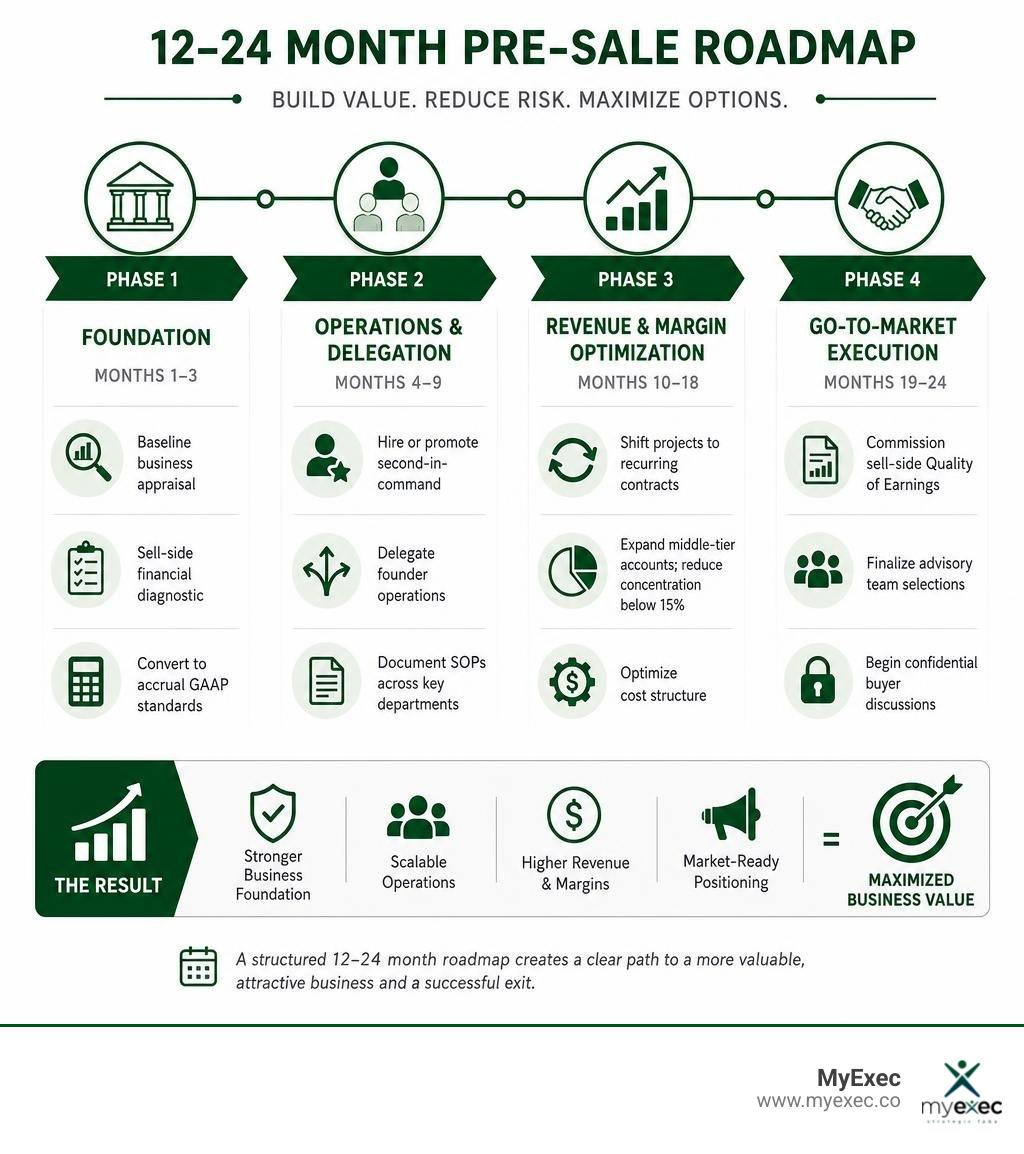
The 12-to-24-Month Pre-Sale Roadmap
A structured timeline keeps your exit preparation on track:
- Phase 1: Foundation (Months 1-3): Obtain a baseline business appraisal, conduct a sell-side financial diagnostic, and convert accounting records from cash to accrual GAAP standards.
- Phase 2: Operations and Delegation (Months 4-9): Hire or promote a second-in-command, delegate founder operational decisions, and complete SOP documentation across primary departments.
- Phase 3: Revenue and Margin Optimization (Months 10-18): Shift project clients to recurring contracts, expand middle-tier accounts to lower customer concentration below 15%, and optimize your cost structure.
- Phase 4: Go-To-Market Execution (Months 19-24): Commission a formal sell-side Quality of Earnings report, finalize advisory team selections, and begin confidential buyer discussions.
Assembling Your Exit Advisory Team
Navigating an exit requires a coordinated team of specialists:
- M&A Transaction Attorney: Drafts non-disclosure agreements, reviews purchase contracts, and structures deal terms to protect seller liability.
- Certified Exit Planning Advisor (CEPA): Coordinates personal, financial, and business planning goals into an exit roadmap.
- Investment Banker or Business Broker: Conducts market positioning, builds confidential marketing materials, and creates competitive buyer bidding.
- CPA and Tax Strategist: Structures transaction terms (asset sale versus stock sale) to minimize capital gains and corporate tax liabilities.
- Fractional Finance Leadership: Manages day-to-day FP&A requirements, builds forward-looking financial forecast models, and leads sell-side Quality of Earnings diligence.
What Are the Most Frequently Asked Questions About Increasing Business Value?
What's the single fastest way to increase my business valuation multiple?
Transitioning one-time project revenue into contractual recurring revenue and empowering a second-in-command management team to remove founder dependency are the two fastest levers to expand your multiple. Combined, these moves can expand a company's valuation multiple from 3.0x EBITDA to 5.0x or 6.0x EBITDA within 12 to 18 months.
How much do unrecorded or personal expenses hurt my company's sale price?
Unrecorded personal expenses and undocumented add-backs undermine buyer trust during Quality of Earnings reviews. When buyers uncover messy financial records or unsubstantiated perks, they'll apply a risk penalty, often reducing offer prices by 10% to 20% or demanding larger escrow withholdings to cover unverified risks.
How do business valuation multiples differ between $5M and $20M EBITDA companies?
Scale drives multiple expansion because larger earnings attract institutional private equity buyers and public strategic acquirers. A company generating $20,000,000 in EBITDA commands a 30% to 60% higher valuation multiple than a business generating $3,000,000 in EBITDA within the same industry sector due to lower systemic risk and better access to leverage.
How Can Strategic Financial Advisory Help Maximize Your Company's Value?
Building enterprise value requires moving beyond basic bookkeeping and historical tax compliance. It demands forward-looking strategic financial management, rigorous FP&A, dynamic scenario modeling, and routine valuation tracking.
At MyExec, we deliver fractional CFO and FP&A services built specifically for growing U.S. businesses ($5M to $50M revenue) that are outgrowing their existing finance function. Our full-stack model pairs you with the right level of financial expertise from analyst level through CFO depending on your needs and for a fraction of the cost of full-time hires.
Our firm experience spans companies from a few million in revenue up to roughly $2B, across private equity owned companies, closely held businesses, nonprofits, and publicly traded corporations. With a credentialed Certified Valuation Analyst (CVA) on staff, we help middle-market companies across the mid-Atlantic and Northeast regions establish accurate baseline valuations, close their Value Gap, and prepare for high-value exits.
Whether you need to optimize profit margins, eliminate accounting red flags, build multi-year growth forecasts, or execute a sell-side preparation roadmap, our full-stack model scales to match your business stage. We'll support your growth until hiring a full-time CFO makes sense, then help define the role, select the right candidate, and execute a clean transition.
Ready to understand what your business is worth and identify the steps that could increase its transferable value? Book a meeting with MyExec to talk with our strategic finance team, or explore our Business Valuations services to see how we can help you build a practical value-improvement roadmap before a sale process begins.