How Customer Concentration Affects Business Valuation
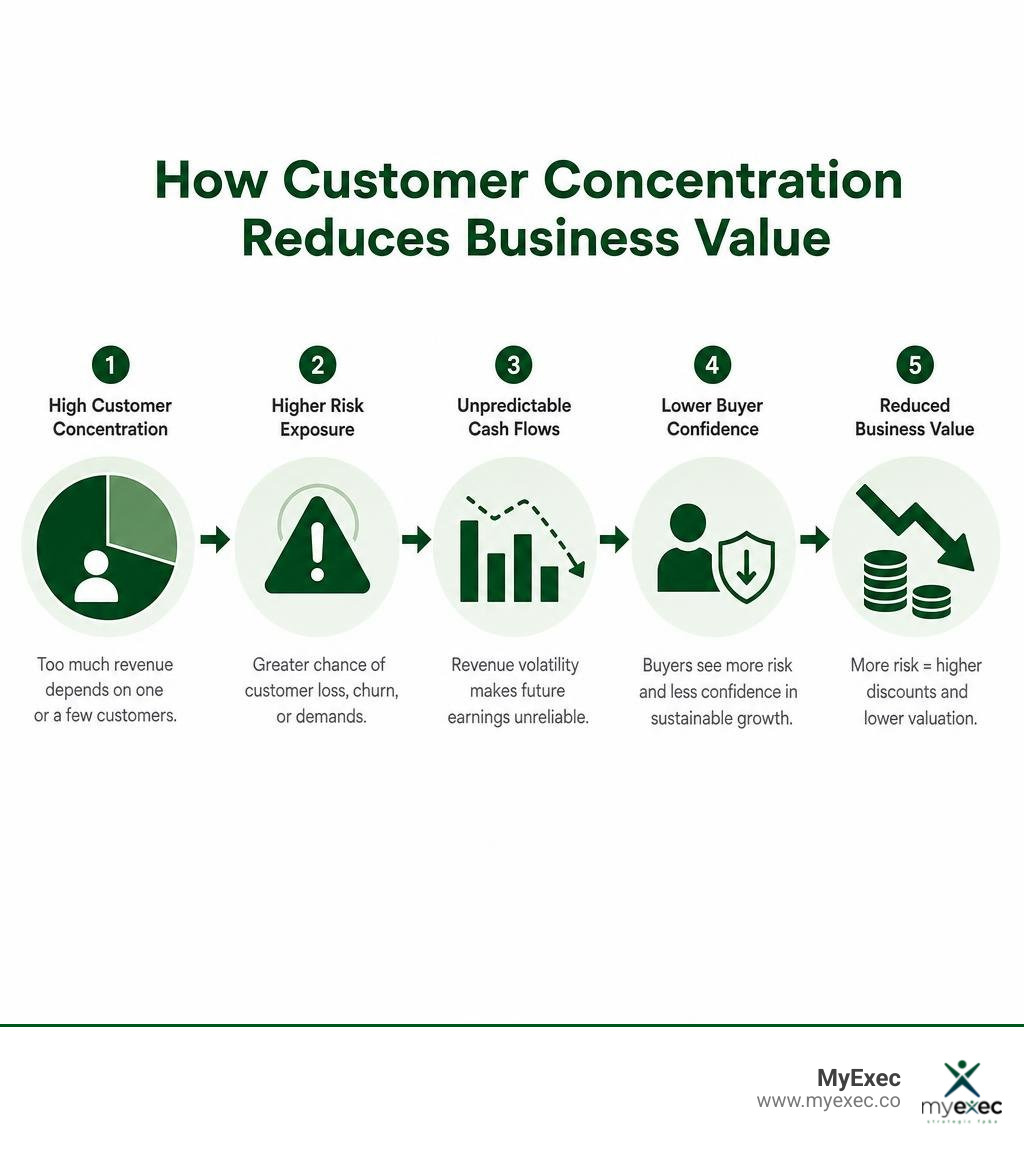
Customer concentration is the measure of how much of your business's total revenue comes from your largest clients. When we talk about business valuation, concentration is one of the first things a buyer or investor looks at. It represents a potential single point of failure. If one client makes up a massive chunk of your sales, your business's survival is tied directly to that client's goodwill, financial health, and operational decisions.
There's often a major psychological gap between how founders view this setup and how buyers evaluate it. As a founder, you might look at a 12 year relationship with your largest customer as a badge of honor. You see it as proof of your excellent service, product quality, and revenue stability.
Buyers, however, use objective risk models. They don't see a loyal partner, they see a catastrophic risk. They ask hard questions: What happens if that client's procurement team changes? What if they decide to bring your services in-house? What if they go bankrupt? Because of these risks, buyers will adjust their valuation models to protect themselves.
The standard definition of customer concentration
To understand how buyers measure this risk, we have to look at the standard thresholds used in professional finance. Under GAAP standards, public companies must disclose any single customer that accounts for 10% or more of their total revenue. This 10% rule is the baseline where professional analysts start paying attention.
In private markets and M&A transactions, the standard first flag is 20%. A single customer representing 20% or more of revenue triggers a detailed buyer review in every serious due diligence process. If that number climbs above 30%, some buyers will decline the process entirely.
We also have to look at cluster concentration, which measures the cumulative share of your top three or top five accounts. Even if your largest customer is only 12% of your revenue, you still have a concentration problem if your top five accounts represent 70% of your total sales. A healthy, well-diversified business typically has no single customer representing more than 10% of total revenue, and the top ten accounts represent less than 50% of total revenue.
Why buyers care about concentration risk
Buyers care about customer concentration because it directly threatens the predictability of future cash flows. Here are the four main reasons they'll discount your value:
- Single point of failure: If your top customer leaves, your revenue drops instantly, and your business might immediately become unprofitable.
- Relationship transferability: If the key customer relationship is built entirely on the founder's personal network or handshakes, the buyer has no guarantee that the client will stay after the sale.
- Loss of bargaining power: When a customer knows they represent 30% of your business, they hold all the cards. They can demand price cuts, extended payment terms, or custom features, and you have very little leverage to say no.
- Operational strain: Giant customers often demand custom setups, dedicated support teams, or specialized inventory. This makes your operations rigid and expensive, which limits your ability to scale.
How Do Buyers Quantify the Customer Concentration Discount?
When buyers find material customer concentration, they don't just ask for a lower price, they mathematically discount the business's valuation multiple. This is known as multiple compression. Buyers treat concentration as a risk factor that applies to the entire business's cash flow stability, not just the portion of revenue tied to that single client.
To understand how this works, we can look at how buyers translate risk into price. When a single customer exceeds 30% of revenue, the valuation can be reduced by 20% to 35% compared to a diversified peer. You can read more about how this plays out in this article about Customer Concentration Risk in M&A transactions.
The three concentration zones buyers use
Buyers generally categorize businesses into three distinct risk zones based on their top customer's revenue share:
- Green Zone (Under 15%): This is the ideal profile. A top customer representing less than 15% of revenue typically results in no concentration discount. Buyers view this as a healthy, diversified business that can easily survive the loss of any single account.
- Yellow Zone (15% to 30%): This triggers a detailed buyer review. Most buyers apply a 5% to 15% multiple discount in this range. They'll demand to see formal contracts, review historical ordering patterns, and evaluate the depth of the relationship.
- Red Zone (Above 30%): This represents material risk. Concentration in the 25% to 40% range typically reduces the price by 10% to 20% relative to a well-diversified comparable business. If concentration climbs above 40%, it can reduce the price by 20% to 30% or more, and many institutional buyers will walk away entirely.
The math of multiple compression
Let's look at the concrete math of how this affects your headline valuation. Imagine a business generating $5M in EBITDA. In a well-diversified state (Green Zone), this business might command a 5.0x multiple, resulting in a $25M valuation.
If that exact same business has a single customer representing 35% of its revenue (Red Zone), the buyer will apply a multiple discount. A business where the top customer represents 25% or more of revenue typically sees a discount of 1.0x to 2.0x EBITDA multiple or more.
If the buyer compresses the multiple from 5.0x to 3.7x, the valuation drops to $18.5M. That's a $6.5M reduction in enterprise value, even though the business is generating the exact same $5M in earnings. The buyer is simply pricing in the high probability that those earnings won't persist post-close.
The Table of Concentration Zones
| Concentration Zone | Revenue Percentage | Typical Multiple Discount | Buyer Behavior & Deal Impact |
|---|---|---|---|
| Green Zone | Under 15% | 0% (No Discount) | Standard market multiples; clean deal structures with minimal holdbacks. |
| Yellow Zone | 15% to 30% | 5% to 15% | Detailed buyer review; introduction of earnouts or minor holdbacks. |
| Red Zone | Above 30% | 15% to 30%+ | Heavy earnouts (20-40% of price); large escrows; some buyers decline entirely. |
Why Does Revenue Concentration Differ From Profit Concentration?

Many business owners make the mistake of only looking at top-line revenue concentration. But during a transaction, sophisticated buyers care much more about profit concentration. There's often a major difference between your top-line sales mix and your bottom-line profitability.
For example, a single customer might represent 30% of your total revenue, but because you had to offer them aggressive volume discounts, they might only represent 15% of your gross profit. In this scenario, your true economic risk is lower than your revenue concentration suggests.
Conversely, you might have a customer that represents 20% of your revenue but 40% of your EBITDA because they buy your highest-margin products. If that customer leaves, your profitability takes a massive hit. Understanding this distinction requires regular Product Profitability tracking and a detailed Profitability Analysis to spot where your margins actually live. You can learn more about identifying these trends in our guide on Revenue Concentration and Risk.
The definition trap of a single customer
Another common error is failing to group related accounts properly. Business owners often think they're diversified because they bill ten different entities. However, during a Quality of Earnings (QoE) review, buyers will look for the ultimate-parent level of economic control.
If you bill five different subsidiaries that are all owned by the same parent company, the buyer will aggregate them and count them as a single customer. The same rule applies to buying groups, franchise systems, and channel partners. If you sell your products to hundreds of retail stores, but they all purchase through a single distributor, your customer concentration is with that distributor, not the individual stores. If that distributor drops your product line, your entire retail channel disappears.
EBITDA normalization and margin analysis
To find your true economic concentration, you must perform a detailed margin analysis and normalize your EBITDA. This means allocating customer-specific costs that are often buried in general operating expenses. These expenses include:
- Dedicated support labor: Staff members who spend 100% of their time managing or servicing that single account.
- Special freight and logistics: Expedited shipping or custom packaging requirements demanded by the client.
- Rebates and volume discounts: Year-end cash-back structures tied to volume targets.
- Warranty and return costs: Higher-than-average return rates or custom warranty terms for that specific client.
When you allocate these costs directly to the customer, you might find that your biggest client is actually your least profitable. Our fractional FP&A teams help mid-market businesses build these account-level profitability models to Increase Business Value with Smarter Financial Reporting.
How Does Customer Concentration Affect Deal Structure and Financing?

Customer concentration doesn't just lower your headline valuation, it fundamentally reshapes the deal structure. When risk is high, buyers will use structural mechanisms to shift that risk back to you, the seller. They want to ensure they only pay for the revenue that actually survives the transition of ownership.
This means that even if you agree on a solid purchase price, a large portion of that cash might be deferred or made contingent on post-close performance. You can read more about how buyers approach this underwriting process in Customer Concentration: What It Is, Why It Matters, and How It Impacts Value When You Buy or Sell a Business.
Structural mechanisms buyers use to manage risk
Buyers have several tools at their disposal to protect themselves against customer churn:
- Earnouts tied to key account retention: The buyer will defer 15% to 25% of the purchase price over a 12 to 24-month period. You'll only receive this money if the key customer continues to generate defined revenue levels post-close.
- Escrow holdbacks: The buyer will place 10% to 20% of the purchase price in a third-party escrow account for 12 to 18 months. If the concentrated customer leaves or significantly reduces their spend during this window, the buyer clawbacks that money directly from the escrow.
- Seller notes with offset provisions: The buyer will ask you to finance a portion of the transaction through a seller note. However, they'll include an offset clause stating that if the major customer departs, the buyer can stop making payments on the note.
The lender's perspective and financing limits
Lenders are often the silent drivers of concentration discounts. If a buyer is using debt to finance the acquisition, the lender's underwriting standards will dictate what's possible.
SBA lenders, who fund the majority of small and lower-mid-market acquisitions, frequently avoid financing at 30% customer concentration. If your top customer represents 35% of your revenue, the buyer likely won't be able to secure an SBA loan. This immediately shrinks your buyer pool to cash buyers or private equity firms, who will demand a steeper discount.
Conventional commercial lenders are equally strict. They'll run detailed stress tests on your financials. If the business cannot maintain a Debt Service Coverage Ratio (DSCR) of at least 1.25x under that stress test, the lender will decline the loan. Furthermore, conventional loan agreements can also include covenants that make the acquisition debt immediately callable if that key customer departs post-close.
How Can You Reduce Customer Concentration Before Selling Your Business?

If you plan to sell your business in the next few years, you must address customer concentration early. It typically takes 18 to 36 months of active business development to meaningfully reduce a concentrated revenue base.
The most important rule of de-risking is that you should never try to reduce concentration by cutting revenue from your largest client. Firing or scaling down a profitable customer to change your ratios is financially damaging. It shrinks your EBITDA and permanently destroys enterprise value.
Instead, you must focus on growing the denominator. The goal is to grow the rest of your customer base faster than your top client is growing. This requires a structured approach to business development, which we evaluate during a Strategic Finance Assessment or when preparing formal Business Valuations.
Contractual protections that reduce the discount
If you can't dilute your top customer's share in time, your next best defense is to secure strong contractual protections. This gives the buyer legal certainty that the revenue will persist post-close.
- Multi-year Master Service Agreements (MSAs): Work to transition your top accounts from month-to-month or annual purchase orders to 3 to 5-year contracts.
- Take-or-pay or minimum order quantities (MOQs): Include clauses that guarantee a baseline level of revenue, regardless of the client's actual ordering volume.
- Early termination penalties: Ensure the contract requires at least a 12-month written notice for termination, with heavy financial penalties for early exit.
- Clear transferability and assignability: Make sure the contract contains clear language stating that the agreement transfers automatically to a new owner during a change of control. If the client has to consent to the transfer, the buyer will view it as a major risk.
Institutionalizing key relationships
Buyers are terrified that your biggest customer is only loyal to you personally. If the client's CEO is your golf partner, the buyer will assume that relationship disappears the day you hand over the keys.
You must prove that the relationship is institutional, not personal. Transition the day-to-day account management from yourself to dedicated team members. Introduce your operations, product, and customer service leads to their counterparts at the client's company. Document your delivery processes, quality scorecards, and communication workflows. When a buyer sees that your team handles 95% of the client's touchpoints without your involvement, the perceived risk of customer churn drops significantly.
When Is High Customer Concentration Acceptable or Strategic?
While customer concentration is generally viewed as a risk, there are specific industries and business models where high concentration is normal, expected, and discounted much less by buyers. Understanding these exceptions can help you position your business properly in the market.
Government contracting and defense
In government contracting and defense, having 50% or more of your revenue tied to a single federal agency is incredibly common. Buyers and lenders understand this model and don't penalize it the way they would a commercial services firm.
The stability here comes from regulatory procurement rules and institutional inertia. Once a government contract is awarded, especially if it's a multi-year prime contract, it's highly stable. The government rarely breaches contracts, and the switching costs and security clearance requirements make it very difficult for competitors to displace an incumbent.
Manufacturing and enterprise software
In manufacturing, high concentration is often structural and tied to specific OEM relationships. If you manufacture specialized components for a major automotive brand, you might have 40% of your production dedicated to that single client.
Buyers will tolerate this if there's deep operational integration. If you own the custom tooling, if your systems are linked directly to their assembly line via EDI, and if you're the sole-source supplier for a critical part, the customer's switching costs are massive. It would take them years and millions of dollars to qualify a new vendor, which mitigates the risk of sudden churn.
In enterprise software, high concentration can be offset by exceptional retention metrics. If you have a single client representing 25% of your ARR, but you can prove a Net Revenue Retention rate of over 110% across your entire base, buyers will be much more comfortable. When combined with strong Rule of 40 Valuation Planning, high-performing software metrics can help preserve your multiple even with an anchor tenant.
Frequently Asked Questions About Customer Concentration?
At what percentage does customer concentration become a problem for buyers?
Buyers begin paying closer attention when a single customer exceeds 20% to 25% of revenue. This is the standard threshold where they'll flag the business for detailed due diligence. Once a single customer exceeds 30% of revenue, it becomes a material risk that will almost always result in a valuation discount, more complex deal structures, or lenders refusing to fund the transaction.
Do buyers count subsidiaries of the same parent company as a single customer?
Yes. During a Quality of Earnings review, buyers will aggregate all accounts at the ultimate-parent level. If you bill three different subsidiaries or separate regional offices that are ultimately owned by the same parent corporation, the buyer will treat them as a single customer. They look at the ultimate economic decision-maker, not the individual billing addresses on your invoices.
Can a long-term contract completely eliminate the customer concentration discount?
A long-term contract with strong termination penalties and clear assignability clauses will reduce the concentration discount, but it rarely eliminates it entirely. Buyers know that contracts can be breached, renegotiated, or tied up in legal disputes if a client wants to exit. While a 5-year contract makes your business much more sellable, the concentration will still be factored into the overall risk profile of the deal.
How Can MyExec Help You Navigate Customer Concentration and Protect Your Valuation?
If your business is generating between $5M and $50M in revenue, you're likely outgrowing founder-led finance. Managing customer concentration, building defensible financial models, and preparing for a future sale require sophisticated financial leadership.
At MyExec, we provide fractional CFO and FP&A services designed specifically for growing businesses throughout the US. We deliver senior finance leadership, strategic planning, and valuations at a fraction of the cost of a full-time hire.
We've worked across companies from a few million in revenue to roughly $2B, including nonprofits, private equity owned, closely held, and publicly traded companies. We can help you:
- Build account-level margin reports to identify your true economic profit concentration.
- Model stress-test scenarios to prove to buyers and lenders that your business remains cash-flow positive even under conservative assumptions.
- Design and execute an 18 to 36-month diversification playbook to grow your denominator and dilute key risk accounts.
- Structure your contracts and internal metrics to maximize your valuation multiple before you go to market.
Our goal is to help you grow until a full-time CFO makes sense, then help you find the right person and transition cleanly. If you're ready to understand what your business is worth and build a plan to protect your value, start with a Strategic Finance Assessment today or Schedule a Consultation.