The Difference Between Strategic Finance, Fractional CFO & Accounting Roles

To build a strong financial foundation, you have to understand how different financial roles connect. Many business owners treat accounting, fractional CFO advisory, and strategic finance as interchangeable services. In reality, they represent distinct layers of a company's financial operations.
Accounting and bookkeeping serve as the historical record keeper. Bookkeepers record daily transactions, reconcile bank accounts, manage bills, and run payroll. Accountants take those entries and ensure they follow standard accounting rules like U.S. GAAP, close the general ledger each month, and maintain tax compliance. This discipline answers one core question: What happened in the business financially?
A fractional CFO acts as an executive strategist on a flexible retainer basis. Rather than simply organizing historical data, a fractional CFO interprets financial statements to guide business decisions. They look at working capital, evaluate funding options, oversee banking relationships, and design financial controls. This role answers the question: What do these numbers mean for our business strategy?
Strategic finance is the forward-looking discipline that combines financial planning and analysis (FP&A) with business modeling. Strategic finance professionals build multi-year forecasting models, evaluate unit economics, analyze product pricing, and test growth scenarios. They bridge the gap between high-level company goals and everyday operational decisions. This discipline answers the question: How should we allocate our resources to reach our growth goals?
When companies generate between $5M and $50M in annual revenue, relying solely on basic accounting leaves major blind spots. Strategic finance and fractional CFO leadership build directly on clean accounting data to create a modern corporate financial stack. To explore how integrated support can strengthen your operations, learn more about our Services.
How Does Backward-Looking Accounting Differ From Forward-Looking Strategic Finance?
The fundamental split in business finance lies between historical reporting and forward-looking projection. Both perspectives are essential, but they serve entirely different management needs.
Historical accounting centers on balance sheet accuracy, general ledger reconciliation, monthly closes, tax filings, and regulatory compliance. It ensures your operational records reflect reality and satisfy external tax authorities. However, relying exclusively on historical accounting to run a business is like driving down a highway while looking only in your rearview mirror. Past financial reports show where cash went, but they cannot show where cash is going next month.
Strategic finance turns your gaze toward the windshield. It focuses on rolling financial forecasts, dynamic scenario modeling, unit economics, and capital allocation. When leadership evaluates a major capital expense, such as opening a new distribution center or expanding a team in a new geography, backward-looking accounting only shows current cash balances. Strategic finance models how that investment impacts cash runway, gross margins, and hiring plans over a multi-year horizon.
Inaccurate historical data corrupts strategic forecasting. For example, if labor overhead is not allocated properly into project costs, historical P&L records show artificially high gross margins. If a strategic finance team uses those distorted numbers to model market expansion, the company will scale unprofitable services and burn through cash reserves.
Dynamic financial forecasting acts as an early warning system. By modeling cash flows on a rolling schedule, leadership can anticipate seasonal cash squeezes or unexpected revenue dips weeks before they hit the bank account. For deeper guidance on upgrading your financial insights, read our Strategic Finance Guide and discover practical ways to Improve Financial Reporting.
What Specific Problems Does Each Financial Role Solve Day-to-Day?
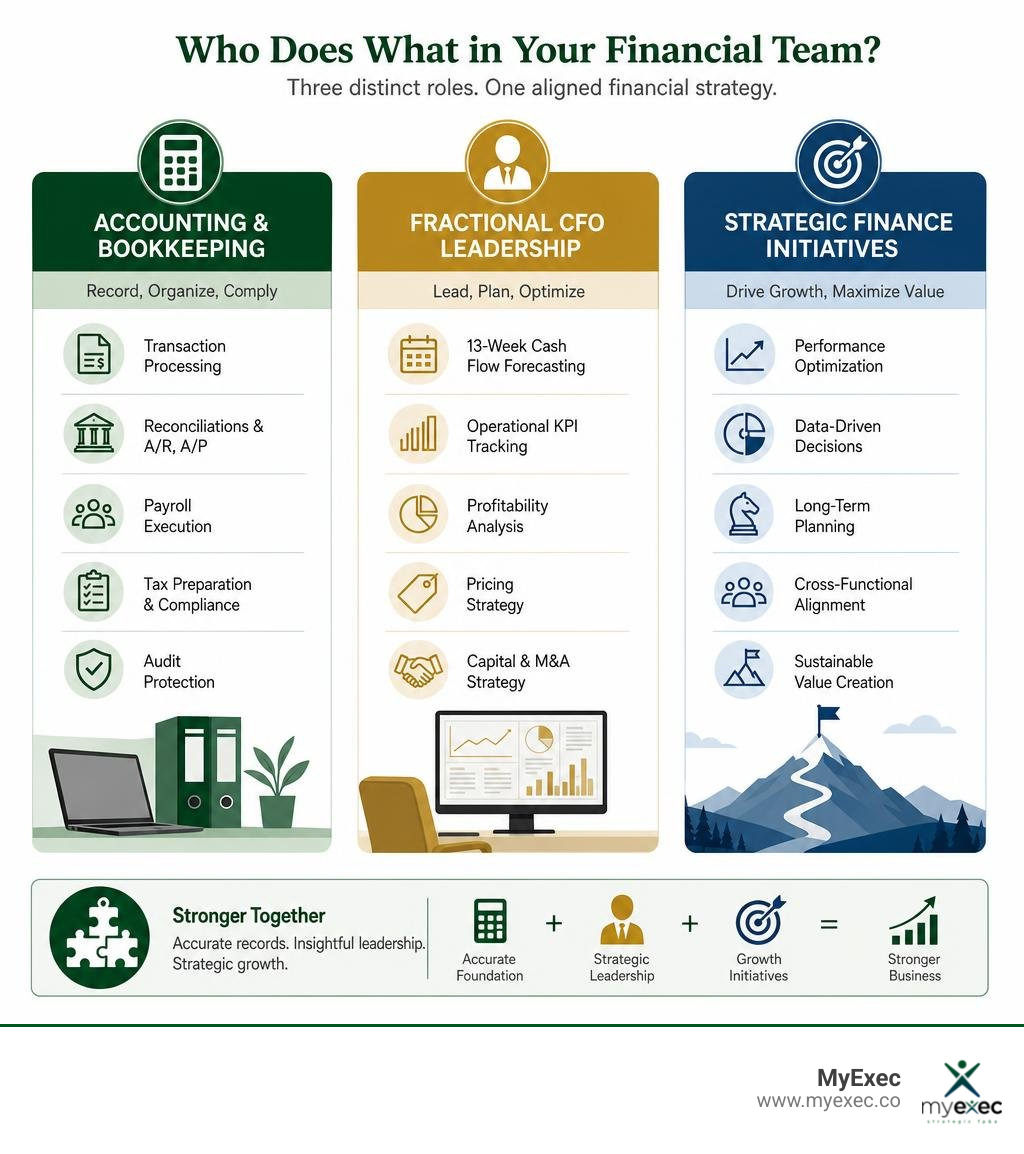
Each financial role tackles specific day-to-day challenges. Understanding these responsibilities ensures you assign tasks to the right specialists.
What Does a Bookkeeper and CPA Handle Day-to-Day?
Bookkeepers and Certified Public Accountants (CPAs) handle transaction capture, financial controls, and external compliance:
- Transaction Processing: Recording daily customer invoices, vendor bills, expense reports, and bank transfers.
- Reconciliations and Accounts Payable/Receivable: Matching bank records to general ledger entries and tracking customer collections and vendor payments.
- Payroll Execution: Processing routine payrolls while ensuring accurate tax withholdings and benefits deductions.
- Tax Preparation and Compliance: Filing state, local, and federal tax returns and managing annual compliance requirements.
- Audit Protection: Categorizing payroll codes correctly throughout the year to prevent costly surprises during annual workers' compensation audits.
What Does a Fractional CFO and Strategic Finance Team Handle Day-to-Day?
A fractional CFO and strategic finance team handle high-level planning, cash management, and capital strategy:
- 13-Week Cash Flow Forecasting: Building rolling short-term cash projections to manage operational liquidity and working capital.
- Operational KPI Tracking: Establishing performance metrics that link departmental activities to overall company margins.
- Product and Service Profitability Analysis: Breaking down gross margins across business units to find underperforming products or unprofitable client accounts.
- Pricing Strategy: Evaluating unit economics, customer acquisition costs, and pricing structures to expand profit margins.
- Capital and M&A Strategy: Structuring debt facilities, preparing financial materials for bank loans, supporting acquisitions, and providing certified business valuations. (Our team includes a staff Certified Valuation Analyst credentialed through the National Association of Certified Valuators and Analysts to guide these valuation efforts).
To optimize your operational profitability, review our insights on Profit and Loss Management and tracking Business Performance Metrics.
How Do Costs Compare Across Bookkeeping, CPAs, and Fractional CFOs?
Building an internal finance department can be expensive. Evaluating cost structures across external providers helps middle-market companies structure their investment wisely.
Bookkeeping fees depend on transaction volume, account complexity, and company scale. Most middle-market businesses pay a standard monthly fee for professional outsourced bookkeeping. CPA costs generally follow an annual cycle, reflecting tax return preparation, quarterly estimations, and periodic planning sessions.
Fractional CFO services operate on fixed monthly retainers tailored to scope and complexity. Compared to hiring a full-time in-house CFO (which requires significant executive base compensation, performance bonuses, health benefits, and equity grants), fractional leadership delivers top-tier financial expertise at a fraction of the overhead.
To maximize ROI, growing mid-sized firms often dedicate between 2% and 4% of their annual revenue toward comprehensive financial operations. This investment pays for itself by plugging margin leaks, optimizing working capital, improving pricing power, and preventing costly capital allocation mistakes.
The table below breaks down how these financial roles compare across key operational areas:
| Financial Role | Cost Structure | Primary Responsibilities | Primary Output | Focus Horizon |
|---|---|---|---|---|
| Bookkeeper | Monthly Fee | Data entry, bill payment, invoicing, bank reconciliations | Reconciled General Ledger & Trial Balance | Past (Daily/Monthly) |
| CPA / Tax Accountant | Annual / Project Fee | Tax planning, regulatory filings, formal financial audits | Tax Returns & Compliance Statements | Past (Annual) |
| Fractional CFO | Monthly Retainer | Executive strategy, banking relations, capital structuring | Strategic Roadmap & Financing Plans | Present & Future |
| Strategic Finance Team | Scalable Retainer | FP&A, dynamic financial modeling, unit economic analysis | Rolling Forecasts & Executive Dashboards | Future (1-5 Years) |
For more details on structuring leadership retainers, explore our Fractional CFO Consulting services.
When Should Your Business Hire Each Financial Role in the Growth Cycle?
Hiring financial help in the wrong order is one of the most expensive mistakes a growing business can make. Bringing in high-level strategic advisors before setting up clean bookkeeping wastes executive strategy budgets on basic data correction.
Companies should follow a clear hiring progression as revenue scales:
- Early Stage (Founder-Led to Initial Revenue): The owner manages finances using basic software, focusing on cash preservation and sales generation.
- Foundation Stage (First Hires & Scaling Operations): The business outgrows founder-led entry and hires an outsourced bookkeeper to handle reconciliations, invoicing, and payroll. A CPA is added to oversee quarterly tax filings.
- Expansion Stage ($5M to $10M Revenue): Operational complexity increases. Historical financial statements are no longer enough to manage cash flow and margins. The business adds fractional CFO leadership and FP&A support to build forecasts, track KPIs, and manage working capital.
- Mid-Market Middle Stage ($10M to $50M Revenue): The company adopts a full-stack finance architecture that combines financial analysts for modeling with a fractional CFO for senior guidance. This approach builds sophisticated infrastructure without committing to full-time executive overhead prematurely.
- Enterprise Scale ($50M+ Revenue): High volume, multiple business units, or international operations justify bringing on a full-time, in-house CFO supported by a dedicated internal FP&A department.
By following this sequence, companies make sure every dollar spent on financial leadership builds on reliable data. To benchmark where your company sits in this maturity curve, take our Strategic Finance Assessment.
How Do You Know If Your Books Are Clean Enough for a Fractional CFO?
A CFO advisor working with messy accounting data is merely an expensive guesser. Before adding strategic financial leadership, evaluate the health of your accounting records.
Signs of reliable bookkeeping include:
- Bank accounts, credit cards, and lines of credit fully reconciled through the end of the previous month.
- A steady monthly close process completed within 10 to 15 days of month-end.
- Consistent chart of accounts categories without random expense classification shifts.
- Accounts receivable and accounts payable sub-ledgers that match the balance sheet.
Conversely, warning signs of messy books include accumulating balances in un-reconciled accounts, balance sheet accounts that haven't been reviewed in months, inaccurate inventory records, and manual entry adjustments made outside the core accounting software.
If historical records contain errors, start with a targeted cleanup engagement. Professional cleanup projects restore baseline accuracy, ensuring strategic advisors draw conclusions from reliable facts. Once your financial records are verified, you can centralize performance management through a custom Financial Reporting Dashboard.
What Are the Most Common Questions About Strategic Finance and Fractional CFOs?
Can a Bookkeeper Provide Strategic Business Advice?
Bookkeepers excel at recording past transactions accurately. While an experienced bookkeeper might point out basic patterns like rising supplier costs or late-paying customers, they generally lack training in quantitative financial modeling, valuation, debt structuring, and multi-year forecasting. Asking a bookkeeper to guide strategic growth is like asking a court reporter to manage trial strategy. Strategic business advice requires the skill set of a strategic finance specialist or fractional CFO.
What Is the Difference Between a Fractional CFO and a Business Coach?
Business coaches focus on leadership mindset, accountability, time management, and organizational processes. They offer broad guidance across management disciplines. A fractional CFO focuses specifically on hard quantitative metrics: financial modeling, gross margin analysis, cash runway management, debt structuring, and capital allocation. While a business coach helps you clarify operational goals, a fractional CFO builds the financial roadmap and capital strategy needed to achieve them.
Can One Firm Provide Both Bookkeeping and Strategic CFO Services?
Yes, working with an integrated firm that provides both bookkeeping and strategic CFO leadership offers clear advantages. When bookkeeping and strategic finance operate under one roof, communication gaps disappear. The CFO advisor works with internal data they know is accurate, eliminating back-and-forth delays between separate accounting and advisory vendors.
How Can MyExec Help Scale Your Financial Operations?

Navigating financial growth requires a flexible approach. Many growing companies between $5M and $50M in revenue find themselves trapped between single-person advisory retainers that lack analytical horsepower and the steep overhead of a full-time executive team.
MyExec bridges this gap by delivering a flexible, full-stack finance solution. We provide dedicated financial analysts to handle detailed modeling, FP&A, and reporting alongside senior fractional CFO leadership for executive guidance. Our flexible model scales up or down based on your company's stage and complexity.
Our team brings deep operational experience gained across businesses ranging from several million dollars in revenue up to $2B, including private equity-owned enterprises, closely held mid-market firms, non-profits, and publicly traded entities across the mid-Atlantic region from Philadelphia, Reading, and Pittsburgh to Baltimore, Wilmington, Washington D.C., and Arlington. With a staff Certified Valuation Analyst (CVA), we also help clients benchmark performance, improve unit economics, and prepare for capital raises or eventual sale.
Our goal is simple: help build your financial infrastructure and scale your business efficiently until hiring a full-time CFO makes sense. When that time comes, we help define the role, find the right executive, and transition management without operational disruption.
Ready to upgrade your financial operations? Visit MyExec to learn more about our Services, review our Business Valuations guidance, or schedule a strategy consultation with our senior finance team.