How to Improve Financial Reporting Accuracy in 30 Days
Why So Many Growing Companies Are Flying Blind on Their Own Finances

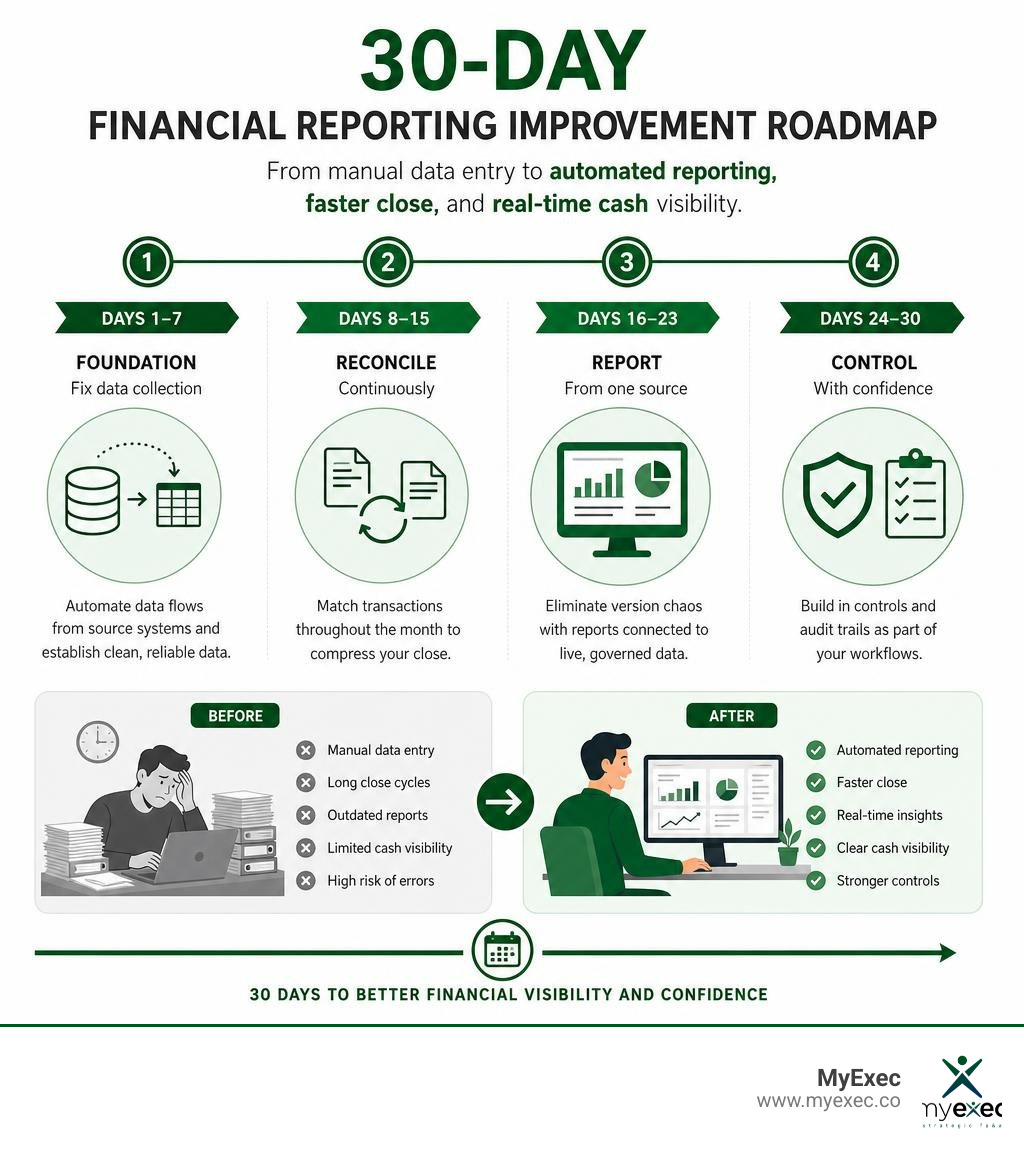
The most effective ways to improve financial reporting come down to four things:
- Fix data collection first - automate how financial data flows from your source systems before touching dashboards or reports
- Reconcile continuously - don't batch everything at month-end; match transactions throughout the month to compress your close
- Work from a single source of truth - eliminate version control chaos by connecting reports directly to live, governed data
- Build in controls early - segregation of duties and audit trails need to be part of the workflow design, not an afterthought
Right now, your finance team is probably spending most of their time finding and organizing numbers, not analyzing them. Research shows finance teams spend up to 75% of their time just collecting and organizing data, leaving only 25% for the analysis that actually helps you run the business. Finance leaders spend up to 2,300 hours a year on quarterly and year-end reports alone.
That's not a people problem. It's a process problem.
And it shows up in ways that are easy to recognize. Your month-end close takes longer than it should. You're making decisions based on data that's already two weeks old. Your cash flow picture only becomes clear after the fact, when it's too late to act on it. The numbers in last week's spreadsheet don't match the ones in this week's.
This isn't just an inconvenience. According to the U.S. Chamber of Commerce, 82% of businesses fail because they struggle to manage cash flow, with poor financial visibility as a major contributing factor. The companies that get this right aren't necessarily bigger or better staffed. They've just built better systems.
This guide walks you through exactly how to do that in 30 days, without ripping out your existing systems or hiring a full team.
At MyExec, a fractional CFO practice built for companies in the $5 million to $50 million range, we apply our experience performing complex finance functions, where the work of building reliable reporting at scale directly shapes how we approach efforts to improve financial reporting for growing companies today. That experience is what this guide is built on.
The Core Bottlenecks That Slow Down Your Close
If your finance team is working late nights during the first week of the month, they are likely fighting system friction rather than accounting complexity. For a growing business, the close process slows down because of three common operational bottlenecks.
First, manual data entry is a constant drag. When analysts spend their days copying transaction details from billing platforms, bank statements, and inventory systems into Excel, they are not doing finance work. They are doing data entry. This manual handling introduces errors that take days to track down later.
Second, multi-entity complexity creates massive coordination challenges. Data shows that 65% of companies have more than 10 business units, and 59% have over 10 active legal entities. Even at a smaller scale, managing two or three entities with different bank accounts, intercompany transactions, and tax rules makes consolidation highly complex. If your team is manually managing intercompany eliminations and foreign exchange translations in spreadsheets, your close timeline will naturally expand.
Third, version control issues destroy trust in the numbers. When financial models are shared via email, different departments end up working off different versions of the same file. The sales team might be looking at an outdated revenue draft while the operations team builds their plans on older expense assumptions. This disconnect leads to long, unproductive meetings where teams argue about whose spreadsheet is correct instead of making decisions.
These bottlenecks create real business risks. When you are looking to identify and address these weak spots, it helps to ask your team hard questions about their daily workflows. You can read more about managing these internal vulnerabilities in our guide on operational risks to ask your finance team.
How to improve financial reporting by targeting manual data collection
To improve financial reporting, you must start where the data starts. Many companies try to fix their reporting issues by buying expensive visualization tools. This is a mistake. If the underlying data collection is still manual, you are simply visualizing bad data faster.
True improvement begins with data normalization. This means establishing consistent rules for how data is structured, categorized, and cleaned before it ever reaches a report. Instead of having analysts manually reformat CSV files every month, you can set up direct API connections between your ERP, billing systems, and bank feeds.
These API connections automatically pull transaction data into a central repository in a standardized format. This eliminates the manual extraction step entirely, saving dozens of hours and removing human error from the initial phase of the close. For a deeper look at how to set up these automated data pipelines, you can read this practical automated financial reporting guide.
Shifting from reactive to proactive cash flow management
When financial reporting is manual, it is always backward-looking. You receive a report on the tenth of the month telling you what happened thirty days ago. This delay creates high decision latency, meaning you cannot react to cash flow changes until long after they occur.
Real-time reporting changes how you run your business. By automating data flows, you gain daily visibility into key metrics like cash balances, accounts receivable aging, and operating expenses.
This visibility shifts your leadership team from a reactive posture to a proactive one. Instead of wondering why cash is tight at the end of the quarter, you can spot payment delays or unexpected expense spikes as they happen. This allows you to adjust spending, follow up on outstanding invoices, or renegotiate vendor terms before a minor cash flow dip becomes a major business challenge.
How to Improve Financial Reporting Without Replacing Your ERP
Many business owners believe they need to replace their entire ERP system to get better financial reports. This is rarely true, and for mid-market companies, a full ERP replacement is often a costly, multi-month distraction that introduces new risks.
You can significantly improve financial reporting by keeping your existing systems and connecting them using modern middleware and API integrations. Instead of moving to a massive enterprise ERP, you can layer a dedicated data connection tool over your current accounting software. This middleware acts as a bridge, pulling raw transaction data from your legacy systems, cleaning it, and feeding it into a secure reporting layer.

This approach preserves the workflows your team already knows while giving you the data centralization of a much larger enterprise system. It is faster to implement, costs a fraction of a new ERP, and delivers immediate improvements in data accuracy.
Automating underlying data reconciliation versus building dashboards
A common mistake growing companies make is prioritizing dashboards over data integrity. A beautiful pie chart is useless if the numbers behind it are incorrect.
When you focus only on the presentation layer, you build dashboards that rely on fragile, manual spreadsheets. If an analyst makes a copy-paste error or breaks a formula in the source file, the dashboard will display incorrect information without warning.
To build a reliable system, you must automate the underlying data collection and reconciliation first. This creates a single source of truth where every transaction is matched, validated, and locked. Once you have a clean, automated data pipeline, any report or dashboard you build will automatically be accurate and reliable. You can read more about how this foundation drives business growth in our insights on smarter financial reporting.
The highest ROI automation tasks for mid-market companies
Not all finance tasks are created equal when it comes to automation. If you try to automate everything at once, you will overwhelm your team and stall your progress. Instead, focus on the tasks that offer the highest return on investment in terms of hours saved and errors reduced.
- Bank Reconciliation: Automating the matching of bank transactions to your general ledger ledger lines can save up to 20 hours per month while catching discrepancies immediately.
- Data Collection: Connecting billing systems, payroll, and CRM data directly to your finance layer eliminates 40% to 60% of manual preparation work.
- Journal Entries: Setting up automated, template-based journal entries for recurring monthly transactions reduces manual input and ensures consistent categorization.
- Report Distribution: Scheduling automated distribution of standard financial packages ensures stakeholders receive updates on time, without manual emailing.
By focusing on these high-impact areas, you can free up your team to focus on strategic planning and variance analysis. For a detailed breakdown of how to structure these automation efforts, consult this guide on financial reporting automation.
Designing Workflows for GAAP and IFRS Compliance
Whether your business follows GAAP or IFRS, your financial reporting must stand up to regulatory standards and audit scrutiny. When automating your workflows, compliance cannot be an afterthought; it must be built directly into the system design.
Automated workflows must be configured to handle complex accounting standards, such as ASC 606 and IFRS 15 revenue recognition rules, consistently. By coding these rules directly into your data transformation pipelines, you ensure that revenue is recognized correctly every time, regardless of who runs the report.
Furthermore, automation allows you to maintain permanent, digital audit trails. Every data sync, journal entry modification, and report generation should be automatically logged with a timestamp and user ID. This level of traceability makes audits much simpler and faster. To understand how the broader financial industry is adapting to these automated compliance standards, you can read the KPMG report on AI in financial reporting.
Maintaining the four Cs of financial data
To ensure your financial reports are reliable enough for board members, lenders, and investors, your underlying data must consistently meet the four Cs:
Manual spreadsheet systems make it incredibly difficult to maintain these four standards. An automated data pipeline, however, enforces them by design. It pulls data directly from source systems, updates on a set schedule, aggregates all entities, and applies identical business rules to every run.
Internal controls and segregation of duties in automated systems
A common concern with automation is the risk of losing control over financial processes. In reality, modern automation tools provide stronger internal controls than manual systems can ever offer.
By implementing role-based access controls, you can restrict who can edit transaction data, approve journal entries, or modify reporting templates. This enforces a clear segregation of duties, ensuring that the person who prepares a transaction is never the one who approves it.
Additionally, automated systems can run continuous anomaly detection, flagging unusual transactions or balance discrepancies for human review before they are finalized. This combination of automated guardrails and human oversight reduces fraud risk and ensures audit readiness.
A Practical 30-Day Action Plan for Mid-Market Finance Teams
Mid-market companies face unique challenges when attempting to improve financial reporting. Unlike large enterprises, they do not have massive IT budgets or dedicated data engineering teams. They must achieve their goals using their existing staff and limited resources.
This means your approach to automation must be highly practical and focused on quick wins. Instead of trying to build a custom data warehouse, you should rely on direct, out-of-the-box integrations and simple middleware. The table below highlights how mid-market companies can achieve enterprise-level reporting accuracy without the enterprise price tag.
| Feature | Large Enterprise Approach | Mid-Market Approach ($5M to $50M) |
|---|---|---|
| Technology Stack | Custom data warehouse, enterprise ERP | Middleware integrations, out-of-the-box APIs |
| Implementation Time | 6 to 18 months | 30 days |
| Resource Needs | Dedicated IT and data engineering teams | Existing finance team + fractional CFO support |
| Primary Focus | Complex custom workflows | High-ROI task automation (reconciliations, reports) |
To guide your strategic planning during this transition, you can consult our strategic finance guide.
Step-by-step roadmap to improve financial reporting in four weeks
Here is a practical, week-by-week plan to transform your financial reporting process in 30 days.
Week 1: Audit and Map
Map every data source that feeds into your financial reports. Identify where manual data entry, copy-pasting, or file formatting occurs. Document the exact steps your team takes to complete the close, and identify the single biggest bottleneck that slows down the process.
Week 2: Reconciliation and Integrity
Focus entirely on your reconciliation processes. Set up daily or weekly bank reconciliations rather than waiting until the end of the month. Establish clear matching rules for transactions and set up automated alerts for any exceptions or discrepancies.
Week 3: Pipeline Build
Connect your primary systems using direct APIs or middleware. Build automated data flows from your billing systems and bank accounts directly into your general ledger. Create standardized templates for your monthly financial package so reports can be generated with a single click once the data is clean.
Week 4: Review and Refine
Run your new automated reporting process in parallel with your old manual process to verify accuracy. Check that all numbers match perfectly and that the system maintains a complete audit trail. Set up a structured, in-document review process for your leadership team to add commentary and sign off on the final reports.
Frequently Asked Questions About Financial Reporting
What metrics should we track to measure reporting success?
To measure the success of your efforts to improve financial reporting, you should track three primary operational metrics:
- Close Cycle Time: The number of business days it takes to close the books and distribute financial reports. Your target should be five days or fewer.
- Error Rates: The number of adjustments, reclassifications, or corrections required after the reports are distributed. This should drop close to zero.
- Analyst Hours: The total hours your finance team spends on manual data collection and formatting versus strategic analysis.
By tracking these metrics, you can clearly see the return on your automation investments.
How does agentic AI change the financial close process?
Agentic AI tools are shifting finance from a historical tracking function to a forward-looking advisory role. Unlike traditional software that simply follows static rules, agentic systems can analyze patterns, run complex scenarios, and flag anomalies autonomously.

In a modern close process, these systems can automatically flag unusual transactions, draft variance commentary based on historical trends, and clean up formatting issues in your spreadsheets. This allows your senior finance leaders to focus on approving assumptions and strategic planning rather than manual verification. For a practical look at how to use these advanced tools safely, read this guide on using Codex for finance reviews and scenario planning.
Can we automate reporting without a dedicated data engineering team?
Yes. Modern financial software is designed to be set up and managed by finance professionals, not IT departments.
By using direct, pre-built integrations and no-code middleware platforms, you can connect your systems and automate your workflows without writing a single line of code. This allows growing companies to achieve enterprise-grade reporting accuracy and speed without the overhead of a dedicated technology team.
Conclusion
Improving your financial reporting is not about buying the most expensive software or hiring a massive team. It is about building simple, structured processes that connect your systems, automate manual tasks, and protect your data integrity.
At MyExec, we help growing businesses in the $5 million to $50 million revenue range build these exact systems. We provide fractional CFO and FP&A services, delivering senior finance leadership and scalable support at a fraction of the cost of a full-time hire. If you are ready to stop fighting spreadsheets and start running your business with clear, accurate financial visibility, explore our smarter financial reporting services.