How to Create a Financial Model for Sale
How Do You Align Your Financial Model with a Compelling Investor Narrative?

A financial model is not just a collection of formulas. It is a story told in numbers. When investors or buyers look at your projections, they are evaluating your strategic thinking, your operational discipline, and your understanding of the market.
Many business owners make the mistake of building a model backwards. They start with a target revenue figure, perhaps $50M in five years, and then back-solve the growth rate to make the numbers fit. This approach results in a hockey-stick growth curve that immediately triggers skepticism. Experienced investors see hundreds of deals a year and can quickly spot a model that lacks operational reality.
To build a credible model, you must define your strategic narrative before you input a single number into Excel. Your financial projections must be a direct reflection of your operational plan. If you project a 40% increase in revenue next year, your model must show the corresponding investments required to achieve that growth.
This means aligning your sales and marketing spend with key performance indicators like Customer Acquisition Cost (CAC) and Customer Lifetime Value (LTV). If your model projects rapid customer acquisition without a realistic increase in marketing spend or sales headcount, investors will reject the model as indefensible.
For early-stage and growth-stage companies alike, a strong model demonstrates that you understand the mechanics of your business. Aligning these operational drivers with your financial statements is a core part of establishing M&A financial readiness.
What considerations go into the narrative?
To build a believable narrative, you must document the underlying assumptions that drive your business. Your model should address several key operational questions:
- Market Size and Share: What is your Total Addressable Market (TAM), and what share can you realistically capture? A top-down assumption like "we will capture 1% of a $5B market" is rarely convincing. Instead, build a bottom-up model based on your actual sales capacity, lead conversion rates, and historical performance.
- Competitive Positioning and Pricing Power: How does your pricing compare to competitors? If you project price increases, does your historical retention rate support that assumption?
- Operational Bottlenecks: What is preventing your business from growing faster today? If you are raising capital to solve a specific bottleneck, such as upgrading manufacturing equipment or hiring a dedicated sales team, your model must show exactly how that capital relieves the constraint and drives revenue.
- Scalability: How does the business scale from its current $5M to $50M range to the next level? Your model should show operating leverage, meaning your fixed overhead expenses should grow at a slower rate than your revenue as you scale.
What do investors look for in the model?
Investors do not expect your five-year projections to be 100% accurate. They know that the future is uncertain. Instead, they are looking at the quality of your thinking and the logic behind your assumptions.
They will look for consistency between your pitch deck and your spreadsheet. If your pitch deck highlights a focus on enterprise customers, but your financial model shows revenue driven primarily by low-contract transactional sales, the mismatch will raise red flags.
Investors want to see that your unit economics are the primary driver of your profitability. They want to see that as you acquire more customers, your profitability improves because your customer acquisition costs are well-aligned with your lifetime value.
What Key Financial Statements and Projections Must Be Included?
To satisfy institutional buyers, lenders, or investors, your financial model must be a fully integrated three-statement model. A simple income statement projection is completely insufficient. Sophisticated stakeholders need to see how your profit and loss performance impacts your balance sheet and, most importantly, your cash flow.
An integrated model means that a change in any single assumption dynamically updates all three statements. For example, if you increase your projected sales in month 12, that change should automatically increase your accounts receivable on the balance sheet, adjust your working capital on the cash flow statement, and update your ending cash balance.
To understand how your current financial records stack up, consider starting with a strategic finance assessment.
The Income Statement (P&L)
The Income Statement projects your revenue, Cost of Goods Sold (COGS), and operating expenses (SG&A) over your forecast period, which is typically five years.
When preparing for a sale or capital raise, one of the most critical steps in building your P&L is normalizing your historical earnings. This process involves identifying and documenting owner add-backs and non-recurring expenses to calculate your Adjusted EBITDA (Earnings Before Interest, Taxes, Depreciation, and Amortization).
Common add-backs include:
- Owner compensation that is above or below market rate
- Personal expenses run through the business, such as personal vehicles or travel
- One-time legal fees or litigation costs
- Discontinued product lines or one-time consulting projects
Normalizing your earnings is vital because every dollar of valid add-backs directly increases your business valuation. At a 5x valuation multiple, finding $100,000 in legitimate add-backs adds $500,000 to your enterprise value.
The Balance Sheet
The Balance Sheet tracks what your business owns (assets) and what it owes (liabilities) at any given point in time.
For growing businesses, the balance sheet is where many expansion plans run into trouble. Growth requires cash, and that cash is often tied up in working capital. Your model must accurately project:
- Accounts Receivable (AR) Cycles: How long does it take your customers to pay you? If your payment terms are 30 days, but your actual collections take 45 days, your model must reflect that delay.
- Inventory Cycles: How much inventory do you need to keep on hand to support your sales projections?
- Capital Expenditures (CapEx): What physical assets, equipment, or technology infrastructure do you need to purchase to support your growth?
Your balance sheet must remain in balance across all projected periods without the use of hardcoded "plug" numbers. A broken balance sheet immediately signals to investors that the model's math is unreliable.
The Cash Flow Statement
The Cash Flow Statement is the ultimate metric for both investors and lenders. It translates your accounting profits into actual cash, showing exactly when cash enters and leaves your bank account.
Your model must clearly calculate:
- Operating Cash Flow: The cash generated by your day-to-day business operations.
- Free Cash Flow: The cash left over after paying for operating expenses and capital expenditures. This is the cash available to pay down debt or distribute to investors.
- Net Cash Change: The net increase or decrease in your cash balance each month.
The cash flow statement is what tells you, and your potential investors, exactly how much funding you need and when you will run out of cash (your runway) if you do not raise capital.
How Do You Structure the Model to Appeal to Different Stakeholders?
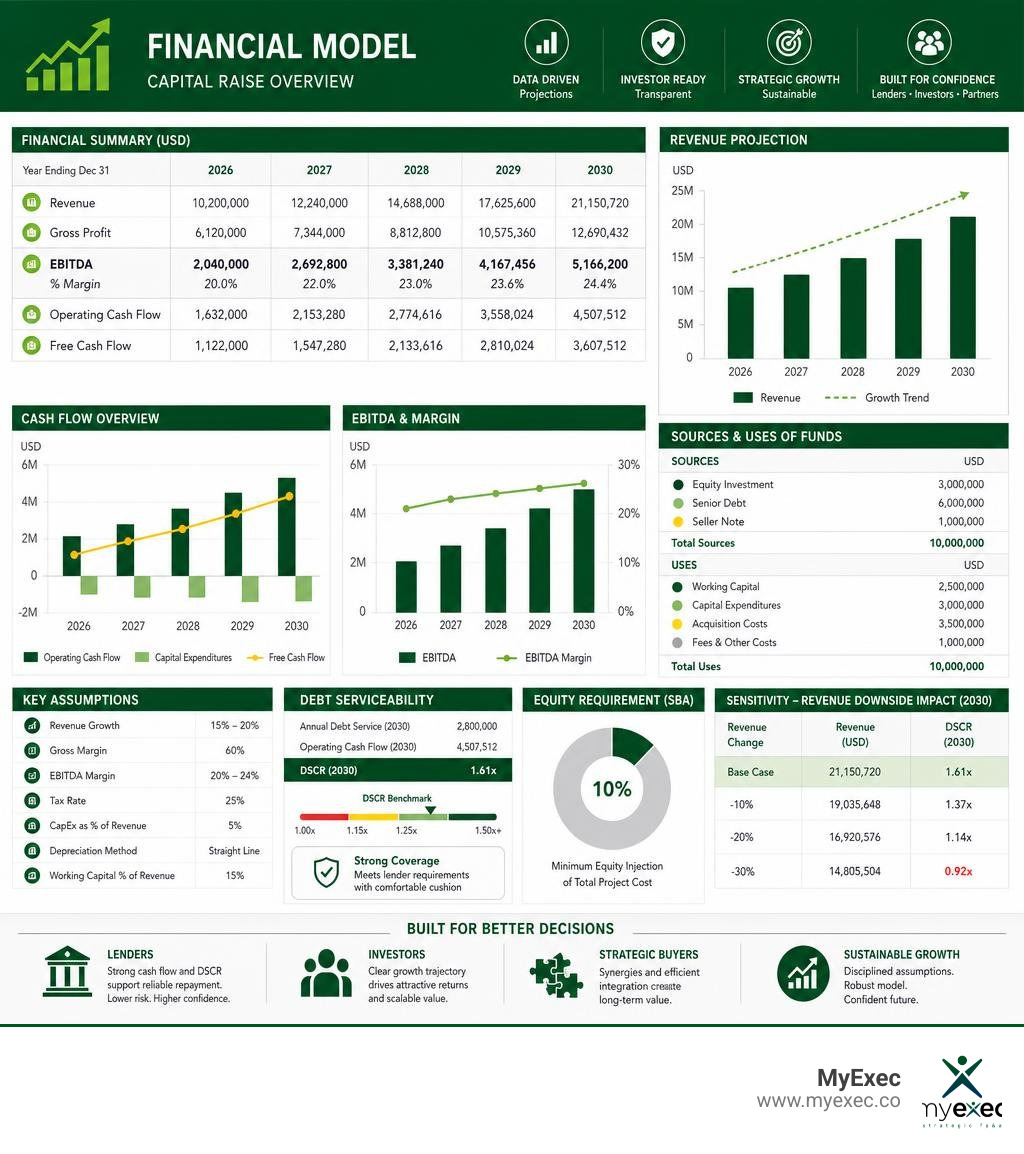
Not all stakeholders look at a financial model through the same lens. A commercial lender has entirely different priorities than a venture capital investor or a strategic corporate buyer. To maximize your chances of success, you must structure your model so that it highlights the specific metrics each stakeholder cares about most.
If you are working with an independent sponsor or structuring a leveraged buyout, you can find specialized architecture tips in the Independent Sponsor Financial Model guide by Peony. To help navigate these different structural requirements, many business owners rely on fractional CFO consulting to tailor their presentation.
Designing for Lenders and SBA Loans
Lenders are risk-averse. They are not investing for equity upside; they are investing for steady, predictable repayment of principal and interest. Therefore, when presenting your model to a bank or preparing for an SBA-guaranteed loan, your model must focus heavily on creditworthiness and debt serviceability.
The key metric for lenders is the Debt Service Coverage Ratio (DSCR), which measures your business's ability to cover its annual debt obligations with its operating cash flow. Lenders typically look for a minimum DSCR of 1.15 to 1.25, meaning your cash flow is at least 15% to 25% higher than your debt payments.
Your model should also clearly show:
- SBA Equity Injection Requirements: Under SBA guidelines, buyers typically need a minimum equity injection of 10% of the total project cost. Your sources and uses table must clearly demonstrate where this equity is coming from.
- Covenant Cushions: How much can your revenue drop before you breach your bank covenants? Lenders want to see that your business can withstand a moderate downturn and still meet its obligations.
For more details on preparing your business for debt funding, you can refer to the SBA guide on funding your business.
Designing for Venture Capital and Private Equity
Equity investors, such as venture capital (VC) and private equity (PE) firms, are looking for growth, scalability, and significant returns on their investment. Unlike lenders, they are willing to take higher risks in exchange for equity ownership and a share of your future profits.
When presenting to equity investors, your model must focus on:
- Internal Rate of Return (IRR) and Multiple on Invested Capital (MOIC): Investors want to see how much their investment will grow over their target holding period, which is typically three to seven years.
- Equity Waterfalls: If your deal structure includes preferred returns, catch-up provisions, or tiered promote structures, your model must include a fully formula-driven waterfall tab that calculates exactly how distributions are split between sponsors and limited partners.
- Sources and Uses of Funds: A clear table showing where the capital is coming from (equity, senior debt, seller notes) and exactly how it will be spent (working capital, acquisition costs, capital expenditures).
Designing for Strategic Acquirers
Strategic acquirers are corporate buyers who operate in your industry or an adjacent market. They are looking to buy your business because of how it fits into their existing operations.
When presenting your model to a strategic buyer, you should focus on:
- Synergies: How will the acquisition reduce costs or increase revenue? For example, if the buyer can eliminate redundant administrative functions or cross-sell your products to their existing customer base, your model should show both standalone projections and pro-forma combined projections that include these synergies.
- Integration Costs: Strategic buyers know that integrating two companies costs money and takes time. Your model should realistically project the one-time costs and timeline associated with the integration.
How Do You Determine and Defend Your Business Valuation?
One of the most important functions of your financial model is to establish a credible, defensible valuation range for your business. Coming to the negotiating table with an arbitrary valuation based solely on "market gossip" or ungrounded multiples is a quick way to lose credibility.
Instead, you should use your financial model to run multiple valuation methodologies. This approach gives you a range of values and provides the mathematical backing you need to defend your price during due diligence.
To explore how these valuations impact your transaction, you can read more about our approach to business valuations and how valuation ties directly into deal structure.
Discounted Cash Flow (DCF) Analysis
A Discounted Cash Flow (DCF) analysis calculates the intrinsic value of your business based on the present value of its future free cash flows. The theory behind a DCF is that a business is worth the sum of all the cash it will generate in the future, discounted back to today's dollars to account for the time value of money and risk.
To run a DCF, your model will:
- Project your free cash flows over a five-year period.
- Determine a discount rate, typically your Weighted Average Cost of Capital (WACC), which reflects the risk of your business.
- Calculate a terminal value, which estimates the value of your business beyond the five-year projection period.
Because DCF models are highly sensitive to small changes in assumptions, such as your discount rate or terminal growth rate, you must be prepared to defend every input.
Comparable Company Analysis (CCA) and Precedent Transactions
While a DCF provides an intrinsic valuation, market-based valuations show what buyers are actually paying in the real world.
- Comparable Company Analysis (CCA): This method looks at the public trading multiples of similar companies in your industry.
- Precedent Transactions: This method looks at historical acquisition multiples for similar private or public transactions.
When using market multiples for a business in the $5M to $50M revenue range, you must apply a size discount. Smaller companies typically trade at lower multiples than large, publicly traded peers because they carry higher operational risk and lower liquidity. Your model should document these adjustments clearly to remain credible.
Valuation Methodology Comparison Table
To present a complete picture to potential buyers or investors, it is best practice to show a comparison of the different valuation methodologies.
| Methodology | Primary Focus | Pros | Cons |
|---|---|---|---|
| Discounted Cash Flow (DCF) | Intrinsic value based on future cash flows | Highly customizable; reflects specific business drivers | Sensitive to small changes in assumptions and discount rates |
| Comparable Company Analysis (CCA) | Market valuation of public peers | Reflects real-time market sentiment and public data | Hard to find direct public matches for mid-market companies |
| Precedent Transactions | Historical acquisition multiples | Includes control premiums paid in actual transactions | Data can be outdated or difficult to access for private deals |
What Are the Best Practices for Building a Credible, Diligence-Ready Model?

When institutional buyers or investors enter the due diligence phase, they will send your financial model to their internal FP&A teams or external accounting firms for a comprehensive review. If your model is messy, hard to follow, or filled with errors, it can kill the deal or lead to a significant reduction in purchase price.
To pass due diligence on the first read, your model must follow strict financial modeling standards. You can study templates to understand how professional models are organized.
Working with an experienced financial modeling consultant can also ensure your workbook is built to institutional standards.
The 10-Tab Model Architecture
A clean, professional model should be organized logically so that detailed operating drivers feed into a summarized, integrated three-statement view:
- Cover & Assumptions: This is the control center of your model. All hardcoded inputs, such as growth rates, margins, hiring plans, pricing assumptions, and interest rates, must live here. Color-code these inputs, typically in blue font, and make sure every operating tab references these cells.
- Sources & Uses: A single table showing where the transaction capital is coming from and exactly how it is being allocated.
- Revenue & COGS Build: A detailed operating build that shows how revenue is generated by customer count, pricing, volume, product line, contract value, utilization, or other business-specific drivers. This tab should also calculate direct costs and gross margin assumptions before they flow into the P&L.
- OpEx Build: A detailed operating expense schedule that breaks out sales and marketing, general and administrative expenses, software, facilities, professional fees, and other recurring costs. Investors should be able to see which costs scale with growth and which remain relatively fixed.
- Headcount Assumptions: A hiring and compensation schedule that supports the growth plan. This tab should show planned roles, timing of hires, salaries, benefits, payroll taxes, commissions, and department-level allocation so the staffing plan clearly ties to the revenue story.
- 3-Statement Model: Your integrated Income Statement, Balance Sheet, and Cash Flow Statement, typically laid out monthly for the first two years and annually for years three through five. This tab should function as the summarized financial output, not the place where every detailed revenue, cost, and hiring assumption is buried.
- Debt Schedule: Tracks principal payments, interest rates, and covenant compliance tests over time.
- Returns Waterfall: Calculates the distribution of returns to different equity classes and sponsors.
- Sensitivity Analysis: Multi-axis tables that show how changes in key variables impact your valuation, cash runway, DSCR, or IRR.
- Executive Summary: A clean, visually appealing tab with key charts, KPIs, and a summary of the financial projections.
Incorporating Scenario and Sensitivity Analysis
A credible model does not just present a single "perfect" future. It acknowledges risk and shows how the business will perform under different economic conditions.
Your model should include dynamic scenario toggles that allow users to switch between:
- Base Case: Your realistic, most likely growth path.
- Upside Case: A growth path that assumes successful product launches or faster market expansion.
- Downside Case: A conservative path that assumes market stagnation, customer churn, or margin compression.
You should also run sensitivity analyses on your most critical business drivers. For example, show how a 5% decrease in customer retention or a 10% increase in labor costs impacts your cash flow and DSCR. To learn more about setting up these analyses, read our guide on scenario vs sensitivity analysis.
Common Mistakes to Avoid
When building your model, be sure to avoid these common mechanical errors that can damage your credibility:
- Hardcoded Numbers in Formulas: Never hardcode a number inside a formula (e.g.,
=A1*1.15). If you want to model a 15% growth rate, put "15%" in an input cell on your assumptions tab and reference that cell. - Double-Counting Management Rollover: In a business sale, owners often roll over a portion of their equity into the new entity. Make sure this rollover is treated correctly on your sources and uses table and is not double-counted as new cash.
- Ignoring Working Capital Pegs: Buyers will look closely at your working capital requirements. If your model assumes you can grow revenue significantly without a corresponding increase in working capital, it will be rejected as unrealistic.
- Broken Circular References: Avoid using formulas that reference themselves, which can cause Excel to crash or display errors. If you must use circular logic, such as calculating interest on a cash balance that depends on interest income, ensure you have built-in proper error-handling logic.
How Can a Growth-Stage CFO Help You Prepare for a Transaction?
Preparing a business for a sale or capital raise is a full-time job. Many founders try to manage the process themselves, only to find that the demands of building a financial model, managing a data room, and negotiating with buyers pull them away from running the business. This distraction often leads to a drop in operational performance, which buyers will immediately use to negotiate a lower price.
For businesses in the $5M to $50M revenue range, the solution is often to bring in senior strategic finance leadership. A growth-stage CFO can step in to lead the financial preparation, allowing you to focus on maintaining operational momentum.
At MyExec, we provide fractional CFO and FP&A services tailored specifically for mid-market businesses. Our model is scalable and flexible. Depending on your current needs, you might need an analyst to clean up your historical data, a senior CFO to lead negotiations, or a mix of both. This full-stack approach gives you institutional-grade support without the cost of a full-time executive hire.
To learn more about how we can support your business through this transition, explore our full range of services.
Preparing the Business for Due Diligence
A fractional CFO will start by cleaning up your historical financial records, identifying valid add-backs, and building a bottom-up forecasting model that stands up to institutional scrutiny.
They will also help you set up and manage your virtual data room, ensuring that all supporting documentation, from customer contracts to tax returns, reconciles perfectly with your financial model. When buyers ask technical questions about your working capital cycles or tax structures, your CFO will be there to provide clear, defensible answers.
Negotiating from a Position of Strength
Having a professional financial model and a strategic CFO on your side changes the dynamic of your negotiations. It signals to buyers that you are prepared, sophisticated, and represented by senior leadership.
Your CFO can use the financial model to:
- Counter lowball offers by showing the mathematical reality of your future cash flows.
- Structure the deal to optimize your post-closing tax outcomes.
- Evaluate the trade-offs between different offers, such as weighing a higher purchase price with a large earn-out against a slightly lower all-cash offer.
Our goal at MyExec is to help you grow your business and navigate your transaction successfully. When the time comes that a full-time CFO makes sense, we will help you define the role, find the right candidate, and manage a clean transition.
Frequently Asked Questions About Financial Modeling for a Sale
How far into the future should my financial model project?
For most business sales or capital raises, a five-year projection period is the industry standard. This timeframe is long enough to show the long-term growth potential and return on investment, but short enough to remain grounded in operational reality. The first 12 to 24 months should be projected on a monthly basis, while years three through five can be summarized annually.
Should I use a standard template or build my model from scratch?
While standard templates can be a helpful reference for structure, every business has unique revenue drivers, cost structures, and operational bottlenecks. A generic template often contains hidden formulas or rigid logic that does not fit your business model, which can lead to calculation errors during due diligence. It is almost always better to build a bespoke model tailored to your specific business, or to have a professional customize a proven framework for you.
What is the difference between a seller note and equity in my sources and uses?
In a business sale, a seller note is a form of debt where the buyer pays a portion of the purchase price over time with interest. In your sources and uses table, a seller note is listed as a source of debt capital. However, under certain SBA loan guidelines, if a seller note is structured with a multi-year full standby period (meaning no payments are made on it for the first few years), lenders may treat it as equity for the purpose of meeting debt service coverage and equity injection requirements.
Conclusion
Creating a financial model for a sale or capital raise is about much more than filling out a spreadsheet. It is about translating your hard work, your operational strategy, and your vision for the future into a cohesive, mathematically defensible narrative that institutional stakeholders can trust.
For businesses in the $5M to $50M revenue range, building a model that survives due diligence requires a level of strategic finance experience that goes beyond traditional accounting. By following the best practices outlined in this guide, such as integrating your three statements, tailoring your model to your target audience, and defending your valuation with solid methodology, you can approach the negotiating table with confidence.
You do not have to navigate this complex process alone. If you are ready to prepare your business for a successful transaction, contact MyExec to discuss your financial modeling needs. Our flexible, full-stack fractional CFO and FP&A teams are here to help you maximize your transaction value and guide your business to its next stage of growth.