A Practical Guide to Pricing Strategy Services
Are You Leaving Money on the Table? What to Know About Pricing Strategy Services

Pricing strategy services help businesses set, test, and optimize prices to improve margins and revenue growth. Here's a quick overview of what they cover:
- Core pricing models: Cost-plus, competitive, value-based, penetration, and price skimming
- Key deliverables: Price floor and ceiling analysis, customer segmentation, willingness-to-pay research, and tiered packaging design
- Who they're for: Companies that want to move beyond gut-feel pricing toward a structured, repeatable approach
- The payoff: Research shows a 1% improvement in pricing yields an average 11% improvement in operating profit
Most companies don't have a formal pricing strategy. Research suggests fewer than 30% of professional services firms do. That's not a minor gap. It means most businesses are setting prices by instinct, copying competitors, or defaulting to whatever the market seems to charge. None of those approaches answer the real question: are you capturing the value you actually deliver?
Pricing sits at the intersection of finance, marketing, and strategy. Get it right, and it compounds across every deal you close. Get it wrong, and no amount of volume fixes the margin problem.
This guide walks through the major pricing frameworks, how to choose between them, and how to put a structured approach in place without overcomplicating it.
At MyExec, we are a fractional CFO practice that helps growing companies connect pricing strategy services to the financial outcomes that matter, including margin expansion, cash flow, and business value. Our work spans everything from unit economics reviews to full pricing model transitions for founders who've outgrown their current approach.
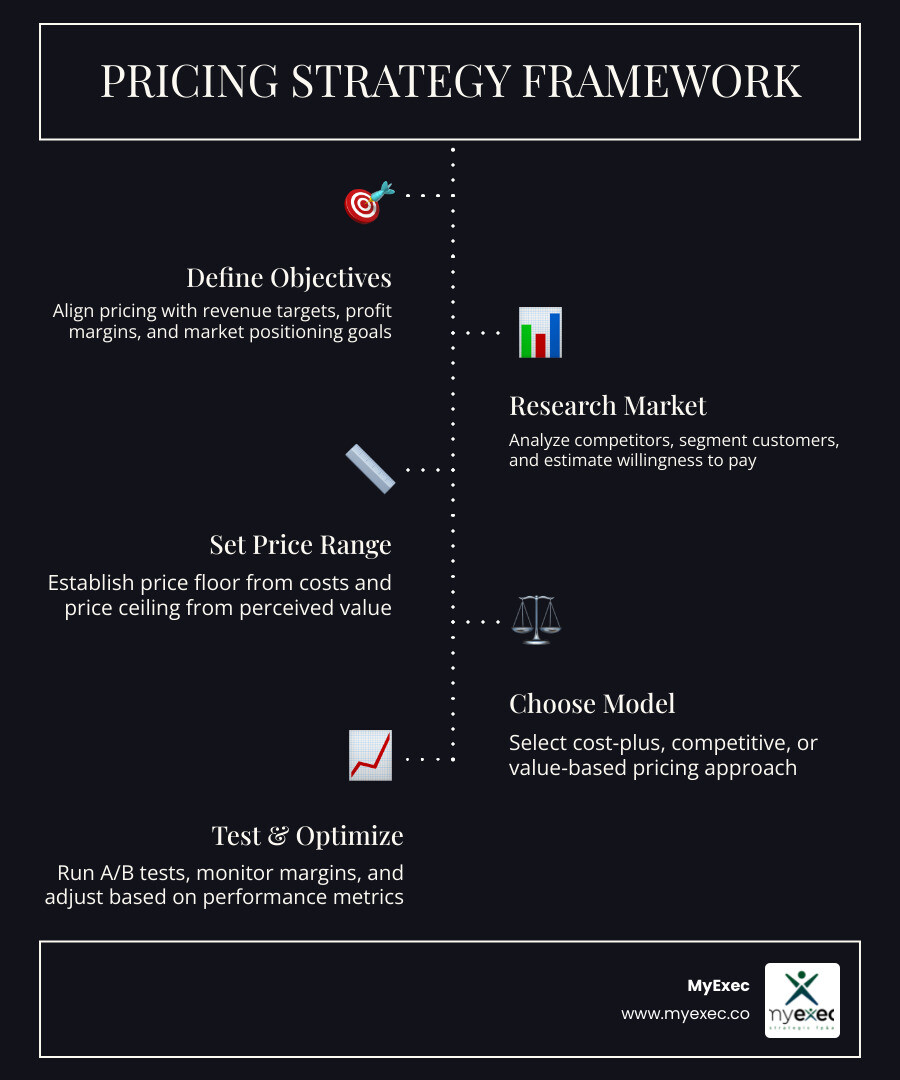
The Core Framework of Pricing Strategy Services
Setting the right price is not a single mathematical formula. It is a continuous business process. When we work with companies to design their pricing, we start by looking at the foundation. A structured pricing framework helps companies achieve 15% to 25% higher margins than those relying on instinct or competitor benchmarking.

To build a reliable pricing model, you must bring together several distinct inputs. You need deep market research, competitive analysis, customer segmentation, and a clear understanding of your customer's willingness to pay. Without these components, any change to your pricing is just a guess. You can read more about how these pieces fit together in this Pricing Strategy Decision Framework.
Aligning Price with Business Objectives
Your pricing must directly support your broader business goals. If your primary objective is rapid market share acquisition, your pricing structure will look very different than if you are focused on maximizing immediate profit margins.
We often see companies set revenue targets without checking if their pricing model can actually support those numbers. Your sales volume, customer acquisition costs, and target margins all must work together. If you position your brand as a premium provider but price your services like a discount utility, you confuse the market and erode your positioning.
Finding the Acceptable Price Range
Every product or service has an acceptable price range. The bottom of this range is your price floor, which is determined by your total cost structure. If you charge less than this floor, you lose money on every transaction.
The top of the range is your price ceiling. This is the maximum amount a customer is willing to pay based on their perceived value of your solution.
Understanding where your current pricing sits between this floor and ceiling requires an analysis of price elasticity. This helps you predict how customer demand will change when you adjust your rates.
Comparing the Five Main Pricing Strategies
Choosing a strategy requires understanding the trade-offs of each approach. Here are the five most common models used across industries.

Cost-Plus and Competitive Models
Cost-plus pricing is the traditional fallback. You calculate your direct and indirect costs, then add a set markup percentage to secure a profit margin. While this provides a safe profit floor, it completely ignores what the customer actually values.
Competitive pricing, or market-based pricing, is another common path. Companies look at their closest competitors and match or slightly undercut their rates. This is a dangerous trap. Firms relying solely on market-based pricing experienced 18% lower profit margins than those incorporating value-based elements. Following the crowd often leads directly to price wars and severe margin erosion.
Value-Based Pricing Strategy Services
Value-based pricing is the gold standard for differentiated offerings. This approach focuses entirely on the customer. You determine how much money your service saves them, how much risk it mitigates, or how much additional revenue it helps them generate.
Our experience shows that B2B service firms using value-based models grew revenue 2.3 times faster than peers using cost-plus models over a five-year period. It requires more research up front, but it allows you to capture a fair share of the economic value you create. For new companies looking to establish this foundation, this guide on Pricing Strategy for New Businesses offers practical steps.
Launch Strategies: Skimming versus Penetration
When introducing a new product or service, you generally choose between two paths:
- Price Skimming: You start with a high price to capture early adopters who are less price-sensitive. As the market matures and competition increases, you gradually lower the price to reach broader segments.
- Penetration Pricing: You enter the market with a low price to quickly acquire market share and build a customer base. Once you are established, you gradually transition to standard market rates.
Both models have distinct risk profiles. Skimming can attract early competitors who see your high margins. Penetration pricing can anchor customer expectations too low, making it difficult to raise prices later without causing high churn.
Optimizing Revenue with Dynamic Pricing and Tiered Packaging
Once you select your primary strategy, you can use packaging and dynamic adjustments to maximize your yield.
These tools are central to long-term profit optimization.
Dynamic Pricing in Revenue Management
Dynamic pricing involves adjusting your rates in real-time based on demand fluctuations, seasonality, or customer behavior. While common in travel and hospitality, more industries are adopting this approach to manage capacity and optimize yield. It is highly effective when you have fixed capacity and varying demand, allowing you to capture high margins during peak times and maintain volume during slow periods.
Structuring Tiered and Bundled Models
How you package your services is often just as important as the price itself. Using a three-tier pricing structure is an incredibly effective way to use price anchoring and the decoy effect.
By presenting three options, most buyers will naturally gravitate toward the middle tier. This simple packaging shift increases average deal size by 12% to 18% compared to single-option proposals. Bundled pricing also simplifies the buying decision, reduces sales friction, and improves overall customer retention. To see how these packaging models perform in software and subscription environments, read more about SaaS Pricing Strategy: Models That Actually Work.
Adapting Pricing Strategy Services for Professional and IT Services
Service-based businesses face unique challenges. Unlike physical products, services have intangible value, fluctuating delivery costs, and the constant threat of scope creep.
At MyExec, we help professional and IT service providers analyze their service delivery economics to find margin improvement opportunities. You can learn more about our approach on our Services page.
Service-Led Pricing Models
Professional services typically rely on a few core models:
- Hourly Billing: Simple to track but aligns your incentives poorly. The more efficient you become, the less you get paid.
- Fixed-Fee Packages: Gives clients budget predictability, but leaves you open to margin loss if scope is not tightly managed.
- Subscription or Retainer Models: Provides predictable monthly recurring revenue and stabilizes cash flow.
- Outcome-Based Pricing: You tie your fees directly to verified business results, such as a percentage of cost savings.
Many service firms use the 3x rule as a starting point. This means charging three times the direct payroll cost of the person delivering the work to cover overhead and secure a healthy profit margin.
Transitioning to Value-Based Pricing Strategy Services
Moving away from hourly billing requires a deliberate transition. You cannot simply double your rates overnight. You must first establish clear scope boundaries and define the exact value metrics your clients care about.
This transition requires careful change management and clear client communication. You must shift the conversation from your inputs to their outcomes.
Testing, Validating, and Measuring Pricing Performance
You should never roll out a new pricing model based on theory alone. You need to test your assumptions in the real market.
We help our clients build the financial infrastructure to track these experiments. You can find our complete framework in our Strategic Finance Guide.
Testing and Validation Methods
Before a full rollout, you can use several methods to validate your pricing:
- Price Sensitivity Interviews: Talk to existing and prospective clients about their budgets and alternative options.
- A/B Testing: Present different price points to similar cohorts of new traffic to measure conversion rates.
- Shadow Billing Pilots: Run new pricing models in parallel with your current billing for a small group of test clients to see how the numbers compare.
- Conjoint Analysis: Use structured surveys to understand how customers trade off different features against price points.
Key Performance Metrics and Signals
To know if your pricing is working, you must track more than just top-line revenue. You need to monitor your proposal win rate, average deal size, gross margin, add-on attach rate, and average discount depth. If your win rate is close to 100%, your prices are likely too low. If your average discount depth is high, your sales team is likely relying on discounts to close deals rather than communicating your value.
Common Mistakes and Future Trends
The most common mistake growing businesses make is underpricing out of a fear of losing deals. This is often compounded by the grandfathering trap, where you keep early clients on low rates forever, creating a massive revenue gap over time.
Looking ahead, we are seeing a shift toward AI-driven pricing engines that can analyze market data in real-time. There is also a strong push toward pricing transparency and performance-based models where fees are directly tied to delivered outcomes.
Frequently Asked Questions about Pricing Strategy Services
How often should a business review and adjust its pricing strategy?
We recommend reviewing your pricing strategy quarterly. You do not need to change your prices every quarter, but you must monitor your margins, competitor movements, and inflation. Regular, small adjustments are much easier for the market to absorb than a massive price hike every few years.
What is the most common mistake companies make when transitioning to value-based pricing?
The most common mistake is failing to conduct proper customer research. Without a deep understanding of how your clients define value, your new pricing is just guesswork. Companies also struggle with poor value communication and failing to set strict scope boundaries, which leads directly to margin-eroding scope creep.
How does pricing strategy affect business valuation?
Your pricing strategy has a massive impact on your business valuation. Investors look for predictable revenue, strong gross margins, and pricing power. A company that can raise prices without losing customers is far more valuable than one that must compete solely on price. You can learn more about how we assess these factors on our business-valuations page.
Conclusion
Pricing is one of the most powerful levers you have to grow your business and improve your bottom line. Yet, many mid-market companies continue to treat it as an afterthought.
At MyExec, we provide the fractional CFO services and scalable finance support that growing businesses need to make these decisions with confidence. We help you move past gut-feel pricing and build a structured, data-driven strategy that protects your margins and supports your long-term goals.
If you want to understand where your pricing stands and how to improve your financial performance, take our Strategic Finance Assessment or explore our full range of Services to see how we can help.