

Ultimate Checklist for Finding Growth Stage CFO
What a Growth Stage CFO Actually Does (And Why It Matters)

A growth stage CFO is not the same as a traditional CFO who closes the books and files compliance reports. At the growth stage, the finance function needs to drive decisions, not just record them.
Here's a quick breakdown of what this role covers:
- Strategic capital allocation: deciding where to invest for maximum return, not just tracking spend
- Fundraising and investor readiness: building models, managing data rooms, and preparing for due diligence
- FP&A and forecasting: rolling forecasts anchored in operational drivers, not last year's numbers
- Financial systems and reporting: moving beyond spreadsheets to scalable infrastructure
- Cash and runway management: keeping the business solvent while it scales aggressively
Most companies in the $5M to $50M revenue range hit a wall where the founder's instincts and a bookkeeper can no longer carry the financial function. Decisions get bigger. Investors ask harder questions. Cash gets more complicated. But a full-time CFO at $250K to $350K or more in compensation is often not the right answer yet.
That's the gap a growth stage CFO fills.
One CFO described the early months at a Series A company as "building the plane while flying it." That captures it well. The finance function is being constructed in real time, while the business is already moving fast.
Four out of five growth-stage companies have books that need meaningful cleanup before they can support serious investor scrutiny or strategic planning. That's not a failure, it's just the reality of early-stage growth. The right CFO knows how to fix it without slowing the business down.
At MyExec, our team brings deep experience in corporate and strategic finance. We have worked across companies from a few million in revenue to roughly $2B, including nonprofits, private equity owned companies, closely held businesses, and publicly traded companies. This background shapes how we approach every engagement, from early-stage cleanup to exit readiness.
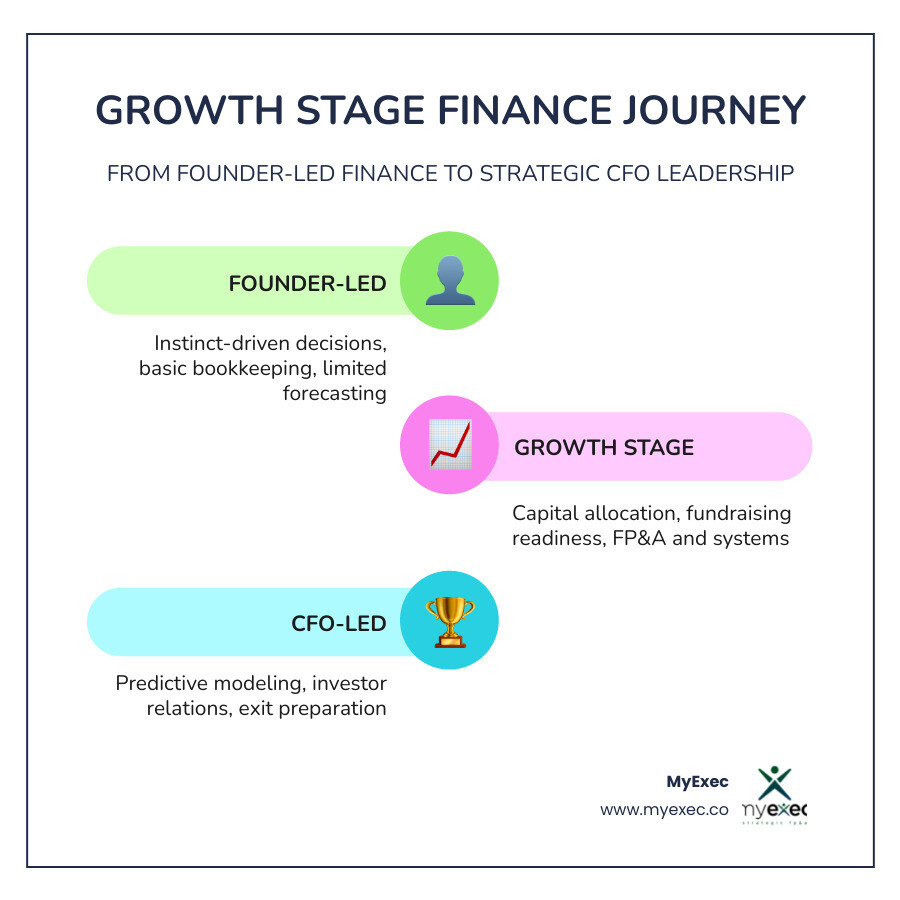
Traditional CFO vs. Growth Stage CFO: Why the Distinction Matters
To build a high-growth business, you have to understand that not all finance leaders are built the same way. A traditional CFO is often a historian. They look backward, ensuring the books are balanced, taxes are filed, and the company complies with every regulation. While those tasks are incredibly important, they do not help you decide where to deploy your next dollar of capital to maximize growth.
A growth stage CFO is a strategist and a forward-looking capital allocator. Instead of focusing solely on cost control, they focus on return on investment. They analyze customer acquisition channels, evaluate product line margins, and build predictive models that help you navigate rapid scaling.
When you are growing fast, you cannot afford a finance leader who only tells you what happened last month. You need someone who can tell you what will happen six months from now if you hire ten more sales representatives or expand into a new geographic market. This distinction is the difference between playing defense and playing offense with your capital. For a deeper look into why this hire is so critical, check out Why Your Next CFO Hire Is the Key to Scaling Fast.
To make the differences clear, we can look at how these two profiles approach the business:
| Feature | Traditional CFO | Growth Stage CFO |
|---|---|---|
| Primary Focus | Historical reporting and risk mitigation | Forward-looking strategy and capital allocation |
| Data Approach | Backward-looking financial statements | Predictive modeling and operational metrics |
| Core Mandate | Compliance and cost control | Scaling operations and fundraising readiness |
When to Hire a Growth CFO: Key Triggers and Stages
Knowing when to bring in strategic financial leadership is one of the most important decisions a founder will make. If you hire too early, you spend valuable capital on strategy when you really just need clean bookkeeping. If you hire too late, you face messy books, missed tax deadlines, and a lack of clear financial data that can stall your fundraising rounds.
If your business is experiencing any of the following triggers, it is time to consider a strategic partner:
- You are preparing for a new institutional funding round (Series A, B, or C).
- Your business model has grown complex, with multiple revenue streams or international transactions.
- You are struggling to understand which customer segments or products are actually profitable.
- Your cash runway is becoming difficult to forecast as your monthly spend increases.
If you are unsure where your finance function currently stands, taking a Strategic Finance Assessment can help you identify the gaps in your current setup.
The Series A to Series B Transition for a Growth Stage CFO
During the Series A phase, the primary goal of the finance function is to get the house in order. Many Series A companies have messy accounting systems and almost no forward-looking reporting. The CFO at this stage acts as a builder, cleaning up the ledger and establishing basic financial controls.
As you transition to Series B, the focus shifts from basic reporting to enabling growth. The CFO must build out a mature FP&A function, implement better software systems, and turn financial data into a tool for commercial decision-making. They help the executive team understand the financial impact of operational choices. For a detailed breakdown of how this role changes across these stages, see the CFO Roadmap Series: Part 2.
Scaling Beyond Series C with a Growth Stage CFO
By the time a company reaches Series C and beyond, the financial complexity multiplies. You are no longer just managing a single business entity. You are often dealing with multi-entity consolidation, international currency fluctuations, and complex debt facilities.
At this stage, the growth stage CFO acts as a scalability leader. They optimize the capital stack by balancing equity with venture debt, and they ensure that every subsidiary and business unit is aligned under a single, clear financial architecture.

Essential Systems, Metrics, and Processes for Scaling
To scale a business from $5M to $50M, you cannot rely on basic accounting software and disconnected spreadsheets. You need a financial infrastructure that acts as a single source of truth. This means migrating to a mid-market ERP, automating your accounts payable and receivable, and connecting your financial data directly to your operational tools.
With the right systems in place, your finance team can move away from manual data entry and focus on data-driven storytelling. They can present the numbers in a way that helps department heads make better choices. Implementing a Financial Reporting Dashboard is a great way to give your leadership team real-time visibility into these metrics.
Core Business Performance Metrics to Track
A growth-stage finance leader does not just track revenue and expenses. They monitor metrics that measure the health and efficiency of your business model.
Some of the most important metrics include:
- The Rule of 40: Your year-over-year revenue growth rate plus your EBITDA margin should equal or exceed 40 percent. This is a key indicator of balanced, healthy scaling.
- Unit Economics: Understanding your customer lifetime value (LTV) relative to your customer acquisition cost (CAC), along with your CAC payback period.
- Contribution Margin by Segment: Analyzing the profitability of individual products, customer cohorts, or geographic regions after accounting for variable costs.
Tracking these Business Performance Metrics allows you to treat your business like a portfolio, allocating capital to the segments that deliver the highest returns.
Operational Risks and Cash Flow Management
Rapid growth eats cash. It is entirely possible to be highly profitable on paper while running out of money in the bank due to working capital constraints. A strategic CFO manages these operational risks by building detailed cash runway models and optimizing your treasury.
They set up processes to accelerate collections, manage vendor payment terms, and ensure you maintain enough covenant headroom if you have venture debt. To evaluate how well your current team is managing these challenges, consider these Operational Risks 5 Questions To Ask Your Finance Team.
Fundraising, M&A Readiness, and Strategic Planning
Whether you are raising a venture capital round, securing a debt facility, or preparing for an acquisition, your finance leader is the quarterback of the transaction. They do not just pull reports for the data room. They craft the financial narrative that explains your business model to investors and buyers.
One of the most important tools in this process is a sell-side Quality of Earnings (QoE) report. While audits are useful for compliance, a QoE report analyzes the sustainability and accuracy of your earnings. It gives buyers confidence in your numbers and can significantly increase deal certainty.

Financial Modeling for Strategic Decisions
A great financial model is not just a spreadsheet filled with formulas. It is a mathematical representation of how your business actually operates. A strategic CFO builds three-statement financial models that link your P&L, balance sheet, and cash flow statement directly to operational inputs like sales hiring velocity and marketing conversion rates.
This allows you to run scenario analyses to see how different strategic decisions will affect your cash runway and profitability. To understand how these models drive business strategy, read about The Role Of A Financial Modeling Consultant In Business Strategy.
Preparing for Capital Raises and Exits
When you enter due diligence, any discrepancy in your financial data can destroy investor trust and kill the deal. Common issues like inaccurate cap tables, unrecorded liabilities, or inconsistent revenue recognition can delay transactions for months.
Your CFO ensures that your data room is organized, your cap table is clean, and your financial reporting is pristine. They also prepare the executive team for board meetings and investor presentations. You can learn more about this level of preparation in our guides on M&A Financial Readiness and crafting a Board Paper Executive Summary.
Evaluating the Right Fit: Fractional vs. Full-Time CFO
For companies in the $5M to $50M revenue range, hiring a full-time CFO is often not the most efficient use of resources. A full-time executive is expensive, and you may not have enough strategic work to keep them fully utilized every week.
A fractional CFO model allows you to access senior financial leadership at a fraction of the cost of a full-time hire. At MyExec, we take this a step further. Instead of offering a single-person retainer, we provide a full-stack finance approach. You get the strategic guidance of a senior CFO, supported by the analytical horsepower of our FP&A team. This ensures you are not paying CFO rates for analyst-level work like updating spreadsheets or building basic dashboards. You can explore how this model works by reading about Fractional CFO Consulting.
Risks of Hiring Too Early, Too Late, or the Wrong Profile
Hiring the wrong financial leader can be a costly mistake. While CPA or CFA credentials can be useful, they do not automatically make someone a strong CFO for a scaling business. If you focus too much on credentials, you might hire someone who lacks the strategic finance experience needed to drive growth.
Instead, prioritize hands-on experience in forecasting, KPI design, capital planning, and transaction support. You need a leader with operating experience at your relevant scale who knows how to turn financial data into clear business decisions. Hiring a pure accountant who lacks this strategic background can lead to a focus on cost-cutting rather than growth opportunities, creating operational drag.
Conversely, hiring a highly strategic CFO too early when your books are still in disarray means you are paying a premium for basic cleanup work. The key is to match the financial leader's skills with your current stage of growth. Our Strategic Finance Guide offers practical advice on how to avoid these common hiring mistakes.
Frequently Asked Questions About Growth CFOs
How do AI tools and automation change the growth CFO role?
AI and automation are transforming how modern finance functions operate. Today, a growth stage CFO uses AI-powered meeting recorders to capture notes, automated software to handle accounts payable, and tools that integrate financial databases with operational platforms.
However, AI cannot replace human context. While an AI tool can quickly analyze a spreadsheet and point out that marketing spend increased last month, it does not know that you deliberately increased that spend to support a new product launch. The value of a modern CFO lies in their ability to combine automated data with real-world business strategy to make smart decisions.
What is the typical cost of a fractional CFO compared to a full-time hire?
A full-time CFO for a scaling business is a major investment, often requiring a high base salary, bonuses, and a meaningful equity package. When you add the cost of benefits and recruitment fees, the total investment is substantial.
Fractional CFO services are structured around your specific needs, typically costing a fraction of a full-time salary. Because you only pay for the strategic time you actually need, you can redirect the saved capital into product development, sales, or marketing to accelerate your growth.
How does a growth CFO balance short-term operations with long-term strategy?
They do this by anchoring your financial plans in operational drivers. Instead of building a budget based on high-level revenue targets, they work with your department heads to build a participatory budget based on actual business activities, such as sales conversion rates or customer support capacity.
They also use long-range planning models that look three to five years into the future. This allows the leadership team to see how short-term operational decisions will affect the long-term value of the business and investor expectations.
Moving Forward with Strategic Finance
Scaling a business from $5M to $50M in revenue requires a fundamental shift in how you manage your finances. You must move away from basic, backward-looking accounting and embrace strategic, forward-looking financial leadership.
At MyExec, we provide the full-stack finance support you need to navigate this journey. We do not just sit in a silo and look at spreadsheets. We partner with you to clean up your books, build driver-based financial models, and help you make data-driven decisions that increase the value of your business.
Our ultimate goal is to help you grow to the point where a fractional model is no longer enough and a full-time CFO makes sense. When that day comes, we will help you define the role, find the right person, and transition the finance function cleanly. To learn more about how we can help you scale, read about how to Increase Business Value With Smarter Financial Reporting.