

The Ultimate Guide to Board Paper Executive Summary
Why Most Board Packs Fail Before the Meeting Starts

A board paper executive summary is the single most important page in any board report. It's what directors read first, and for 67% of board members, it's often all they read for routine matters.
Here's what a strong board paper executive summary includes:
| Component | What It Does |
|---|---|
| Context | Explains why the report exists and how it connects to bigger goals |
| Key Questions | Identifies 3-5 specific issues the report addresses |
| Conclusions | Gives direct answers to each question upfront |
| Recommendation | States clearly what action you're asking the board to take |
| Financial Impact | Summarizes costs, ROI, and risk in plain numbers |
The average board pack for a large enterprise hit 294 pages in 2024. Directors are already stretched. Many balance board duties with full-time roles, and preparing for a single meeting can take two full days. If your executive summary doesn't give them the full picture fast, the important things get missed.
This isn't just a large-company problem. Growing businesses between $5M and $50M in revenue face it too, often without the internal finance support to produce clean, board-ready materials. The result is decisions made without the right context, or meetings that stall because the board doesn't have a clear ask in front of them.
At MyExec, we've worked directly with executive leadership on the financial strategy and reporting behind major decisions, including board-level presentations at a private equity-owned company with $2 billion in revenue. That experience shapes how we approach the board paper executive summary as a tool for driving real decisions, not just documenting activity.
What is a Board Paper Executive Summary and Why It Matters
In board governance, the board paper executive summary acts as a bridge between deep operational analysis and decisive board action. It is not just an introduction or a brief description of the report. It is a standalone document that contains the core arguments, key findings, and explicit requests that directors must consider.
When corporate boards meet, their primary role is strategic oversight and risk management. However, the volume of information they receive can easily lead to cognitive overload. This issue has grown as board packs expand. When directors are forced to wade through hundreds of pages of raw data, meetings often devolve into operational discussions rather than high-level strategic debates.
The FROM GOVERNANCE STEWARDS TO BUSINESS SHAPERS survey highlights that boards are spending more time on governance than ever before. Yet, many directors report declining confidence in their ability to oversee critical, fast-moving risks like artificial intelligence and shifting geopolitical dynamics. This gap between the time spent and actual decision confidence shows that simply giving boards more information does not lead to better governance. Directors need synthesized, high-value insights.
For growing businesses with $5M to $50M in revenue, this challenge is particularly acute. At this stage, companies outgrow founder-led, informal decision-making. To scale successfully, owners must Increase Business Value with Smarter Financial Reporting. A structured board summary ensures that external directors, advisors, and investors can quickly understand the health of the business and provide the strategic guidance the company needs to reach its goals.
How to Structure a Board Paper Executive Summary Using the CQC Framework
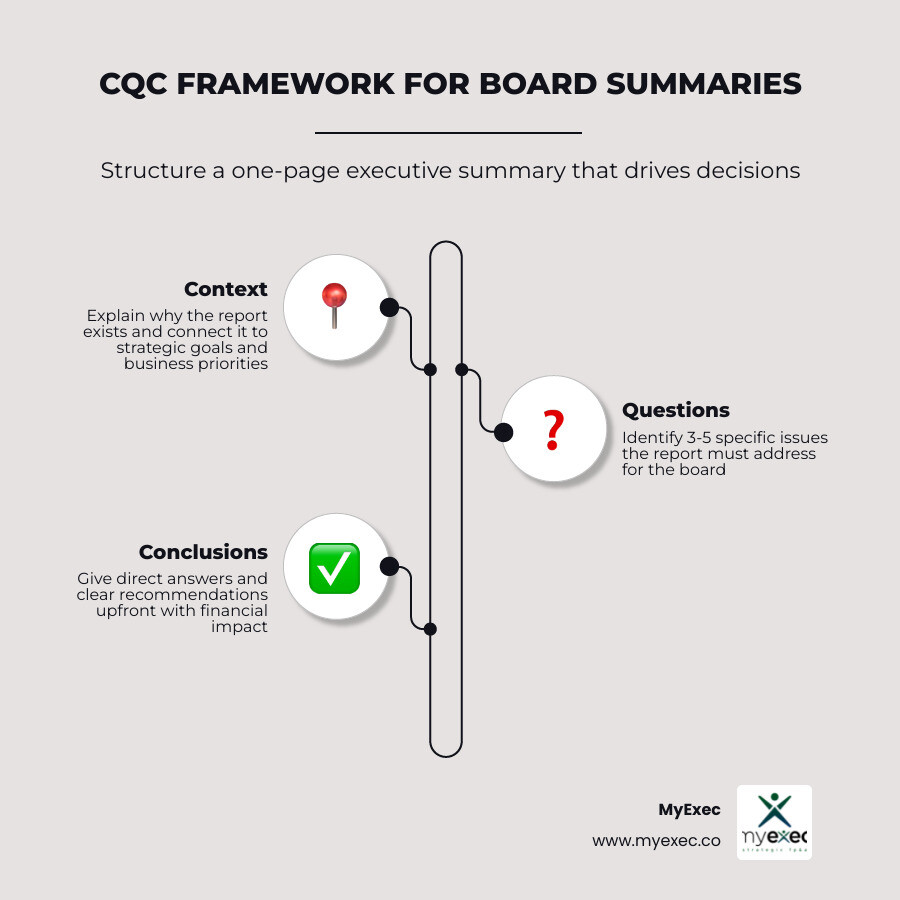
An effective way to structure your summary is the CQC framework, which stands for Context, Question, and Conclusion. This formula helps you organize complex information on a single page, ensuring that the board can digest the material in under five minutes.
The framework divides the summary into clear, logical sections:
- Context: Set the scene by explaining the background and the trigger for the report.
- Questions: Identify the core questions that the board needs to address.
- Conclusions: Provide direct, evidence-backed answers to those questions.
- Input Sought: Specify exactly what you need from the board, whether it is an approval, advice, or simply noting the information.
Using this structure prevents a common boardroom frustration: directors feeling like they are joining the middle of a conversation without knowing why a proposal is on the table.

The table below outlines how these components work together to guide a reader from the initial background to a final decision.
| Section | Focus | Key Question It Answers |
|---|---|---|
| Context | The trigger and strategic alignment | Why are we discussing this topic right now? |
| Questions | The core issues (using MECE principles) | What specific problems or choices must we resolve? |
| Conclusions | The data-backed answers and recommendations | What is the best path forward and what are the financial impacts? |
When structuring these sections, it is helpful to apply the MECE principle, which stands for Mutually Exclusive and Collectively Exhaustive. This means the questions you present to the board should not overlap, yet together they must cover all aspects of the decision.
This level of structured thinking is especially important when presenting complex financial strategies. For instance, when a board reviews capital allocation or major investments, the summary must connect the strategic questions directly to a working financial model. To see how these pieces fit together, you can read about The Role of a Financial Modeling Consultant in Business Strategy.
The Directors Quarterly: Q2 2026 report by KPMG emphasizes that boards must focus on disciplined capital allocation, especially when balancing tangible and intangible investments. Using the CQC framework allows management to present these complex trade-offs clearly, helping the board assess the long-term value of strategic proposals.
Writing a Board Paper Executive Summary: Context, Questions, and Conclusions
When writing the Context section, avoid the temptation to write a long history of the company or the project. Focus only on the immediate trigger. For example, did a competitor launch a new product? Did quarterly revenue miss targets by a specific margin? Connect this trigger directly to your broader strategic goals, such as international expansion or market share targets.
For the Questions section, limit yourself to three to five core questions. These should be the questions that are genuinely on the minds of the board, not just the questions that were easiest for the project team to answer.
In the Conclusions section, give direct answers. Do not make the directors read the entire board paper to find your recommendation. If you are proposing an acquisition, state the purchase price, the expected return on investment, and the primary risks upfront. This approach respects the board's time and sets a professional tone for the meeting.
Best Practices for Formatting Your Board Paper Executive Summary
Keep your executive summary to a single page. If the underlying report is exceptionally long or complex, you may extend it to two pages, but it should never exceed 10% of the total document length. A word count of 250 to 400 words is the ideal range for a one-page summary.
To make the summary easy to scan, use a clear visual hierarchy:
- Use bold headers for each section of the CQC framework.
- Use bullet points to break up lists of risks, options, or financial impacts.
- Bold key financial metrics, such as acquisition costs, projected revenues, or headcount changes, so they stand out immediately.
- Leave plenty of white space on the page to prevent the document from looking dense and uninviting.
Key Differences Between Summaries, Abstracts, and Full Reports
It is common for writers to confuse an executive summary with an academic abstract or the introduction to a full report. However, they serve entirely different purposes in business writing.
An abstract is a neutral, descriptive summary of a document. It tells the reader what topics are covered but does not offer recommendations, take a position, or push for a decision. Abstracts are typically short, often under 300 words, and are common in scientific, academic, or technical research papers.
An executive summary is a persuasive, action-oriented document. It is designed to help busy leaders make decisions. It includes specific recommendations, outlines financial impacts, and details the risks of action versus inaction. Unlike an abstract, an executive summary is designed to stand alone. A director should be able to read the summary and fully understand the business case, the decision required, and the expected outcomes without ever opening the main report.
The full report, by contrast, contains the detailed analysis, historical data, methodology, and technical appendices. While the executive summary presents the key takeaways and recommendations, the full report is there to support those findings for directors who want to perform a deeper review.
When presenting operational risks or financial performance to the board, you must ensure that your summary highlights the most critical vulnerabilities. To prepare for these discussions, you can review these Operational Risks: 5 Questions to Ask Your Finance Team to help focus your summary on what matters most to board members.
Common Mistakes to Avoid in Board Summaries
Writing a weak executive summary can lead to unproductive board meetings, delayed decisions, and frustrated directors. Here are the most common mistakes to watch out for:
- Hiding the bad news: There is a natural tendency for management teams to want to present only positive results. However, hiding operational problems or missed financial targets is counterproductive. Boards are there to help solve problems, and they cannot do that if the executive summary glosses over the challenges.
- Using excessive jargon: Board members often have diverse backgrounds and may not be experts in your specific industry or technical field. Avoid acronyms, technical terms, and internal company jargon. Write in plain, direct language that any educated reader can understand.
- Vague recommendations: Avoid recommendations like "we suggest the board reviews our options." Instead, use the "tomorrow test." If the board approves your recommendation today, will they know exactly what they authorized when they walk into the office tomorrow? A good recommendation states the precise action, the budget required, the timeline, and the expected owner.
- Writing the summary first: It is incredibly difficult to write an accurate summary of a report that is not yet finished. Always write the full report first, verify all your data, and then write the executive summary last. This ensures that the numbers and conclusions in your summary perfectly match the details in the main document.
A high-profile example of the need for clear, direct reporting can be seen in the strategic reviews conducted by major conglomerates. For instance, as reported by The Financial Express , top executives had to present clear turnaround plans and capital allocation strategies for several high-investment, loss-making business units. When billions of dollars are on the line, board presentations must get straight to the point, outlining performance challenges, capital requirements, and execution steps without any fluff.

Tailoring Your Summary to Diverse Board Audiences
A typical board of directors is made up of individuals with varying expertise. You might have a marketing expert, a legal professional, a seasoned operations executive, and an investment banker sitting at the same table. Your board paper executive summary must speak to all of them.
To do this, present your financial metrics in a way that does not require a degree in accounting to understand. Instead of pasting large, complex spreadsheets into the summary, highlight the key drivers of value. Focus on clear trends, such as year-over-year revenue growth, changes in operating margins, cash flow forecasts, and return on investment timelines.
Many modern boards now use digital board portals like Diligent, Convene, or Board Intelligence to distribute and review meeting materials. These platforms allow directors to easily click through from the executive summary to specific sections of the full report if they want to see the underlying data.
To support this digital reading experience, you should organize your financial data into clear, visual formats. Utilizing a Financial Reporting Dashboard can help you track and present these key metrics in a way that is easy for directors of all backgrounds to interpret during their pre-meeting preparation.
Frequently Asked Questions about Board Summaries
How long should a board paper executive summary be?
An executive summary for a board report should ideally be one page. For very long or complex reports, it can extend to two pages, but it should never exceed 10% of the total document length. Most summaries should be readable in five minutes or less, keeping the word count between 250 to 400 words.
Should you write the executive summary before or after the full report?
You should always write the executive summary after the full report is finalized. This ensures that the summary accurately reflects the final data, conclusions, and recommendations of the main document, preventing discrepancies that could confuse board members.
Can an executive summary include financial tables or visuals?
Yes, simple financial tables or visual aids can be highly effective in an executive summary. However, they should be used sparingly. A small table comparing three strategic options or a simple chart showing a revenue trend is much easier to digest than a dense block of text, but avoid large spreadsheets that clutter the page.
Driving Better Decisions at the Board Level
Writing a strong board paper executive summary is not just about saving time for busy directors. It is about improving the quality of your board's decisions and ensuring that your strategic meetings are focused on the future of the business.
For growing companies with $5M to $50M in revenue, preparing these materials can be a challenge. At this scale, you need professional financial reporting, but you may not have the budget or the need for a full-time, in-house CFO.
At MyExec, we provide scalable, fractional CFO and FP&A services designed specifically for businesses at this stage. We deliver the senior finance leadership, strategic planning, and professional board-level reporting you need to scale your business, at a fraction of the cost of a full-time hire. If you are ready to improve your board reporting and drive smarter business decisions, learn how we can help you Increase Business Value with Smarter Financial Reporting.