In-Depth Guide to Profit and Loss Management
What Profit and Loss Management Actually Means (And Why It's Not Just a Report)

Profit and loss management is the ongoing process of monitoring, analyzing, and acting on your company's revenues and expenses to protect and grow profitability. It goes well beyond generating a monthly income statement.
Here's a quick breakdown of what it involves:
| Element | What It Means |
|---|---|
| Monitor | Track revenue and expenses on a regular cadence, not just at year-end |
| Analyze | Identify trends, variances, and margin changes before they become problems |
| Act | Make decisions on pricing, costs, and resource allocation based on real data |
| Own | Assign accountability for P&L lines across departments, not just finance |
Most businesses generate a P&L. Fewer actually manage it. The difference shows up in the margins.
Companies that review their P&L regularly are 2.5 times more likely to achieve sustainable growth. Businesses that don't actively manage it face a 30% higher risk of cash flow problems, even when revenue is growing. High revenue does not automatically mean high profitability, and the P&L is where that gap becomes visible.
The stakes get higher as your company grows. A founder can hold a lot in their head at $3 million in revenue. At $15 million, that stops working. The decisions get bigger, the cost structure gets more complex, and the margin for error shrinks. That's exactly the stage where a disciplined approach to profit and loss management stops being optional.
MyExec is a fractional CFO and FP&A practice built for companies in the $5 million to $50 million range. We help our clients execute profit and loss management at scale, from budgeting and forecasting to capital allocation and acquisition integration.
The Core Pillars of Profit and Loss Management
To make financial data work for you, it helps to look at the core pillars of how profitability is steered. True financial health is not about looking backward at tax time. It is about using your numbers to make active, forward-looking decisions.
Defining Profit and Loss Management
Many business owners treat the income statement as a historical scorecard. It arrives in their inbox twenty days after the month ends, they glance at the net profit line, and they file it away.
Active profit and loss management is the opposite of this passive approach. It is the process of controlling your company's revenue, cost of goods sold, and operating expenses to maximize profitability. Instead of simply tracking transactions, we use the P&L as a decision framework.
This means looking at the drivers behind the numbers. If your cost of goods sold spiked, was it because of supplier price increases, lower utilization, or shipping delays? If marketing costs went up, did they generate the expected return? By asking these questions, you turn a static document into a tool for financial stability.
Why Profit and Loss Management Matters for Growth
When a company scales from $5 million to $20 million, the operational complexity increases exponentially. Without structured oversight, cost creep can quickly eat away at your margins. You might see your sales team celebrating a ten percent year-over-year revenue increase, while raw material costs rose fifteen percent in the background. If you are not actively managing the P&L, you are operating in the dark.
Strong P&L management matters for several reasons:
- Margin Protection: It helps you spot cost increases early so you can renegotiate supplier contracts or adjust your pricing.
- Cost Visibility: It separates the fixed costs needed to keep the lights on from the variable costs that scale with your sales volume.
- Investor Confidence: Showing a clean history of active cost control and margin stability builds trust with banks and equity investors alike.
- Sustainable Scaling: It ensures you only invest in growth when your unit economics actually support it, preventing the common trap of scaling a business that loses money on every transaction.
Structuring the P&L Statement for Management Use
The standard P&L statement generated by your bookkeeping software is usually built for tax compliance, not business operations. It often contains dozens of tiny expense lines listed in alphabetical order, which makes it hard to see the big picture. To manage profitability, you need to restructure your P&L for management use.
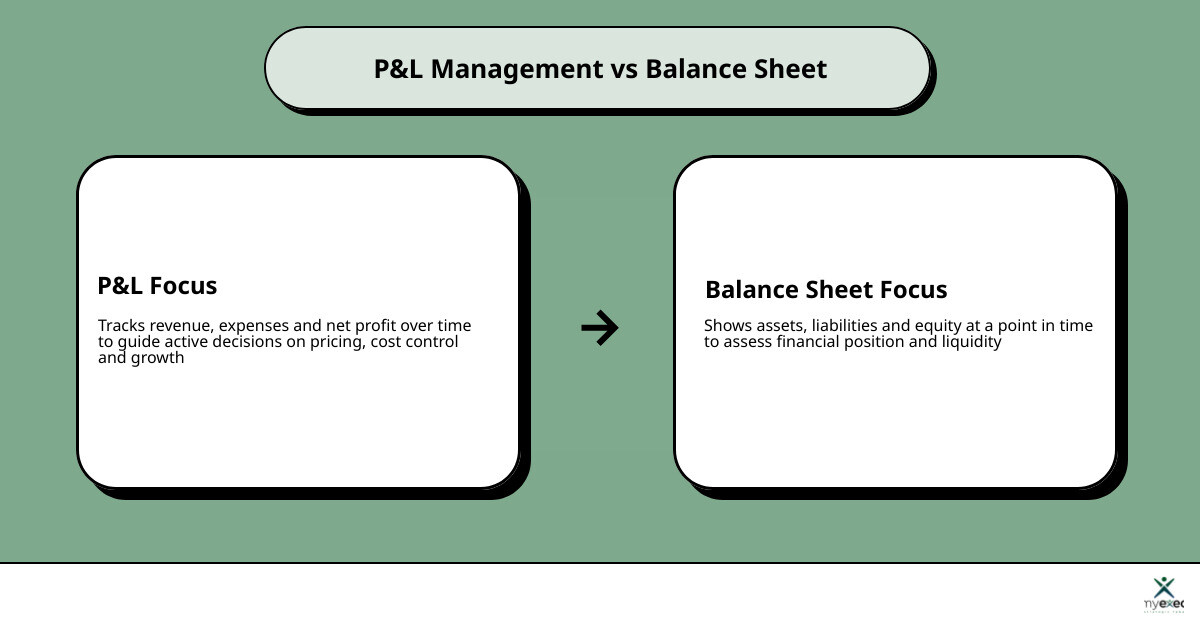
To understand how this fits into your broader financial picture, you can read our comparison of the P&L and Balance Sheet.
| Feature | Standard Accounting P&L | Management-Focused P&L |
|---|---|---|
| Layout | Alphabetical list of accounts | Grouped by major business drivers |
| Cost Separation | Fixed and variable costs mixed together | Separated to show contribution margin |
| Owner Costs | Hidden inside general payroll accounts | Isolated to show true operating margins |
| Comparisons | Often just current period versus budget | Prior year, budget, and rolling variance |
Key Components of a Management-Focused Report
A management-focused P&L groups expenses into a few high-level categories so you can quickly see where your money is going.
- Revenue: Your total sales, broken down by major product lines or service streams.
- Cost of Goods Sold (COGS): The direct costs required to deliver your product or service. This includes raw materials, direct labor, and shipping.
- Gross Profit and Contribution Margin: Gross profit is revenue minus COGS. Contribution margin goes a step further by subtracting all variable costs, showing you exactly how much money each sale contributes to covering your fixed overhead.
- Operating Expenses (OPEX): The fixed overhead costs needed to run the business. This includes rent, general salaries, marketing, and software.
- Owner Compensation: In growing businesses, owner salaries and benefits should be broken out separately. This allows you to evaluate the true profitability of the operations independently of how the owners choose to pay themselves.
Segmenting Your Financial Data
If your company has multiple product lines, regional offices, or business units, looking at a single consolidated P&L can hide serious problems. One highly profitable division might be masking a failing product line that is quietly draining cash.
By segmenting your P&L, you can calculate individual margins for each part of your business. This helps you spot margin compression early. If you run a services business, for example, segmenting by client or project type can reveal if rising contractor rates are eroding your profitability on specific accounts. This level of detail allows you to make targeted pricing adjustments rather than relying on broad, across-the-board cost cuts.
Common Mistakes in Managing Profitability
Even experienced leadership teams can fall into traps that distort their financial reality. Avoiding these mistakes is often the fastest way to stabilize your margins.

Confusing Profit with Cash Flow
This is one of the most common issues we see in growing businesses. A company can look highly profitable on paper while its bank account is completely empty.
This happens because of payment timing. Under accrual accounting, you recognize revenue when you deliver the service, not when the client pays the invoice. If you have long payment terms with your customers but must pay your suppliers and payroll immediately, your cash runway can shrink rapidly even as your revenue grows.
To manage this, you must connect your P&L analysis directly to your working capital and accounts receivable. A profitable month on the P&L is only a win if you actually collect the cash. For a deeper look at these common pitfalls and how to avoid them, see the P&L Management Guide: 8 Common Mistakes & How to Improve.
Treating the P&L as a Finance-Only Document
When the finance team is the only group that looks at the budget, P&L management fails. Finance does not spend the money, the department heads do.
If your marketing director, sales VP, and operations managers do not understand their budgets, they cannot be held accountable for cost overruns. We recommend assigning clear ownership of specific P&L lines to the leaders who actually control those activities. The head of marketing should own the customer acquisition cost line, while the operations manager owns direct labor utilization.
To make this work, you need to connect financial numbers to operational metrics that non-finance leaders understand. Instead of just telling the operations team that their costs are high, show them how those costs relate to labor hours per unit produced.
Building a Repeatable Operating Rhythm
The secret to better financial performance is not a complex spreadsheet. It is a consistent, repeatable operating rhythm.

Establishing the Monthly Review Cadence
An effective operating rhythm is built on a monthly loop: Own, Explain, Act.
- Step 1: The Month-End Close: Your accounting team closes the books on a set schedule each month.
- Step 2: Variance Analysis: Compare actual results against your budget and forecast. Focus on the biggest changes by setting variance thresholds, such as investigating any line item that is ten percent or $10,000 off track.
- Step 3: Driver-Led Explanations: Do not settle for simple explanations like "marketing spent more." Find the operational driver, such as "we increased spending on paid ads to support a new product launch."
- Step 4: Action Tracking: Every variance review should end with a list of decisions and clear next steps. If a cost is over budget, who is going to fix it, and by when?
This structured approach turns your monthly financial package into a tool for active performance storytelling.
Driver-Based Forecasting and Scenario Planning
Once your monthly review rhythm is stable, you can move from looking backward to planning forward. This is where driver-based forecasting and scenario planning become valuable.
Instead of just guessing next month's revenue, build your forecast around key business drivers. For example, your revenue forecast might be driven by headcount, average contract value, and customer churn rates.
With this model in place, you can run scenario planning to prepare for unexpected changes. What happens to your cash runway if a major client leaves? What if supplier costs rise by five percent? By modeling these base, upside, and downside scenarios, you can make proactive decisions about hiring, resource allocation, and pricing adjustments before you are forced to react in a crisis.
Frequently Asked Questions About Profitability
How does P&L management differ for SaaS businesses?
Software-as-a-Service (SaaS) and subscription businesses have unique financial models that require a different approach to P&L management.
Because revenue is recognized over the life of a subscription rather than upfront, traditional P&L metrics can be misleading. A fast-growing SaaS company might show a net loss on paper because it is investing heavily in customer acquisition costs (CAC) to build long-term recurring revenue.
When managing a SaaS P&L, you must track traditional financial lines alongside SaaS-specific operational metrics. This includes monitoring customer lifetime value (LTV), monthly recurring revenue (MRR), and customer churn. Your gross margin target will also be much higher, typically seventy to eighty percent, to cover the significant research, development, and customer support costs required to maintain the software.
How often should a growing business review its P&L statement?
At a minimum, a growing business should review its full P&L statement monthly. This monthly cadence is the sweet spot for spotting trends, analyzing budget variances, and adjusting your forecast.
However, key drivers should be monitored more frequently. High-volume businesses, such as retail, e-commerce, or manufacturing, often benefit from weekly tracking of direct labor costs, raw material prices, and daily sales volumes. This allows you to catch margin compression early in the month rather than waiting for the formal month-end close.
What is the fastest way to manage P&L without overwhelming stakeholders?
The fastest way to keep your leadership team engaged is to simplify the conversation. Do not hand a non-finance department head a fifty-row spreadsheet and expect them to find the key insights.
Instead, use visual dashboards that highlight the three or four key drivers they actually control. Establish clear variance thresholds so they only need to focus on significant budget deviations. By automating your data collection and reporting, you can deliver these insights in a clean, easy-to-read format that keeps everyone aligned on profitability without burying them in accounting detail.
Turning Financial Data into Business Value
Active profit and loss management is what separates high-performing companies from those that struggle to scale. It is the bridge between basic bookkeeping and strategic decision-making.
As your company grows past $5 million in revenue, managing this complexity requires more than just a standard accounting setup. It requires senior financial leadership to build the models, establish the operating rhythms, and guide your strategic planning.
At MyExec, we provide fractional CFO and FP&A services designed specifically for businesses in this transition phase. We deliver the strategic oversight and financial planning you need to protect your margins and grow sustainably, without the cost of a full-time executive hire.
If you are ready to build a clearer path to profitability, you can read our guide on how to increase your business value with smarter financial reporting.