

The Complete Guide to Fractional CFO Consulting
Why Fractional CFO Consulting Is the Smartest Finance Move for Growing U.S. Businesses

Fractional CFO consulting gives growing businesses access to senior financial leadership on a part-time basis, without the cost of a full-time hire. Here's what you need to know at a glance:
- What it is: A fractional CFO is an experienced financial executive who works with your company part-time or on retainer, providing the same strategic guidance as a full-time CFO.
- Who it's for: Businesses typically in the $5M to $50M revenue range that have outgrown founder-led finance but aren't ready to justify a full-time executive salary.
- What they do: Cash flow forecasting, financial modeling, KPI dashboards, fundraising support, M&A prep, and board reporting.
- Why it works: You get forward-looking financial strategy, not just historical reports, at a fraction of the cost of a full-time hire.
- When to consider it: When cash flow is unpredictable, you're preparing to raise capital, margins are shrinking, or you're making decisions without clear financial visibility.
Many founders reach a point where the business has grown, but the finance function hasn't kept up. The bookkeeper records what happened. The accountant files the taxes. But nobody is telling you where cash will be in 90 days, which products are actually profitable, or what your business is worth to a buyer. That's the gap fractional CFO consulting fills.
It's not about adding overhead. It's about getting the financial intelligence your business needs to make better decisions, faster, without waiting until you can afford a $300,000 full-time executive.
At MyExec, our team brings deep experience from leading finance departments at private equity-owned companies with up to $2 billion in revenue, managing budgeting, forecasting, capital planning, and acquisitions. That background is the foundation of the fractional CFO consulting work we do for founders and CEOs running businesses between $5M and $50M.
What is Fractional CFO Consulting?
Fractional CFO consulting is the practice of hiring an experienced Chief Financial Officer on a part-time, contract, or retainer basis. Instead of paying for a full-time executive salary, benefits, and equity, you secure senior financial leadership for a set number of hours or days each month.
For many businesses, the word "finance" brings to mind tax preparation and basic bookkeeping. While those functions are necessary, they look backward. A bookkeeper tells you what you spent last month. An accountant tells you how much tax you owe for last year.
A fractional CFO looks forward. They take your historical data and turn it into a strategic roadmap. They build models that project your cash flow, analyze your margins, and help you decide when to hire, when to expand, and how to price your products. If you want to understand the foundational shift from backward-looking accounting to forward-looking strategy, read our Strategic Finance Guide.
Fractional CFO vs. Full-Time and Interim CFOs
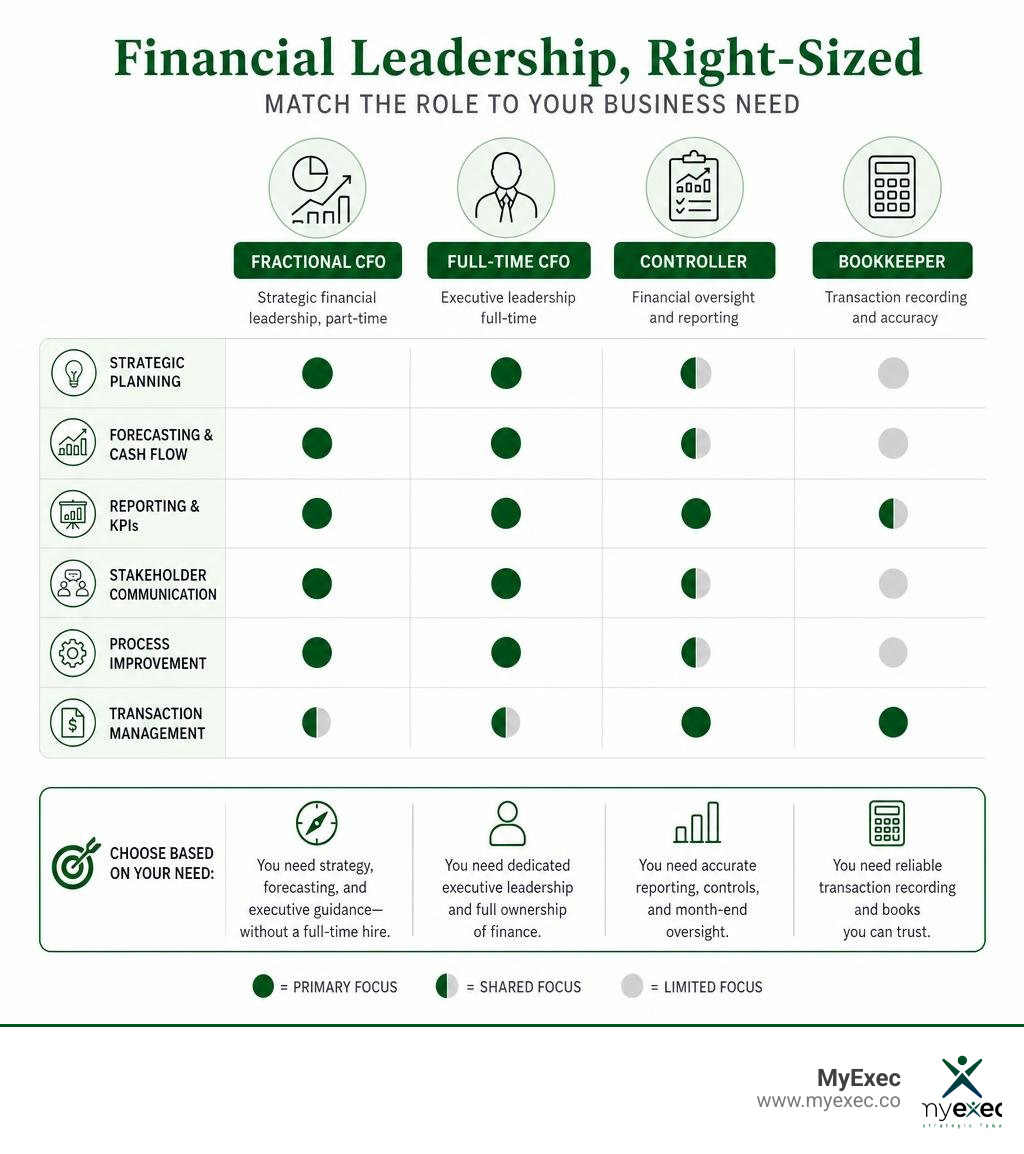
To understand if fractional support is right for you, it helps to compare it to other financial roles.
An interim CFO is a full-time professional hired for a short, defined period. You typically bring in an interim CFO during a crisis, a sudden vacancy, or a major transition like an acquisition. They work forty hours or more a week for a few months until you find a permanent replacement.
A full-time CFO is a permanent member of your executive team. They own the entire financial strategy, manage investor relations, and lead your internal finance department. This role is highly valuable, but it is expensive. For businesses with under $15 million in revenue, a full-time CFO is often an unnecessary expense.
A fractional CFO gives you the strategic benefit of a full-time CFO but on a part-time schedule. This model allows you to scale your support as your business grows.
To help visualize where each role fits, we have outlined the core differences in the table below.
| Role | Focus | Time Horizon | Typical Cost |
|---|---|---|---|
| Bookkeeper | Data entry & transaction recording | Historical | $24K - $60K / year |
| Controller | Accounting operations & compliance | Historical & Present | $80K - $140K / year |
| Fractional CFO | Strategic planning & financial modeling | Forward-looking | $36K - $120K / year |
| Full-Time CFO | Enterprise leadership & capital strategy | Forward-looking | $200K - $400K+ / year |
The Strategic Value of Fractional CFO Consulting for SMBs
Small and mid-sized businesses operate in competitive environments where capital is limited. You cannot afford to make decisions based on gut feelings or incomplete data.
A fractional CFO brings financial visibility to your leadership team. They build customized dashboards that track your true cost of customer acquisition, your customer lifetime value, and your operating margins. With these metrics in place, you can make data-driven decisions about pricing, product development, and hiring.
When you clean up your reporting and base your strategy on accurate forecasts, you build real equity value. To learn how to turn your financial data into an asset, see our guide to Increase Business Value with Smarter Financial Reporting.
When to Hire a Fractional CFO vs. Building an In-House Team
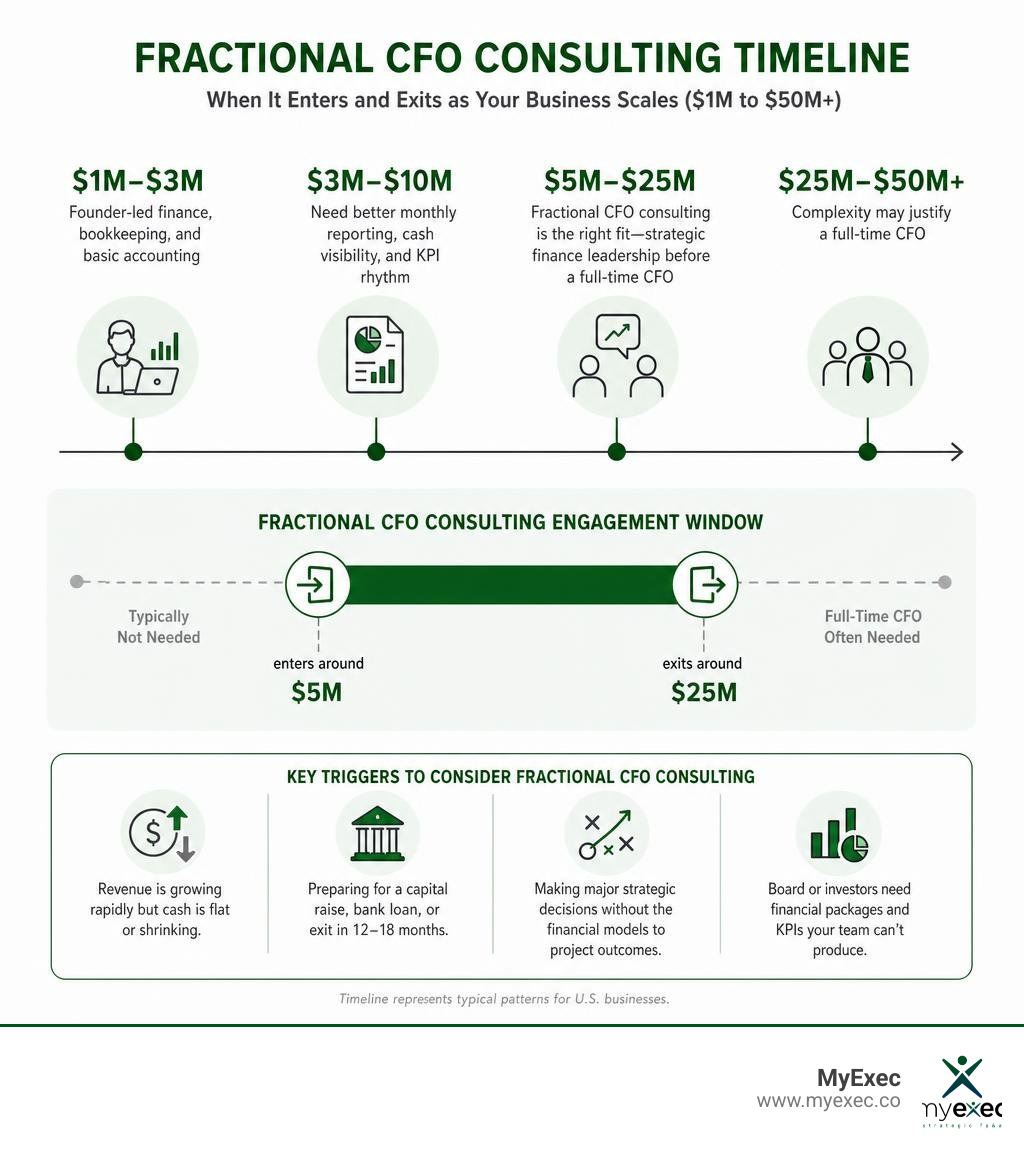
Deciding when to hire external help versus building an in-house team is a common challenge for businesses in the $5M to $50M revenue range.
In the early stages of a business, the founder handles the finances. As the company grows, you hire a bookkeeper to handle invoices and payroll. Eventually, you might hire an internal accountant or controller to manage day-to-day compliance.
But building a full, in-house strategic finance team is incredibly expensive. Hiring a full-time CFO, an FP&A manager, and a financial analyst can easily cost over $500,000 annually. For most growing businesses, that capital is better spent on product development, sales, or marketing.
A fractional CFO gives you the strategic layer of a complete finance department without the overhead. If you're unsure where your current financial setup stands, you can take our Strategic Finance Assessment to evaluate your needs.
Key Indicators Your Business Has Outgrown Founder-Led Finance
Many founders wait too long to seek professional financial help. They assume that as long as there's cash in the bank, the business is healthy. This assumption can lead to major operational risks.
You've likely outgrown founder-led finance if you notice any of these warning signs:
- Margin compression: Your revenue is growing, but your profits are flat or declining.
- Unpredictable cash flow: You have plenty of sales, but you struggle to make payroll or pay vendors on time.
- Slow month-end close: It takes your team three or four weeks after the month ends to produce financial statements.
- Decision paralysis: You want to expand, buy equipment, or hire staff, but you don't know if the business can afford it.
When you work with a fractional CFO, one of the first improvements is the speed and accuracy of your financial close. In fact, companies using fractional CFO services often see significantly faster month-end close times and improved financial reporting accuracy.
If you're concerned about your current setup, review these Operational Risks: 5 Questions to Ask Your Finance Team to identify potential blind spots.
Core Services: How Fractional CFOs Drive Growth and Enterprise Value
A fractional CFO doesn't just sit in meetings and offer opinions. They build the models, systems, and controls that allow your business to scale safely.
Our team at MyExec focuses on three core areas: strategic planning, capital structure optimization, and risk management. We work inside your existing accounting software to build forward-looking tools that help you run your business. You can view our complete list of capabilities on our Services page.
Cash Flow Management and Financial Forecasting
Cash is the lifeblood of any growing business. You can be highly profitable on paper and still go out of business if your cash is tied up in inventory or unpaid invoices.
A fractional CFO helps you manage this risk by building a 13-week cash flow forecast. This tool maps out exactly when cash will enter and leave your bank account, giving you early warning of potential shortfalls.
We also build dynamic scenario models. If you want to know how a 10% drop in sales or a new hiring plan will affect your cash position in six months, we can show you the exact impact. With a fractional CFO, businesses typically establish much stronger control over their cash cycles and working capital. To understand how these models are built, read about The Role of a Financial Modeling Consultant in Business Strategy.
Fundraising, M&A, and Exit Planning Support
If you plan to raise venture capital, secure a bank loan, or sell your business, your financial records must be spotless. Lenders and buyers will perform deep due diligence on your books.
A fractional CFO prepares your business for these events by:
- Normalizing your EBITDA to show the true earning power of your business.
- Building investor-ready financial models and pitch decks.
- Managing the due diligence process and answering technical questions from buyers or banks.
- Helping you understand the true value of your business before negotiations begin.
This preparation helps position your business for a successful transaction or capital raise. It gives buyers and lenders the confidence they need to move forward, helping you maximize enterprise value during a transition.
If you're planning an exit or a capital raise, check out our guides on M&A Financial Readiness and Business Valuations to start preparing.
The Cost of Fractional CFO Consulting: Pricing Models and ROI
One of the biggest benefits of fractional CFO consulting is its cost efficiency. A full-time CFO in the U.S. typically commands a base salary of $200,000 to $400,000, plus bonuses, benefits, and equity.
A fractional CFO costs 60-80% less than a full-time CFO while providing similar strategic value. This allows you to keep your cash focused on growth. For general advice on managing business finances and budgeting, you can also consult the U.S. Small Business Administration guide on managing business finances.
Common Pricing Structures in 2026
Fractional CFO firms typically use one of three pricing models:
- Monthly Retainers: You pay a flat monthly fee for a set scope of work, such as recurring meetings, financial model updates, and board reporting. This is the most common model for ongoing strategic advisory.
- Hourly Rates: You pay for the exact hours worked. This is common for light advisory roles or ad-hoc questions.
- Project-Based Pricing: You pay a flat fee for a specific deliverable, such as building a financial model, preparing for an audit, or structuring a capital raise.
The graphic below shows how these costs generally scale based on the size and complexity of your business.

Measuring the ROI of Fractional CFO Consulting
To justify the investment, you need to measure the return on your fractional CFO engagement. While some benefits are strategic, many are directly financial.
You can measure ROI by tracking:
- Working capital improvements: Reductions in outstanding accounts receivable or optimized inventory levels.
- Cost savings: Identifying wasted expenditures, renegotiating vendor contracts, or restructuring debt.
- Time savings: Freeing up the CEO and leadership team to focus on sales and operations instead of spreadsheets.
- Margin expansion: Improving pricing strategies and unit economics to drive higher profitability.
How to Choose the Right Fractional CFO Provider
Choosing a fractional CFO isn't like hiring a traditional accountant. You're not just looking for someone to keep the books balanced. You're looking for a strategic partner who understands how to scale a business.
When evaluating providers, don't overemphasize CPA or CFA credentials. While credentials can be useful, they don't automatically make someone a strong CFO.
Instead, prioritize:
- Strategic finance experience: Have they actually led finance functions at growing companies?
- Forecasting and KPI design: Can they build dynamic financial models and dashboards that help you make decisions?
- Relevant scale experience: Have they worked with businesses at your current size and your target size?
- Operating experience: Do they understand the operational challenges of inventory, hiring, and sales?
A great CFO can translate complex financial data into simple, actionable business decisions. This perspective is backed by research from the Harvard Business Review on the evolving role of the CFO, which emphasizes that modern CFOs must be strategic partners to the CEO, not just financial gatekeepers.
Frequently Asked Questions
Can a fractional CFO prepare audited financial statements?
A fractional CFO doesn't perform audits or issue audited financial statements. By law, audits must be conducted by an independent CPA firm.
However, a fractional CFO is highly valuable during an audit. They'll design and implement the internal controls required by auditors, organize your financial records, and manage the relationship with the external CPA firm to ensure the audit goes smoothly.
How does a fractional CFO work with my existing bookkeeper?
A fractional CFO doesn't replace your bookkeeper or accountant. Instead, they establish a supervisory relationship.
Your bookkeeper will continue to handle daily transaction recording and invoicing. The fractional CFO will review their work, ensure the data is accurate, and use that data to build strategic forecasts and models. This structure gives you a complete, professional finance team at a fraction of the cost.
When should we transition to a full-time CFO?
Most businesses don't need a full-time CFO until they reach $15M to $25M in annual revenue, raise a Series B funding round, or face extreme operational complexity.
At MyExec, our goal is to help you grow to the point where a fractional model is no longer enough and a full-time CFO makes sense. When that day comes, we'll help you define the role, find the right person, and transition the finance function cleanly.
Conclusion
You didn't start your business to spend your days building spreadsheets and worrying about cash flow. You started it to build something that matters.
At MyExec, we provide the senior finance leadership, planning, and valuations you need to scale with confidence. Our unique full-stack approach gives you access to both analytical support and executive leadership, tailored to your exact stage of growth.
If you're ready to turn your finance department into a competitive advantage, visit our Services page to learn how we can partner with you.