The Complete Guide to Business Performance Metrics
What Are Business Performance Metrics (And Why They're Critical for Growth)?

Business performance metrics are the numbers your company uses to track whether it's actually moving forward -- or just staying busy.
Here's a quick breakdown:
| Term | What It Means |
|---|---|
| Business performance metrics | Quantifiable measures that track financial, operational, and organizational health. |
| KPIs | A focused subset of metrics tied directly to strategic goals. |
| Leading indicators | Forward-looking metrics that help predict future outcomes. |
| Lagging indicators | Historical metrics that confirm what already happened. |
| Qualitative metrics | Subjective measures like customer satisfaction or employee engagement. |
| Quantitative metrics | Hard numbers like revenue, margin, or churn rate. |
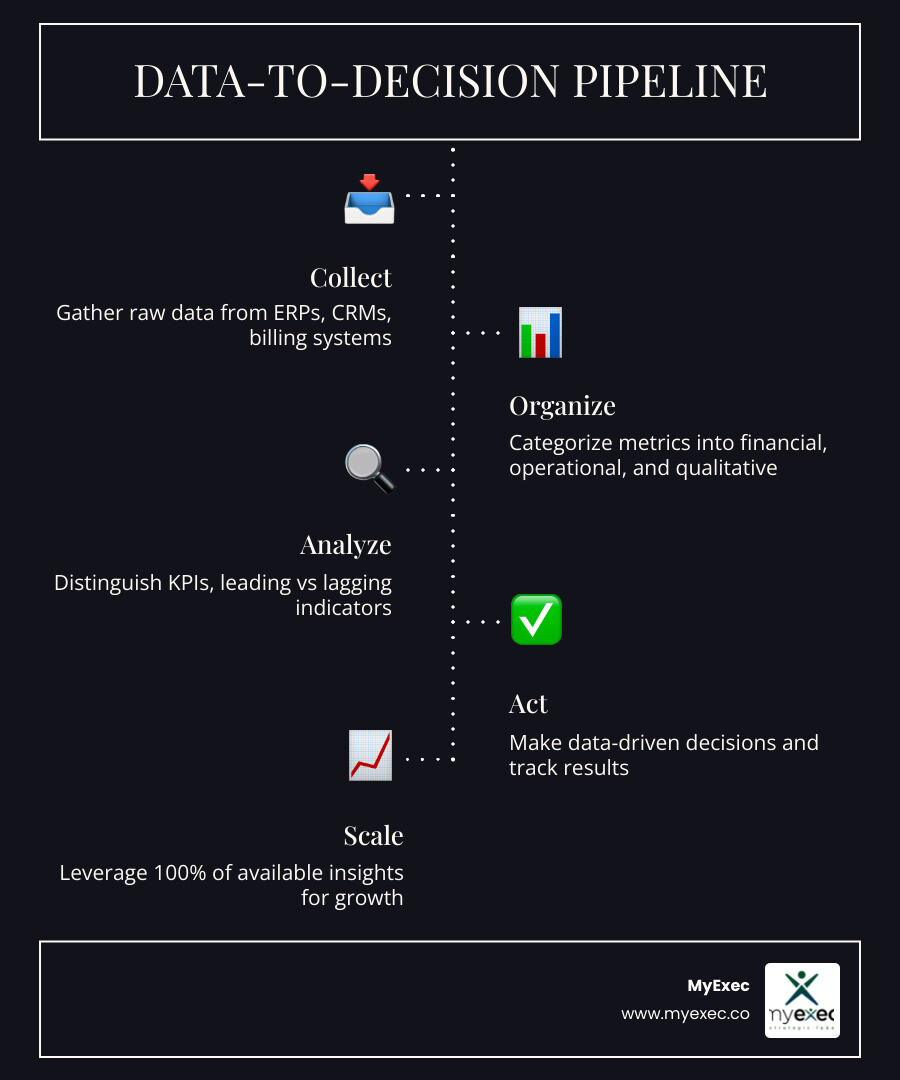
Most growing companies track something. But research shows businesses act on just 32% of the data available to them -- leaving 68% unleveraged. That gap between data collected and data used is where growth quietly stalls.
The problem isn't usually a lack of information. It's the wrong metrics, tracked inconsistently, without a clear link to decisions that matter.
This guide cuts through that. It covers what to measure, how to measure it, and how to turn your numbers into a real management system -- not just a reporting exercise.
Why Business Performance Metrics Matter for Mid-Market Growth
When a business is small, founders can manage by feel. You know your cash balance, you talk to your key customers, and you can see everyone working in the office. But as you scale past $5 million toward $50 million in revenue, that direct visibility disappears. Growth adds complexity, and operating on assumptions or intuition becomes dangerous.
This is where many mid-market companies run into a wall. They collect massive amounts of data from their ERPs, CRMs, and billing systems, yet they only act on 32% of it. The remaining 68% of their data goes completely unleveraged. This means leaders are flying blind, making critical decisions based on incomplete pictures.
Tracking the right business performance metrics solves this by turning raw data into actionable management tools. When designed correctly, metrics provide three main benefits:
- Strategic Alignment: They ensure that every department, from sales to customer success, is working toward the same high-level goals.
- Accountability: They establish clear, objective standards of success, removing subjectivity from performance reviews.
- Early Detection: They reveal operational bottlenecks and financial leaks before they show up as a cash crisis on your balance sheet.
Without standardized metrics, it is impossible to implement effective Performance Management Insights. To build a company that grows predictably, you must move from reactive bookkeeping to proactive, metrics-driven leadership.
Categorizing Performance Metrics Across Key Business Functions
To get a complete view of your business, you cannot look at financial statements alone. You need to track performance across several distinct categories.
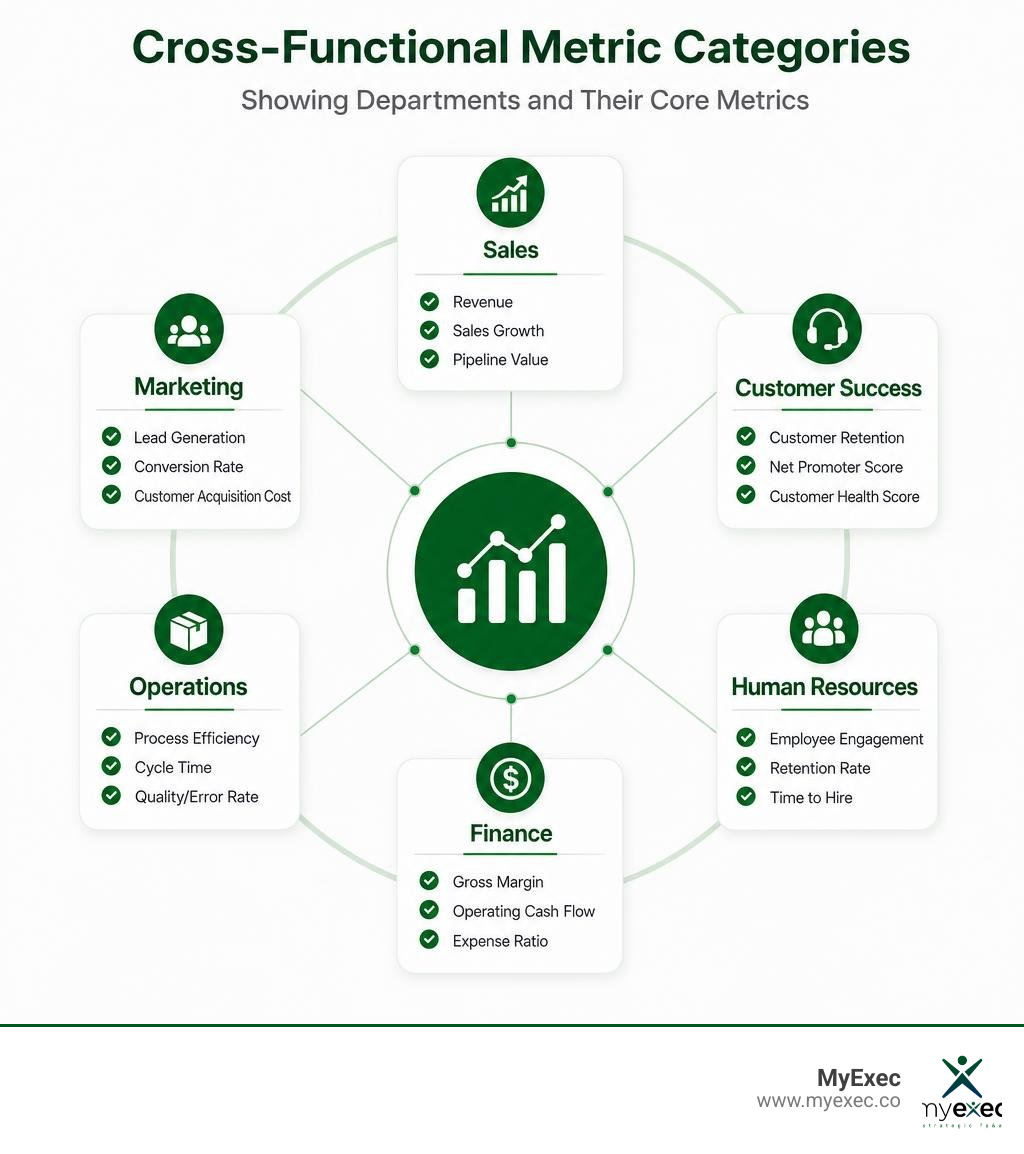
A balanced tracking system monitors metrics across six core operational areas:
- Financial Health: Measures profitability, liquidity, and capital efficiency to ensure the business remains solvent and attractive to investors.
- Operational Efficiency: Evaluates how well the company uses its resources, capacity, and assets to deliver products or services.
- Sales Pipeline: Tracks the speed, volume, and conversion rates of deals moving through your sales funnel.
- Marketing ROI: Measures the cost and effectiveness of customer acquisition efforts.
- Customer Success: Monitors customer retention, satisfaction, and lifetime value.
- Human Resources: Evaluates employee turnover, engagement, and productivity.
Key Differences: KPIs vs. Business Performance Metrics
Many business leaders use the terms "metrics" and "KPIs" interchangeably, but they serve different purposes.
A business performance metric is any quantitative measure used to track and assess a specific business process. A Key Performance Indicator (KPI) is a highly selective subset of those metrics that is directly tied to a major strategic target.
Think of it this way: all KPIs are metrics, but not all metrics are KPIs. For example, your overall website traffic is a performance metric. It is useful to track, but it does not necessarily drive your business strategy. However, if your strategic goal is to grow online sales by 30%, then your website conversion rate becomes a KPI.
| Feature | Business Performance Metrics | Key Performance Indicators (KPIs) |
|---|---|---|
| Scope | Broad tracking of overall operational and financial health. | Highly focused subset of critical strategic goals. |
| Purpose | Provides baseline context and operational tracking. | Drives specific strategic outcomes and business decisions. |
| Actionability | Informational, helping teams understand day-to-day work. | Directly tied to specific targets, rewards, and consequences. |
| Example | Website traffic, inventory turnover rate, overall payroll cost. | Net Revenue Retention (NRR) of 115% or Gross Margin of 70%. |
Leading vs. Lagging Indicators in Performance Measurement
To manage a growing company effectively, you must balance leading and lagging indicators.
- Lagging indicators measure past performance. They tell you what has already happened. Examples include monthly revenue, net profit margin, and customer churn. While lagging indicators are highly accurate and easy to measure, they are backward-looking. By the time a lagging indicator shows a problem, the damage is already done.
- Leading indicators are predictive. They point to future outcomes and help you anticipate changes. Examples include customer satisfaction (CSAT) scores, new sales pipeline opportunities, or employee engagement levels. If your CSAT scores drop this month, it is a leading indicator that customer churn (a lagging indicator) will likely rise in the coming quarters.
If you only track lagging indicators, you are driving your business by looking in the rearview mirror. By balancing both, you can manage risks proactively and adjust your operational strategies before problems impact your bottom line.
Essential Financial Metrics for Profitability and Liquidity
Financial metrics are the vital signs of your business. To understand your true financial health, you must look beyond top-line revenue growth and analyze efficiency, liquidity, and capital returns.

The following five financial metrics are essential for any mid-market company looking to scale sustainably:
1. Gross Profit Margin
This metric reveals how efficiently your company produces its goods or delivers its services. It measures the percentage of revenue left after subtracting the Cost of Goods Sold (COGS).
Formula:
$$ \text{Gross Profit Margin} = \frac{\text{Revenue} - \text{Cost of Goods Sold}}{\text{Revenue}} \times 100 $$
Why it matters: If your gross margin is shrinking, it means your production or delivery costs are rising faster than your prices. This is a common issue for growing companies facing inflationary pressures or supply chain inefficiencies.
2. Net Profit Margin
This is the ultimate measure of bottom-line profitability, showing how much of each dollar earned translates into actual net income after all operating expenses, interest, and taxes are paid.
Formula:
$$ \text{Net Profit Margin} = \frac{\text{Net Income}}{\text{Revenue}} \times 100 $$
Why it matters: A business can have high gross margins but still be unprofitable if its administrative overhead, marketing spend, or debt service costs are too high.
3. Current Ratio
This liquidity metric measures your company's ability to cover its short-term liabilities (debts due within one year) using its short-term assets (cash, accounts receivable, and inventory).
Formula:
$$ \text{Current Ratio} = \frac{\text{Current Assets}}{\text{Current Liabilities}} $$
Why it matters: A current ratio below 1.0 is a major warning sign that your business may struggle to meet its immediate financial obligations. A healthy ratio typically sits between 1.5 and 2.0.
4. Cash Conversion Cycle (CCC)
The CCC measures the time, in days, it takes for your company to convert its investments in inventory and resources into cash flows from sales.
Formula:
$$ \text{Cash Conversion Cycle} = \text{Days Inventory Outstanding} + \text{Days Sales Outstanding} - \text{Days Payable Outstanding} $$
Why it matters: A shorter or negative CCC means you are generating cash quickly, reducing your dependence on external working capital. If your DSO is rising, it means customers are taking longer to pay, which can quickly drain your cash reserves.
5. Operating Cash Flow Ratio
This ratio compares the cash generated from your day-to-day operations to your total liabilities, showing how well your current revenues can cover your long-term debt commitments.
Formula:
$$ \text{Operating Cash Flow Ratio} = \frac{\text{Operating Cash Flow}}{\text{Total Liabilities}} $$
Why it matters: High paper profits on an income statement do not always guarantee a healthy business. This ratio ensures that your operations are actually generating real cash, not just accounting profits.
For a deeper dive into these and other critical financial indicators, review our guide on Accounting KPIs: 30 Financial Metrics Every Business Should Track | ECOSIRE.
Mid-Market and SaaS Valuation Metrics
If you run a subscription-based business or are preparing your company for a transaction, you must also track valuation-specific performance metrics. Two of the most important are:
- The Rule of 40: This metric states that a software company's combined growth rate and EBITDA margin should equal or exceed 40%. For example, a SaaS business growing at 30% year-over-year should maintain at least a 10% EBITDA margin. Managing this balance is essential for maximizing your company's market value. You can read more about this in our guide on Rule of 40 Valuation Planning.
- Net Revenue Retention (NRR): This measures the percentage of recurring revenue retained from existing customers over a given period, including expansion revenue from upsells and subtracting downgrades or churn. An NRR above 100% indicates that your customer base is growing organically without relying solely on new customer acquisition. Learn how to calculate and optimize this metric with our guide on Net Revenue Retention SaaS 101.
To put these metrics into perspective, we also recommend reading the comprehensive guide on Financial Performance: What It Is & How to Measure It to understand how different financial statements interact to show your company's true health.
Frameworks for Monitoring and Presenting Metrics
Simply selecting a list of metrics is not enough. You need a structured framework to monitor, analyze, and present this data so that your leadership team can make informed decisions.
Diagnostic Control Systems and Balanced Scorecards
A diagnostic control system is a formal, information-based routine that managers use to monitor organizational outcomes and correct performance deviations. This includes standard cost-accounting systems, project monitoring tools, and employee performance scorecards.
One of the most effective frameworks is the Balanced Scorecard. Instead of focusing strictly on financial metrics, a balanced scorecard tracks performance across four key perspectives:
- Financial: How do we look to shareholders? (e.g., Gross Margin, ROI)
- Customer: How do customers see us? (e.g., CSAT, Net Promoter Score)
- Internal Processes: What must we excel at? (e.g., Cycle Time, Error Rate)
- Learning and Growth: How can we continue to improve and create value? (e.g., Employee Retention, Training Hours)
By using a balanced scorecard, you prevent "metric myopia" -- the dangerous habit of optimizing for short-term financial targets at the expense of long-term operational health.
Presenting Metrics and Ensuring Compliance
When presenting performance metrics to board members, lenders, or potential buyers, consistency and transparency are critical. In the corporate world, regulatory bodies set clear standards for how metrics should be defined and reported.
For instance, the Securities and Exchange Commission provides detailed guidelines in its Interpretive Release: Commission Guidance on Management’s Discussion and Analysis of Financial Condition. This guidance outlines how companies must define their key performance indicators, explain why they are useful to investors, and disclose how management uses them to run the business.
Similarly, Deloitte's guide on 2.4 Certain Financial or Operating Metrics | DART – Deloitte Accounting Research Tool highlights that companies must maintain effective disclosure controls when presenting non-GAAP financial measures or operational statistics.
If you change the way you calculate a metric, you must disclose:
- The differences between the old and new calculation methods.
- The reasons why the change was made.
- The financial effect of this change on both current and previously reported periods.
Even if your mid-market business is privately held, adopting these institutional-grade standards builds immense credibility with lenders and potential acquirers. The best way to organize and display this data is through a centralized, automated Financial Reporting Dashboard that updates in real time and serves as a single source of truth for your entire leadership team.
How to Choose the Right Business Performance Metrics for Your Industry
Every business model requires a unique set of metrics. Tracking the wrong numbers leads to wasted effort and poor decision-making.
To help you choose, let us look at how four different industries should prioritize their metric tracking:
1. Software as a Service (SaaS)
SaaS businesses rely on recurring revenue and customer retention.
- Primary Metrics: Monthly Recurring Revenue (MRR), Customer Acquisition Cost (CAC), Customer Lifetime Value (CLV), and Net Revenue Retention (NRR).
- Why: Because customer acquisition costs are paid upfront while revenue is collected over time, SaaS companies must closely monitor the ratio of CLV to CAC (aiming for at least a 3:1 ratio) to ensure long-term profitability.
2. Manufacturing and Distribution
Manufacturing is asset-heavy and relies on physical supply chains.
- Primary Metrics: Inventory Turnover, Days Inventory Outstanding (DIO), Mean Time to Repair (MTTR), and overall production downtime costs.
- Why: For a manufacturer, cash tied up in unsold inventory is cash that cannot be used to grow. Tracking inventory turnover ensures that production schedules align closely with market demand.
3. Professional Services
Consulting, legal, and accounting firms are human-capital businesses.
- Primary Metrics: Employee Utilization Rate, Resource Capacity, and Project Profitability.
- Why: If your team's utilization rate is too low, you are carrying excess payroll overhead. If it is too high, you risk employee burnout and quality issues. Finding the right balance is key to profitable scaling.
4. Retail and E-commerce
Retailers manage high transaction volumes and physical or digital storefronts.
- Primary Metrics: Same-Store Sales Growth, Gross Merchandise Volume (GMV), and Days Sales Outstanding (DSO).
- Why: E-commerce and retail brands operate on tight margins. Tracking same-store sales helps isolate true organic growth from the impact of opening new locations.
Frequently Asked Questions about Performance Metrics
What is the difference between a KPI and a metric?
A metric is a general quantifiable measure used to track business activities. A KPI is a strategically selected metric that is tied to a specific business goal. For example, employee turnover rate is a metric. If your company sets a goal to reduce turnover by 15% this year to save on recruitment costs, that metric becomes a KPI.
How often should a mid-market business review its financial metrics?
The review cadence depends on the metric's sensitivity:
- Daily: Cash balances, operating cash flows, and daily sales.
- Weekly: Sales pipeline metrics, marketing conversion rates, and operational capacity.
- Monthly: Full financial statements (Income Statement, Balance Sheet, Cash Flow Statement) and department-level scorecards.
- Quarterly: Strategic metrics like NRR, eNPS, and long-term valuation indicators.
Why do non-financial metrics like employee engagement affect profitability?
Non-financial metrics are leading indicators of financial performance. Research shows that high employee engagement can increase company profitability by up to 23%.
When employee engagement is low, turnover rates rise. This increases recruitment and training costs while reducing operational efficiency. Similarly, poor customer satisfaction scores are a leading indicator of future revenue declines. Intangible assets like brand loyalty and employee morale may not appear on your balance sheet, but they directly drive your long-term financial results.
Building a Metrics-Driven Future with MyExec
As your business grows past $5 million in revenue, managing your finances and operations through spreadsheets and gut feel is no longer sustainable. You need professional, senior-level financial leadership to design, track, and analyze the business performance metrics that will guide your next phase of growth.
But hiring a full-time, experienced CFO can be incredibly expensive, and a single-person retainer often lacks the analytical bandwidth your business needs.
MyExec provides scalable, full-stack fractional CFO and FP&A services designed specifically for growing mid-market companies. Our team-based approach gives you access to both strategic senior leadership and financial analysts, providing institutional-grade reporting, forecasting, and KPI design at a fraction of the cost of a full-time hire.
Our ultimate goal is to help you build a highly valuable, metrics-driven business. We will help you scale your finance function to the point where a full-time CFO makes sense, and then we will help you recruit, hire, and transition the role cleanly.
Ready to turn your financial data into a powerful growth engine? Let us help you Increase Business Value with Smarter Financial Reporting.