The Complete Guide to Cost Structure Optimization
What Is Cost Structure Optimization (And Why It Matters for Growing Businesses)

Cost structure optimization is the ongoing process of aligning every dollar your business spends with the outcomes that actually drive growth, profit, and long-term value. It's not about cutting everything in sight. It's about spending smarter.
Here's a quick breakdown of what it involves:
| What It Is | What It Is Not |
|---|---|
| Strategic alignment of costs with business goals | Across-the-board budget cuts |
| Eliminating waste without harming capability | Reducing headcount to hit a short-term number |
| Continuous discipline built into operations | A one-time cost reduction project |
| Reinvesting savings into growth and resilience | Treating savings as the end goal |
If you run a business between $5M and $50M in revenue, your cost structure is probably one of the biggest levers you haven't fully pulled yet. Most growing companies have costs that made sense at an earlier stage but haven't kept up with how the business has changed. Some spending is redundant. Some is invisible. And some looks productive on the surface but quietly erodes margin.
The numbers here are worth knowing. Fewer than half of businesses hit their cost-cutting goals in the first year. Only 11% sustain those cuts over three years. And only 9% maintain their desired pace of innovation after cuts are made. That's not a willpower problem. That's a method problem.
The companies that get this right aren't just cutting. They're restructuring how they operate so that lower costs become the natural result of a more efficient business, not a forced constraint on a broken one.
At MyExec cost structure optimization is a core part of how we drive value for our clients. We bring the same discipline used to run multi-billion dollar companies to growing businesses that need senior finance leadership without a full-time hire. Whether you're trying to protect margin, prepare for a sale, or free up capital to reinvest, getting your cost structure right is one of the clearest paths forward.
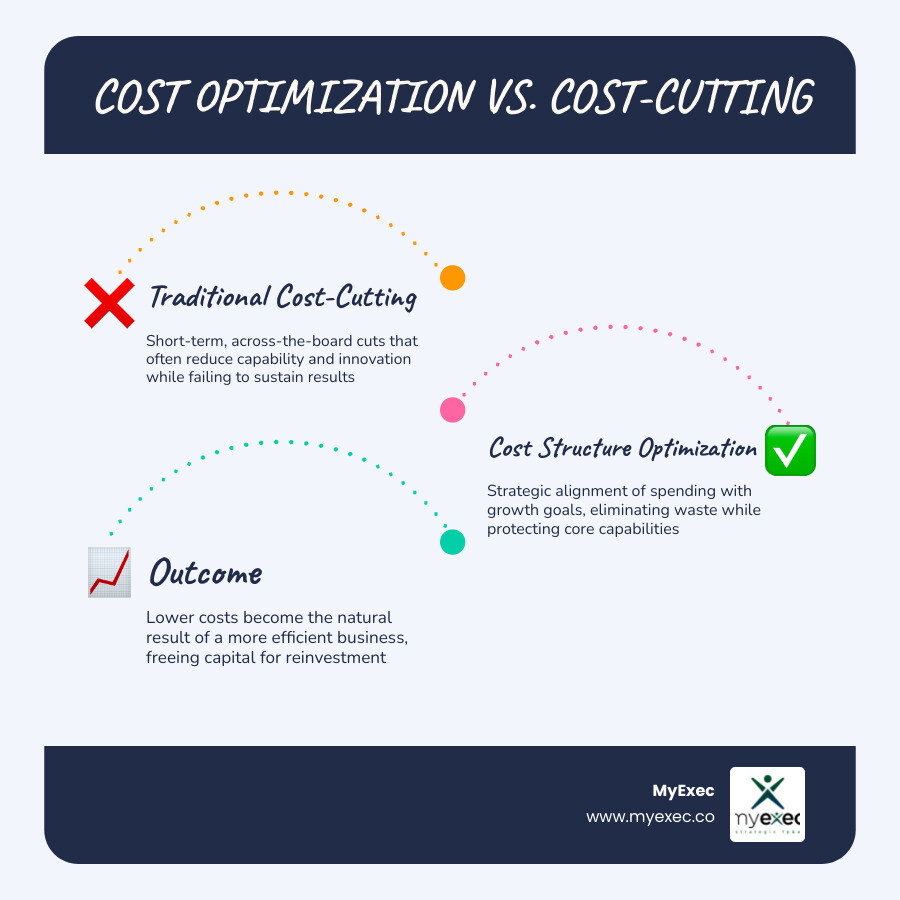
Cost Optimization vs. Cost-Cutting: A Strategic Shift
Many business owners use the terms cost optimization and cost-cutting interchangeably. However, they represent two entirely different approaches to managing a company's financial health.
Traditional cost-cutting is a defensive, short-term reaction. It usually happens when a company misses its quarterly targets or faces a sudden market downturn. The leadership team looks at the profit and loss statement and decides to slash expenses by a flat percentage across all departments. This blunt approach might improve the bottom line for a month or two, but it often damages the company's core capabilities. It can lead to worker burnout, lower product quality, and unhappy customers.
Cost structure optimization is an offensive, long-term strategy. It focuses on value creation and waste elimination. Instead of asking how much we can cut, we ask how we can configure our resources to deliver the highest possible value at the lowest sustainable cost. It is about restructuring how the business operates so that efficiency is built into the daily workflow. This strategic shift allows growing companies to fund sustainable growth using the capital they already have.
Defining Cost Structure Optimization for Mid-Market Businesses
For mid-market businesses in the $5M to $50M revenue range, cost structure optimization is about maturity. When a company is small, the founder manages every expense. As the business grows, this informal approach breaks down. Departments form, systems are added, and overhead increases.
Without a deliberate strategy, a growing company often ends up with a bloated cost structure that eats away at its margins. Optimization at this stage means examining every fixed and variable expense to ensure it supports the company's strategic goals. It involves analyzing resource allocation to make sure the highest-performing areas of the business get the funding they need.
By focusing on Profit Optimization, mid-market leaders can transition from survival mode to a disciplined operating model where every dollar spent is an investment in future value.
Why Traditional Cost-Cutting Fails
Traditional cost-cutting fails because it treats all expenses as equal. When you implement a flat 10% cut across the board, you treat your core sales engine the same way you treat your office supply budget. This leads to a decline in innovation and a slow erosion of organizational capability.
When you cut headcount or budgets indiscriminately, you often remove the very resources that keep your business competitive. Employees spend more time putting out fires and less time building new products or serving clients. According to research on Cost Optimization That Funds the Future, companies that rely on short-term cuts rarely sustain their savings. Within a year or two, the old expenses creep back in, often accompanied by the added costs of hiring replacement staff or fixing broken processes. True optimization avoids this trap by focusing on the root causes of waste rather than the symptoms.
Comparing Cost-Cutting and Cost Optimization
To understand the difference clearly, it helps to look at how these two approaches handle the same business challenges.
| Feature | Traditional Cost-Cutting | Cost Structure Optimization |
|---|---|---|
| Primary Goal | Immediate expense reduction | Improved business value and margin expansion |
| Time Horizon | Short-term (weeks to months) | Long-term and continuous (multi-year) |
| Methodology | Across-the-board percentage reductions | Process redesign and waste elimination |
| Resource Impact | Removes resources, leaving processes broken | Removes waste, making fewer resources necessary |
| Growth Outlook | Restricts innovation and capacity | Frees up capital to fund future investments |
Core Levers of Cost Structure Optimization
To build a leaner, more resilient business, we look at several core levers across the organization. These levers help us address non-labor spend, support functions, organizational design, and process complexity.
Non-Labor Spend and Procurement Discipline
For many mid-market companies, non-labor spend is a massive, unmanaged area of waste. It is easy for software subscriptions, marketing vendors, and logistics contracts to grow out of hand when there is no centralized procurement process.
Optimizing non-labor spend starts with visibility. We need to look at what we are buying, who we are buying it from, and whether we are getting the best value. This involves vendor consolidation: partnering with fewer, higher-value vendors to secure volume discounts. It also requires rigorous contract negotiation. Instead of accepting standard vendor terms, we negotiate tiered pricing, flexible user caps, and favorable payment terms.
By managing this spend actively, we directly improve the company's Gross Margin and free up cash that would otherwise be wasted on redundant services.
Organizational Redesign and Operating Model Efficiency
As a business grows, its organizational structure often becomes complex and inefficient. Layers of management are added, communication channels break down, and employees find themselves spending more time in meetings than doing productive work.
Organizational redesign is about simplifying the business. We look at the span of control for managers and streamline reporting lines to eliminate unnecessary layers. This also involves evaluating the company's overall Operating Model. For example, can we consolidate support functions like finance, HR, and IT into shared services?
By simplifying the organizational structure, we reduce the corporate overhead needed to support the business. A simpler organization is not only cheaper to run, it is also faster and more agile.
Process Simplification and Activity-Based Costing
Many companies struggle to optimize their cost structures because they do not know what it actually costs to deliver their products or services. Traditional accounting spreads overhead costs evenly across all products based on volume. This is often called the "peanut butter problem" because it spreads expenses smoothly but inaccurately, masking the true profitability of individual offerings.
To solve this cost distortion, we use activity-based costing. This methodology assigns overhead costs to products and customers based on the actual resources they consume. For instance, a low-volume, highly customized product might require ten times more customer support and engineering time than a high-volume, standardized product. Traditional costing would show both products as equally profitable, but activity-based costing reveals that the custom product is actually losing money.
By using tools like the ABC Costing Engine logic, we can identify unprofitable SKUs, adjust our pricing, and simplify our processes to eliminate high-cost, low-value activities.
Benchmarking and Diagnosing Your Cost Structure
Before we can optimize a cost structure, we must understand our starting point. This requires building a clear financial baseline and comparing our performance against industry standards.

Building a Cost Baseline and Identifying Margin Leaks
A cost baseline is a detailed breakdown of where every dollar goes, categorized by department, vendor, and activity. To build an accurate baseline, we separate fixed costs from variable costs. We also use Pareto analysis to identify the 20% of cost categories that drive 80% of our total spend. This allows us to focus our optimization efforts where they will have the greatest impact.
Another powerful tool is zero-based budgeting. Instead of taking last year's budget and adding 5% for inflation, zero-based budgeting requires managers to justify every single expense from scratch each year. This process forces the team to question legacy habits and identify hidden margin leaks.
By combining these diagnostics with active Profit and Loss Management, we can pinpoint exactly where the business is losing efficiency. For a structured approach to this diagnosis, we can adapt the steps found in the Operations & Cost Framework for Case Interviews (2026) to map out our cost drivers and prioritize our levers.
Tracking Business Performance Metrics and Unit Economics
We cannot manage what we do not measure. To sustain our cost optimization gains, we must track key Business Performance Metrics that reflect our operational efficiency. These metrics include:
- Cost as a percentage of revenue: This shows whether our expenses are growing faster or slower than our top line.
- Labor productivity: Measured by revenue per employee or units produced per labor hour, this helps us understand if our team is operating efficiently.
- Operating Expense (OpEx) ratio: This tracks our overhead costs relative to our net sales.
We also look closely at our unit economics. Understanding the direct costs associated with acquiring and serving a single customer allows us to make better decisions about pricing, marketing spend, and product development. If the unit economics do not work, scaling the business will only accelerate our losses.
Balancing Short-Term Savings with Long-Term Growth
One of the biggest risks of any cost initiative is sacrificing the future for the sake of the present. To prevent this, we must balance immediate savings with the strategic investments needed to sustain our competitive advantage.
Strategic Planning and Reinvestment Frameworks
Cost structure optimization should never be a race to the bottom. The goal is to free up capital from low-value activities so we can reinvest it in high-value, growth-oriented initiatives. This requires a strong link between our cost program and our broader strategic planning efforts.
When we identify savings, we do not just let them drop to the bottom line to make the current quarter look good. We establish a clear reinvestment framework. For example, if we save $200,000 by consolidating our software vendors, we might allocate half of those savings to fund a new product development initiative or hire a key sales resource.
By treating cost management as a tool to fund our future, we turn a defensive exercise into a growth driver. This approach aligns with the Cost optimization strategies framework, which emphasizes using efficiency gains to build new capabilities.
Scenario Planning for Market Resilience
The business environment can change rapidly. Inflation, supply chain disruptions, and shifting customer demands can quickly make a fixed cost structure dangerous. To build a resilient business, we use scenario planning to test how our cost structure will perform under different market conditions.

Through Scenario Planning and Sensitivity Analysis, we model various situations, such as a 20% drop in revenue or a 15% increase in material costs. This helps us identify which of our costs are truly fixed and which can be adjusted quickly if market conditions soften.
By understanding the differences outlined in our guide on Scenario vs Sensitivity Analysis, we can build a flexible cost structure that allows us to scale down during downturns and scale up quickly when opportunities arise.
The Role of Technology and AI in Modern Cost Management
Technology is a massive driver of modern cost management. It allows us to automate manual tasks, gain real-time visibility into our spending, and make data-driven decisions faster than ever before.
Overcoming Legacy Infrastructure Barriers
Many growing businesses are held back by legacy technology systems. These outdated platforms often operate in silos, meaning the finance team cannot easily access data from sales, operations, or inventory. This lack of integration leads to manual workarounds, data entry errors, and a general lack of visibility into the company's cost structure.
In fact, half of senior business executives surveyed in a major industry study cited legacy technology infrastructure as a primary barrier to operational efficiency. Overcoming these barriers is a critical step in any finance transformation.
By upgrading to modern, cloud-based ERP systems and integrated financial planning tools, we can create a single source of truth for our financial data. This integration is a core element of modern Finance Transformation insights models, which focus on building data foundations that support rapid decision-making.
Leveraging AI and Automation for Cost Structure Optimization
Once we have a solid data foundation, we can apply artificial intelligence and automation to accelerate our cost optimization efforts. AI-powered analytics tools can scan thousands of vendor invoices in seconds to identify billing errors, duplicate payments, or contract non-compliance. These tools can also analyze spending patterns to suggest negotiation opportunities or warn us when a department is on track to exceed its budget.
Furthermore, robotic process automation can handle repetitive, rule-based tasks in the back office, such as invoice processing, payroll reconciliations, and basic financial reporting. This automation does not just reduce labor costs, it also improves accuracy and frees up our finance team to focus on strategic analysis.
By integrating AI and automation into our daily operations, we can significantly shorten our execution timelines and build a structurally superior cost model that adapts to our business needs.
Frequently Asked Questions about Cost Structure Optimization
How long does it take to see results from a cost optimization program?
The timeline for seeing results depends on the levers you choose to pull. Quick wins, such as renegotiating software contracts, consolidating vendors, or eliminating obvious waste, can deliver measurable savings within the first 30 to 90 days.
More structural changes, such as reorganizing departments, redesigning core workflows, or implementing new enterprise technology, typically take longer. These initiatives usually go through a stabilization phase of three to nine months, with full cost benefits and operational efficiencies fully realized within 12 to 18 months.
For a deeper look at these phases, you can read about the structured implementation timelines in this Manufacturing cost optimization article.
What are the most common pitfalls in cost optimization?
The most common pitfall is falling back on traditional, across-the-board cuts that starve productive areas of the business. Another frequent mistake is ignoring the impact of cost decisions on product quality and customer experience. If you reduce headcount in your customer service department to save money, but your customer retention rate drops as a result, you have not optimized your cost structure, you have simply damaged your revenue engine.
Finally, many initiatives fail due to a lack of governance and change management. If leadership does not establish clear accountability, define metrics, and build a cost-conscious culture, any savings achieved will likely disappear within six to twelve months as old habits return.
How do private equity firms approach cost optimization in portfolio companies?
Private equity firms focus heavily on EBITDA improvement and complexity reduction. When they acquire a company, they immediately look for operational levers to increase margins and cash flow.
Their playbook typically starts with rapid transparency: building detailed spend cubes and headcount baselines to see exactly where money is being spent. They focus on right-sizing the organizational structure by widening the span of control and consolidating back-office support functions. They also drive extreme procurement discipline, forcing vendor consolidation and renegotiating major contracts.
The goal is to simplify the business as quickly as possible. A simpler, more focused business requires less administrative overhead and is much easier to scale.
Aligning Your Cost Structure for Growth
Getting your cost structure right is not a project with a start and end date. It is a continuous business discipline that determines how resilient and profitable your company will be as it scales. For businesses in the $5M to $50M range, trying to manage this transformation without senior financial leadership is incredibly difficult. Founders are often too busy running daily operations, and junior bookkeepers lack the strategic experience to design and execute a modern cost program.
That is where we come in. At MyExec, we provide fractional CFO and FP&A services designed specifically for growing businesses. We do not just offer a single consultant on a retainer. We deliver a full-stack, scalable finance team, from high-level strategic CFO guidance to hands-on analytical support.
We help you build the financial visibility, benchmarking, and operating models you need to optimize your cost structure and fund your future growth. When your business eventually grows to the point where a full-time CFO is necessary, we will help you define the role, find the right leader, and transition the finance function cleanly.
To find out how we can help you build a leaner, more profitable business, explore our services.