The Definitive Guide to Audited Financial Statements
What Audited Financial Statements Are (and Why They Matter)

Audited financial statements are your company's financial reports (balance sheet, income statement, cash flow statement, statement of changes in equity, and supporting notes) that have been independently examined by a certified public accountant (CPA) and verified to be free of material misstatement.
Here's what that means in plain terms:
| What They Include | What They Confirm |
|---|---|
| Balance sheet | Financial position at a point in time |
| Income statement | Revenue and expenses over a period |
| Cash flow statement | Where cash came from and where it went |
| Statement of changes in equity | How owner equity changed during the reporting period |
| Notes to financial statements | Accounting policies and key disclosures |
| Independent auditor's opinion | Whether the statements are fairly presented |
The auditor's opinion is the key piece. It tells lenders, investors, and regulators that an independent professional has reviewed your books and found them to be accurate and prepared in accordance with Generally Accepted Accounting Principles (GAAP).
This matters more than most founders realize. When a commercial lender reviews a loan application, or a major donor evaluates a nonprofit, or a private equity firm considers an acquisition, audited financials are often the first thing they ask for. They want third-party verification, not just your word.
Consider this scenario: a nonprofit suddenly learns its biggest funder now requires audited financial statements, with six weeks to deliver. The books are a mess. That kind of panic is avoidable, but only if you understand what audited financials require and how to stay ready.
At MyExec, our team has worked across companies from a few million in revenue to roughly $2 billion, including nonprofits, private equity-owned companies, closely held businesses, and publicly traded companies. We have managed audited financial statements as a routine part of capital planning, acquisition due diligence, and lender relationships. That experience informs everything in this guide.
What Are Audited Financial Statements?
An audited financial statement is the gold standard of financial reporting. It represents a complete set of financial records that an independent, external CPA has rigorously examined.
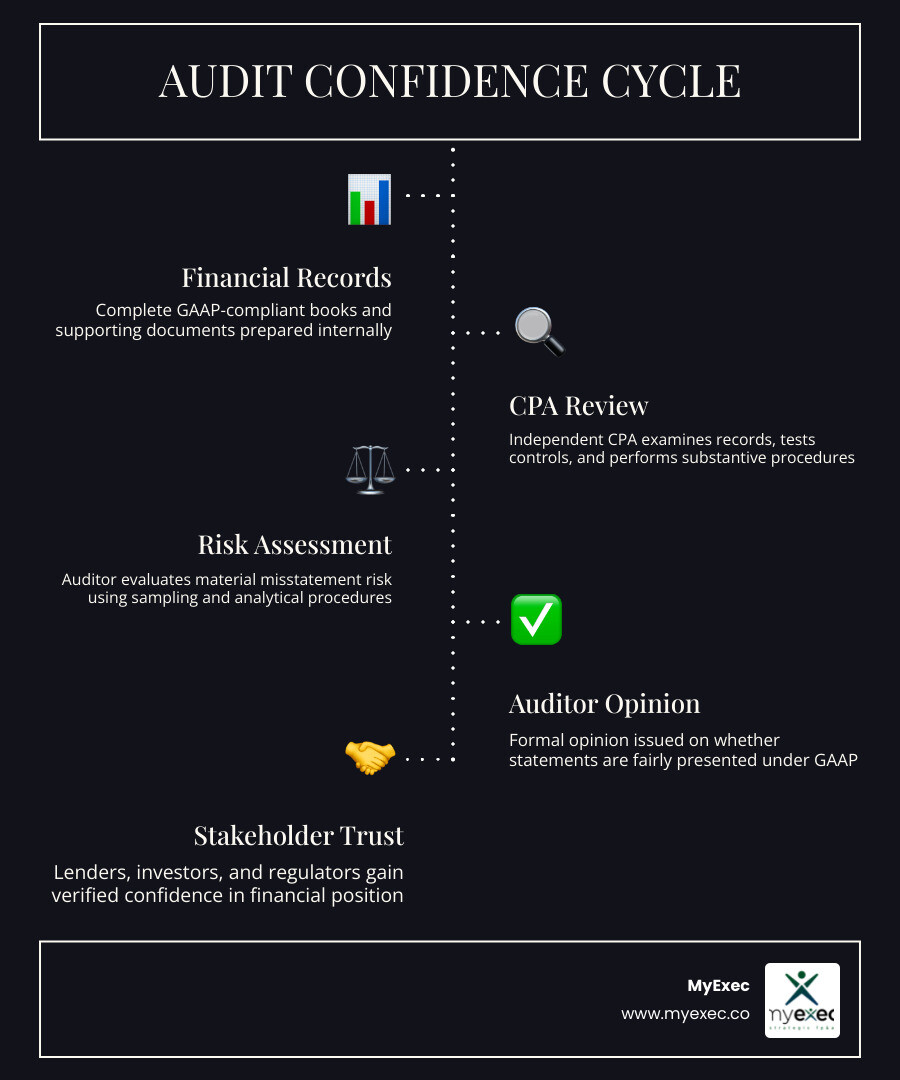
The primary goal of an audit is to obtain reasonable assurance about whether the financial statements are free from material misstatement. Reasonable assurance is a high level of assurance, though it is not an absolute guarantee. Auditors cannot check every single transaction, so they use statistical sampling, risk assessments, and internal control testing to verify the numbers.
To conduct an audit, the CPA must be completely independent of your business. This means they cannot have a financial interest in your company, nor can they perform management functions or prepare the bookkeeping records they are supposed to audit.
All audited financials must comply with GAAP, or in some international cases, International Financial Reporting Standards (IFRS). These frameworks ensure that every company reports its revenue, expenses, assets, and liabilities using the same set of rules. For example, look at the GiveDirectly 2023 Audited Financial Statements to see how a major organization structures its disclosures, net assets, and accounting policies to meet GAAP requirements.
For growing businesses, maintaining an accurate PL Balance Sheet throughout the year is the foundation of a successful audit. If your daily bookkeeping is sloppy, the audit process will be slow, painful, and expensive.
Why Growing Businesses Need Audited Financial Statements
Most businesses do not start out getting audits. When you are doing $2 million in revenue, a simple tax return and compiled financial statements are usually enough. But as you scale into the $5 million to $50 million range, the expectations change.
Commercial lenders are a primary driver. Many banks require audited financial statements before approving substantial business loans, often starting for credit facilities over $1 million or $2 million. Lenders want to know that the collateral and cash flow backing the loan actually exist.
Venture capital and private equity firms also look for audited financials. If you are preparing for a major funding round or an exit, having clean, audited books increases investor confidence and can directly impact your valuation. It shows you have graduated from amateur bookkeeping to professional financial management.
Nonprofits face unique rules. In many states, nonprofits with budgets over $750,000 are legally required to undergo an annual audit to maintain their registration and continue fundraising. Major foundations and government grantors often make audited financials a prerequisite for funding.
Investing in these audits is not just about checking a compliance box. High-quality financial data helps you make better decisions, protect your margins, and implement smarter financial reporting that drives real business value.
Regulatory and Compliance Drivers
Beyond lenders and investors, regulatory bodies often make audits mandatory.
Publicly traded companies in the United States must submit annual audited financial statements to the Securities and Exchange Commission (SEC). While smaller private businesses do not face SEC oversight, they may face other federal requirements.
Government contractors must often provide audited statements to prove they have the financial capability to execute contracts and to comply with Federal Acquisition Regulations (FAR).
Additionally, any organization that expends $750,000 or more in federal grant funding in a single fiscal year is subject to a Single Audit, previously known as an A-133 audit. This is a rigorous compliance audit that runs alongside the standard financial statement audit to ensure federal funds were spent appropriately.
Audited vs. Reviewed vs. Compiled Statements
When a lender or board member asks for financial statements, they might specify the level of assurance they need. CPAs offer three primary levels of service: compilations, reviews, and audits.
Understanding the differences will save you thousands of dollars, as you should never pay for an audit if a review will satisfy your stakeholders.
- Compilation: A compilation is the most basic service. The CPA takes your raw financial data and organizes it into standard financial statement format. They do not perform any testing, ask analytical questions, or verify the numbers. A compilation offers zero assurance to third parties.
- Review: A review provides limited assurance. The CPA performs analytical procedures, such as comparing your current-year margins to prior years, and asks management targeted questions about unusual fluctuations. They do not test internal controls or verify physical inventory. The CPA's report will state that they are not aware of any material modifications that need to be made.
- Audit: An audit provides the highest level of assurance. The CPA performs extensive testing, physically inspects inventory, confirms bank balances directly with your financial institutions, and tests your internal controls.
To keep track of your financial health before these formal engagements, many businesses rely on a real-time financial reporting dashboard to monitor key trends and spot errors early.
| Feature | Compilation | Review | Audit |
|---|---|---|---|
| Assurance Level | None | Limited (Passive) | High (Active) |
| CPA Procedures | Formatting only | Analytics & inquiries | Physical testing & verification |
| Internal Control Testing | No | No | Yes |
| Relative Cost | Low | Medium | High |
When to Choose a Review or Compilation
If you are a private business and your lenders or investors do not explicitly require an audit, a review is often the smartest choice.
Reviews are much cheaper than audits and require significantly less staff time. They are ideal for internal management review, satisfying basic bank covenants on smaller lines of credit, or preparing a business for a future sale where the buyer will perform their own due diligence anyway.
Compilations are best when you simply need professional-looking statements for tax preparation or to show to minor, inactive shareholders who already trust your management team.
Key Components and Opinions of an Audit
A complete set of audited financial statements contains several critical documents. You cannot present just the balance sheet or the income statement. The package must include:
- Independent Auditor's Report: This is the cover letter where the CPA states their opinion on the financial statements.
- Balance Sheet: A snapshot of your assets, liabilities, and equity at the exact end of the fiscal year.
- Income Statement: Your revenues, expenses, and net income over the 12-month period.
- Statement of Cash Flows: A breakdown showing how cash moved through operating, investing, and financing activities. This is crucial because net income does not always equal cash in the bank.
- Notes to the Financial Statements: These disclosures are often longer than the financial statements themselves. They explain your revenue recognition policies, debt terms, lease obligations, litigation risks, and tax positions.
To see how complex these components can be in practice, you can review the Mass General Brigham 2025 Consolidated Audited Financial Statements. This document shows how a large organization handles massive balance sheets, pension liabilities, and complex investment notes.
To keep these components accurate, your internal team must practice rigorous profit and loss management throughout the year, ensuring every transaction is coded correctly.
Understanding Audit Opinions
The auditor's report will conclude with one of four opinions. This opinion is what lenders and investors look at first.
- Unqualified Opinion (Clean): This is the best outcome. It means the auditor concluded that your financial statements present your financial position fairly, in all material respects, in accordance with GAAP.
- Qualified Opinion: This means the financial statements are mostly accurate, but there is a specific, isolated departure from GAAP or a limitation on what the auditor could test. For example, if you did not count physical inventory at year-end, the auditor might issue a qualified opinion concerning the inventory balance.
- Adverse Opinion: This is a disaster. It means the auditor found pervasive material misstatements, and the financial statements do not fairly present the company's financial health. Lenders will typically call their loans, and investors will walk away if you receive an adverse opinion.
- Disclaimer of Opinion: This occurs when the auditor cannot gather enough evidence to form an opinion. This might happen if your records were destroyed, or if you refuse to grant the auditor access to critical financial files.
For public company context on how complex opinions and critical audit matters are presented, you can read the JBS N.V. 2025 PCAOB Audit Report. This report highlights how international tax uncertainties and large-scale operations require specialized audit procedures.
When presenting these outcomes to your board of directors, you will want to summarize the audit findings clearly in a board paper executive summary so they can quickly digest the results.
The Financial Statement Audit Process
An audit is not a single event. It is a structured process that typically plays out over several months. Understanding the phases of an audit helps you manage your team's workload and avoid business disruption.

- Planning and Risk Assessment: In this phase, the auditors learn about your business, your industry, and your accounting systems. They identify areas with a high risk of misstatement, such as complex revenue contracts or inventory valuation.
- Internal Control Testing: The auditors evaluate the controls you have in place to prevent fraud and errors. For example, they will check if the person who writes the checks is different from the person who reconciles the bank statements. If your controls are strong, the auditors can perform less substantive testing.
- Substantive Testing (Fieldwork): This is the most intensive phase. Auditors ask for invoices, bank statements, customer contracts, and payroll records. They will send letters to your customers to confirm outstanding accounts receivable balances.
- Reporting and Finalization: The auditors draft the financial statements, write the notes, and issue their final opinion. They will also present a management letter to your board, outlining any weaknesses they found in your internal controls.
Before kicking off this process, it is wise to run a strategic finance assessment of your business to ensure your systems, personnel, and records are prepared for the scrutiny.
The Role of the Independent Auditor
Keep in mind that independent auditors are not there to help you run your business or do your bookkeeping. They are there to protect the public and your stakeholders.
Auditors must maintain professional skepticism. This means they assume that errors or fraud could exist, and they must verify your financial assertions rather than taking management's word for it.
Because they cannot test every single transaction, they rely on materiality thresholds. Materiality is a dollar amount that, if omitted or misstated, would influence the decisions of a reasonable user of the financial statements. If your business has $20 million in revenue, a $500 error is immaterial, but a $500,000 error is highly material.
Preparing Your Business for an Audit
The secret to a stress-free audit is year-round preparation. If you wait until the auditors arrive to clean up your books, you will face high stress, late nights, and inflated audit fees.
Start by closing your books on time every single month. Your monthly close should be completed within 15 to 20 days of month-end. This ensures that bank reconciliations are done, journal entries are documented, and balance sheet accounts are tied out while the transactions are still fresh in your mind.
You also need to establish strong internal controls. Separate financial duties among different people where possible. Require supporting documentation for every single journal entry, and store digital copies of invoices and contracts in an organized, central system.
When the audit begins, the CPA firm will provide a Prepared by Client (PBC) list. This is a detailed checklist of every document, schedule, and confirmation they need. Assigning ownership of this list to specific team members is critical to keeping the audit on track.
If you are preparing for a major event like a sale or merger, achieving M&A financial readiness through a pre-audit clean-up is one of the best ways to preserve your deal value.
The Cost and Timeline of Audited Financial Statements
Getting audited is a major financial and time commitment.
A standard financial audit generally costs between $7,000 and $50,000 or more. The final price tag depends on several factors:
- The size and complexity of your business
- The quality of your internal records
- Your industry (regulated industries like healthcare or banking cost more)
- The CPA firm you choose (national firms cost significantly more than regional firms)
The timeline is also substantial. A typical audit takes 8 to 12 weeks from the start of planning to the final report. Fieldwork usually takes 2 to 4 weeks of that time, during which the auditors will be actively asking your staff for documents and explanations.
To manage these costs and timelines, many growing businesses work with a financial modeling consultant or a fractional CFO to clean up their books and build the schedules before the external auditors arrive. This preparation can easily cut your audit fees in half.
Common Audit Red Flags and How to Avoid Them
Auditors look for inconsistencies that suggest either weak controls, accounting errors, or deliberate fraud. Some of the most common red flags include:
- Inconsistent Financial Records: If your general ledger does not match your sub-ledgers, such as your accounts receivable aging report not matching the balance sheet, auditors will dig deeper.
- Weak Internal Controls: If a single employee can write checks, approve invoices, and reconcile the bank account, auditors will assume the risk of fraud is high and will increase their testing.
- Revenue Recognition Issues: Recognizing revenue before a product has shipped or a service has been fully performed is a major GAAP violation. Auditors will closely review your customer contracts around year-end to ensure cut-off was handled correctly.
- Unrecorded Liabilities: Failing to record expenses in the period they occurred to make your profits look better is a common issue. Auditors will look at payments made in January and February of the new year to see if they should have been recorded as liabilities in December.
To prevent these issues, establish clear business performance metrics and review them monthly to spot anomalies before the auditors do.
Frequently Asked Questions about Audited Financial Statements
Do small businesses need audited financial statements?
Generally, no. Most small businesses do not need audited financial statements unless they are required by a lender for a large loan, required by venture capital or private equity investors, or required by government contracts. Many small businesses find that a review or compilation is more than enough for their needs. However, if you plan to sell your business or raise institutional capital in the next two to three years, starting the audit process early is a smart way to prepare for that transition.
How long does a financial statement audit take?
For a business with $5 million to $50 million in revenue, a standard audit takes about 8 to 12 weeks from the initial planning meeting to the delivery of the final report. The active fieldwork phase, where auditors are testing transactions, usually takes 2 to 4 weeks. If your books are disorganized or if you are slow to provide documents from the PBC list, the audit can easily drag on for four to six months.
What is a PBC list in auditing?
The Prepared by Client (PBC) list is a detailed checklist provided by the auditors before the audit begins. It lists all the documents, schedules, reconciliations, and agreements the auditors need to complete their work. A typical PBC list includes items like bank statements, accounts receivable aging reports, inventory count sheets, debt agreements, board minutes, and corporate tax returns. Organizing these documents before fieldwork starts is the single best way to keep your audit on time and under budget.
Clean Books, Smooth Audits
Audited financial statements are more than just a regulatory burden. They are a powerful tool that builds trust with lenders, attracts investors, and gives you absolute confidence in your financial data.
But preparing for an audit is a massive drain on your internal team if you do not have senior finance leadership.
At MyExec, we provide fractional CFO and FP&A services designed specifically for growing businesses in the $5 million to $50 million range. We do not just give you advice. We deliver a scalable, full-stack finance team, from analysts to seasoned CFOs, to help you implement smarter financial reporting.
We can clean up your books, establish strong internal controls, manage the external audit relationship, and eventually help you transition to a full-time CFO when your business is ready.