The Non-Accountant's Guide to the P&L and Balance Sheet
Why Every CEO Should Understand the P&L Balance Sheet Relationship

The P&L balance sheet pairing is the foundation of every meaningful financial conversation, whether you're talking to a bank, a potential buyer, or your own board.
Here's a quick answer if you need it fast:
| Statement | What It Shows | Time Frame |
|---|---|---|
| Profit & Loss (P&L) | Revenue, expenses, and net income | A period (month, quarter, year) |
| Balance Sheet | Assets, liabilities, and equity | A single point in time |
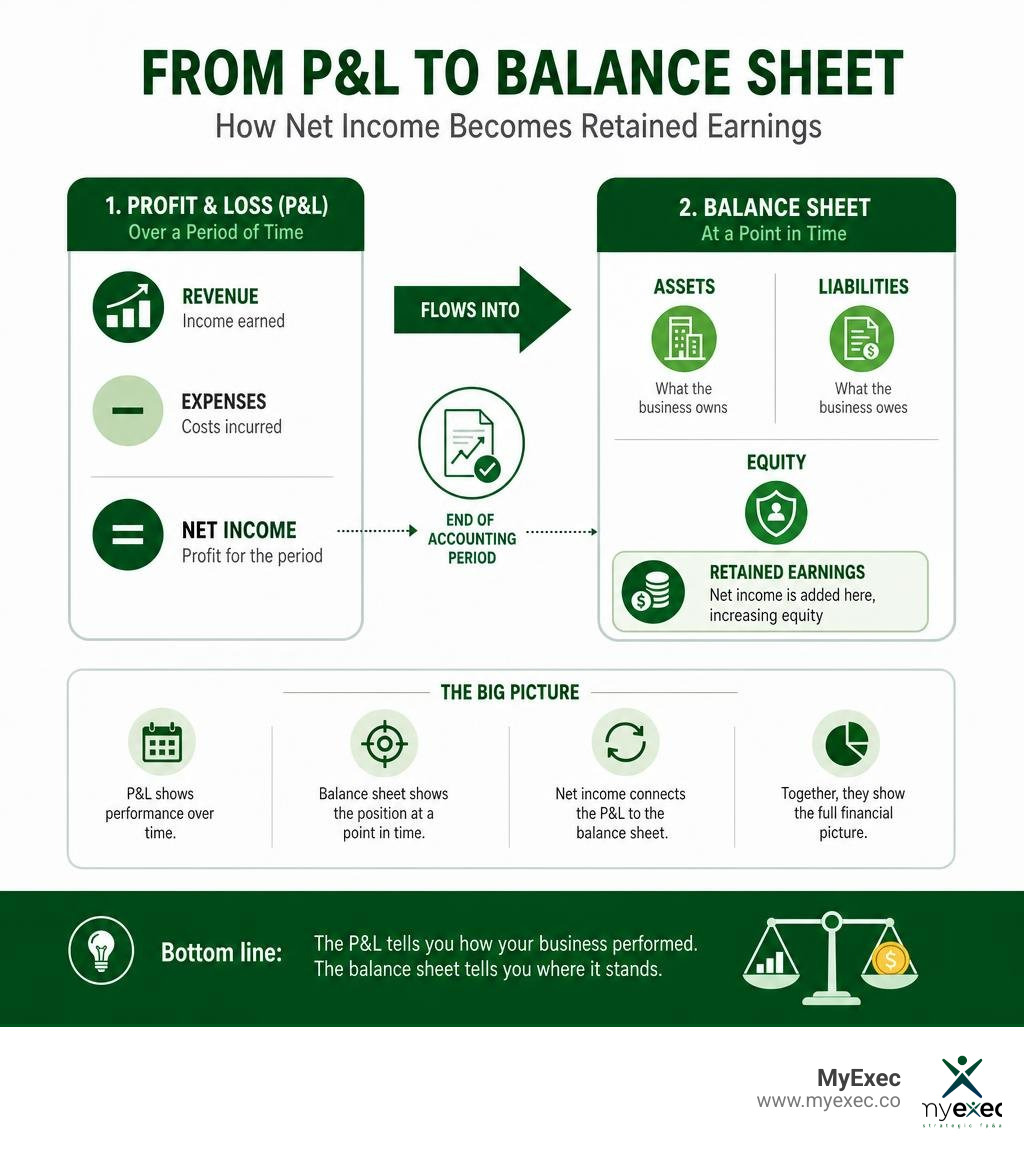
| How they connect | Net income from the P&L flows into retained earnings on the balance sheet | End of each accounting period |
Bottom line: The P&L tells you how your business performed. The balance sheet tells you where it stands. You need both to see the full picture.
Most CEOs look at their P&L and stop there. That's a problem.
A strong P&L can mask serious risks hiding on the balance sheet. Debt levels, cash on hand, what customers owe you, what you owe vendors...none of that shows up in your profit number. Over 60% of small businesses fail due to poor cash flow management, and many of those businesses were profitable on paper right up until they weren't.
These two reports answer different questions. Used together, they give you the financial clarity to make smarter decisions faster.
As founder of MyExec and a former Director of Finance at a $2 billion private equity-owned company, I worked hands-on with P&L and balance sheet analysis across complex, high-stakes environments. In the sections below, I'll break down exactly what each statement contains, how they connect, and what they reveal about your business that neither one can show alone.
Demystifying the P&L Balance Sheet Connection
To run a business successfully in June 2026, you cannot afford to view your financial statements as isolated documents. They are part of an integrated financial reporting ecosystem.
When we talk about an accounting period—whether it is a month, a quarter, or a fiscal year—we are looking at a slice of time. The P&L captures what happened during that slice of time. The balance sheet captures where things stand at the exact end of that slice.
This connection is governed by accrual accounting. Unlike cash accounting, which only records transactions when cash changes hands, accrual accounting records revenues when they are earned and expenses when they are incurred. This means your P&L might show a magnificent profit, but your balance sheet might show that most of that profit is still sitting in "Accounts Receivable" (money customers owe you) rather than in your bank account.
Understanding how these elements move together is vital. According to industry data, entities that reconcile their P&L and balance sheet monthly reduce reporting errors by up to 40%. If you want to dive deeper into how to set up these reports, check out this comprehensive Balance Sheet vs Profit and Loss Statement Guide.
What is a P&L Balance Sheet Comparison?
A P&L balance sheet comparison is the practice of analyzing both statements side-by-side to evaluate a company's performance alongside its financial position.
The primary bridge between the two is net income (the "bottom line" of your P&L) and retained earnings (a key component of the equity section on your balance sheet). At the end of every accounting period, your net income is transferred into retained earnings, which represents the cumulative profits your business has kept and reinvested over time rather than distributing to owners or shareholders.
Evaluating this connection is the fastest way to assess your business's true financial health. For instance:
- A business with high net income but rapidly declining cash and ballooning liabilities is likely struggling with collections or over-investing in inventory.
- Conversely, a business with modest net income but a clean, debt-free balance sheet and strong cash reserves is incredibly stable.
By comparing these statements regularly, you gain the power to spot issues before they turn into crises. To build a highly valuable business, you must learn to look beyond simple profit metrics. Discover how to elevate your reporting with our guide on how to Increase Business Value with Smarter Financial Reporting.
The Profit and Loss Statement: Measuring Performance Over Time
The Profit and Loss (P&L) statement, also commonly referred to as the income statement, is your business's scoreboard. It measures your financial performance over a defined period of time.
The basic formula of a P&L is straightforward:
$$\text{Revenue} - \text{Expenses} = \text{Net Profit or Loss}$$
To understand how this looks in practice, let's look at a standard $1,000,000 revenue business breakdown:
- Revenue (Top Line): The total amount of money brought in by selling your products or services. In this example, let's say it is $1,000,000.
- Cost of Goods Sold (COGS): The direct costs attributable to the production of the goods or services sold (e.g., raw materials, direct labor). Let's assume COGS is $600,000.
- Gross Profit: Revenue minus COGS. In this case, $400,000. This shows how efficiently you produce your core offering.
- Operating Expenses (OPEX): The indirect costs of running the business, such as rent, marketing, administrative salaries, and utilities. Let's say these total $250,000.
- Operating Income (EBIT): Gross profit minus OPEX, which leaves us with $150,000.
- Taxes and Interest: Non-operating expenses, which we will set at $50,000.
- Net Income (Bottom Line): The final profit left over for the business: $100,000.
Key Components of the P&L Balance Sheet Equation
To understand how the P&L feeds the balance sheet, we have to look closely at the expenses that sit below operating income.
Interest expense, for example, is directly tied to the liabilities on your balance sheet. If you take on a $500,000 bank loan (a balance sheet liability), the interest you pay on that loan each month will appear on your P&L as an interest expense, reducing your net income.
Similarly, tax expense on the P&L is calculated based on your profitable activities, but any unpaid taxes at the end of the year will sit on your balance sheet as a tax liability until paid.
For a highly detailed technical breakdown of how these line items must be presented to satisfy auditors and financial institutions, you can refer to PwC's official guide on Financial statement presentation.
The Balance Sheet: A Snapshot of Financial Position
If the P&L is a record of your business's performance over time, the balance sheet is a high-resolution snapshot. It shows exactly what your business owns, owes, and is worth at one specific moment in time (usually the last day of the month or year).
The balance sheet is anchored by the fundamental accounting equation:
$$\text{Assets} = \text{Liabilities} + \text{Shareholders' Equity}$$
This equation must always balance. If it doesn't, there is an error in your bookkeeping.
The balance sheet is crucial because it helps lenders, investors, and leadership judge two critical aspects of financial survival:
- Liquidity: Your ability to convert assets into cash quickly to pay off short-term debts.
- Solvency: Your long-term financial health and ability to meet ongoing, long-term financial obligations.
Assets, Liabilities, and Equity Breakdown
Let's break down the three core pillars of the balance sheet:
- Assets (What You Own): These are resources with economic value that your business controls. They are divided into current assets (cash, accounts receivable, and inventory that can be converted to cash within a year) and non-current assets (property, equipment, intellectual property, and long-term investments).
- Liabilities (What You Owe): These are financial obligations to outside parties. They include current liabilities (accounts payable, credit card debt, and short-term loans due within a year) and long-term liabilities (long-term debt, deferred tax liabilities).
- Shareholders' Equity (What You Are Worth): Also called owner's equity, this represents the residual value of the business if all assets were liquidated and all debts paid off. It consists of the capital invested by owners plus accumulated retained earnings.
To see how these line items are presented in professional practice under international standards, review the 2024 Example Financial Statements published by Grant Thornton.
Key Differences and How They Work Together
Understanding how these two statements differ in timing, structure, and intent is the first step toward master-level financial analysis.
The P&L is always prepared first. Why? Because you cannot complete a balance sheet without knowing your exact net income for the period, which must be added to your retained earnings.
Here is a side-by-side comparison to help you keep them straight:
| Feature | Profit & Loss (P&L) | Balance Sheet |
|---|---|---|
| Primary Purpose | Measures financial performance and profitability | Shows financial position and net worth |
| Time Frame | Over a period of time (e.g., Jan 1 to Dec 31) | As of a specific date (e.g., Dec 31) |
| Core Equation | Revenue - Expenses = Net Income | Assets = Liabilities + Equity |
| Key Metrics | Gross margin, operating profit, net income | Liquidity ratios, debt-to-equity, working capital |
| Preparation Order | Prepared first | Prepared second (uses P&L net income) |
| Primary Audience | Managers, sales teams, tax authorities | Investors, lenders, acquirers |
When you master the relationship between these statements, you can build a highly proactive financial strategy. For a complete blueprint on how to leverage these statements to build a resilient, high-value company, explore our Strategic Finance Guide.
Real-World Scenarios: Profitability vs. Liquidity Issues
To truly appreciate the value of the P&L balance sheet relationship, let's look at how they interact in real-world business scenarios.
Scenario A: The Profitable Business That Ran Out of Cash
Imagine a fast-growing SaaS business. Their P&L looks spectacular: they are booking thousands of dollars in new contracts, and their net income is growing 20% month-over-month.
However, they offer their enterprise clients 90-day payment terms. On the P&L, that revenue is recognized immediately under accrual accounting. But on the balance sheet, their "Accounts Receivable" is skyrocketing while their "Cash" account is nearly empty. They have a massive liquidity crisis because they cannot use pending invoices to pay their employees' salaries this Friday.
Scenario B: The Expense Leak Revealed
Consider a mid-sized services business. The CEO notices that profits have slipped by 38% from Q1 to Q2, despite revenue remaining completely flat at $200,000.
By comparing the quarterly P&L statements, they find that operating expenses jumped by 15%. Digging into the balance sheet, they find that accounts payable has spiked. A quick investigation reveals a major billing error from a key vendor who has been double-charging them for software licenses.

Without analyzing both reports together, these issues can easily slip through the cracks until it is too late. Managing these risks requires a structured approach to your operational and financial blind spots. We recommend asking your team the questions outlined in our guide on Operational Risks: 5 Questions to Ask Your Finance Team.
Strategic Decision-Making and Compliance Standards
As your business grows past $5M in revenue, your financial reporting needs to transition from simple tax compliance to a powerful tool for strategic decision-making.
Whether you report under US GAAP or prepare for IFRS compliance, maintaining clean, integrated financial statements is non-negotiable. Even global regulatory bodies emphasize this integration. For example, the Reserve Bank of India's Master Directions - Reserve Bank of India outlines incredibly strict presentation and disclosure rules, proving that standardized financial reporting is the bedrock of trust in the global market.
If you are planning for major milestones such as raising capital, restructuring, or preparing for an exit your financial statements must be flawless. Buyers and investors will look at your historical P&L to judge your growth, but they will look at your balance sheet to determine your risk profile and calculate your company's value.
To prepare effectively, you can leverage advanced financial planning strategies:
- If you are preparing for a potential sale or merger, read up on M&A Financial Readiness.
- If you need to understand what your business is actually worth today, explore our guide on Business Valuations.
- For software and subscription-based businesses, understanding metrics like SaaS Expansion Revenue and Net Revenue Retention SaaS 101 is essential, especially when aiming for elite status like Rule of 40 Valuation Planning.
- If you are dealing with macroeconomic shifts, we suggest reviewing Tariff Impact Financial Planning.
Static historical reports are only half the battle. To navigate future growth safely, you need dynamic forecasting. This is where a financial modeling consultant becomes invaluable. Learn more about their strategic impact in our article on The Role of a Financial Modeling Consultant in Business Strategy, and discover how to stress-test your business model by comparing Scenario vs Sensitivity Analysis.
Frequently Asked Questions about Financial Statements
Why can a company be profitable but still run out of cash?
A company can be profitable on paper but cash-poor due to non-cash items (like depreciation), timing effects (recognizing revenue before cash is received), and working capital demands. If you are paying your suppliers in 15 days but your customers are paying you in 60 days, your cash will drain rapidly even if your sales are booming.
Which statement should be prepared first?
The P&L statement must always be prepared first. The net income calculated at the bottom of the P&L flows directly into the retained earnings section of the balance sheet. You cannot balance your balance sheet without this final net income figure.
How often should a business review these reports?
At a minimum, businesses should conduct a monthly reconciliation and review of both statements. Waiting until the end of the fiscal year to look at your balance sheet is a recipe for disaster. Monthly reviews allow you to spot trends, catch rising expenses, and manage your cash reserves proactively.
Conclusion
Understanding the P&L balance sheet connection is not just about keeping your accountants happy—it is about taking control of your business's future.
However, as a growing business with $5M to $50M in revenue, you might not have the budget or the need for a full-time, high-salaried CFO. That is where we can help.
At MyExec, we provide fractional CFO and FP&A services designed specifically for growing companies. We deliver senior finance leadership, strategic planning, and professional valuations at a fraction of the cost of a full-time hire. Unlike single-person retainers, we offer a scalable, full-stack finance team, from analysts to seasoned CFOs, that grows alongside your business.
Ready to gain absolute clarity over your numbers and unlock your company's true value? Take the next step to Increase Business Value with Smarter Financial Reporting.