How to Spot Cash Flow Issues Faster
Why Does Your Bank Balance Lie About Your Real Cash Position?

Many business owners start their day by logging into their online banking portal. They see a healthy six-figure balance and assume everything is fine. This habit is one of the most dangerous traps in business. Relying solely on your checking account balance creates a false sense of security because bank balances only show what happened yesterday, not what is coming tomorrow.
The reality for most businesses is incredibly tight. The average small business holds only 27 days of cash reserves. This means a single major client delaying a payment by two weeks or an unexpected tax bill can instantly push a business into a liquidity crisis. It is no surprise that cash flow issues are the leading reason growing businesses close, even when their sales pipelines look incredibly strong.
The core of this problem lies in the difference between cash and profit. If you use accrual accounting, your profit and loss statement shows revenue when a sale is made, not when the cash actually lands in your bank account. You can show strong profits on paper while your bank account is completely empty. If you invoice a client for $100,000 in June, your P&L shows a $100,000 gain. If that client has net-60 terms, you will not see a dime of that cash until August. In the meantime, you still have to cover payroll, rent, and vendor payments in July.
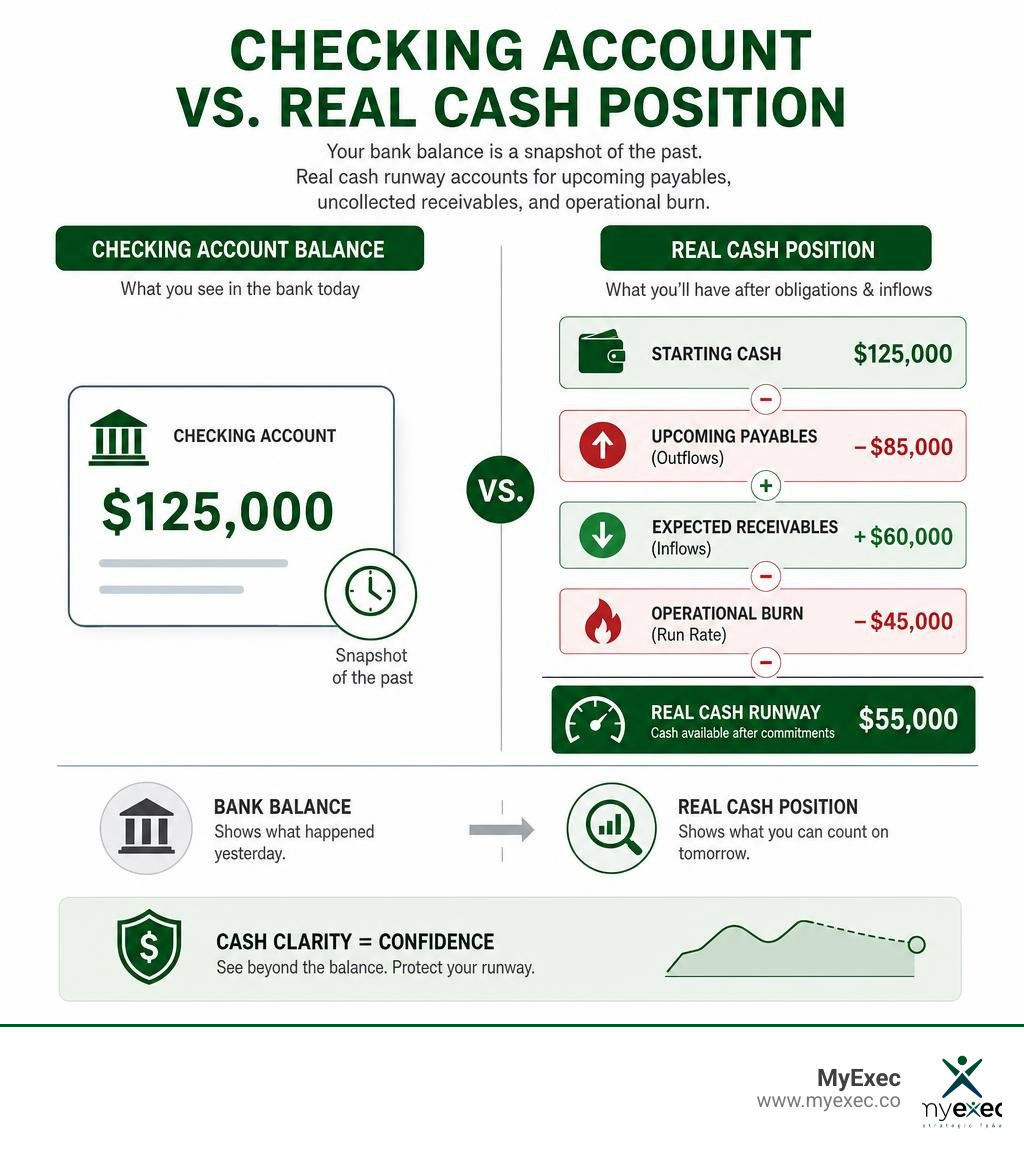
Checking Account vs. Real Cash Position
Your bank balance is a snapshot of the past. Real cash runway accounts for upcoming payables, uncollected receivables, and operational burn.
Additionally, businesses lose massive amounts of money to quiet inefficiencies. U.S. businesses lose an estimated $1.5 trillion annually to revenue leakage from billing errors, uncollected payments, and process inefficiencies. When billing systems are disorganized, invoices go out late, errors occur, and follow-ups are missed. This leakage drains cash before it ever has a chance to reach your bank account. To build a business that can scale without constant cash anxiety, you must look beyond the bank balance and adopt a forward-looking approach. For a deeper look at managing these dynamics, review our Strategic Finance Guide.
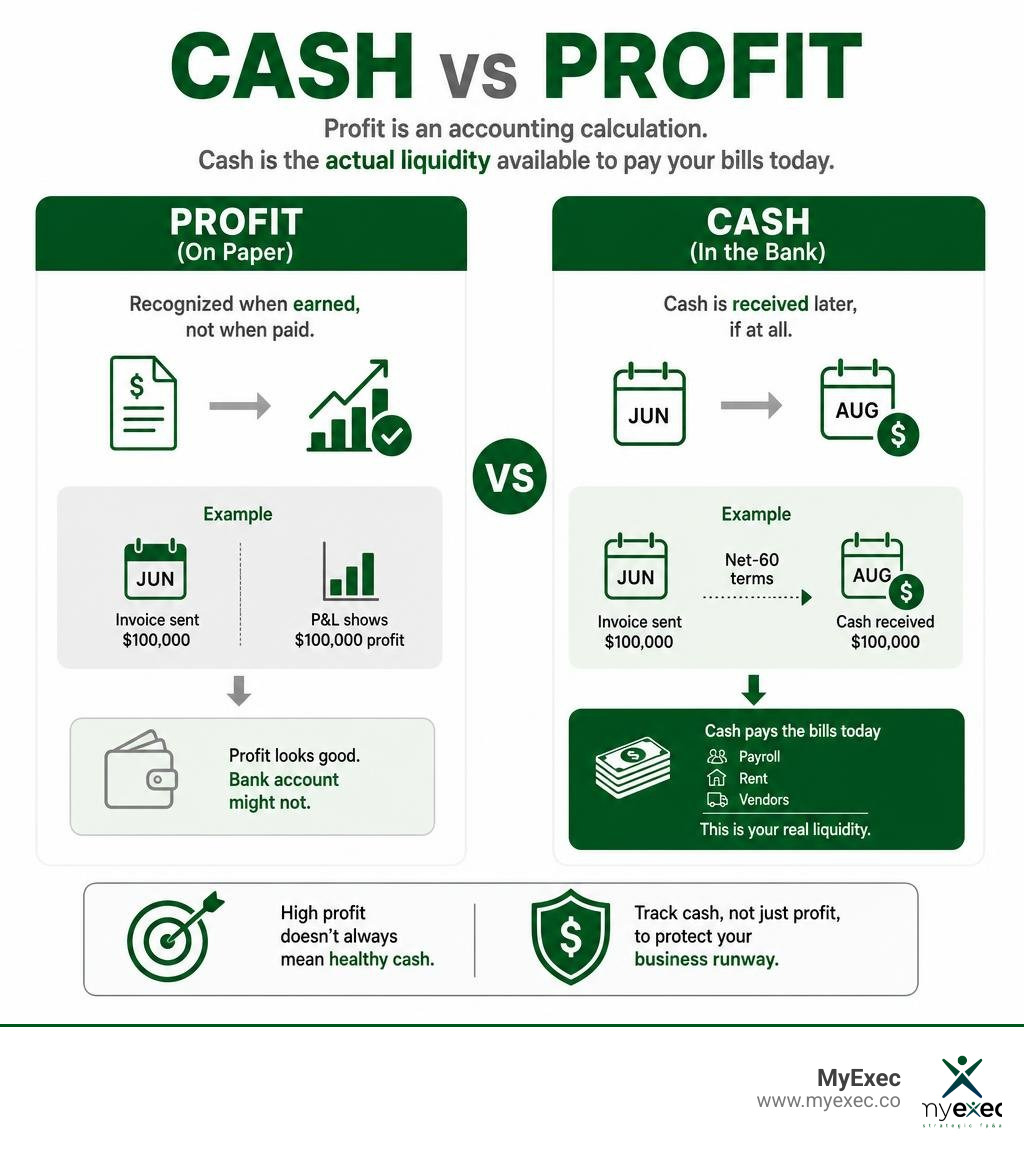
Cash vs. Profit Infographic
Profit is an accounting calculation. Cash is the actual liquidity available to pay your bills today.
What Are the Early Warning Signs of a Cash Flow Crisis?
A cash flow crisis rarely happens overnight. It leaks into your business slowly, building gradually over time. The good news is that you can often identify cash flow red flags well before they impact your profit and loss statement. By paying attention to these early indicators, you can take corrective action before a minor tight spot turns into a business-threatening emergency.
One of the most common early signs is when you realize your business is financing your customers' operations. If you are paying your suppliers on 15-day terms but allowing your customers 45 or 60 days to pay, you are acting as an unpaid lender. You are using your own working capital to bridge their timing gaps, which leaves you with less cash to fund your own growth.
The Profit-Cash Disconnect
The most confusing warning sign for many founders is the profit-cash disconnect: sales are up, but cash is down. You are celebrating record-breaking revenue months, yet you are struggling to cover basic operational costs. This disconnect usually points to a pricing, margin, or working capital problem.
When inflation or supply chain disruptions drive up your cost of goods sold (COGS), your gross margins shrink. If you use unadjusted pricing strategies, you fail to keep up with these rising costs. Guessing on pricing without unit-level profitability analysis leads to cash crunches because you are essentially selling more units at a loss or at margins too thin to cover your fixed overhead. To get a handle on this, you must actively manage your Profit and Loss Management to ensure every sale actually contributes to your cash reserves.
Accounts Receivable and Collection Drift
Your accounts receivable ledger is often where cash flow problems hide. Late customer payments, slow invoice follow-up, and unclear payment ownership can all delay cash even when sales look healthy. According to Sage's overview of common cash flow problems, slow-paying customers and weak receivables processes are recurring causes of cash flow strain for growing businesses.
To spot this issue before it becomes critical, you must track Days Sales Outstanding (DSO) against your actual payment terms. If your standard terms are net-30 and your DSO is climbing to 45 or 50 days, your collections are drifting. This drift means your cash is trapped in your customers' bank accounts instead of working in yours. For practical steps on identifying these collection gaps, read How To Identify Cash Flow Problems - Business On Purpose.
The Danger of Mixing Personal and Business Finances
For many growing businesses, especially those transitioning from founder-led operations, personal and business finances can become blurred. Overlapping accounts make it impossible to track your true cash position. When you pay for business expenses out of personal accounts, or use business cash to cover personal needs, you create a chaotic financial picture.
Undocumented owner draws and informal staff salaries drain cash without showing up properly on your monthly financial statements. This mixing of accounts also creates serious tax qualification issues and leads to surprise tax bills at the end of the year. If you do not know exactly how much cash belongs to the business and how much is personal, you cannot make accurate financial decisions.
Over-Reliance on Credit and Lines of Credit
Another clear red flag is how you use debt. If you find yourself regularly using credit cards to pay vendor invoices or cover business loans, you are in a dangerous cycle.
A revolving line of credit is designed to bridge short-term timing gaps, not to fund daily operations. If your line of credit is constantly maxed out and never gets paid down to zero, it indicates underlying unprofitability. You are using tomorrow's debt to pay for yesterday's expenses, which only compounds the problem. For more on identifying these systemic operational threats, see How to Know If Your Business Is Failing: 7 Signs & Fixes.
How Do You Distinguish Between a Temporary Cash Crunch and a Structural Issue?
When cash gets tight, you must diagnose the root cause immediately. Is this a temporary timing issue, or is it a structural flaw in your business model? Treating a structural issue with short-term debt is like pouring water into a leaky bucket: it only delays the real problem and leaves you with more debt to pay back later.
| Feature | Temporary Cash Crunch | Structural Cash Flow Issue |
|---|---|---|
| Core Cause | Timing mismatch between payables and receivables | Fundamental business model flaw or low margins |
| P&L Impact | Business is profitable on paper with positive net income | Persistent operating losses or shrinking gross margins |
| Duration | Short term, usually resolved within 30 to 90 days | Long term, persists across multiple quarters |
| Corrective Action | Short-term financing, collection acceleration, or vendor negotiation | Pricing adjustments, overhead reduction, or business model pivot |
Identifying Temporary Cash Flow Gaps
A temporary cash flow gap is a timing problem. The business is fundamentally healthy and profitable, but the timing of cash coming in does not align with cash going out.
Seasonal ups and downs are a classic example of temporary gaps. Many businesses experience peak months where cash floods in, followed by slow months where revenue drops but fixed expenses remain the same. If you do not prepare for this seasonality proactively by building reserves during peak months, you will face a predictable cash crunch during the off-season. Another common temporary gap is a simple timing mismatch, such as having to pay a major vendor for inventory today while waiting 45 days to collect payment from the customers who buy that inventory.
Recognizing Deep Structural Cash Flow Problems
A structural cash flow problem is much more serious. It means your business model is fundamentally broken, and no amount of collection acceleration will fix it.
The clearest sign of a structural issue is negative operating cash flow over multiple periods. This means the core operations of your business are losing money month after month. This often happens during periods of rapid growth. Growth eats cash faster than it generates it because you must invest heavily in upfront hiring, equipment, and inventory before you can deliver services and collect revenue.
Other structural issues include low margins and underpriced work, where your pricing does not cover your direct costs, and high fixed overhead compared to your revenue. If your fixed costs are too high, even a massive increase in sales will not generate enough cash to keep the business afloat. To evaluate these structural vulnerabilities, you can ask your team the questions outlined in Operational Risks: 5 Questions to Ask Your Finance Team.
Which Financial Metrics and Reports Should You Monitor Weekly?
To spot cash flow issues before they become critical, you must move away from monthly rearview reporting. Waiting until the middle of the following month to review your financial statements is too slow. You need real-time, forward-looking cash visibility.
Establishing a weekly financial review routine is the best way to protect your business. Running a weekly cash reconciliation compares your actual bank balance to your accounting system balance, allowing you to catch errors, billing discrepancies, and missed payments before they compound into major problems.
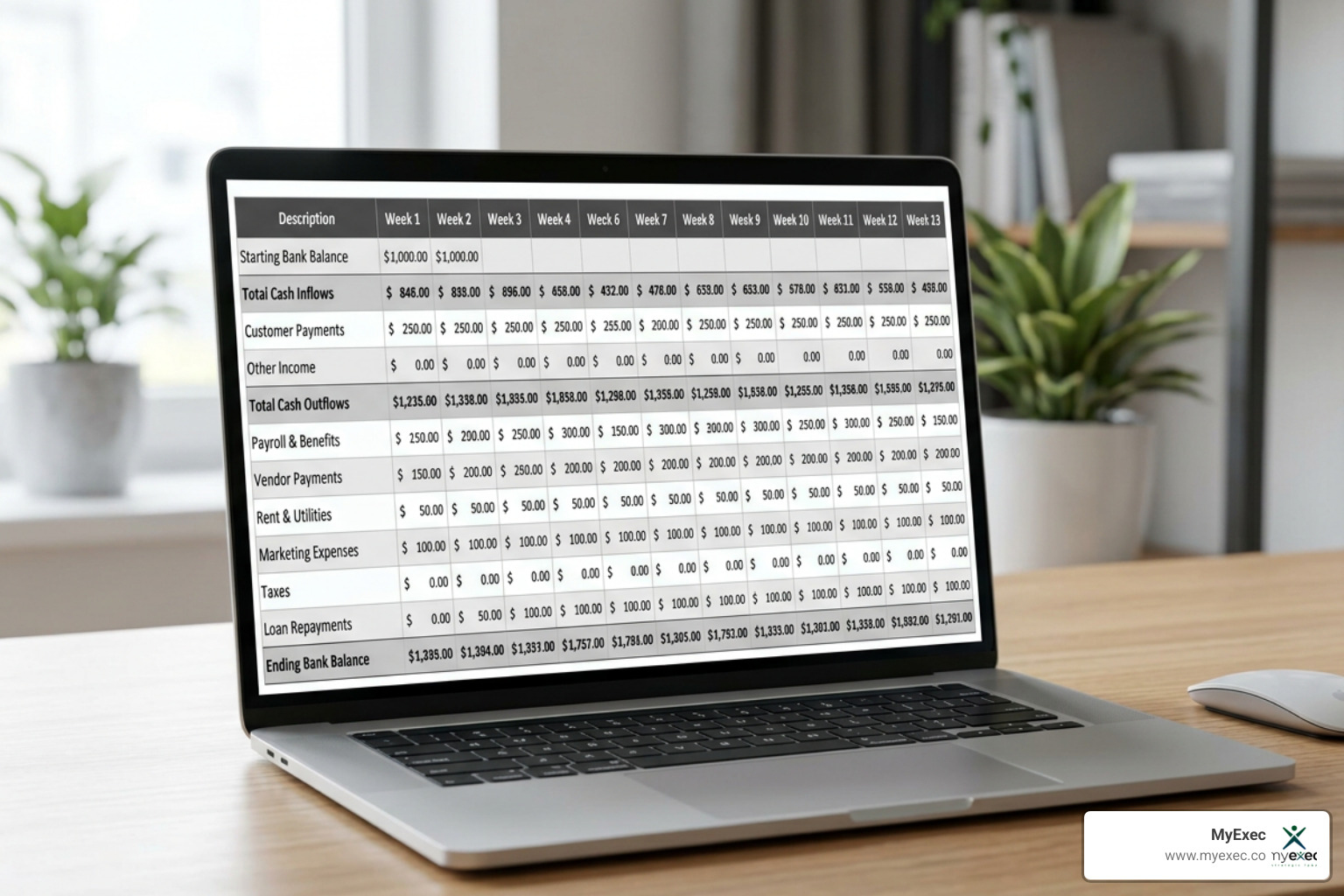
The 13-Week Rolling Cash Flow Forecast
The single most practical tool for any growing business is a 13-week rolling cash flow forecast. While a monthly budget is useful for long-term planning, a weekly 13-week forecast gives you the granular visibility you need to manage weekly payroll, vendor payments, and debt service.
To build a direct-method 13-week forecast, follow these steps:
- Start with your real, available cash position: Begin with your current bank balance, excluding any restricted cash or funds already committed to uncleared checks.
- Map your non-negotiable outflows: Place all fixed, predictable expenses on the calendar for the next 13 weeks. This includes payroll, rent, utilities, tax payments, and debt service.
- Forecast collections based on historical behavior: Do not look at your sales pipeline or assume customers will pay on their exact invoice due dates. Instead, review your accounts receivable aging report and forecast collections based on when those customers actually pay. If a client historically pays 15 days late, schedule their payment for 15 days past the due date.
- Add a small buffer line: Include a weekly buffer line for unexpected expenses. This ensures that a single surprise bill does not completely derail your financial plan.
By updating this forecast every week, you can see cash dips three to six weeks before they happen, giving you plenty of time to adjust your spending or accelerate collections.
Key Cash Flow Metrics to Track
In addition to your 13-week forecast, you should track a few key cash flow metrics on your Financial Reporting Dashboard to monitor the overall financial health of your business:
- Days Cash on Hand (DCOH): This measures your cash runway. It tells you how many days your business can survive if all revenue instantly stopped. Calculate it by dividing your current cash balance by your average daily operating expenses.
- Operating Cash Flow Conversion Ratio: This tracks your working capital efficiency. It measures how effectively your net income converts into actual cash. Calculate it by dividing your operating cash flow by your net income. If this ratio stays below 80% for two consecutive quarters, your working capital is tied up in inventory or unpaid invoices.
- Days Sales Outstanding (DSO): This monitors your collection efficiency. It tells you the average number of days it takes to collect payment after a sale is made. Watch for any upward trend, which indicates that collections are slowing down.
- Inventory Turnover Rate: If your business holds physical inventory, this metric is critical. It measures how many times you sell and replace your inventory over a period. A low turnover rate means cash is sitting on your warehouse shelves in the form of slow-moving stock.
How Can You Fix Cash Flow Problems Before They Become Critical?
Once you identify a cash flow issue, you must act quickly. Managing your cash flow effectively requires taking proactive control of your cash conversion cycle. This means finding ways to speed up the cash coming into your business while strategically managing the cash going out.
Short-Term Cash Flow Fixes
If you need to improve your cash position immediately, there are several tactical levers you can pull:
- Accelerate your receivables: Offer your customers early payment discounts, such as a 2/10 net 30 term, which gives them a 2% discount if they pay within 10 days instead of 30. Additionally, set up automated payment reminders that go out at day 7, 14, and 21 past the due date.
- Manage your payables strategically: Do not pay your bills earlier than necessary. Match your vendor payment schedule exactly to their terms. If a supplier offers net-45 terms, pay on day 44, not day 15. For key suppliers, reach out and transparently negotiate extended terms before you miss a payment.
- Audit recurring expenses: Run a quick audit of your software subscriptions and vendor contracts. Most growing businesses run 15 to 30 software subscriptions, many of which are unused or duplicated. Cancel nonessential subscriptions to immediately reduce your monthly cash burn.
Long-Term Cash Flow Strategies
While short-term fixes can help you survive a temporary crunch, you need long-term strategies to build permanent financial stability:
- Build a cash reserve: Aim to build a cash reserve that covers 3 to 6 months of operating expenses. Set a monthly savings goal and treat it as a non-negotiable expense until your reserve is fully funded.
- Strengthen your pricing strategy: Move away from competitor-based guessing and build your pricing on detailed unit-level profitability analysis. Ensure your margins are wide enough to absorb rising costs and support your operational overhead.
- Automate your financial processes: Implement automated invoicing and payment collection systems. Reducing manual steps in your billing process minimizes errors, speeds up invoice delivery, and makes it easier for customers to pay you via ACH or credit card. To understand how these improvements build enterprise value, read Increase Business Value with Smarter Financial Reporting.
When to Bring in Professional Financial Support
Many business owners struggle to manage cash flow because they do not have the right financial leadership. It is important to understand the difference between a CPA and a CFO. A CPA is excellent for historical bookkeeping, tax compliance, and clean financial records. However, a CPA looks backward. A CFO looks forward, focusing on strategy, forecasting, capital planning, and cash optimization.
For businesses generating between $5M and $50M in revenue, hiring a full-time, seasoned CFO is often too expensive. That is where we come in. At MyExec, we provide full-stack Fractional CFO Consulting and FP&A services. We deliver senior finance leadership, strategic forecasting, and KPI design at a fraction of the cost of a full-time hire.
We believe that strategic finance experience, scale experience, and the ability to turn financial data into business decisions matter far more than credentials alone. Our goal is to help you build a highly profitable, cash-healthy business, guiding you to the point where a fractional model is no longer enough. When you are ready for a full-time CFO, we will help you define the role, find the right person, and transition your finance function cleanly.
What Are the Most Common Questions About Cash Flow Management?
Managing cash flow can be incredibly challenging, and business owners often have the same core questions when trying to navigate liquidity constraints.
Can a highly profitable business still run out of cash?
Yes, highly profitable businesses run out of cash all the time. Profitability and cash flow are entirely different financial concepts. Profit is calculated on an accrual basis, showing revenue when a sale occurs and expenses when they are incurred.
Cash, however, is the actual money moving in and out of your bank accounts. Your P&L can show record-breaking profits, but that cash can easily get trapped in several places:
- Accounts Receivable: Your customers are taking 60 to 90 days to pay their invoices.
- Inventory: You have purchased raw materials or finished goods that are sitting in your warehouse unsold.
- Debt Principal Payments: Principal payments on business loans reduce your cash balance but do not show up as expenses on your P&L.
- Owner Draws: Discretionary distributions to owners drain cash directly from the balance sheet without affecting net income.
Additionally, rapid growth is incredibly cash-intensive. You must hire staff, purchase inventory, and fund operations upfront to support new sales, which can drain your cash reserves long before you collect the revenue from those new customers.
How much cash reserve should a growing business maintain?
The right cash reserve depends on your business model, revenue predictability, and market volatility.
For most growing businesses, a common starting point is one to three months of operating expenses. This provides a basic safety net to cover payroll and essential overhead during a minor disruption.
However, if your business has less predictable cash flow, high seasonality, or significant customer concentration risk, you should aim for a minimum of three to six months of operating reserves. Having a larger buffer ensures that the loss of a major client or a prolonged slow season will not force you into a sudden liquidity crisis.
When is a line of credit the wrong solution for cash flow issues?
A line of credit is an excellent tool for managing short-term timing gaps. For example, if you need to cover payroll this week while waiting for a guaranteed, high-probability customer payment that is arriving next week, a line of credit is the perfect bridge.
However, a line of credit is the wrong solution if you are using it to cover structural losses, low profit margins, or uncontrolled spending. Debt does not solve unprofitability; it only masks it. Using a line of credit to fund ongoing operational losses adds interest expenses to your overhead, making your business even less profitable and compounding the cash flow problem over time. If your business cannot survive without constantly carrying a balance on your line of credit, you have a structural issue that requires immediate operational changes, not more debt.