Understanding the Importance of an Annual Business Valuation
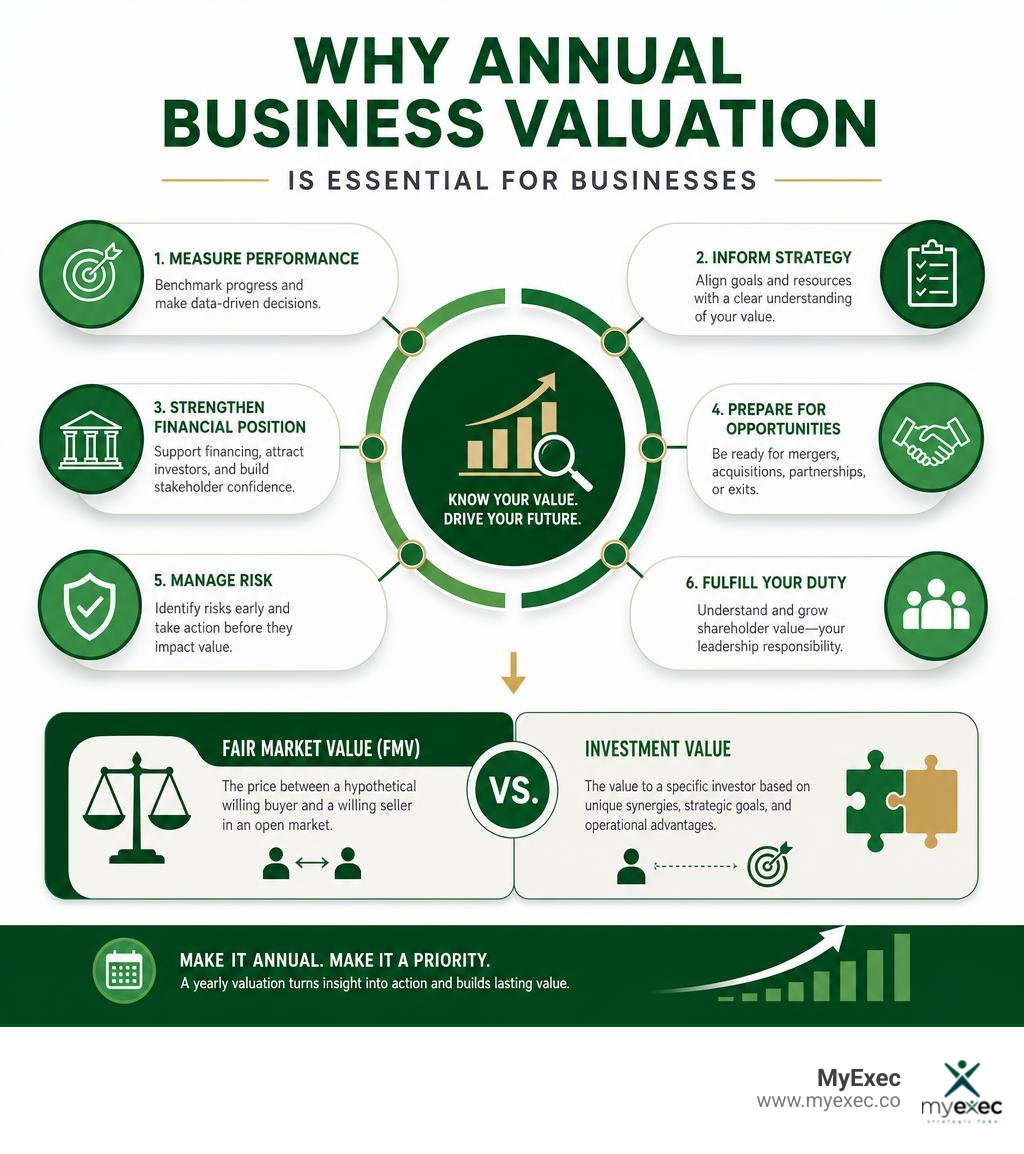
Treat your business like a vehicle for growth and think of an annual valuation as your yearly tune-up. If you only check under the hood when the engine starts smoking, you are setting yourself up for an expensive breakdown.
An annual business valuation is a comprehensive financial assessment that calculates the total economic value of your company. For growing U.S. businesses in July 2026, keeping this number updated is not just a good habit, it is a strategic necessity. A formal valuation analyzes your financial records, historical performance, assets, liabilities, and broader market conditions to establish what your business is actually worth.
Many business owners view valuation as a reactive task. They only order one when they are preparing to sell, facing a partnership dispute, or applying for a major loan. However, this reactive approach ignores the fundamental duty of company leadership.
Back in 1919, the Michigan Supreme Court ruled in the landmark case Dodge v. Ford Motor Co. that a business corporation is organized and carried on primarily for the profit of the stockholders. This legal precedent implied that maximizing shareholder value is an executive's primary legal and operational duty. If your main job is to build value, you must know what that value is on a consistent basis.
When you conduct a valuation every single year, it transforms from a transactional trigger into a year-end benchmarking tool and performance scorecard. It gives you a objective baseline to measure whether your strategic decisions are actually building equity or just generating busywork.
To use this scorecard effectively, you must understand the difference between two primary standards of value:
- Fair Market Value (FMV): This is the price at which a property would change hands between a hypothetical willing buyer and a willing seller on the open market. Neither party is under any compulsion to buy or sell, and both have reasonable knowledge of the relevant facts.
- Investment Value: This represents the specific value of the business to a particular investor. It takes into account their unique synergies, strategic goals, and operational advantages. For example, a strategic buyer in New York, NY might pay a premium well above FMV for a logistics firm in Reading, PA because they can integrate it into their existing distribution network.
By understanding these standards, you can better align your internal growth plans with realistic market expectations.
How Does an Annual Valuation Drive Strategic Planning and Performance Tracking?
As the famous statistician Karl Pearson once wrote, "That which is measured improves. That which is measured and reported improves exponentially." This principle lies at the heart of strategic financial planning.
When you compare year-over-year valuations, you can benchmark company performance over time with extreme precision. Standard profit and loss statements only tell part of the story. You might show rising revenues, but if your operational efficiency is slipping or your customer concentration is rising, your overall business value might actually be shrinking.
An annual valuation forces you to track the key value drivers that institutional buyers and lenders care about most:
- Revenue Growth and Quality: Is your revenue recurring, or do you have to chase new contracts every single month?
- Profit Margins: Are your margins expanding, or are rising costs eating away at your bottom line?
- Customer Concentration: Do you rely on one or two clients for the majority of your sales?
- Operational Efficiency: How effectively do you turn working capital into cash flow?
Our fractional CFOs and FP&A teams help mid-market businesses prepare their financial data and build the detailed financial models required to track these metrics. By implementing smarter financial reporting, we help you see how daily operational decisions impact your total enterprise value.
Tracking these business performance metrics allows you to make data-driven adjustments to your business model. If you see that your valuation multiple is lagging behind industry peers due to weak cash flow, you can pivot your strategy to prioritize collections and inventory management before it impacts your borrowing capacity.
What Are the Key Financial and Operational Benefits of a Yearly Valuation?
Standard accounting software and balance sheets are designed for tax compliance, not strategic management. Because of this, they often fail to capture the true economic power of your business.
One of the greatest benefits of an annual valuation is its ability to uncover hidden, intangible assets. Things like brand reputation, proprietary software, customer loyalty, and intellectual property rarely show up on a standard balance sheet. A professional valuation quantifies these assets, giving you a more accurate picture of your company's real worth.
Additionally, the valuation process acts as an operational diagnostic. It helps you identify efficiencies and inefficiencies by analyzing the relationship between your expenses and your profits over time.
Consider a real-world use case. A growing food service and manufacturing company in Baltimore, MD reviews its annual valuation report. The analysis reveals that while their retail storefronts generate high gross revenue, their margins are thin and operational costs are high. Meanwhile, their corporate catering division has incredibly high margins and low overhead.
With this insight, the owners decide to shift their capital, marketing budget, and new hires away from retail expansion and focus on growing corporate catering. This operational pivot, driven directly by valuation data, increases their profitability and enterprise value over the next twelve months.
Regular valuations also establish a clear baseline for capital reinvestment planning. When you know your exact financial position, you can make smarter decisions about whether to buy new equipment, hire key executives, or open a new office.
To help you understand how these valuations are calculated, our team utilizes three primary approaches depending on your industry and stage of growth. We have outlined these approaches in the table below:
| Valuation Approach | Core Methodology | Best Used For |
|---|---|---|
| Income Approach | Calculates value based on expected future cash flows (e.g., Discounted Cash Flow) | High-growth companies and businesses with predictable cash flows |
| Market Approach | Compares the business to recent sales of similar companies in the same sector | Industries with abundant transaction data and public comparables |
| Asset-Based Approach | Adjusts the book value of company assets and liabilities to reflect their current fair market value | Asset-heavy businesses, holding companies, or liquidation scenarios |
By using a combination of these methods, we can perform a deep profitability analysis and build a dynamic financial reporting dashboard that keeps your leadership team aligned.
How Do Annual Valuations Support Risk Management and Financial Stability?
Regular valuations act as a vital diagnostic tool to spot operational vulnerabilities before they escalate into major crises. One of the most common risks we see in mid-market companies is customer concentration risk. If 40% of your revenue comes from a single client, your business is highly vulnerable. An annual valuation will clearly show how this concentration depresses your valuation multiple, prompting you to diversify your client base.
Valuation data also helps you assess your true debt capacity and solvency ratios. If you are planning an expansion, you need to know if your balance sheet can safely support additional leverage. Lenders will look closely at your debt-to-equity and interest coverage ratios. An up-to-date valuation ensures you present these metrics in the best possible light.
Furthermore, having a pre-existing annual valuation precedent is one of the best ways to prevent partner disputes. In multi-owner businesses, sudden triggering events like death, disability, retirement, or divorce can throw the company into chaos.
If you do not have an agreed-upon valuation process, partners or heirs may accuse each other of bias and launch expensive legal battles. An annual valuation, prepared by an independent third party, sets a clear, unbiased precedent that everyone can trust.
Finally, documented annual valuations protect you against aggressive tax audits. The IRS looks closely at business transitions, estate transfers, and gift taxes. Having a consistent, multi-year paper trail of professional valuations makes it much harder for the IRS to challenge your asset values.
To evaluate your company's current risk profile, you can start with our strategic finance assessment to identify gaps in your reporting and risk management structures.
In What Ways Does a Yearly Valuation Assist with Succession, Exit, and Tax Planning?

Every business owner will eventually exit their company. Whether you plan to pass the business to your children, sell to a competitor, or transition ownership to your employees, success requires advanced planning.
Keeping your business transaction-ready is a major benefit of annual valuations. When you have a clean, documented history of your company's value, you can respond to sudden opportunities or transition plans without delay. Having these records on hand dramatically reduces the time and stress of exit planning.
Annual valuations are also essential for navigating estate, gift, and tax planning. If you want to transfer shares of your business to family members, you can often apply valuation discounts for lack of control or lack of marketability. These discounts can legally reduce the taxable value of the transferred shares, saving your family significant money in estate and gift taxes.
Additionally, documented valuations support tax-efficient executive compensation. If you want to retain key leadership with share-based compensation, you must establish a defensible fair market value. Proper valuations allow you to structure these incentives so they are characterized as capital gains rather than ordinary income, which carries a much lower tax rate.
For businesses that operate an Employee Stock Ownership Plan (ESOP), annual valuations are not optional. Under ERISA regulations, ESOP-aligned companies are legally required to update their stock valuations every year to ensure employees are receiving fair value for their shares.
Whether you are planning an exit or setting up an incentive plan, our team can guide you through the process of obtaining compliant business valuations.
How Does an Annual Valuation Prepare Your Business for M&A or Financing?
If you want to raise capital, secure a bank loan, or sell your business, you must be able to prove what your company is worth.
An up-to-date valuation is your ticket to a smooth transaction. When you present institutional lenders or private equity investors with a professional valuation report, you instantly build trust. It shows that you have financial discipline and that your financial projections are based on hard data, not wishful thinking.
It is also important to understand how different buyers will look at your business:
- Strategic Buyers: These buyers are looking for synergies. They want to know how your company fits into their existing operations. Because they can often cut redundant costs or cross-sell to your database, they are usually willing to pay a premium.
- Private Equity Groups: These financial buyers are focused on cash flow, EBITDA multiples, and return on investment. They want to see a clean, stable financial history and a strong management team.
Having an annual valuation allows you to negotiate from a position of strength, especially if you receive an unsolicited buyout offer. If a competitor makes a sudden bid for your company, you do not have to scramble to figure out if it is a fair deal. You will already know your baseline value and can counter with confidence.
Our fractional CFOs can streamline this entire process for you. We handle the heavy lifting of data gathering, organize your historical financial statements, and build the necessary financial models to support your valuation.
We can help you prepare for these transitions by assessing your M&A financial readiness. If you need to raise capital, we can assist in creating a financial model to raise capital and guide you in deciding if a business investment is worth it.
What Are the Most Common Questions About Annual Business Valuations?
How often should a business be valued, and what factors influence the frequency?
For mid-market companies with revenues between $5M and $50M, an annual schedule is the industry standard. This frequency ensures that your financial data remains fresh and useful for strategic planning.
However, certain factors can influence how often you need an update. If your business is experiencing rapid growth, navigating extreme market volatility, or preparing for an upcoming transaction, you may need to update your valuation more frequently. Additionally, compliance requirements, such as ESOP plans or annual estate gifting programs, will dictate a strict annual schedule.
Keeping these records updated year-over-year is significantly faster and more cost-effective than starting from scratch every few years.
What are the common methods used in business valuations?
Valuation professionals rely on three primary methods:
- Income-Based Methods: These methods, such as a Discounted Cash Flow (DCF) analysis, calculate the present value of your company's future cash flows. This is highly useful for businesses with predictable earnings.
- Market-Based Methods: This approach looks at transaction data from similar companies that have recently sold in your industry. It helps establish a realistic multiple of EBITDA or revenue.
- Asset-Based Methods: This method adjusts the book value of company assets and liabilities to reflect their current fair market value. It is typically used for asset-heavy businesses, holding companies, or liquidation scenarios.
Do I need a certified professional to perform the valuation?
Yes. To be legally defensible and reliable for lenders, investors, the IRS, or the courts, your valuation must be conducted by a qualified expert. Look for professionals who hold accredited credentials such as:
- CVA (Certified Valuation Analyst)
- ABV (Accredited in Business Valuation, typically held by CPAs)
- ASA (Accredited Senior Appraiser)
MyExec has a CVA on staff, giving clients direct access to certified valuation expertise. Our full-stack finance team prepares your financial data, builds the underlying models, and supports the valuation process so it is smooth, accurate, and cost-effective.
How Can MyExec Help You Build and Measure Enterprise Value?
If your business is generating between $5M and $50M in revenue, you are likely outgrowing founder-led finance. You need senior-level financial guidance, but you might not be ready for the expense of a full-time, in-house CFO.
That is where we come in. MyExec provides fractional CFO and FP&A services designed specifically for growing mid-market companies.
We do not believe in one-size-fits-all retainers. Our unique service model provides flexible, scalable full-stack finance support. Depending on your current needs, complexity, and stage of growth, we can provide senior CFO leadership, analyst-level execution, or a mix of both.
Our team has deep operational experience. We have worked across companies ranging from a few million in revenue up to roughly $2B. Our background includes working with:
- Nonprofits
- Private equity owned businesses
- Closely held private companies
- Publicly traded organizations
Our ultimate goal is to help you grow until a full-time CFO makes sense. When that day comes, we will help you define the role, find the right candidate, and transition your financial operations cleanly.
We focus on the strategic finance initiatives that actually drive enterprise value, including:
- Dynamic forecasting and budgeting
- Custom KPI design and performance tracking
- Capital planning and cash flow optimization
- Transaction and M&A support
- Turning complex financial data into clear business decisions
To learn more about how we can support your growth, check out our full range of Services or read more about our approach to Business Valuations.