The Revenue Quality Spectrum: Contracted, Recurring, and Repeat Revenue

Recurring revenue increases business valuation multiples, lowers buyer risk, and stabilizes cash flows. When buyers evaluate a privately held company, they don't treat every dollar of revenue the same. Two companies generating $15 million in top-line sales with identical operating expenses can have radically different enterprise values based solely on revenue quality. In lower-middle-market deals, revenue durability dictates how much confidence an acquirer places in your forward projections.
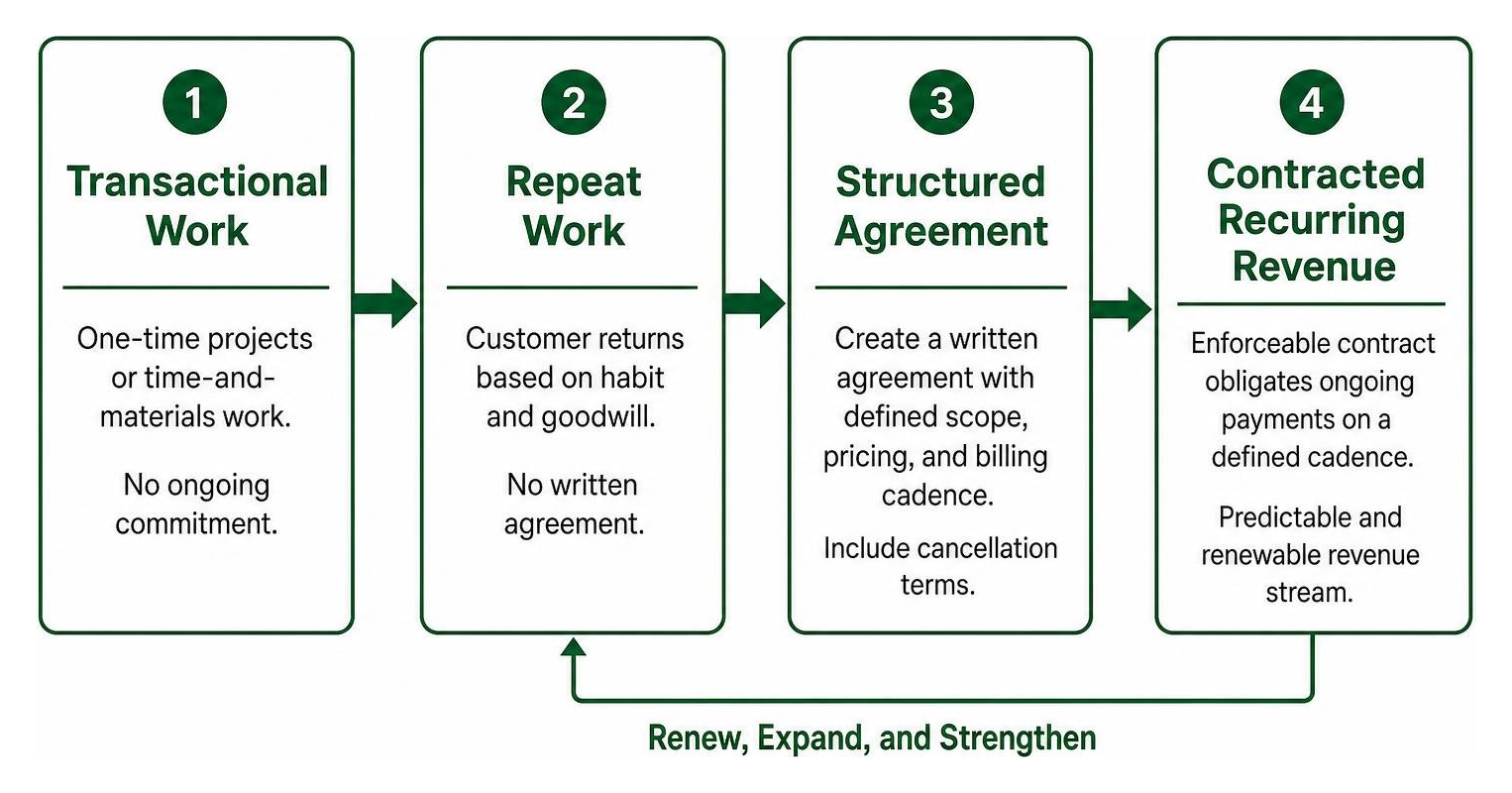
In traditional service agreements, commercial maintenance plans, and distribution retainers, revenue falls along a distinct spectrum. On one end sits one-time project revenue, which forces your sales team to win every single dollar from scratch each quarter. In the middle sits habitual repeat business, where loyal clients return frequently out of habit but without legal commitments. On the highest tier sits multi-year contracted recurring revenue, where customers agree in writing to pay on an ongoing schedule with clear renewal terms.
| Revenue Model | Predictability | Buyer Risk | Valuation Multiple Tendency |
|---|---|---|---|
| Transactional or project revenue | Lower | Higher | Typically lower, all else equal |
| Repeat customer revenue | Moderate, depends on repurchase history | Moderate | Context-dependent |
| Contracted recurring revenue | Higher, depends on contract terms and renewals | Lower, all else equal | Typically higher, all else equal |
Defining Contracted vs. Repeat Revenue in Non-Software Companies
Many founders of commercial trade services, equipment dealerships, and logistics firms assume their repeat clients count as recurring revenue. They don't.
Contracted recurring revenue requires an enforceable written agreement that obligates the client to pay on a defined billing cadence. This includes multi-year Master Service Agreements (MSAs), structured preventive maintenance plans, and ongoing advisory retainers with written cancellation windows and auto-renewal clauses.
Informal repeat business, by contrast, relies entirely on customer habit and goodwill. If a commercial HVAC contractor services the same warehouse fleet every year on a time-and-materials basis without an active service contract, that income is repeat revenue. If the facility manager changes or a competitor bids lower, that work can evaporate overnight. When assessing how to value a business, valuation professionals separate contractual commitments from repeat buying patterns to gauge genuine risk.
Valuation Multiples Across Revenue Types
Market transaction data consistently reflects a valuation premium for contracted revenue streams. In the lower middle market, business valuation multiples expand as revenue predictability rises. According to published market studies from the International Business Brokers Association (IBBA) and M&A Source for Q1 2026 transactions, median multiples for main-street and lower-middle-market deals typically run between 2.0x and 3.0x Seller's Discretionary Earnings (SDE) for businesses under $2M, and around 4.0x EBITDA for companies generating $2M to $5M in earnings.
However, companies that lock in long-term contractual streams command significantly higher enterprise values. For example, a business where over 70% of revenue stems from contracted service agreements can trade at 5.0x to 7.0x EBITDA or higher, while a peer with purely project-based income often sells for 2.5x to 3.2x EBITDA.
When preparing a formal valuation, valuation professionals frequently apply a blended multiple analysis across mixed-revenue firms:
- Contracted Service Agreements (3+ year terms): Valued at upper-tier market multiples (5.0x to 6.0x EBITDA or higher).
- Annual Retainers and Programmatic Maintenance: Valued at mid-tier multiples (4.5x to 5.5x EBITDA).
- Month-to-Month Agreements: Valued at moderate multiples (4.0x to 4.5x EBITDA).
- Repeat and Project Work: Valued at lower baseline multiples (2.5x to 3.5x EBITDA).
By weighting each revenue stream by its contribution to gross profit, buyers calculate a composite multiple that directly penalizes uncontracted sales and rewards predictable cash flows.
How Recurring Revenue Affects Business Valuation and Perceived Buyer Risk
Valuation math comes down to expected future cash flows and the risk of those cash flows failing to materialize. When business owners ask when a revenue multiple works, the answer often depends on how contractually secure those cash flows are.
When a buyer purchases an owner-led business, their primary concern is downside risk: will revenue decline once the founder steps away? Contracted recurring revenue creates an enterprise value floor. It provides assurance that base operational costs are covered on day one after closing, leaving less room for post-acquisition performance shocks.
Cash Flow Predictability and Discount Rates in Formal Valuations
In formal business valuations, such as a Discounted Cash Flow (DCF) model, future earnings are discounted back to present value using a discount rate that reflects business risk and the cost of capital.
Unpredictable project revenue carries higher forecast volatility, which increases the required rate of return and inflates the discount rate. A higher discount rate shrinks the present value of the business. Conversely, contracted revenue stabilizes cash flows, improves forecast reliability, and lowers the discount rate, producing a higher valuation.
Predictable cash flows also increase commercial borrowing capacity. Lenders underwriting an acquisition can offer more favorable debt terms when supported by locked-in service contracts, allowing financial buyers to pay higher purchase prices.
Contract Terms, Renewal Clauses, and Transferability
Not all service contracts carry equal weight in due diligence. Buyers and their legal teams scrutinize the specific contract language to ensure revenue durability:
- Assignment and Change of Control: Contracts must allow assignment to a new owner without requiring explicit customer consent. If an agreement terminates upon a change of control, the buyer bears the risk of renegotiating every account.
- Auto-Renewal Terms: Agreements that automatically renew for 12-month terms unless canceled with 60 or 90 days' written notice provide far greater valuation support than agreements that expire annually without notice.
- Cancellation Windows and Termination for Convenience: A multi-year agreement that allows a customer to cancel at will with 14 days' notice provides little real security and will be discounted by buyers.
While owners should consult their attorney regarding legal terms, structuring contracts with clear transferability and practical renewal incentives protects transaction value.
Core Metrics Buyers Diligence: Churn, Retention, and Revenue Per Client
During sell-side due diligence, buyers will evaluate customer cohorts rather than accepting top-line summaries. In our client engagements, we build KPI scorecards tracking customer acquisition cost, average revenue per customer, and net revenue retention to establish clear revenue durability.

How Churn and Retention Rates Shape Valuation
Customer churn directly impacts the sustainability of your earnings. High churn forces a business to continuously spend money acquiring new customers just to stay flat, eroding operating margins.
Buyers assess two distinct retention metrics:
- Gross Revenue Retention (GRR): The percentage of recurring revenue retained from existing clients over a given period, excluding expansion. High GRR (consistently above 85% to 90% in commercial service businesses) proves customer loyalty and contract stickiness.
- Net Revenue Retention (NRR): Total revenue retained from existing clients, including upsells, service expansions, and price adjustments, minus churn. An NRR above 100% indicates that the existing customer base expands organically, offsetting lost accounts.
A company with low customer churn signals strong pricing power and client satisfaction, giving buyers confidence to stretch their valuation multiples.
Customer Concentration and Average Revenue Per Customer
Even a high percentage of recurring revenue can be undercut by poor diversification. If a single contract generates 30% of your total earnings, the loss of that one relationship threatens the company's solvency. Acquirers frequently demand purchase price reductions, earnouts, or escrow holdbacks to offset severe customer concentration risks.
Tracking Average Revenue Per Customer (ARPC) helps demonstrate that contract value is distributed across a healthy client base. Consistent account sizes with disciplined annual pricing reviews demonstrate that recurring revenue is scalable and not reliant on founder-led sweetheart deals.
Strategic Playbook: Transitioning to Recurring Contracts Before Budget Season
Transforming a transactional business into a contracted recurring model takes time, typically requiring 12 to 24 months of consistent execution before taking a company to market. Budget season is the ideal window to introduce multi-year agreements as commercial clients plan their upcoming annual spend.
Here is a practical sequence for converting project customers into contracted accounts:
- Audit Historical Work Orders: Review the past 24 to 36 months of invoices to identify customers who routinely purchase scheduled maintenance, periodic inspections, or routine replenishment.
- Standardize Service Bundles: Package fragmented, ad-hoc services into structured, tiered service plans that cover baseline preventive maintenance and emergency response.
- Offer Priority Terms: Incentivize clients to sign annual agreements by offering priority dispatch scheduling, locked-in labor rates, and proactive equipment monitoring.
- Shift Account Management to Systems: Move day-to-day client communications from the founder's personal inbox to structured account management processes with automated billing cycles.
- Formalize Renewal Tracking: Implement systems that alert account managers to renewal windows 90 days in advance, ensuring agreements renew smoothly.
Following this structured playbook is a proven way of making your business more valuable ahead of an exit.
Packaging Maintenance Agreements and Retainers for 2027
To make recurring agreements appealing to clients setting their 2027 budgets, focus on operational risk mitigation. For commercial trade and distribution clients, equipment downtime and unscheduled outages carry high costs.
Position annual maintenance plans as operational insurance. Offer tiered agreements:
- Base Tier: Scheduled preventive inspections and regulatory compliance testing.
- Standard Tier: Scheduled inspections plus priority emergency scheduling and discounted parts.
- Comprehensive Tier: Full-coverage equipment lifecycle management, ongoing monitoring, and annual system tune-ups.
Structured multi-year agreements with annual CPI price adjustments protect your margins against inflation while creating clean, auditable recurring revenue.
Documenting Revenue Quality for Sell-Side Due Diligence
To receive full valuation credit for recurring revenue, you must prove its quality with organized data. Acquirers will not rely on informal claims. They will demand proof during financial due diligence.
Owners should maintain:
- A Detailed Contract Register: An up-to-date schedule tracking customer names, start dates, renewal windows, cancellation notice periods, billing cadences, and historical price increases.
- Cash Reconciliation Reports: Documentation tying contracted billings directly to general ledger cash receipts over the trailing twelve months.
- Monthly Renewal Schedules: Tracking on-time renewals, upgrades, and cancellations by cohort.
Securing higher multiples requires investment in your accounting operations. Achieving meaningful financial reporting improvements ensures clean due diligence and keeps transactions on schedule.
Frequently Asked Questions About Recurring Revenue and Business Valuation
What counts as recurring revenue for a company that is not a software business?
For non-software businesses such as commercial trades, distribution, and industrial service firms, recurring revenue consists of contracted, predictable service agreements. Examples include scheduled commercial HVAC maintenance plans, fleet preventive maintenance retainers, regular security or fire-alarm monitoring agreements, scheduled water treatment inspections, and recurring consumable supply agreements with minimum purchase obligations.
Is repeat customer revenue worth as much as contracted revenue?
No. While repeat customer revenue indicates customer satisfaction, it lacks contractual certainty. Repeat customers must be re-won continuously, leaving the door open for competitors to underbid or for new client managers to switch vendors. Contracted revenue legally binds the customer, creates switching hurdles, and provides clear visibility into forward cash flows, which commands higher valuation multiples.
How do buyers measure churn and retention in service and distribution companies?
Buyers evaluate customer churn and retention by reviewing trailing 24- to 36-month customer cohort reports. They measure Gross Revenue Retention (revenue retained from existing clients excluding upgrades), Net Revenue Retention (net revenue retained including price increases and expanded scope), and Logo Churn (the percentage of individual customer accounts lost over a period).
Building Recurring Revenue Before You Sell
Understanding how recurring revenue affects business valuation helps you build durable value well before entering the market. Converting transactional work into defensible, contracted agreements lowers perceived buyer risk, increases debt capacity, and expands your valuation multiple.
At MyExec, we provide fractional CFO and FP&A services tailored for growing U.S. businesses with $5M to $50M in revenue that are ready to professionalize their financial operations. Our support is flexible and scalable, giving you access to senior CFO leadership, hands-on FP&A analysts, or a combined team based on your company's stage and complexity. We have worked across organizations ranging from early-stage businesses generating a few million in revenue to enterprises approaching $2B, including private equity portfolio companies, closely held family businesses, nonprofits, and publicly traded firms.
We have helped multiple clients improve enterprise value through planning, forecasting, and dynamic scenario modeling. In our client engagements, we have:
- Implemented cash flow forecasts and rolling 13-month P&L forecasts to improve cash visibility.
- Performed sensitivity and scenario analysis that helped client leadership make better decisions and improve cash flow and value over time.
- Delivered advanced analysis, decision support, and margin optimization, including building integrated three-statement models for new product launches and mergers and acquisitions.
- Deployed critical KPI scorecards tracking customer acquisition cost, average revenue per customer, and net revenue retention.
- Applied deep capital allocation expertise to guide strategic investments and improve the quality and speed of monthly reporting.
If you are planning an exit or want to see how your current revenue structure shapes what your company is worth, try our interactive business valuation calculator to explore valuation ranges and plan your next steps.