Choose the Advisor Who Fits Your Sale

To choose an M&A advisor, start with deals like yours. Ask which sales they've closed at your company's size, who will run your deal day to day, and how they'll prepare your business before contacting buyers. Then test their plan for finding qualified buyers and protecting confidential information. Speak with owners they've worked with before you decide.
For an owner planning to sell in the next one to three years, the right advisor does more than find a buyer. They help show the value of what you've built and guide a sale process that fits your goals. Start the conversation early enough to address gaps in your financial readiness before buyers see them. The U.S. lower-middle-market transaction environment rewards owners who enter a sale with clean reporting, defensible forecasts, and a clear view of how their business will be positioned.
Understanding the Role: M&A Advisors vs. Business Brokers
When you decide to sell your company, choosing the right intermediary shapes your entire transaction experience. Business owners often hear terms like business broker, M&A advisor, and investment banker used interchangeably. While all three facilitate business sales, their operational approaches, buyer networks, and target deal sizes differ significantly.
Business brokers typically handle smaller, main-street businesses. They frequently rely on public business-for-sale databases and general listings, running broad outreach campaigns to find individual buyers.
M&A advisors and boutique investment banks focus on the lower middle market, specifically companies generating between $5M and $50M in revenue. These firms run structured, highly confidential competitive processes tailored to institutional private equity groups and strategic corporate acquirers.
| Factor | Business Broker | M&A Advisor |
|---|---|---|
| Typical deal size | Often smaller businesses | Often larger, more complex transactions |
| Marketing approach | May use listings and broad outreach | Typically uses confidential, targeted outreach |
| Buyer qualification | Varies by advisor and process | Typically includes structured buyer screening |
Matching Your Company Size to the Right Advisory Model
Matching your company scale to the correct advisory model is critical. If your company generates between $5M and $50M in annual revenue, standard listing websites won't serve your strategic needs. Sophisticated buyers, including private equity funds, family offices, and national strategic competitors, do not browse general business listings. They expect structured deal documentation, comprehensive financial modeling, and disciplined negotiation.
Hiring an advisory team built for your transaction size ensures you receive appropriate attention. Large bulge-bracket investment banks rarely prioritize lower-middle-market transactions, while main-street brokers often lack the financial modeling capabilities required to defend complex earnings adjustments. A dedicated lower-middle-market M&A advisor brings the right relationships and institutional discipline directly to your sale.
The Advisor-Led Sell-Side Process
A disciplined M&A process follows distinct phases designed to maximize competitive tension while protecting business operations. Rather than listing your business publicly, an advisor orchestrates a controlled auction.
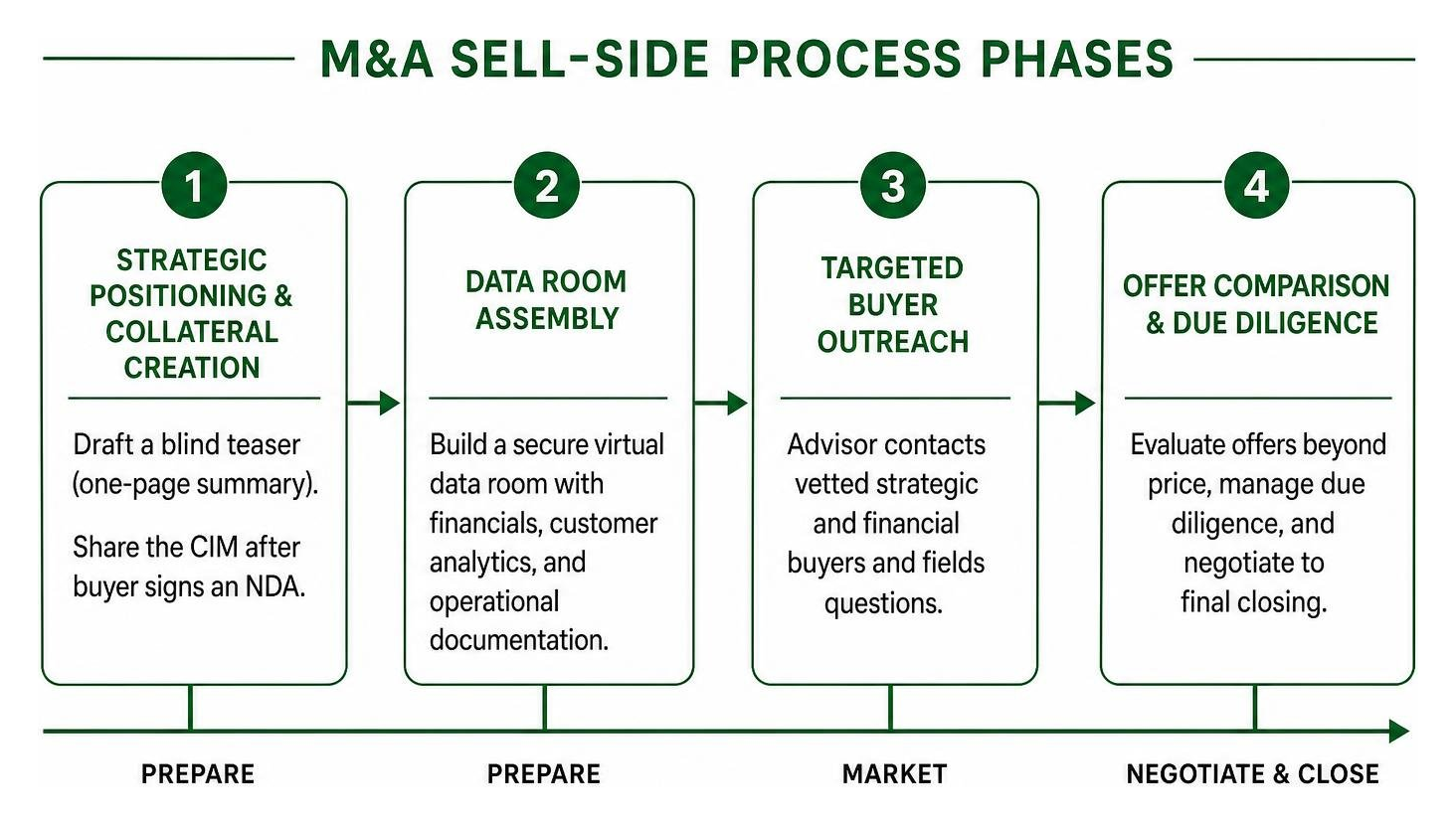
- Strategic Positioning and Collateral Creation: Your advisor drafts a blind one-page summary (the teaser) that highlights financial strengths without revealing your identity. Once an interested buyer signs a strict nondisclosure agreement (NDA), the advisor shares a comprehensive Confidential Information Memorandum (CIM).
- Data Room Assembly: Before approaching buyers, your team constructs a secure virtual data room containing historical financial statements, customer concentration analytics, and operational documentation.
- Targeted Buyer Outreach: The advisor contacts a curated list of vetted strategic and financial buyers, fielding questions while you remain focused on daily operations.
- Offer Comparison and Due Diligence: Once indications of interest arrive, your advisor helps you evaluate terms beyond headline purchase price, managing due diligence through final closing.
At MyExec, we see how clean financial groundwork transforms this process. When we partnered with a regional construction business, their financial records were kept on a cash basis with unorganized job costing. By creating more accurate job costing and establishing rolling 13-month P&L forecasts, we could defend gross margins and secure multiple competing bids.
We also support client transaction readiness by improving the quality and speed of monthly reporting, implementing cash flow forecasts, building KPI scorecards tracking customer acquisition cost, average revenue per customer, and net revenue retention, and applying our capital allocation expertise.
Core Criteria: How to Choose an M&A Advisor for a Lower-Middle-Market Sale

Learning how to choose an M&A advisor requires evaluating clear, verifiable capabilities rather than accepting impressive sales pitches at face value.
Deal Size and Track Record
Review an advisory firm's recent closed transactions within your revenue tier. Ask candidates how many transactions they've closed in the $5M to $50M revenue range over the past 24 to 36 months.
Recency matters because capital markets, interest rate environments, and private equity deal structures evolve constantly. An advisor who closed dozens of deals five years ago may not have active relationships with the private equity sponsors and strategic consolidators currently deploying capital in your sector. Always request references from founders of recently closed deals, and ask those founders how the advisor performed when negotiations became challenging.
Evaluating Pre-Market Preparation and Positioning
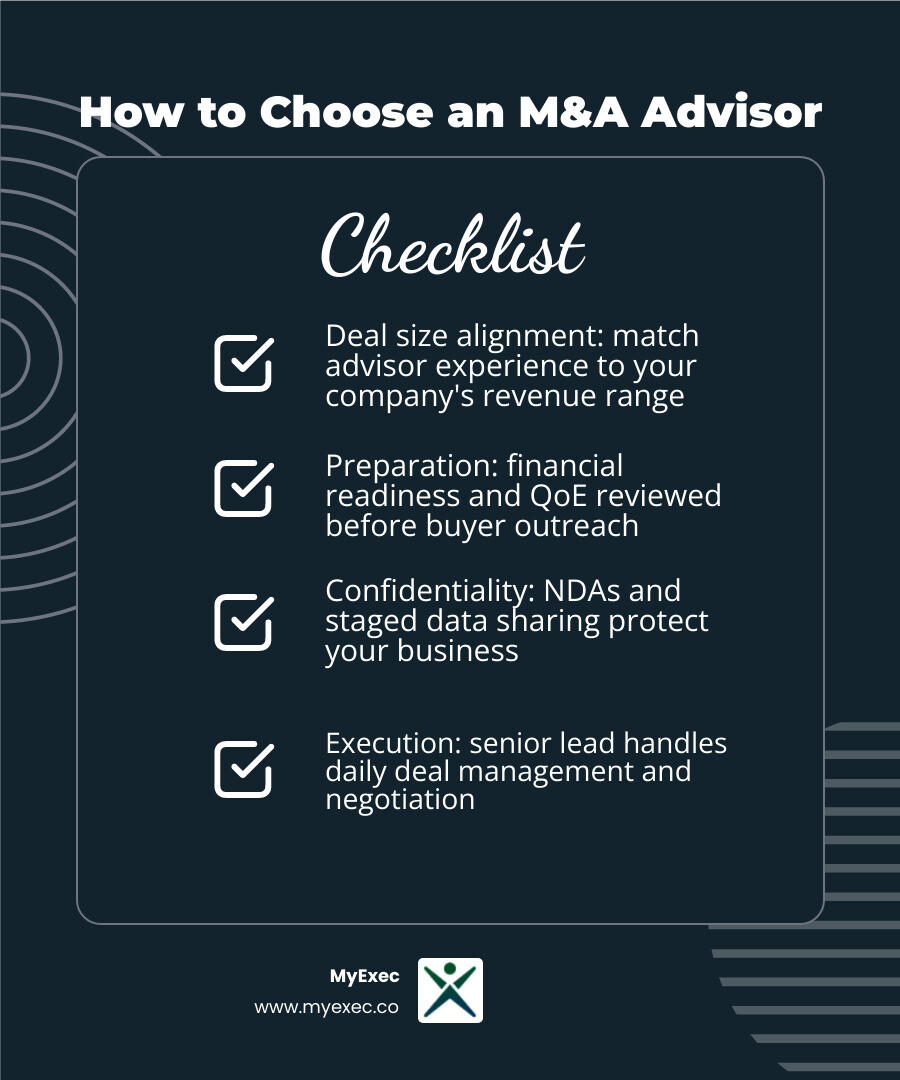
Top-tier advisors invest significant time preparing your business before contacting external parties. They identify operational risks, analyze customer concentration, and evaluate potential Quality of Earnings (QoE) challenges early.
A critical part of this stage is establishing an objective, defensible baseline valuation. You must understand how to value a business before going to market so you don't fall for inflated valuations pitched merely to win your listing mandate.
Our team at MyExec has significant valuation experience. We've helped multiple clients improve enterprise value through planning, forecasting, and dynamic scenario modeling. Our sensitivity and scenario analysis has helped client leadership make better decisions and improve cash flow and value over time. We also provide advanced analysis, decision support, and margin optimization, including integrated three-statement models for new product launches and mergers and acquisitions.
Buyer Outreach Strategy and Confidentiality Safeguards
Confidentiality leaks can disrupt employee morale, alarm key customers, and give competitors an unfair advantage. A qualified M&A advisor uses strict protocols to protect sensitive commercial information:
- Tiered Information Release: High-level financial data is shared only under NDA, while sensitive information like customer names, employee salaries, and intellectual property remains locked until a firm Letter of Intent (LOI) is executed.
- Buyer Vetting and Screening: Advisors confirm that prospective acquirers have proof of funds and a legitimate strategic rationale before granting access to confidential materials.
- Secure Data Room Management: Granular permission settings prevent unauthorized document downloading, printing, or distribution.
Vetting Execution: Who Runs Your Deal Day to Day

One common pitfall in hiring an advisory firm is the junior handoff. A senior managing director delivers a polished pitch presentation, but once you sign the engagement letter, day-to-day buyer calls, financial modeling, and negotiation support are passed to junior analysts.
Questions to Ask Before You Hire an M&A Advisor
Use these direct questions during interviews to evaluate advisory execution:
- Who will lead buyer negotiation calls day to day, and will senior partners attend management meetings?
- How many active client engagements is your execution team managing right now?
- What is your specific strategy for defending EBITDA add-backs during buyer due diligence?
- How do you address retrade attempts when a buyer seeks price reductions late in the diligence process?
- Can you walk us through a recent transaction where negotiations stalled and how you resolved it?
Assessing Senior Deal Team Commitment and Cultural Fit
Selling a company takes several months of intensive collaboration. You need an advisor who communicates candidly, especially when market feedback requires adjustments to deal positioning.
A quality advisor doesn't simply agree with your assumptions. They provide honest assessments regarding owner dependency, customer concentration, and working capital requirements. If your business isn't ready for market, an exceptional advisor will tell you to wait and resolve internal operational bottlenecks first.
Frequently Asked Questions About Choosing an M&A Advisor
What is the primary difference between a business broker and an M&A advisor?
Business brokers primarily assist smaller, owner-operated companies using public listing platforms and broader marketing techniques. M&A advisors manage lower-middle-market transactions ($5M to $50M+ revenue) through structured, confidential bidding processes targeting institutional investors and corporate acquirers.
Does an advisor need deep, specific experience in my exact industry?
While familiarity with your sector helps advisors understand key industry drivers, process discipline, buyer access, and negotiation skill matter just as much. Strong advisors quickly grasp business fundamentals and leverage established networks of financial buyers who invest across complementary industries.
Should a business be valued before meeting with M&A advisors?
Yes. Obtaining an independent valuation or internal financial assessment establishes clear expectations before you begin advisory interviews. It equips you to evaluate advisor pitches objectively and prevents you from selecting a firm based on unrealistic valuation estimates.
Making Your Final Advisor Decision
Choosing the right M&A advisor ensures the value you've built over years of hard work is recognized and rewarded at closing. Take time to interview multiple candidates, verify past transaction performance, and ensure senior dealmakers remain committed to running your sale. For specific legal and tax structuring advice, always consult your transaction attorney and CPA.
At MyExec, we provide flexible fractional CFO and FP&A services for growing businesses between $5M and $50M in revenue. Our support scales to your exact needs, providing senior CFO leadership, dedicated analytical modeling, or a combination of both. Having worked with companies ranging from emerging businesses to $2B enterprises, we help founders clean up financial reporting, build defensible forecasts, and enter the market fully prepared.
Ready to prepare your company for a successful transaction? Visit us at MyExec or connect with our team to discuss how to sell your business with complete financial confidence.