An Introduction to How to Value a Business
What Is Business Valuation and How Does It Work?

At its core, a business valuation is an objective analysis to determine the monetary worth of a company. It examines historical financial performance, future earning potential, balance sheet assets, market dynamics, and operational risks to establish a defensible value conclusion. Depending on the purpose, that conclusion may be framed as fair market value, fair value, investment value, or liquidation value. Fair market value is commonly used for tax and many transaction contexts, while investment value reflects the value to a specific buyer or owner, fair value may apply in financial reporting or legal settings, and liquidation value estimates proceeds under an orderly or forced sale of assets.
Business owners typically seek a valuation during critical company milestones:
- Exit Planning and M&A Transactions: Knowing your worth allows you to set realistic target pricing before putting your business on the market or entering buyout discussions.
- Equity Fundraising and Growth Capital: Investors need clear proof of valuation to determine what equity percentage they receive for their investment.
- Estate Planning and Tax Compliance: Tax authorities require documented valuations for gift taxes, estate transfers, or stock option grants.
- Partner Buyouts and Ownership Transfers: A fair baseline prevents shareholder disputes when partners enter or exit the business.
- Internal Strategic Planning: Understanding value drivers highlights operational weaknesses you can fix long before an actual exit.
Valuing a private company requires balancing quantitative financial modeling with qualitative risk assessment. Public companies have transparent stock prices updated every second. Private mid-market companies ($5M to $50M in revenue) do not. Determining private enterprise value is both a financial science and a strategic art. The numbers set the baseline, but market sentiment, buyer synergies, leadership stability, and growth trends dictate the final selling price.
Why Baseline Valuations Matter for Growing Middle-Market Companies
For companies generating between $5M and $50M in revenue, the financial function often undergoes a major transition. Early on, founder-led finance and basic bookkeeping are enough to keep operations moving. But as you scale toward a potential sale or capital raise, buyers and institutional lenders demand far more sophistication than simple cash-basis tax returns.
Establishing an annual valuation baseline keeps management aligned on long-term value creation. Knowing your numbers allows you to spot margin drag, address customer concentration, and optimize cash flow years before you go to market. Understanding the benefits of an annual business valuation prevents unpleasant surprises during buyer due diligence, helping you set achievable targets and enter negotiations with complete confidence.
What Are the Primary Methods Used to Value a Business?
Valuation professionals rely on three core pillars: the Market Approach, the Income Approach, and the Asset-Based Approach. Relying on just one methodology creates major pricing distortions. For instance, relying solely on historical asset value ignores profitable cash flow, while relying strictly on a projected cash flow model might overlook sudden shifts in market demand.
A thorough analysis combines these approaches to build a defensible range of value rather than a single rigid figure. If you need support applying these frameworks to your company, review MyExec's Business Valuations practice.
The Market Approach (Comparable Transactions & Multiples)
The market approach values a business by comparing it to similar companies recently sold or publicly traded. It applies transaction multiples to a company's normalized earnings.
M&A advisors look at two main data sources:
- Precedent Transactions: Sale metrics from private companies of similar size, industry, and geographic reach. Private transaction databases like PitchBook, DealStats, and BizComps provide real market benchmarks.
- Public Company Comparables: Trading multiples of public firms in the same sector. Because public companies are liquid and much larger, their multiples are adjusted downward to fit private, middle-market entities.
For instance, if similar firms in your sector trade at 5.0x EBITDA and your normalized EBITDA is $3M, your baseline market valuation is $15M.
The Income Approach (Discounted Cash Flow Analysis or Capitalized Cash Flows)
The income approach determines company value based on its expected future cash generation. The two most common methods under this pillar are Discounted Cash Flow (DCF) analysis and Capitalized Cash Flow (CCF) analysis.
A DCF analysis involves three key steps:
- Cash Flow Forecasts: Projecting unlevered free cash flows over a 3-to-5-year forecast period based on realistic growth rate assumptions.
- Discount Rate (WACC): Discounting future cash flows back to present value using the Weighted Average Cost of Capital. For private companies in the $5M to $50M revenue range, discount rates typically fall between high teens and mid-twenties percent to reflect illiquidity and private market risk.
- Terminal Value: Calculating the value of all cash flows beyond the explicit forecast horizon, assuming the company grows at a stable rate capped at long-run GDP trends, typically 2% to 3%.
Capitalized Cash Flow is a prevalent method for mature companies with consistent long-term growth expectations. Instead of building a detailed multi-year forecast, the CCF method normalizes a representative level of cash flow and divides it by a capitalization rate. The capitalization rate generally reflects the discount rate minus the company's expected long-term growth rate.
For a stable business with predictable margins, recurring demand, and modest growth, CCF can provide a practical indication of value without overcomplicating the model. For companies with changing margins, acquisition-driven growth, or volatile working capital needs, a full DCF is usually more useful because it can model year-by-year changes before the business reaches a steady state.
The Asset-Based Approach (Adjusted Net Asset Value Floor)
The asset-based approach calculates a company's net asset value by subtracting total liabilities from total assets. Balance sheet book value relies on historical cost accounting, so a proper asset valuation adjusts all tangible and intangible assets to current fair market value.
This includes evaluating real estate, inventory, machinery, equipment, and local tax obligations such as business tangible personal property taxes. While goodwill and intellectual property are factored in, asset-based valuations are primarily used as a liquidation floor for underperforming companies or asset-heavy industries like real estate and equipment leasing.
How Do You Normalize Earnings and Choose Between SDE and EBITDA?
Before applying any market multiple, you must normalize your financial statements. Financial recasting removes non-operating items, personal expenses, non-recurring legal costs, and owner-specific compensation to reflect true operational profitability. Failing to document your add-backs properly leads to direct purchase price deductions during due diligence. Reviewing what to look for in financial statements when buying a business offers helpful perspective on how buyers scrutinize your numbers.
The table below outlines the core differences between the two main earnings metrics used in private valuations:
| Metric | Calculation Formula | Typical Revenue Threshold | Ideal Business Type |
|---|---|---|---|
| Seller's Discretionary Earnings (SDE) | Net Income + Owner Compensation + Perks + Non-Recurring Costs + Interest + Taxes + Depreciation | Under $5M Revenue (Sub-$1M to $2M Earnings) | Owner-operated Main Street businesses where the owner runs daily operations |
| EBITDA | Net Income + Interest + Taxes + Depreciation + Amortization ± Market Executive Pay Adjustments | $5M to $50M+ Revenue ($1M to $2M+ Earnings) | Management-run firms with an established leadership layer |
Seller's Discretionary Earnings (SDE) Normalization
SDE measures the total financial benefit a single owner-operator extracts from the business. It adds back salary, health insurance, personal vehicle leases, retirement contributions, and discretionary expenses. SDE is the standard for smaller businesses because the incoming buyer will usually take over daily operations directly. Transaction multiples for SDE generally range between 2.0x and 4.0x.
Earnings Before Interest, Taxes, Depreciation, and Amortization (EBITDA)
As a business grows beyond $5M in revenue, buyers expect it to operate independently of the founder. EBITDA removes owner-operator bias by replacing the owner's compensation with market-rate salaries for professional managers.
Around the $1M to $2M earnings threshold, valuation shifts from SDE to EBITDA multiples. Lower-middle-market companies typically command 4.0x to 7.0x EBITDA, while larger platform businesses with strong leadership and higher revenue command significant size premiums.
Upgrading Financial Reporting for Normalization Readiness
Unorganized, cash-basis accounting invites buyer skepticism and lower offers. If your add-backs lack clean documentation, buy-side Quality of Earnings (QoE) auditors will strike them down immediately.
To protect your valuation, you need to increase business value with smarter financial reporting. At MyExec, we deliver fractional CFO and FP&A services that help growing businesses clean up financial records, recast P&L statements, and build defensible add-back schedules before starting sale discussions.
What Drivers and Risk Factors Sway Valuation Multiples?
An industry multiple is just a baseline. Operational risk drivers determine whether your business trades at the top or bottom of its sector range. A half-turn increase or decrease on a multiple can shift your enterprise value by hundreds of thousands or even millions of dollars.
Recurring Revenue Premiums
Buyers pay top dollar for predictable cash flow. Contractual subscriptions, long-term service agreements, and automated maintenance plans reduce future revenue risk.
For example, a home services firm with 50% or more contractual recurring revenue can clear a 1.5x to 2.0x higher multiple than a peer relying entirely on one-off project bids. Incorporating clear growth metrics into your planning is essential, as detailed in our guide on Rule of 40 valuation planning.
Customer Concentration & Owner Dependency Risks
Two major risks consistently depress valuation multiples:
- Customer Concentration: If a single customer represents more than 15% to 20% of total revenue, buyers apply a direct multiple discount. If concentration exceeds 40%, institutional buyers may back out entirely. Explore how to manage this risk in our analysis on how customer concentration affects business valuation.
- Owner Dependency: If the founder controls all key client relationships, vendor terms, and daily decisions, the business cannot run without them. Building a management team to handle daily operations eliminates this bottleneck and elevates your valuation multiple.
Strategic Synergies and Size Premiums
Larger businesses naturally command higher multiples, a dynamic known as the size premium. A company generating $5M in EBITDA commands a higher multiple turn than one generating $1M in EBITDA because it carries lower operational risk and offers greater stability.
Furthermore, strategic buyers often pay more than financial buyers. Strategic acquirers look for immediate cost synergies, cross-selling opportunities, or technology gains that make the acquisition worth far more than standalone market value. If you want to maximize your firm's market value, review our guidance on how to make your business more valuable.
How Do Deal Structure and Working Capital Impact Net Sales Proceeds?
Headline valuation is only part of the equation. What matters most is your net cash at closing after debt payoff, working capital adjustments, deal fees, and taxes.
Bridging Enterprise Value to Equity Value
Valuation formulas yield Enterprise Value (EV), which represents total operational asset value regardless of capital structure. To determine Equity Value (your net check at closing), use this standard equity bridge:
$$\text{Equity Value} = \text{Enterprise Value} + \text{Cash} - \text{Interest-Bearing Debt} \pm \text{Net Working Capital Adjustment}$$
Net Working Capital (NWC) pegs are a common hurdle in middle-market M&A. Buyers expect a target level of working capital (accounts receivable plus inventory minus accounts payable) to land with the business at closing. If your actual working capital falls below the agreed peg, the shortfall is deducted dollar-for-dollar from your purchase price.
Impact of Consideration Types (Cash, Notes, Earnouts)
How a buyer pays for your business directly shapes your financial risk and final proceeds:
- Cash at Close: Liquid funds received immediately upon deal completion.
- Seller Notes: Promissory notes where you finance a portion of the purchase price over 3 to 5 years at a set interest rate.
- Earnouts: Contingent payouts tied to post-closing financial targets. Earnouts carry risk and remain one of the most frequently disputed deal terms in private M&A.
- Asset vs. Stock Purchase: Tax structure matters. Asset sales allow buyers to step up depreciation schedules but can trigger heavy double-taxation for S-Corp or C-Corp sellers. Stock sales offer favorable capital gains treatment to sellers but require buyers to assume historical liabilities.
Getting these terms right requires thorough preparation. Review our advice on M&A financial readiness to protect your post-closing yield.
When Should You Hire a Certified Valuation Professional vs. Self-Appraising?
Online calculators provide quick directional estimates, but single-multiple templates cannot capture nuanced operational risks. Knowing when to use internal estimates versus hiring a credentialed professional depends entirely on your objective.
When Formal Appraisals Are Mandatory
You must hire an independent credentialed appraiser when your valuation faces external legal, regulatory, or tax scrutiny. Formal appraisals carry strict legal liability and are required for:
- SBA loan applications and bank financing
- IRS tax filings, estate planning, and gift tax reporting
- Marital dissolution and shareholder dispute litigation
- Formal employee stock ownership plan (ESOP) buyouts
Look for professionals holding recognized credentials such as Certified Valuation Analyst (CVA), Accredited Senior Appraiser (ASA), or Accredited in Business Valuation (ABV). Formal independent appraisals generally range from basic compliance reviews to comprehensive reports depending on corporate complexity.
Partnering with Senior Financial Leadership for Strategic Valuations
If your goal is exit planning, fundraising, or internal benchmarking, you often need high-level strategic finance guidance rather than a static tax report.
At MyExec, we support growing companies ($5M to $50M revenue) with flexible, fractional CFO and FP&A leadership. We provide scalable support tailored to your complexity, ranging from analyst-level modeling to senior CFO strategy. We have a CVA on staff, and our firm experience spans companies from a few million in revenue to roughly $2B across private equity owned, closely held, nonprofit, and publicly traded businesses.
Whether you need a formal valuation through our Business Valuations practice or complex forward-looking projections, we can help. If you're looking at selling part or all of your business, or raising capital to grow, explore our guidance for when you need to create the financial model that goes along with your strategy.
Frequently Asked Questions About Business Valuation
What is the most common business valuation formula for a small-to-midsize business?
The most common formula uses an earnings multiple approach:
$$\text{Enterprise Value} = \text{Normalized Earnings} \times \text{Industry Multiple} \pm \text{Operational Risk Adjustments}$$
For owner-operated businesses generating under $2M in profit, normalized earnings are measured using Seller's Discretionary Earnings (SDE), with multiples typically ranging from 2.0x to 4.0x. For businesses generating over $5M in revenue with established management teams, normalized EBITDA is used, with multiples typically ranging from 4.0x to 7.0x+.
How long does a formal business valuation process take?
A formal valuation process usually takes two to four weeks from initial document collection to final report delivery. The timeline depends on how quickly management provides reconciled financial statements, tax returns, customer concentration data, and operational detail.
Why do two valuations of the exact same business often differ?
Two valuations can yield different results due to varying underlying assumptions. Different experts may select different comp sets, weight valuation methods differently, or make contrasting normalization add-backs. Purpose also plays a massive role: a fair market value calculated for IRS tax compliance will differ from a strategic investment valuation that accounts for buyer synergies.
How Can You Prepare Your Business for a Defensible Valuation?
Preparing for a business valuation requires systematic preparation. Taking steps to clean up your operations and financial records early ensures you present a clear, compelling case to prospective buyers or investors.
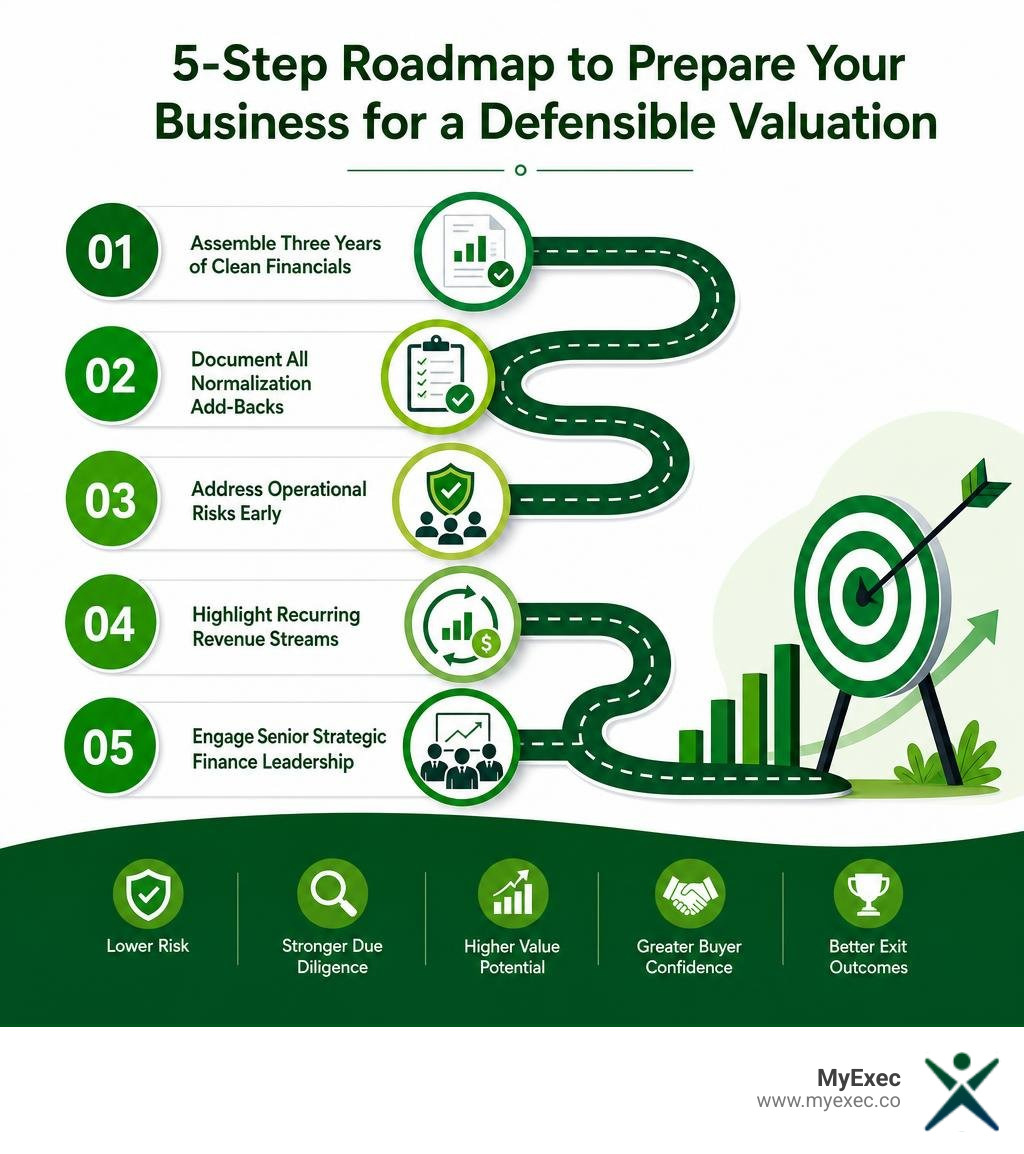
Here is your preparation roadmap:
- Assemble Three Years of Clean Financials: Gather your historical tax returns, reviewed or audited P&L statements, balance sheets, and interim financial reports.
- Document All Normalization Add-Backs: Maintain detailed documentation for every owner add-back, personal expense, and non-recurring cost to ensure they survive due diligence.
- Address Operational Risks Early: Reduce owner dependency by building middle management, and diversify your customer base to eliminate concentration drag.
- Highlight Recurring Revenue Streams: Clearly separate contractual subscriptions and recurring agreements from standard one-off sales.
- Engage Senior Strategic Finance Leadership: Work with experienced financial leaders to build a clear forward-looking financial model and establish a defensible baseline valuation.
Whether you're preparing for an immediate exit or building long-term enterprise value, clean financial reporting and strategic planning are essential. Connect with our team to learn how MyExec Services & Financial Leadership can support your growth journey.