

The short answer
Banks look first at whether the business can repay the loan from its own cash flow. They test that with a few ratios, the most important being debt service coverage, and then look at the strength of the balance sheet, the collateral behind the loan, the owners' credit and track record, and the conditions in the industry. For a $5M to $50M company, they also weigh the quality of the financial statements, customer concentration, and whether the forecast holds up under stress.
Most owners meet their banker twice a year and see the loan review as a formality until the year it is not. A line renewal that used to take a phone call now comes with a request for reviewed statements, a debt schedule and a forecast. An equipment loan or a building purchase brings the same questions in a longer form. Knowing what the bank is testing, and preparing for it 90 to 120 days ahead, is the difference between a renewal on good terms and a scramble under an expired agreement.
This guide covers the five things every commercial lender reviews, the ratios and the covenants that come out of them, how banks read your financial statements, how collateral and the borrowing base work, the structural risks lenders look past the numbers to find, and a preparation plan for a new loan or a renewal. It includes a coverage check for your own figures and a worked example. It is written so your CPA, attorney or banker can forward it to a client; they are part of the team in any loan request, and tax and legal questions in this guide go to them.
The five things every lender reviews
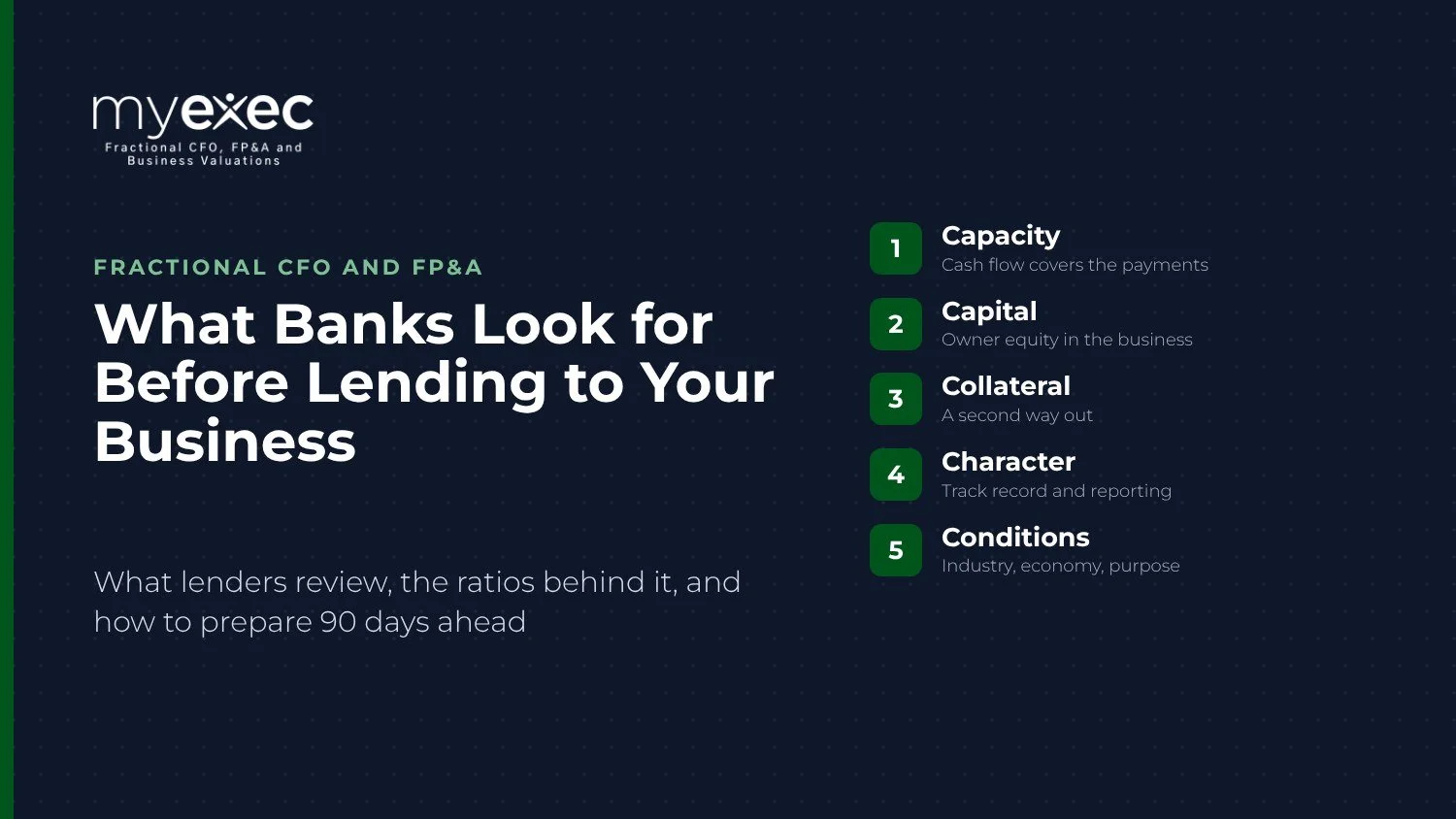
Commercial underwriting is a structured look at downside risk. The credit committee's question is simple: will this company make every interest and principal payment through a slower year, a lost customer or a rate increase? Banks organize that question around five headings, often called the five C's of credit. Here is what each one means in practice for an owner-led company, and what the bank asks to see.
| What the bank reviews | The question behind it | What you show |
|---|---|---|
| Capacity | Can operating cash flow cover the payments with room to spare? | Three years of statements, interim results, a debt schedule and a forecast |
| Capital | How much of the owner's own money is in the business? | Retained earnings, equity on the balance sheet, and the owner's contribution to the project |
| Collateral | If cash flow fails, what can the bank sell? | Receivables aging, inventory detail, equipment list, real estate appraisal |
| Character | Does management do what it says, and report bad news early? | Business and personal credit history, references, prior lender relationships, timely reporting |
| Conditions | What is happening in the industry, the economy and this loan's purpose? | Loan purpose and use of proceeds, industry outlook, customer and supplier exposure |
Capacity carries the most weight. A bank does not want to repossess trucks or foreclose on a building to get repaid; it wants a company whose operations cover the debt comfortably. The other four determine the terms, the pricing and how closely the bank watches the loan after closing.
How a loan request moves through the bank
A request for a new facility or a renewal passes through six stages, and the first and last are the ones most owners underestimate. The package you send sets the tone for everything that follows, and the loan agreement at the end contains covenants you will live with for years.
The ratios banks use, and the covenants that follow
Underwriters turn the capacity question into numbers. The ranges below are typical of commercial bank practice for companies in our size range; the figures that matter are the ones written into your loan agreement, and they vary by bank, industry and loan type.
| Ratio | How it is calculated | Typical bank expectation | What it tells the bank |
|---|---|---|---|
| Debt service coverage (DSCR) | Adjusted EBITDA divided by annual principal and interest | At least 1.25x; higher in cyclical industries | How much cushion operating cash flow has over the payments |
| Senior debt to EBITDA | Term debt plus line balance, divided by adjusted EBITDA | Often capped between 2.0x and 3.5x | How much total debt the bank will carry against cash flow |
| Fixed charge coverage (FCCR) | EBITDA less capital spending, cash taxes and distributions, divided by debt service | Around 1.15x to 1.20x | Coverage after the cash the business must spend to keep running |
| Current ratio | Current assets divided by current liabilities | Around 1.2x to 1.5x | Whether near-term obligations are covered |
| Debt to tangible net worth | Total liabilities divided by equity less intangibles | Usually under 3.0x to 4.0x | How much of the business is funded by lenders versus owners |
Two points on the table. First, "adjusted" EBITDA means the bank will accept add-backs for items that will not recur, such as owner compensation above a market salary, a one-time legal settlement or a discontinued location, provided each one is documented. Add-backs the bank cannot verify are removed, which lowers every ratio at once. Second, FCCR is the ratio that catches companies with strong EBITDA and heavy distributions. If the owners take out most of the profit each year, the bank sees less cash available for the loan.
Whichever ratios appear in your agreement become covenants, tested quarterly or annually from the statements you send in. The useful question before signing is how far results can fall before you fail, rather than whether you pass today. That is covenant headroom, and it belongs in the monthly reporting after closing.
Enter annual figures after the loan you are requesting, and the check below applies the typical expectations above. Your own agreement controls.
Coverage check
Enter your figures to see your coverage and debt ratios.
In our FP&A engagements these ratios are tracked monthly against the covenant levels in the loan agreement, so a problem shows up two quarters before the bank sees it. Our strategic finance guide covers how that reporting is built.
A worked example
The figures below are hypothetical and rounded. A distributor with $18M in revenue and $1.9M of adjusted EBITDA, after documented add-backs for owner compensation above market and a one-time legal cost, asks its bank for a $3.5M term loan over seven years to buy a second warehouse and a $2.0M line of credit, of which it expects to use about $1.0M on average. It already carries $1.1M of equipment notes with $400,000 of annual payments.
At a rate of 7.5%, the term loan costs about $644,000 a year in principal and interest. Interest on the average line balance adds about $75,000. With the equipment notes, total debt service is about $1.12M, and total funded debt is $5.6M.
| Scenario | Adjusted EBITDA | Debt service | DSCR | Debt to EBITDA |
|---|---|---|---|---|
| As presented | $1,900,000 | $1,120,000 | 1.70x | 2.9x |
| Rate up one point | $1,900,000 | $1,150,000 | 1.65x | 2.9x |
| EBITDA down 15% | $1,615,000 | $1,120,000 | 1.44x | 3.5x |
| Both | $1,615,000 | $1,150,000 | 1.40x | 3.5x |
| EBITDA down 25% | $1,425,000 | $1,120,000 | 1.27x | 3.9x |
This is the analysis the bank runs on your request. Running it first, and bringing it to the meeting, changes the conversation. The owner who can say "we have $500,000 of coverage headroom and the tighter covenant is debt to EBITDA, so we would like it set at 3.5x" is asking for terms from a position the banker respects.
How banks read your financial statements
The level of assurance on your statements sets the tone for the whole review. Three tiers exist. Compiled statements are assembled by an outside accountant without verification, and are usually acceptable only for small facilities. Reviewed statements add analytical procedures and inquiry, and are the common minimum for commercial lines in the low millions. Audited statements add testing of balances and controls, and are often required as facilities grow past that range. Our guide to audited financial statements explains what each level involves and when to move up.
Beyond the tier, the bank tests consistency. Do the year-end statements tie to the tax returns, and if not, is the difference explained? Do the interim statements follow the same accounting as the year-end? Is revenue recognized the same way every month? Is inventory counted and valued, or plugged? Does the balance sheet carry old receivables, related-party loans or accrued liabilities that have not moved in two years? Each unanswered question becomes a condition in the approval or a reason to lower the amount.
The quickest signal of reporting quality is the monthly close. A company that produces a reconciled balance sheet and income statement by the middle of the following month, every month, has records a bank can rely on. Our post on improving financial reporting covers how to get there.
Collateral and the borrowing base
Collateral is the bank's second way out. For most $5M to $50M companies it means receivables, inventory, equipment and sometimes real estate, and the bank lends against each at a discount. Typical commercial practice advances a high share of receivables under 90 days, a lower share of inventory depending on how fast it turns and how easily it can be sold, a share of equipment based on what it would bring at an orderly sale rather than its book value, and a share of appraised value on real estate. The exact rates are set in the loan agreement.
Lines of credit secured by receivables and inventory are governed by a borrowing base: the bank advances against eligible collateral, and you report it on a borrowing base certificate, monthly or more often. Three things shrink eligibility fast:
- Aging. Invoices past 90 days from the invoice date drop out of the base.
- Cross-aging. If a set share of one customer's balance is past 90 days, many agreements treat that customer's whole balance as ineligible, current invoices included.
- Concentration. Receivables from a customer above a stated share of the total are capped or excluded, because the bank is lending against that customer's willingness to pay.
Managing collateral well is largely the discipline described in our guide to managing working capital day to day: collecting on time, keeping inventory moving and reconciling the subledgers the certificate is built from. A clean borrowing base also means availability when you need it, which is the point of the line.
What lenders look for beyond the numbers
Strong historical profit can hide structural risk, and underwriters are trained to look for it.
Customer concentration. When one customer is a large share of revenue, the bank is underwriting that customer's purchasing decisions as much as your company. Above a threshold written into the agreement, often somewhere around a fifth of sales, the bank may exclude that customer's receivables from the borrowing base, require a higher coverage ratio or ask for the contract. The same issue affects what a buyer will pay; our post on customer concentration and business value covers that side.
Owner dependence. If the owner holds every customer relationship, signs every quote and is the only person who understands the pricing, the bank's loan depends on one person staying healthy and interested. Underwriters look for a second in command, documented procedures and key-person insurance, and they ask about the succession plan on larger loans. Our guide to owner dependence covers how to reduce it.
Working capital stability. Receivables that stretch each year, inventory that grows faster than sales, or vendor terms that are quietly being extended all show up when the bank spreads three years of balance sheets side by side. A line that never pays down, so the business is using short-term credit to fund long-term assets, is one of the most common findings.
The owners' own credit. For closely held companies, banks review the personal credit of the principal owners alongside the business, and a personal guarantee from significant owners is standard on conventional commercial loans. Your attorney should review the guarantee language, and in particular whether it is limited, joint and several, and how it is released.
The forecast you bring
History shows consistency, but the loan is repaid from the future, so most banks ask for projections on any meaningful request. A forecast that assumes 30% growth on no evidence creates doubt about everything else in the package. A forecast that ties to the historical statements, states its assumptions, and shows the debt service under a base case and a downside is the single most persuasive document an owner can bring.
In our FP&A work with owner-led companies, the lender package is built from the same model the leadership team uses every month: a rolling 13-month forecast of the income statement, balance sheet and cash flow, with the loan covenants calculated at the bottom of each month. The stress cases in the worked example above, slower sales, a lost customer, a rate increase, are run in advance, so the owner walks into the bank knowing the headroom. Our guide to the cash flow forecasting process covers how to build one.
Conditions in November 2026
The Federal Reserve held its policy rate at 3.75% to 4.00% at its October 28, 2026 meeting, so the prime rate stays at 7.00%, where it has been since September 17 (Federal Reserve data via FRED). The 10-year Treasury yield, which drives fixed rates on term loans and commercial mortgages, was 4.95% on November 3 (FRED), down from above 5% in mid-October but still high by the standards of the past 15 years. In the Federal Reserve's October 2026 Senior Loan Officer Opinion Survey, covering the third quarter, most banks left standards for commercial loans to firms with sales under $50 million unchanged, but on net they tightened, citing a less certain economic outlook, and some reported tighter collateral requirements and wider use of interest rate floors for smaller borrowers. Banks also reported weaker loan demand across firm sizes.
For an owner with a renewal or a purchase ahead, the practical reading is that credit is available but the questions are more careful, and a well-prepared package stands out more than it did two years ago. Our post on cash management after the Fed's September move covers what the rate environment means for the line itself.
Preparing for a new loan or a renewal
Start 90 to 120 days before a maturity or a purchase. Commercial real estate approvals can take two months; operating line renewals usually take three to six weeks once the bank has everything. Starting early also avoids operating under an expired agreement, which puts the bank in control of the terms.
- Close the books and reconcile. Year-end statements tied to the tax return, interim statements on the same basis, and a written explanation of any large swing. Ask your CPA to review the add-backs you plan to present.
- Build the debt schedule. Every term loan, equipment note, lease and line, with the balance, rate, payment, maturity and collateral. Banks notice when a schedule is missing something they find in the credit report.
- Run the ratios yourself. Use the coverage check above with the new loan included. Know your DSCR, debt to EBITDA and FCCR, and the headroom on each, before the banker does.
- Prepare the forecast with a downside case. Thirteen months at least, with the debt service and covenants calculated. State the assumptions on one page.
- Clean the collateral. Collect or write off old receivables, dispose of dead inventory, and reconcile the subledgers the borrowing base is built from.
- Write the request. Amount, purpose, structure, repayment source and the owner's contribution, on two pages, with the package attached. Then talk to more than one bank; a second proposal is the best negotiating tool you have.
- Review the documents before signing. Covenant levels, cure periods, reporting deadlines, prepayment terms and guarantee language, with your attorney. Negotiate covenant levels against your downside case rather than your base case.
Common mistakes
- Starting at maturity. A line that expires before renewal leaves the business operating at the bank's discretion.
- Add-backs without paper. Every adjustment to EBITDA needs an invoice, a payroll record or a contract behind it, or the bank removes it.
- A forecast with no downside. Bankers assume the base case is optimistic. Showing the downside yourself earns credibility.
- Interim statements on a different basis. Cash-basis interims against accrual year-ends generate questions the owner cannot answer in the meeting.
- Ignoring FCCR. Heavy distributions and deferred capital spending both show up here, and it is the ratio owners least often calculate.
- Reporting late after closing. Late financials and late borrowing base certificates are technical defaults, and they are the first thing the bank mentions at the next renewal.
- Surprising the banker. A lost customer or a bad quarter reported early, with a plan, is a conversation. The same news discovered in the quarterly statements is a credit event.
Frequently asked questions
What financial statements will the bank ask for?
Expect to provide three years of year-end statements, the matching business tax returns, interim statements for the current year, an accounts receivable and payable aging, an inventory summary, a debt schedule and personal financial statements from the principal owners. Larger facilities usually require reviewed or audited year-end statements. The bank will also ask for a forecast on most new loans and many renewals.
What debt service coverage ratio do banks want?
Most commercial banks look for a debt service coverage ratio of at least 1.25x, meaning adjusted EBITDA covers annual principal and interest with a 25% cushion. Banks often set a higher minimum for cyclical industries or heavily concentrated customer bases. The level written into your loan agreement is the one that matters, and it is tested from the statements you send in each quarter or year.
How do banks view customer concentration and owner dependence?
Both are structural risks that strong profit can hide. Above a concentration threshold set in the agreement, banks may exclude a customer's receivables from the borrowing base or require more coverage. For owner-dependent companies, underwriters look for a capable second in command, documented procedures and key-person insurance. Reducing either risk before the loan request improves the terms and makes the business worth more.
Should I bring a forecast when I apply?
Yes. Loans are repaid from future cash flow, so a forecast that ties to your historical statements, states its assumptions and shows debt service under a base case and a downside is the most persuasive document in the package. Thirteen months is a sensible minimum. Bringing the downside case yourself tells the banker that management has already tested the plan.
Will I have to sign a personal guarantee?
Usually. Personal guarantees from the principal owners are standard on conventional commercial loans to closely held companies, and loans with a government guarantee, such as SBA-backed loans, require them from owners above a stated ownership share. Whether a guarantee is limited, joint and several, or released as the loan pays down is negotiable on some facilities. Have your attorney review the guarantee language before signing.
When should I start preparing for a loan renewal?
Begin 90 to 120 days before the maturity date. That leaves time to close the books, reconcile interim statements with your CPA, update the borrowing base, run the covenant ratios with a downside case and, if the terms are unattractive, talk to another bank. A renewal that starts in the final weeks is negotiated under an expired agreement, which leaves the bank holding the terms.
Walk into the bank knowing your numbers
A loan request often comes with a transaction behind it: a partner buyout, an acquisition, a building purchase or a refinancing. An independent valuation gives you and your banker a defensible figure for the business, and our FP&A work builds the forecast and covenant reporting that turns a loan review into a short meeting.
Funding growth rather than a purchase? Start with how to fund the working capital your growth plan needs.