Working Capital in a Business Sale: How the Target Changes What You Take Home
Why working capital affects what you take home when you sell

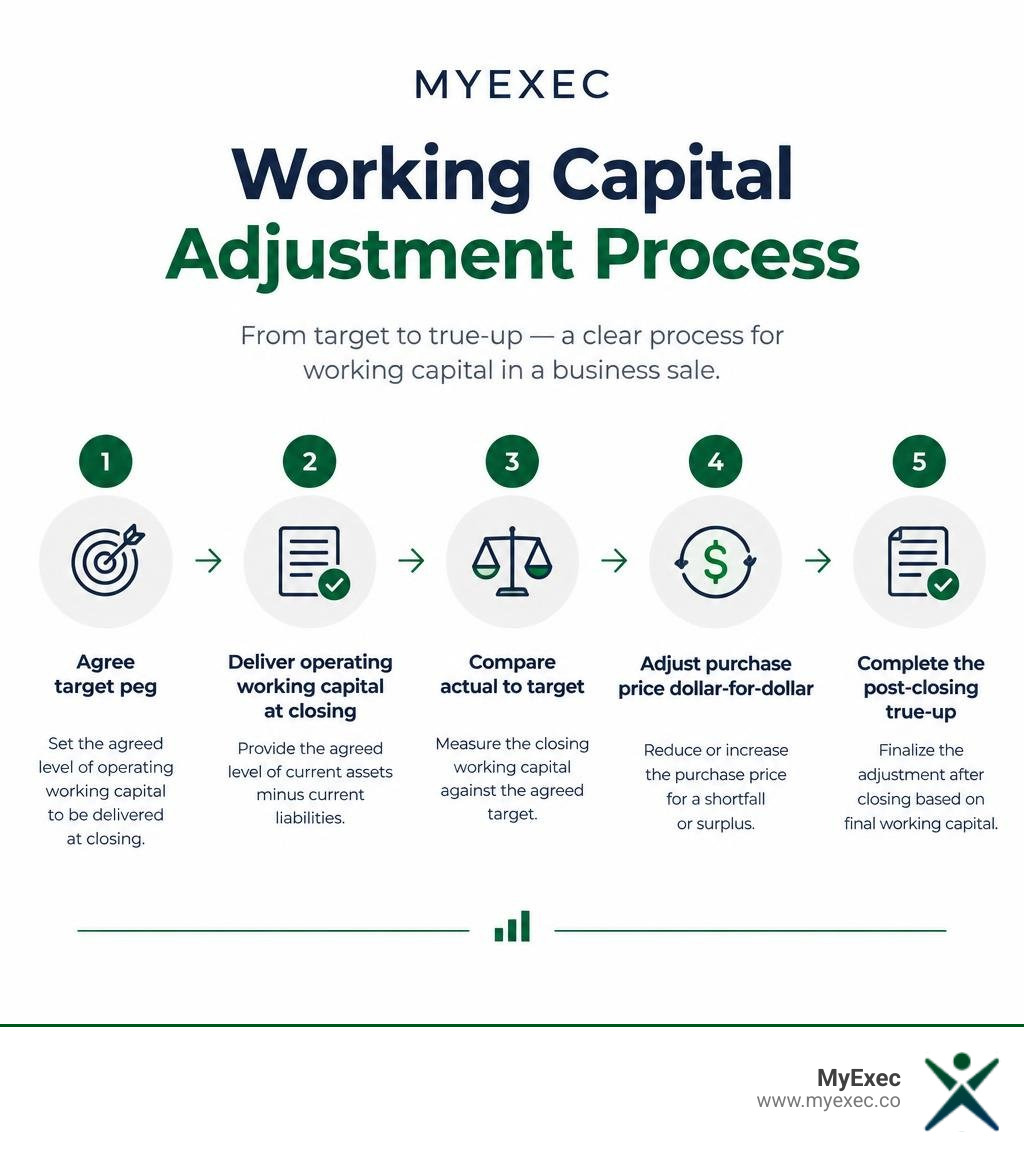
Working capital is current assets minus current liabilities. In a business sale, buyers usually expect you to leave a normal level of operating working capital, such as collectible receivables and usable inventory, after subtracting payables. That agreed level is the working capital target. If you deliver less at closing, the purchase price typically falls by the shortfall. If you deliver more, it may rise.
For example, if the target is $2.5 million but the business delivers $2 million, the price would typically fall by $500,000 before other deal adjustments. That’s why the headline value isn’t necessarily what you take home.
At MyExec, we’ve used sensitivity and scenario analysis to help client leaders make better cash flow decisions, optimize working capital and build value over time. For day-to-day tactics, see our cash management guide.
Understanding Working Capital and How Buyers Calculate the Target
When buyers evaluate middle-market businesses generating $5M to $50M in revenue, they look at operating liquidity. Operating liquidity reflects the day-to-day fuel your company needs to fulfill orders, pay vendors, and run payroll without stalling. In basic accounting terms, you find working capital by subtracting current liabilities from current assets.
In an M&A transaction, buyers do not simply take the raw numbers from your latest balance sheet. Most transactions are structured on a "cash-free, debt-free" basis. Under this framework, you as the seller keep the cash on hand and pay off any long-term debt or line-of-credit balances at closing.
Because you take the cash, the buyer must receive enough short-term operating assets so they do not have to inject fresh capital on day one just to keep the lights on. To determine this amount, the buyer's deal team evaluates a normalized balance sheet and income statement over a trailing twelve-month (TTM) period. They look for recurring operational patterns while stripping out seasonal variances and one-off anomalies.
Core Components of Working Capital in M&A
In deal negotiations, operating net working capital focuses on the assets and liabilities needed to run the business day to day. It typically excludes cash, cash equivalents, interest-bearing short-term debt, and current portions of long-term notes because those items are usually handled separately in a cash-free, debt-free sale structure. Put simply, the buyer is measuring whether the company has enough operating fuel to keep serving customers after closing, not how much excess cash the seller retains or how much financing debt must be repaid. The exact accounts included can vary by deal, which is why owners should review the proposed schedule closely with their M&A and financial advisors.
The primary current assets included are:
- Trade Accounts Receivable: Invoices billed to customers for delivered goods or services that are fully collectible within normal credit terms.
- Salable Inventory: Raw materials, work-in-progress, and finished goods ready for sale, excluding obsolete, slow-moving, or damaged stock.
- Prepaid Expenses: Operational expenses paid in advance that provide future value to the buyer, such as prepaid commercial insurance, software subscriptions, or prepaid rent.
The primary current liabilities included are:
- Accounts Payable: Amounts owed to suppliers and trade vendors for goods and services received.
- Accrued Liabilities: Operational obligations incurred but not yet paid, including accrued payroll, accrued commissions, accrued customer bonuses, and local operating taxes.
Tracking these components through regular managing working capital routines gives owners visibility into operational health. Buyers also evaluate underlying liquidity ratios using a formal ratio analysis report to verify whether the business runs efficiently or ties up excessive cash.
Establishing the Working Capital Target Peg
The agreed dollar baseline that must be delivered at closing is called the "target peg." The peg is established during the late stages of due diligence and codified in the definitive purchase agreement.
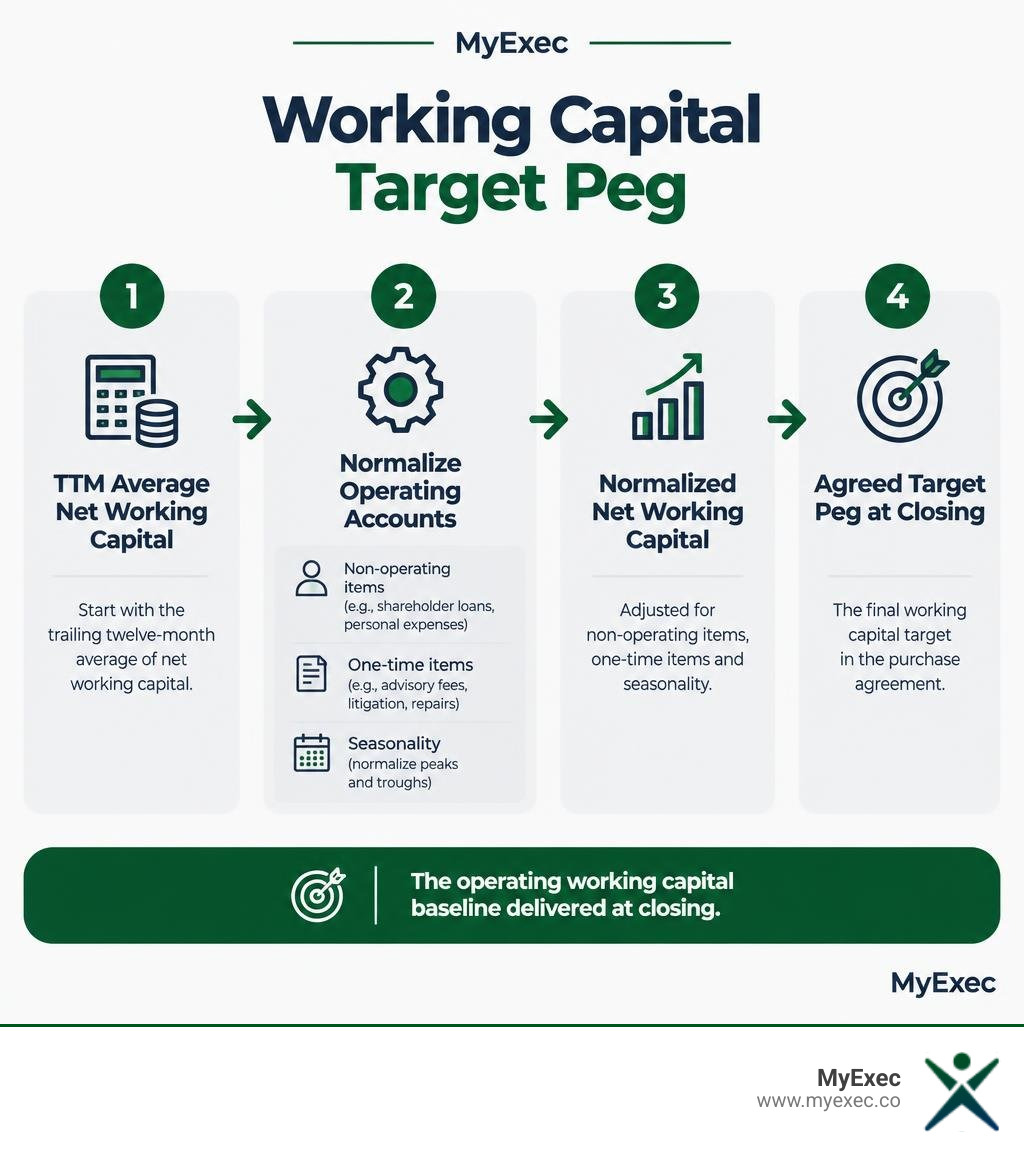
Buyers typically start by calculating the average net working capital across the trailing twelve months. However, simple arithmetic rarely tells the whole story. A fair peg requires normalization adjustments:
- Removing Non-Operating Items: Eliminating shareholder loans, discretionary personal expenses, and non-trade receivables.
- One-Off Expense Add-Backs: Adjusting for unusual advisory fees, litigation settlements, or non-recurring facility repair costs.
- Cyclical and Seasonal Adjustments: Normalizing for seasonal peaks and troughs so the target reflects average operating conditions rather than an extreme high or low.
Global market research, such as the PwC Working Capital Study, highlights that broad macroeconomic pressures and higher cost of capital make buyers scrutinize working capital buffers closely. If an owner does not actively participate in setting this baseline, the buyer will define the peg using assumptions that favor their own downside protection.
The True Impact of Peg Deficits and Surpluses on Closing Cash
The purchase agreement includes a dollar-for-dollar purchase price adjustment clause. This mechanism ensures that if you deliver less working capital than the agreed peg, the headline purchase price decreases dollar-for-dollar. If you deliver more, you receive a dollar-for-dollar increase.
At closing, the parties calculate an estimated working capital balance. If there is an estimated shortfall, the buyer deducts it directly from the wire transfer sent on closing day.
Between 60 and 120 days after closing, the buyer completes a final audit of the closing balance sheet. This process, known as the post-closing true-up, settles any difference between the estimated closing balance and actual delivered accounts. If uncollected receivables get written off or unrecorded vendor payables surface, the buyer will claw back cash from the indemnity escrow.
| Scenario Metric | Target Shortfall | Target Parity | Target Surplus |
|---|---|---|---|
| Agreed Enterprise Value | $20,000,000 | $20,000,000 | $20,000,000 |
| Working Capital Target Peg | $2,500,000 | $2,500,000 | $2,500,000 |
| Actual Delivered Working Capital | $2,000,000 | $2,500,000 | $2,800,000 |
| Purchase Price Adjustment | -$500,000 | $0 | +$300,000 |
| Adjusted Purchase Price | $19,500,000 | $20,000,000 | $20,300,000 |
Worked Example: How a Target Deficit Reduces Take-Home Proceeds
Let's walk through an example for a growing manufacturer or business services company.
Suppose you negotiate a sale with a headline enterprise value of $20 million. During due diligence, the buyer sets a working capital target peg of $2.5 million based on your trailing twelve-month averages.
As the closing date approaches, your finance team neglects collections. Aged accounts receivable over 90 days grow, and several customers delay payments. When the buyer's quality-of-earnings team reviews the final ledger, they write off $500,000 in doubtful accounts. As a result, your delivered operating working capital comes in at $2.0 million instead of $2.5 million.
The outcome is immediate:
- The agreed enterprise value is $20.0 million.
- The working capital shortfall is $500,000 ($2.0M delivered versus $2.5M peg).
- The adjusted purchase price wired at closing drops to $19.5 million.
That $500,000 deficit is money that comes straight out of your pocket. This shows why learning how to increase business value with smarter financial reporting protects your equity well before deal documents are signed.
Operational Levers: Managing the Cash Conversion Cycle Ahead of an Exit
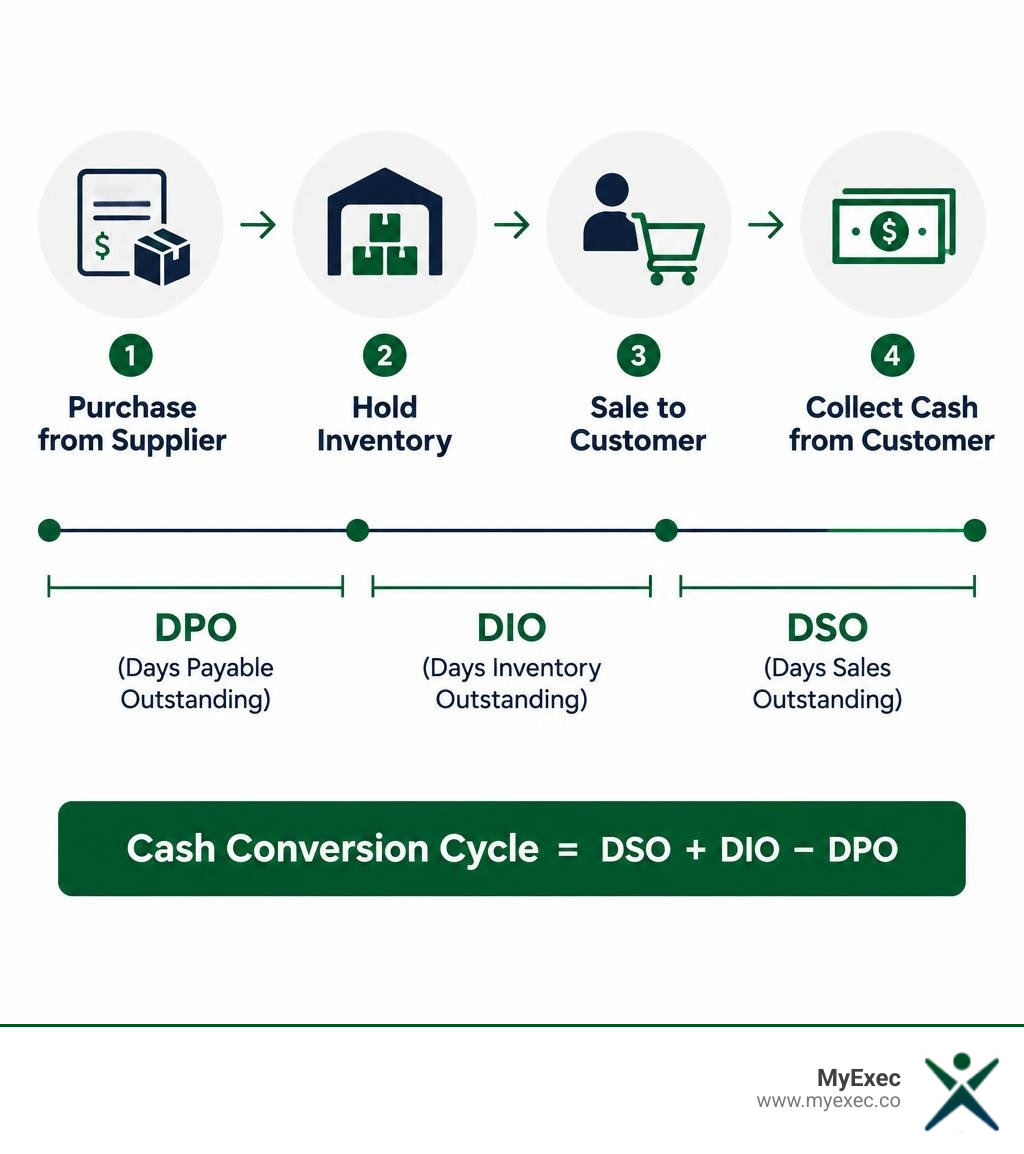
To protect transaction proceeds, you need to understand your cash conversion cycle (CCC). It measures how long cash committed to operations stays tied up before it returns to the business through customer payment.
The cycle follows a simple path shown in the graphic: you purchase goods or services, hold inventory or perform the work, invoice the customer, and collect cash. Days payable outstanding (DPO) reflects how long you take to pay suppliers, days inventory outstanding (DIO) reflects how long cash sits in inventory, and days sales outstanding (DSO) reflects how long customers take to pay. Together, these measures show how efficiently the business turns operating investment back into cash.
For an owner preparing to sell, the goal is not simply to make the CCC as short as possible. It is to create a consistent, supportable operating pattern. Slow collections, excess inventory, or unusual payment practices can raise the amount of working capital the business appears to need, which can affect the target peg a buyer expects at closing.
Practicing sound working capital management shortens this cycle and improves liquidity. Managing these moving parts also helps you answer key operational risk questions regarding balance sheet health.
By tightening the CCC 12 to 24 months before an exit, you convert balance sheet assets into extracted cash, establish a leaner historical baseline, and negotiate a more favorable target peg.
Optimizing Accounts Receivable and Credit Control
Accounts receivable is often the largest component of working capital. Sluggish collections artificially inflate your historical working capital average, pushing your target peg higher while leaving cash locked on the balance sheet.
Practical ways to optimize receivables include:
- Establish Clear Credit Limits: Regularly review customer credit limits and enforce payment terms.
- Resolve Invoice Disputes Rapidly: Invoicing errors delay customer payments and trigger audit deductions by the buyer's quality-of-earnings team.
- Incentivize Early Settlement: Offer minor terms discounts (like 1/10 net 30) or transition customers to automated ACH and credit card payments.
- Enforce Strict Collections: Follow up systematically when invoices reach 15, 30, and 45 days past due.
Streamlining Inventory and Supplier Payables
Holding excess inventory ties up working capital and creates valuation risks. Buyers will exclude obsolete, unmarketable, or aged inventory from the closing working capital calculation, turning what looked like an asset into a purchase price deduction.
Key inventory and payable strategies include:
- Liquidate Slow-Moving SKUs: Discount and sell off aging inventory to convert dead stock into cash before setting the baseline peg.
- Adopt Lean Reordering: Implement just-in-time purchasing to keep inventory levels aligned with near-term demand forecasts.
- Standardize Supplier Terms: Align vendor payment terms with industry standards while maintaining supplier relationships.
- Execute Targeted Cost Optimization: Implement disciplined cost structure optimization to ensure operational spending stays lean.
12- to 24-Month Roadmap to Defend Your Valuation
Defending your transaction proceeds requires preparation 12 to 24 months before going to market. Rushed cleanups during due diligence rarely work because buyers base the target peg on 12-month historical trends.
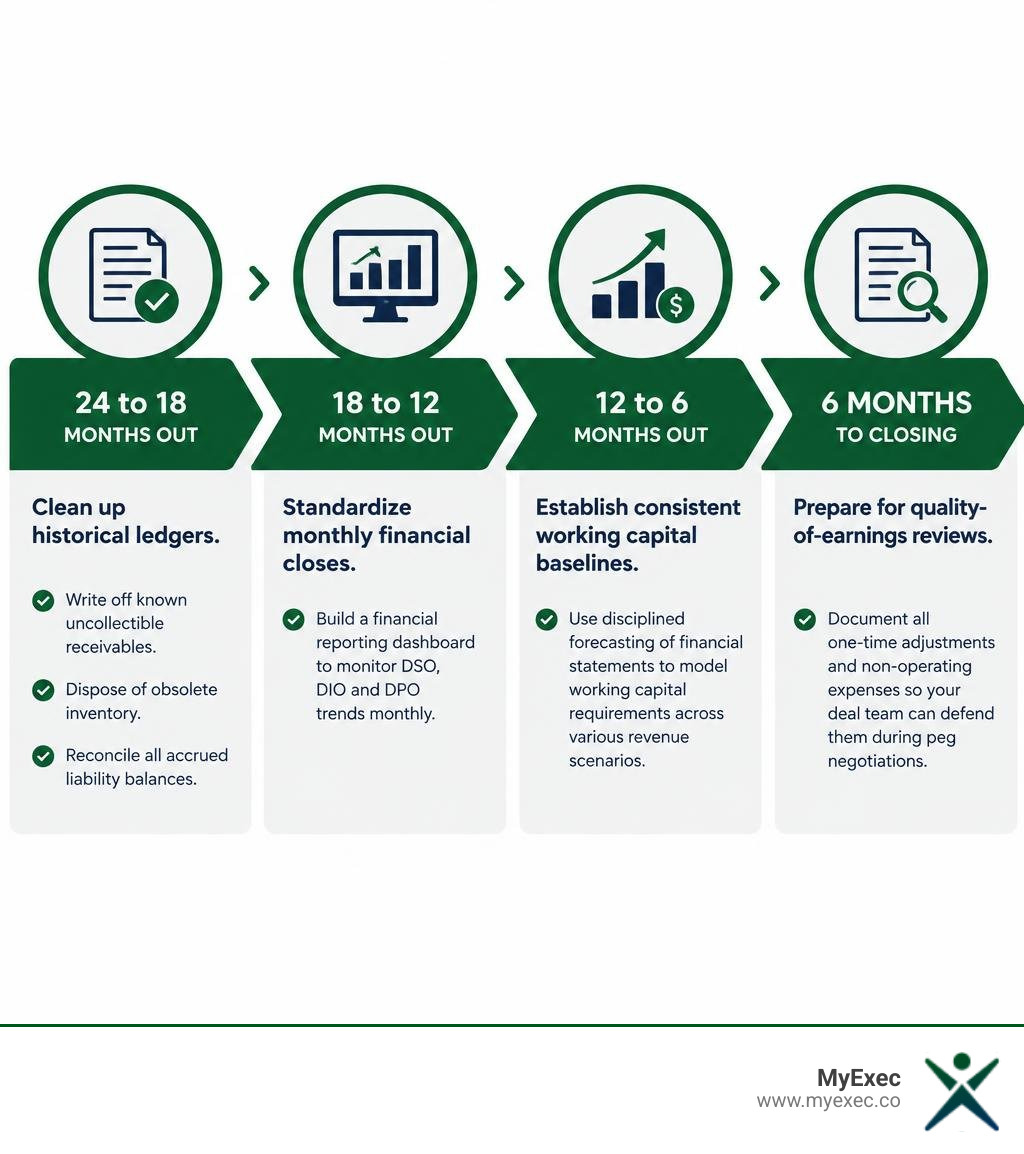
- 24 to 18 Months Out: Clean up historical ledgers. Write off known uncollectible receivables, dispose of obsolete inventory, and reconcile all accrued liability balances.
- 18 to 12 Months Out: Standardize monthly financial closes. Build a financial reporting dashboard to monitor DSO, DIO, and DPO trends monthly.
- 12 to 6 Months Out: Establish consistent working capital baselines. Use disciplined forecasting of financial statements to model working capital requirements across various revenue scenarios.
- 6 Months to Closing: Prepare for quality-of-earnings reviews. Document all one-time adjustments and non-operating expenses so your deal team can defend them during peg negotiations.
Establishing Rigorous Cash Flow Forecasting
Institutional buyers demand reliable forward-looking financial visibility. Companies that lack cash forecasting often face higher escrow holdbacks and unfavorable working capital terms.
Implementing a structured cash flow forecasting process helps business owners maintain control. Tracking weekly variances shows you how to spot cash flow issues faster, preventing last-minute liquidity crunches that could disrupt deal negotiations.
At MyExec, we provide fractional CFO and FP&A services that scale with your business. Depending on your needs, stage, and operational complexity, our flexible model provides hands-on analyst modeling, senior CFO leadership, or a blend of both. We've worked across businesses ranging from a few million in revenue to roughly $2B, including privately held, private equity-owned, publicly traded, and nonprofit organizations.
We regularly implement cash flow forecasts and rolling 13-month P&L forecasts for our clients. We build integrated three-statement models for mergers and acquisitions and new product rollouts, optimize margins, and design KPI scorecards tracking customer acquisition cost, average revenue per customer, and net revenue retention. Our team also delivers capital allocation expertise and helps leadership teams improve the speed and clarity of their monthly reporting.
Frequently Asked Questions about M&A Deal Adjustments
What happens to excess cash on the balance sheet at closing?
In standard cash-free, debt-free transactions, the seller extracts all cash from the company balance sheet at closing via a dividend or capital distribution. However, you must leave behind enough operational current assets (like receivables and inventory) to meet the agreed working capital target.
How does seasonality affect the target peg calculation?
If your business experiences seasonal peaks and troughs, using a simple 12-month average can create an unfair target. If you close during a seasonal peak, working capital needs are high, but during a trough, they are low. In these cases, deal teams negotiate seasonal working capital pegs or establish an adjustment collar to account for predictable volume swings.
Is negative operating working capital always penalized in an acquisition?
Not always. Certain business models, like SaaS platforms with annual upfront subscriptions or high-velocity retail companies, naturally operate with negative working capital. They collect cash from customers before paying suppliers or delivering services. When buyers understand this operating model, negative working capital is accepted as standard operating procedure rather than a deficit.
Conclusion: Secure Your Valuation Before Going to Market
Maximizing your take-home proceeds when selling your business requires more than negotiating a high headline enterprise value. The working capital target peg directly determines how much cash you walk away with when the transaction closes.
By cleaning up your balance sheet, managing customer collections, optimizing inventory, and tracking historical averages 12 to 24 months before a sale, you protect your company's value.
At MyExec, our fractional CFO and FP&A team includes a Certified Valuation Analyst (CVA) on staff. We've helped multiple clients improve enterprise value through dynamic scenario modeling, planning, and forecasting.
If you are planning an exit within the next one to three years, find out where your business stands today. Request your valuation report and consultation to uncover balance sheet opportunities and defend your hard-earned equity before entering negotiations.