

The short answer
Strategic financial planning turns a growth goal into a three to five year financial plan that shows what the goal will cost, how it will be funded, which investments come first, and how progress will be measured. The annual budget is the first year of that plan. Without the plan, the budget is a guess about one year, and the goal is a number on a slide.
Most owners we talk to have a goal. Double the business in five years. Open two more locations. Buy the competitor who keeps calling. They also have a budget, usually built in the fourth quarter, that shows next year in detail. What's missing is the piece in between: a plan that connects the goal to the money and the people it will take, year by year, so the budget is year one of something rather than a standalone exercise.
That piece is strategic financial planning. It isn't complicated, and it doesn't need to be long. This guide covers what it is, how it differs from the budget and the forecast, how to build one in five steps, a worked example of a company planning to grow from $20M to $30M, the measures to track, how to turn the plan into next year's budget, and how the current rate environment changes the math. It's written for owners of $5M to $50M companies who are setting 2027 plans right now.
What is strategic financial planning?
A strategic financial plan is a three to five year view of the business built around a goal. It starts from the business as it runs today, adds the growth initiatives one at a time, puts a cost and a cash requirement on each one, decides how they'll be funded, and sets the handful of measures that will tell you whether the plan is working. It is usually a few pages and one model, and it is owned by the owner or CEO with the finance team doing the building.
The plan answers the questions the budget can't. Can we afford the second location and the acquisition in the same year? How much of the growth can cash flow fund before we go to the bank? What has to be true about margins for this to work? When do we need the next hire, and can we carry the cost before the revenue arrives? A budget assumes those answers. The plan makes them.
Strategic plan, budget and forecast: how they fit together
| Strategic financial plan | Annual budget | Rolling forecast | |
|---|---|---|---|
| Horizon | Three to five years, by year | Next fiscal year, by month | The next 12 to 13 months, rolled monthly |
| Purpose | Connect the goal to capital, people and funding; decide the order of investments | Set targets and hold people to them | Show where the business is likely to land and what cash looks like ahead |
| Owner | The owner or CEO, built by finance | The owner and leadership team | Finance, with monthly inputs from sales and operations |
| How often it changes | Reviewed once a year, or when a major assumption breaks | Fixed for the year | Every month |
| What it feeds | Year one becomes the budget | The forecast's starting point and the variance report | Decisions in the next quarter; the next plan review |
The three are one system. The plan sets direction, the budget commits to the first year, and the forecast keeps the view current as the year unfolds. Our posts on rolling forecasts and budgets cover the second and third; this one is about the first.
How to build a strategic financial plan
Start with the goal and the baseline
Write the goal down in one sentence with a number and a date. "Reach $30M in revenue by the end of 2029 with the same or better margin" is a plan you can build to. "Grow aggressively" is not.
Then model the business as it runs today, with no new initiatives, for the full horizon of the plan, three to five years. Same customers, same locations, normal price increases, the hires you'd make anyway. This is the baseline, and it matters more than most owners expect. It shows how much of the goal the existing business will deliver on its own, which tells you how big the gap is that the initiatives have to fill. In a multi-location business we work with, we budget every existing location on its own first, set the baseline growth, and only then add the planned acquisitions and a capital spending reserve on top. The order keeps the baseline honest.
Layer in the growth drivers one at a time
Add each initiative as its own layer, with its own assumptions, revenue curve and cost. Pricing. Volume from added sales capacity. A new location or line. An acquisition. Adding them one at a time does two things: it shows what each is worth on its own, and it makes the plan explainable, because every dollar of growth traces back to a decision. If you can't say what a layer assumes about price, units and timing, it isn't ready to be in the plan. Our post on deciding whether an investment is worth it covers how to test a single layer.
Size the capital the plan needs
Growth takes cash before it returns any, and the plan has to show how much. Three pieces: the working capital the added revenue ties up in receivables and inventory, the capital spending the initiatives require, and a reserve for the things that don't go to plan. The working capital piece is the one owners miss, because it never appears on the income statement. Our guide to how to fund the working capital growth needs covers how to size it.
Choose how to fund it
Set the cash the plan needs against the cash the existing business generates after tax and distributions. The gap is what has to come from outside: a term loan, a bigger line, seller financing on an acquisition, or outside capital. Decide this in the plan, with the lender conversation timed to the year the money is needed, rather than discovering the gap in the month the acquisition closes. Financing structure and tax effects are decisions for your banker, attorney and CPA; the plan's job is to size the need and put a date on it.
Test the plan with scenarios
Run the plan with the acquisition a year late, with margin a point lower, with the new location ramping in eighteen months instead of twelve, and with rates half a point higher. The plan that survives those cases is the one to commit to. The one that only works in the base case needs a smaller first step. Our post on scenario analysis covers how to set the cases up.
A worked example: from $20M to $30M in three years
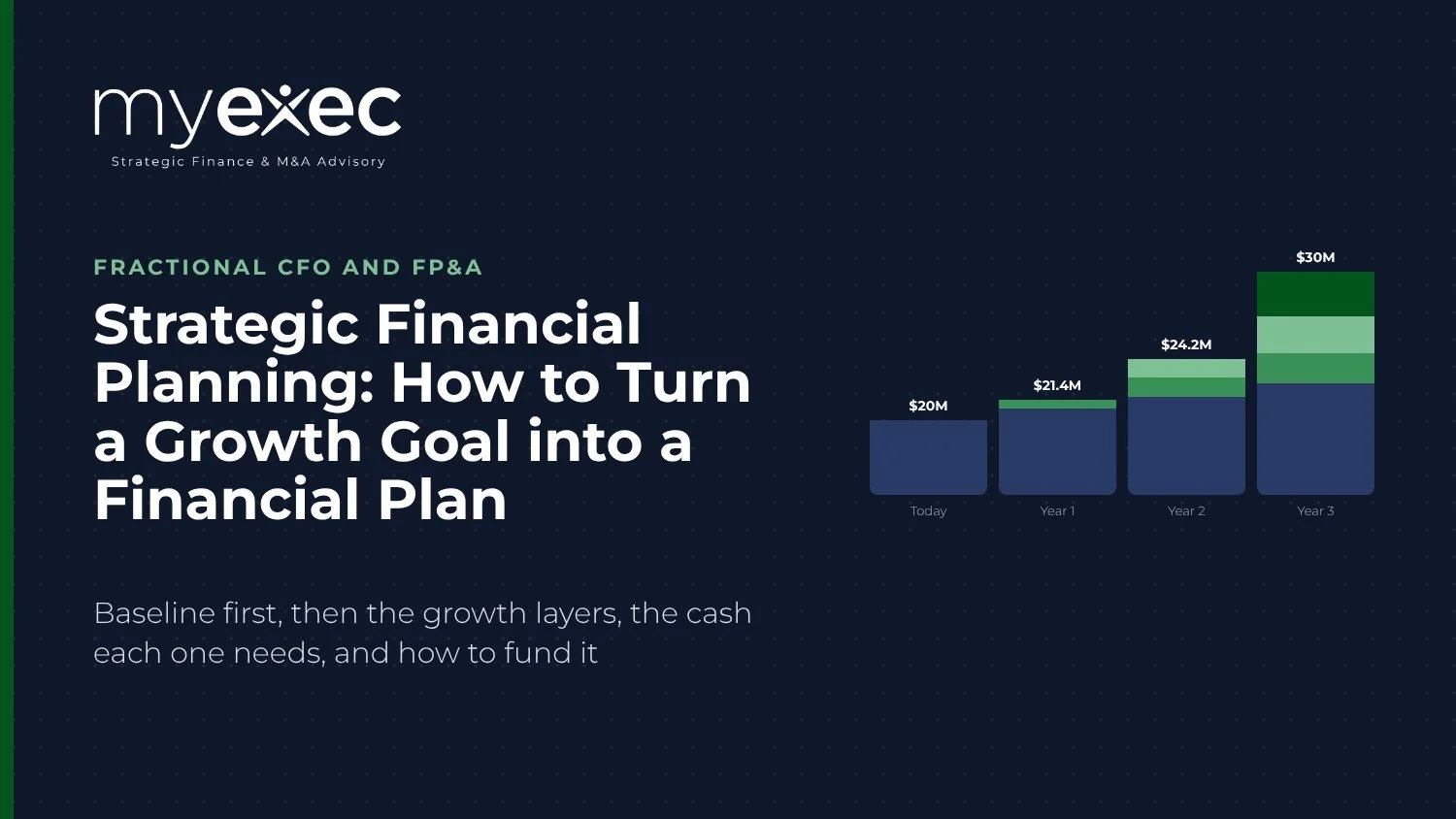
The figures are hypothetical and rounded. A distributor with $20M of revenue and an 8% EBITDA margin sets a goal of $30M in three years, so the plan runs three years. It is built in four layers.
| Layer | Revenue added by year 3 | Cash the layer needs | Funded by |
|---|---|---|---|
| Baseline: existing business at 4% volume growth | +$2.5M | About $375,000 of working capital | Operating cash flow |
| Pricing: 3% a year on the baseline | +$2.0M | Almost none; it mostly drops to margin | None |
| New location, opens in year 2 | +$2.5M at maturity | $600,000 build-out plus about $375,000 of working capital | Operating cash flow and the line |
| Acquisition, closes at the start of year 3 | +$3.0M | About $1.5M price (a hypothetical 5x on $300,000 of EBITDA) plus $450,000 of working capital | Term loan with seller financing |
| Total | $30.0M by year 3 | About $3.3M over three years |
Now the funding question has a shape. At an 8% margin on a growing base, the existing business generates about $6M of EBITDA over the three years. After tax and the owner's distributions, call it $2.5M to $3M available for growth, which covers the baseline working capital, the location, and part of the acquisition. The rest of the acquisition is a term loan, and the plan says so in year one, which gives the owner two years to get the reporting the bank will want in shape. Our post on what banks look for before lending covers that preparation.
Run the scenarios and the plan tells you where it's fragile. If margin slips a point, the cash available for growth falls by about $750,000 over three years and the acquisition needs more debt. If the location takes eighteen months to ramp, year two cash is tight and the acquisition should move to year four. Neither finding kills the plan. Both change the order and the timing, which is exactly what the plan is for. Size your own plan below.
Growth plan cash check
Enter your figures to see what the plan needs and how much of it cash flow can fund.
The free Strategic Finance Assessment scores your planning and forecasting alongside five other areas in about five minutes, which is a quick way to see whether the finance function can carry a plan like this.
Set the measures your leadership team will track
A plan without measures is a document. Pick five to eight numbers, tied to the layers of the plan, and put them in front of the leadership team every month. For the distributor above: revenue against the plan by layer, gross margin, the new location's monthly revenue against its ramp curve, days to collect, cash against the forecast, and headroom on the line. Each one should have an owner and a number it's supposed to hit this quarter. In a 20% growth plan we're building with a leadership team, the measures are reviewed weekly, and the point of the meeting is the two or three that are off plan.
Turning the plan into next year's budget
Year one of the plan becomes the budget, and the budget inherits the plan's structure: the baseline by location or line, each growth layer as its own set of lines with its own assumptions, the capital spending and the funding events on the calendar. Built this way, a variance in March points at a layer and an assumption rather than at "revenue." That is also why the budget should state price and volume separately, so the forecast can be rolled against it through the year. Our guide to building next year's budget covers the mechanics.
If you're reading this in November, you should be working on both at once. The plan sets the goal and the layers; the budget commits to year one. Doing the budget without the plan is how companies end up funding year one of three different ideas.
How higher interest rates change the plan
The Federal Reserve held its target range at 3.75% to 4.00% on October 28, 2026, and the prime rate has been 7.00% since September 17 (Federal Reserve data via FRED). Market estimates cited by ABF Journal on November 2 put the odds of a further increase in December at roughly 77 to 86 percent; that is a market expectation, and the Fed meets on December 9. Meanwhile the economy grew at a 3.4% annual rate in the third quarter (Bureau of Economic Analysis, October 29, 2026). Demand is strong and borrowing is expensive at the same time, which is an unusual combination to plan into.
For the plan, that means three things. The debt-funded layers cost more, so the acquisition's return has to clear a higher bar, and the plan should show the interest at today's rate and at half a point higher. Cash-funded layers look relatively better, which argues for sequencing the location before the acquisition rather than alongside it. And the reserve matters more, because a bank that is tightening will read your year-end numbers closely at the next renewal. None of this says wait. It says build the plan with the rate in it, and let the plan decide the order.
A one-page plan you can copy
- Goal. One sentence: the number, the date, and the margin or cash condition that has to hold.
- Baseline. The existing business for the full horizon with no new initiatives: revenue, margin, cash generated.
- Growth layers. Each initiative on its own line: what it assumes, the revenue curve, the cost, and when it starts.
- Capital. Working capital, capital spending and a reserve, by year.
- Funding. Cash flow first, then the gap and how it's filled, with the lender or investor conversation on the calendar.
- Scenarios. The three cases the plan was tested against and what each one changes.
- Measures. Five to eight numbers, each with an owner and a quarterly target.
- Year one. The budget, built from the layers above.
Common mistakes
- Skipping the baseline. Without it, nobody knows how much of the goal the existing business delivers on its own.
- Planning growth as one number. A 15% growth line can't be funded, staffed or measured. Layers can.
- Forgetting working capital. The cash that growth ties up never shows on the income statement, and it is usually the largest need.
- Doing everything in year one. The plan's job is to set the order. Two initiatives in one year is often one too many.
- Only the base case. A plan that hasn't been tested at a lower margin and a later ramp hasn't been tested.
- No measures, no meeting. If the plan isn't reviewed monthly against a few numbers, it was a planning session rather than a plan.
- Letting the budget drift from the plan. Year one should be recognizable as the first year of the three.
Frequently asked questions
What is the difference between a strategic financial plan and a budget?
The plan is a three to five year view that connects a growth goal to the capital, people and funding it will take, and sets the order of the investments. The budget is the detailed first year of that plan, fixed so results can be measured against it. The plan answers whether the goal can be funded and in what sequence; the budget commits to the first twelve months.
How far ahead should a strategic financial plan look?
Three to five years. Three is enough for most $5M to $50M companies: long enough to include a location, an acquisition or a hiring plan and see the cash they need before they return any, and short enough that the assumptions still mean something. Five fits long build cycles, or a goal that takes more than one acquisition. Beyond five years the numbers are direction rather than plan.
How often should the plan be updated?
Once a year, before the budget is built, and whenever a major assumption breaks: an acquisition falls through, a large customer is won or lost, rates move materially. Between reviews the rolling forecast carries the current view and the monthly measures show whether the plan is on track. Rewriting the plan every quarter defeats its purpose, which is to hold the direction steady.
Who should own the strategic financial plan?
The owner or CEO, because it is a set of decisions about where the company is going and what it will spend to get there. Finance builds it, keeps the model, runs the scenarios and reports the measures. Each leader owns their layers: sales owns the capacity layer, operations owns the location ramp. A plan owned by finance alone is a model nobody runs the business by.
Do we need a strategic financial plan before an acquisition?
Yes. An acquisition is the most expensive layer most companies ever add, and it has to sit on a clear baseline so you can see what it adds and what it costs in cash, debt and management time. The plan shows whether the business can carry the debt, whether the timing works against other initiatives, and what has to be true after closing. Lenders will ask for that view.
How much growth can we fund from cash flow?
Roughly, the cash the business keeps for growth each year, after tax and distributions, divided by the working capital each dollar of new revenue ties up. A company that keeps $900,000 a year and ties up 15 cents per revenue dollar can fund about $6M of added revenue a year before capital spending. Anything beyond that, or any acquisition, needs outside funding planned in advance.
Build your plan with MyExec
We build three to five year financial plans with owners and their leadership teams, baseline first, then the layers, with the cash, the funding and the measures attached, and we turn year one into the budget. If your 2027 plan is a goal and a budget with nothing connecting them, start with our strategic finance guide or talk with our team about scalable strategic finance leadership.
Want to see how the plan fits with the rest of the finance function? Start with the six dimensions of a strategic finance function.