Understand the Six Dimensions of a Strategic Finance Function
Strategic Finance vs. Traditional FP&A: The Critical Shift

A strategic finance function has six connected dimensions:
- Enterprise value optimization: Deciding how each dollar, hire, investment, and financing choice affects company value.
- Planning, forecasting & dynamic scenario modeling: Updating forward-looking plans as business conditions change.
- Real-time financial visibility: Giving leaders timely, reliable numbers they can actually use.
- Advanced decision support: Turning financial analysis into clear recommendations for major business choices.
- Unit economics tracking: Understanding profitability by customer, product, job, location, or service line.
- Strategic alignment across functions: Connecting departmental priorities to shared financial goals.
Together, these capabilities help leadership decide where to deploy capital, how to adjust plans, which margin levers to pull, and how each department contributes to enterprise value. For U.S. businesses between $5M and $50M in revenue that are outgrowing founder-led finance, the shift is from reporting what happened to guiding what should happen next.
Traditional FP&A focuses on recording historical performance, producing static variance analyses, and building annual budgets. While necessary, that approach leaves executive teams looking backward through the rearview mirror. Strategic finance changes the entire posture of the department. It operates as an internal advisory engine that pairs analytical rigor with commercial acumen.
At MyExec, we have taught clients to connect planning, forecasting, scenario modeling, and monthly reporting improvements directly to enterprise value. That experience shapes how we view strategic finance: not as another reporting layer, but as a practical operating discipline that helps leadership make better cash flow, margin, and investment decisions over time.
Understanding the difference between strategic finance, a fractional CFO, and accounting/bookkeeping starts with looking at how finance interacts with everyday business choices. Accounting serves as the compliance foundation and historical system of record. FP&A models historical trends to budget future expenses. Strategic finance actively shapes capital deployment, challenges commercial assumptions, and drives leadership decisions.
Research indicates that organizations with optimized finance functions are 1.5 times more likely to outperform peers in EBITDA growth. Yet, Bain notes that when finance becomes a company's secret weapon, it requires deliberately prioritizing high-impact strategic advisory over basic recordkeeping.
| Operational Attribute | Traditional FP&A | Strategic Finance Function |
|---|---|---|
| Primary Question | What happened, and why did we miss the budget? | What should we do next to maximize enterprise value? |
| Core Output | Static variance reports and quarterly reviews | Actionable decision models and forward-looking business cases |
| Planning Tempo | Annual budgeting cycle with static snapshots | Continuous rolling forecasts and scenario analyses |
| Success Metric | Forecast accuracy and on-time monthly reporting | Quality of strategic decisions, ROI, and EBITDA growth |
The Six Dimensions of a Strategic Finance Function
Transforming finance from an overhead cost into a growth driver requires a connected capability framework. When these dimensions operate in harmony, operational drivers inform financial outcomes directly.
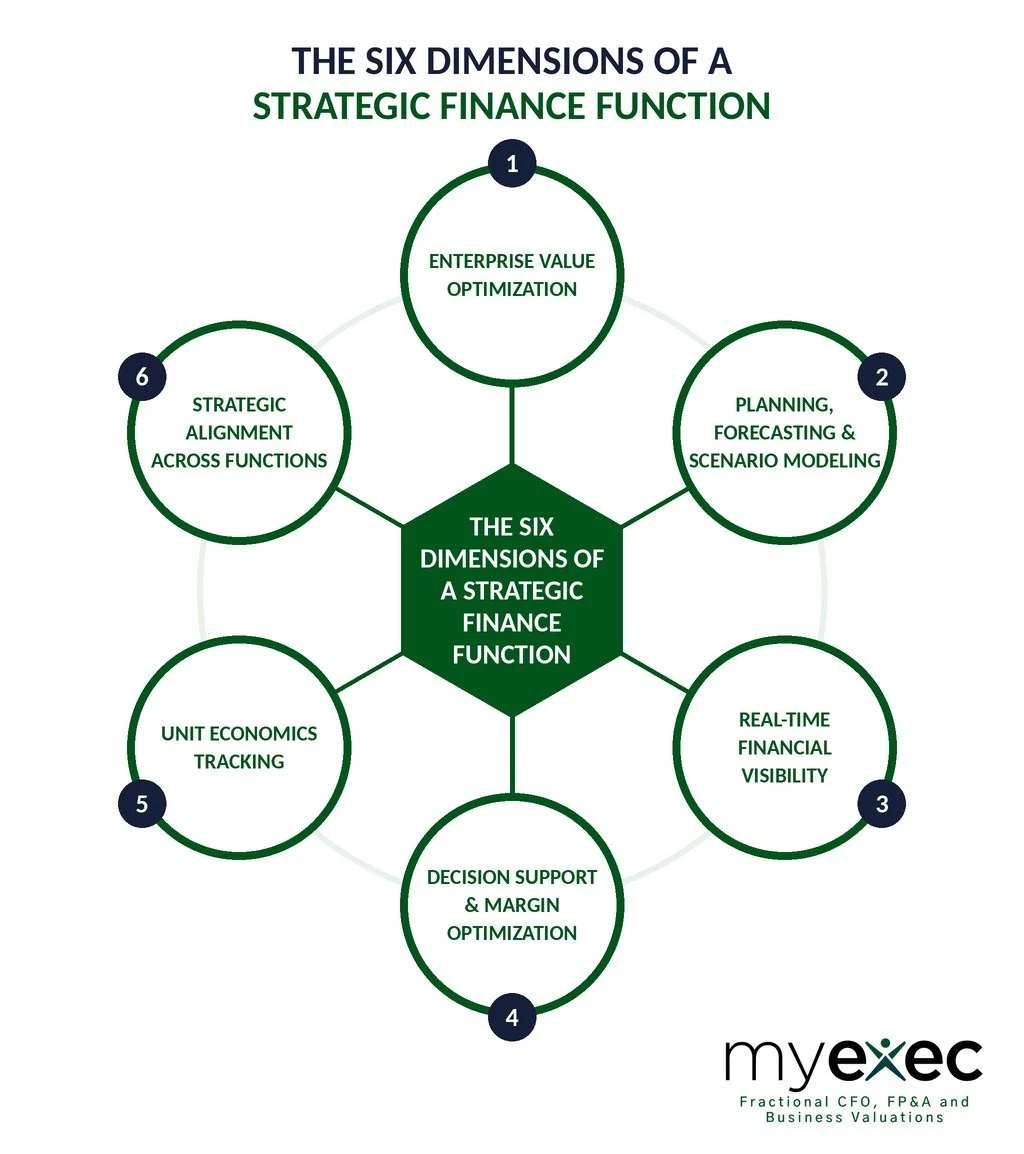
Let us explore each dimension step-by-step.
1. Enterprise Value Optimization
Enterprise value optimization ensures every dollar deployed, every hire made, and every debt facility structured builds tangible company worth. Rather than managing daily bank balances in a vacuum, strategic finance evaluates choices through their impact on valuation multiples, risk profiles, and free cash flow generation.
- Reactive Example: Management commits cash to new product lines because funds exist in the operating account, without modeling long-term payback or valuation impact.
- MyExec Example: We have helped multiple clients connect planning, forecasting, and dynamic scenario modeling to enterprise value improvement. That work often starts by identifying the decisions that most affect cash flow, margin, and valuation, then building models that show leadership how different capital allocation choices could change the company's financial trajectory.
- Self-Check Question: Can your leadership team clearly quantify how your current operating budget directly impacts your company's valuation multiple over the next 24 months?
2. Planning, Forecasting & Dynamic Scenario Modeling
Strategic planning replaces rigid, once-a-year budgeting with flexible, driver-based models. Market conditions shift quickly, making static annual budgets outdated within months.
- Reactive Example: Department heads spend three months building an annual budget that sits untouched on a shared drive while leadership navigates unexpected market shifts blindly.
- MyExec Example: We have implemented cash flow forecasts, rolling 13-month P&L forecasts, and sensitivity and scenario analyses that help client leadership evaluate trade-offs before conditions become urgent. For example, leadership can compare base, upside, and downside plans, understand how revenue or margin changes affect cash runway, and decide which operational moves should happen first.
- Self-Check Question: If your top revenue line drops by 15% next month, can your finance team present a fully updated cash flow forecast with specific operational adjustments within 48 hours?
3. Real-Time Financial Visibility & Reporting Architecture
A modern finance function eliminates manual data aggregation and disconnected spreadsheets. Capturing operational and financial data through automated workflows creates a single source of truth across the entire company.
- Reactive Example: The finance team spends 15 business days manually exporting CSVs from CRM, billing, and accounting systems to compile a monthly report delivered three weeks late.
- MyExec Example: We have helped clients improve both the quality and speed of monthly reporting so leadership teams can get useful numbers faster. That can include cleaner reporting packages, better KPI visibility, and dashboards that connect financial results to the operating metrics leaders use in weekly or monthly decision meetings.
- Self-Check Question: Are your monthly financials closed in under 7 days with departmental budget-versus-actuals distributed immediately to operational leaders?
4. Advanced Analysis, Decision Support & Margin Optimization
Advanced decision support translates raw numbers into commercial recommendations. Instead of just highlighting cost overruns, strategic finance investigates underlying drivers and provides clear options for margin expansion.
- Reactive Example: Finance flags that gross margins compressed by 4% last quarter but offers no diagnosis of whether the cause was discounting, shipping rates, or product mix.
- MyExec Example: We have provided advanced analysis, decision support, and margin optimization by building integrated three-statement models for new product launches and mergers and acquisitions. Those models help leadership understand expected cash impact, financing needs, margin sensitivity, and the operating assumptions that must hold true before committing to a major initiative.
- Self-Check Question: When business leaders make major hiring or pricing decisions, does finance provide a proactive commercial model detailing expected ROI and operational trade-offs?
5. Unit Economics & Operational Driver Tracking
Sustainable scaling requires understanding unit economics at a granular level. Strategic finance links non-financial operational drivers, such as sales pipeline velocity, customer acquisition costs, cohort retention, and labor capacity, directly to bottom-line performance.
- Reactive Example: The P&L shows rising top-line revenue, masking the fact that customer acquisition costs have doubled and newer cohorts are churning at higher rates.
- MyExec Example: We have implemented KPI scorecards that track customer acquisition cost, average revenue per customer, and net revenue retention. The goal is not just to display metrics, but to help leadership see which customer segments, service lines, or channels are creating profitable growth and which ones need pricing, retention, or cost-structure changes.
- Self-Check Question: Do you know your exact customer acquisition cost payback period and contribution margin by customer tier or product line?
6. Strategic Alignment & Cross-Functional Execution
Finance sits at the intersection of all company data, making it uniquely positioned to break down departmental silos. Utilizing this cross-departmental data and connecting various drivers and dependencies, strategic finance ensures operational initiatives align with company goals.
- Reactive Example: Sales pursues aggressive discounts to hit volume quotas while operations adds unbudgeted headcount to fulfill demand, resulting in flat net cash flow.
- MyExec Example: We participate in and help facilitate company planning sessions that align the executive leadership team around shared revenue, profitability, and cash flow targets. From those sessions, leadership can define clear objectives, assign responsible owners, and identify the initiatives required to hit the plan. We then help build the financial forecasting around those initiatives, estimate the level of improvement associated with each one, define the metrics required to reach revenue or profitability targets, and work with departments to stay aligned on the areas they directly control.
- Self-Check Question: Do all department heads know the top three financial metrics they personally influence, and are their operational priorities aligned with those goals?
Building and Scaling Modern Strategic Finance Capabilities
Scaling a strategic finance capability does not mean hiring an army of expensive full-time executives on day one. It requires structuring the right mix of capabilities as business complexity evolves.

Most finance leaders struggle with data integration across platforms, while organizations often face turnover when role structures and career paths remain undefined. Companies also frequently balance resources between centralized core functions and distributed business unit support. Solving these operational hurdles requires matching team design to business revenue.
In practice, that usually means building the finance function around the decisions the business needs to make next. A company preparing for a new product launch, acquisition, or capital raise needs deeper modeling and scenario planning. A company fighting margin pressure may need better unit economics, KPI scorecards, and reporting cadence before adding more headcount.
Our comprehensive strategic finance guide outlines the structural path forward for growing organizations.
Structuring Teams across the Six Dimensions of a Strategic Finance Function
- $5M to $15M Revenue (Emerging Businesses): Companies at this stage outgrow basic bookkeeping but do not need a full-time in-house executive suite. Bringing in experienced fractional CFO leadership paired with core FP&A analyst support delivers strategic planning, cash modeling, and KPI tracking efficiently.
- $15M to $50M Revenue (Scaling Mid-Market): As operations expand across multiple entities, product lines, or geographic locations, businesses require specialized modeling, automated data pipelines, and ongoing transaction support. A hybrid model blending dedicated internal staff with flexible executive advisory helps maintain high-level strategy without payroll bloat.
When evaluating financial leadership, look beyond standard certifications. Prioritize strategic finance experience, dynamic forecasting skills, KPI design, capital planning, and a track record of translating numbers into practical decisions.
Frequently Asked Questions About Strategic Finance
How does strategic finance differ from traditional accounting?
Accounting is focused on compliance, historical recording, tax adherence, and maintaining accurate financial statements. Strategic finance uses those accounting records alongside operational metrics to build forward-looking projections, guide capital allocation, and improve overall profitability.
What technology stack is needed to support strategic finance?
A modern strategic finance tech stack connects your core cloud accounting system with CRM, billing, and dedicated FP&A platforms. Automating data pipelines removes manual data entry, enabling rolling forecasts and real-time dashboard visibility.
How can a mid-market company assess its current finance maturity?
Leadership can evaluate current maturity by identifying workflow bottlenecks, measuring month-end close speeds, and reviewing decision-support capabilities. Taking our strategic finance assessment helps benchmark your current finance operations against modern best practices.
Transforming Your Finance Function into a Strategic Asset
Transitioning from reactive scorekeeping to forward-looking strategic finance is one of the most effective ways to build a scalable, high-value business. When enterprise value planning, dynamic forecasting, clear visibility, decision support, unit economics, and executive alignment work together, finance becomes a competitive engine.
At MyExec, we provide fractional CFO and FP&A services tailored for U.S. businesses between $5M and $50M in revenue that are outgrowing founder-led finance. Our support is flexible and scalable, offering analyst support, senior CFO leadership, or a mix of both based on your complexity and stage.
Our work often includes the practical building blocks discussed throughout this article: cash flow forecasts, rolling P&L forecasts, sensitivity analyses, three-statement models, monthly reporting improvements, and KPI scorecards. Those tools are most valuable when they help leadership make better decisions about cash flow, margin, growth investments, and enterprise value.
Our team includes a Certified Valuation Analyst (CVA) on staff, and we have worked across companies from a few million in revenue to roughly $2B, including nonprofits, private equity owned, closely held, and publicly traded companies.
Explore our strategic finance and fractional CFO services to transform your finance department into a high-performing strategic asset.