Beginner's Guide to Understanding Fractional CFO Value

A fractional CFO is an experienced executive who provides high-level financial guidance on a flexible schedule. Instead of managing routine bookkeeping tasks, they focus on long-term capital strategy, operating efficiency, and financial forecasting. Traditional executive hiring often requires a heavy six-figure salary, stock equity grants, and long recruiting cycles. A fractional arrangement gives growing companies immediate access to executive leadership at a fraction of full-time compensation costs.
This model allows growing businesses to tap into senior executive experience without committing to a full-time compensation package. Companies often pair this service with existing internal accounting teams or an outsourced controller to keep daily accounting running while gaining strategic direction. If you want to learn more about how this advisory setup functions, explore our detailed overview of Fractional CFO Consulting. For broader guidance on business management standards, resources from the U.S. Small Business Administration offer useful frameworks for growing enterprises.
Core Responsibilities in Corporate Governance
Bringing 10 to 20+ years of corporate finance leadership to the table, a fractional executive helps set governance frameworks, establish internal financial controls, and guide capital allocation. They lead discussions on major expenditures, oversee banking relationships, and ensure that executive decisions align with realistic financial forecasts. They don't just produce reports. They sit with leadership to translate operational data into clear strategic choices.
How a Fractional CFO Differs From a Controller or Bookkeeper
It helps to think of accounting and strategic finance as two distinct functions across a company's financial hierarchy:
- Bookkeepers and Accountants: Focus on recording past transactions, managing payroll, handling invoices, and reconciling accounts to keep books clean and audit-ready.
- Controllers: Manage the closing process, maintain regulatory compliance, enforce internal accounting procedures, and publish historical financial statements.
- Fractional CFOs: Use historical data to build forward-looking projections, guide business unit strategy, manage working capital, evaluate debt structures, and prepare for external financing or mergers.
To dive deeper into these distinctions, check out our guide on What is the Difference Between Strategic Finance, a Fractional CFO, and Accounting/Bookkeeping.
Strategic Services Provided to Growing Businesses
A fractional CFO focuses on high-impact projects and ongoing financial steering. They help leadership turn complex financial data into actionable strategy so companies don't make critical choices in the dark.
Strategic FP&A and Long-Term Planning
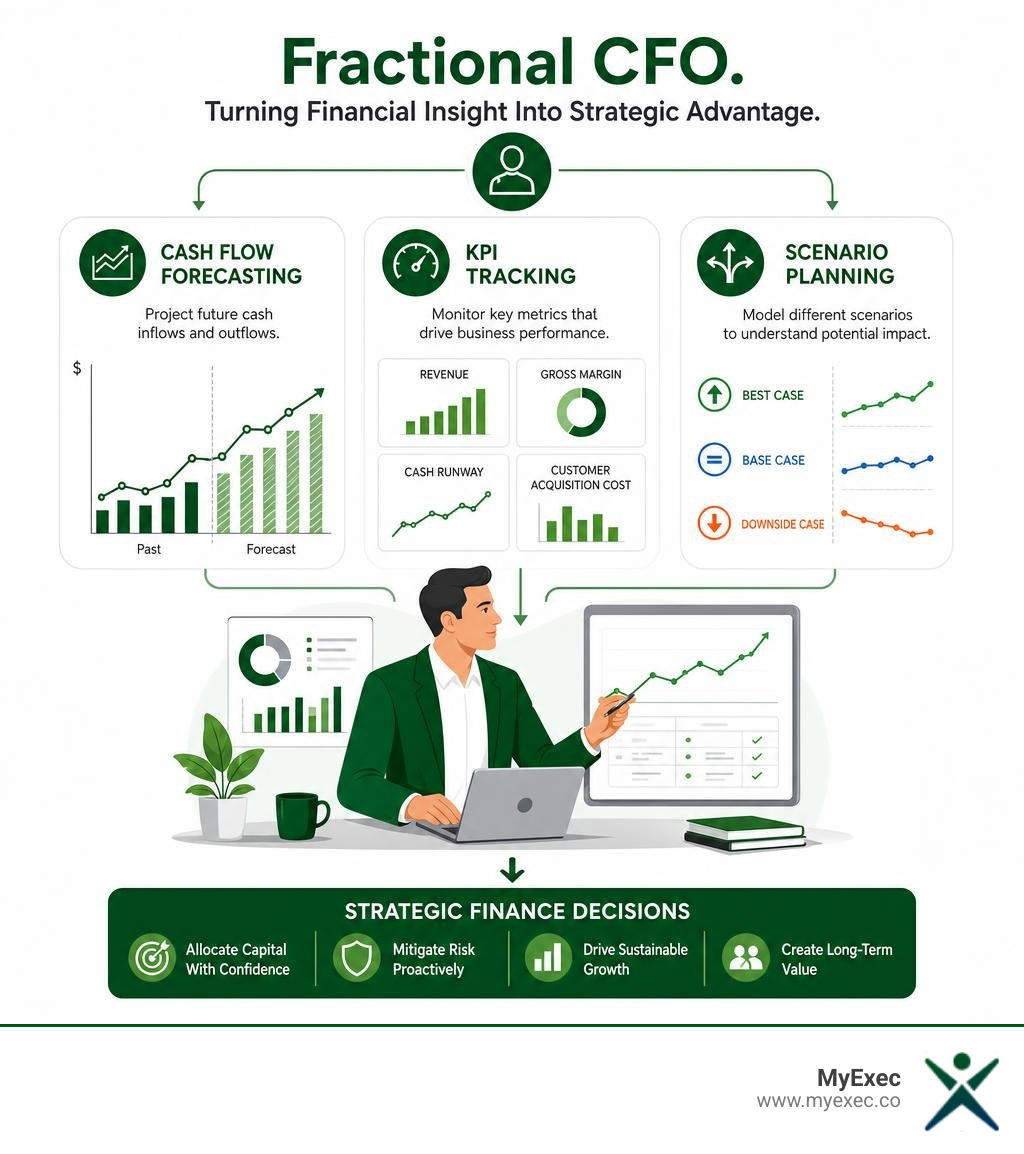
Financial planning and analysis (FP&A) helps companies map out their path forward. A fractional executive models unit economics, forecasts cash burn, sets key performance indicators (KPIs), and optimizes gross margins across product lines. They establish rolling 12-month financial models that update automatically as operational data flows in.
By running scenario analyses, they show how changes in sales velocity, pricing structure, or operating expenses impact long-term enterprise value. You can see how opening a new facility or hiring a sales team affects cash flow before committing capital. Learn more about developing these practices in our comprehensive Strategic Finance Guide and review our tips on Financial Reporting and Financial Statement Analysis. You can also review standard corporate financial terms on Investopedia to understand how executive finance leaders structure balance sheet analysis.
Fundraising, M&A, and Business Valuations
When a business reaches a major milestone, such as securing venture capital, opening credit lines, or evaluating acquisition targets, executive finance guidance is critical. A fractional CFO helps build debt and equity presentation materials, designs data rooms, and leads financial due diligence. They make sure financial records pass rigorous lender or investor scrutiny.
At MyExec, we also support clients who need formal, defensible valuation reports, backed by a Certified Valuation Analyst (CVA) on staff. Whether you're planning an internal partner buyout or preparing for an external exit, our team builds defensible models based on market multiples and discounted cash flows. For additional details on how valuation methodologies support exit planning and capital raises, visit our page on Business Valuations.
Key Triggers and Industry Value
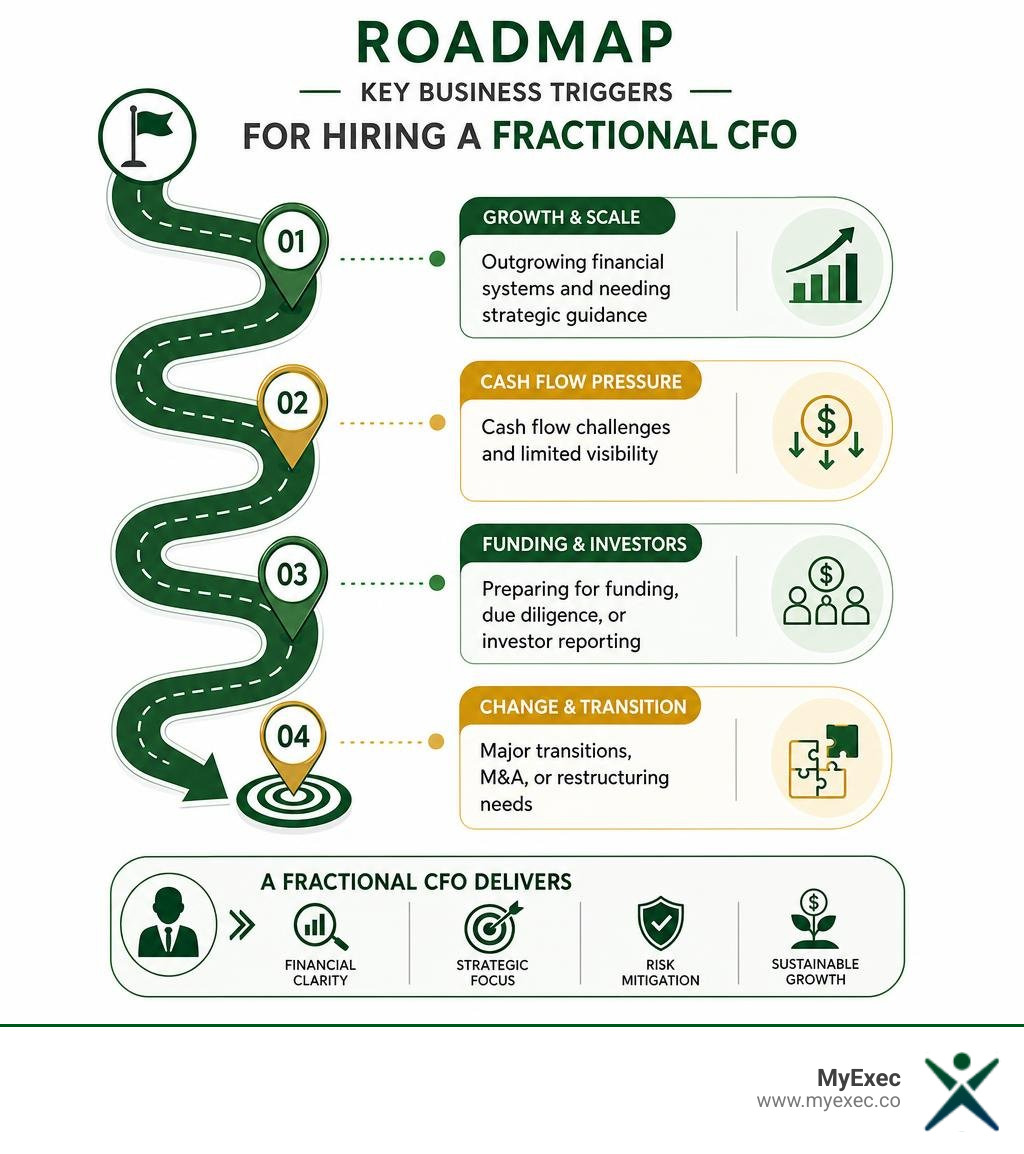
Businesses typically seek fractional leadership when operational scale outpaces their internal accounting systems and founder-led spreadsheet tracking.
Key Triggers: When to Hire a Fractional CFO
Common inflection points include:
- Scaling annual revenues past $5M into the $50M range where founder-led finance becomes risky and time-consuming.
- Preparing for a capital raise, debt financing round, bank credit line expansion, or company exit.
- Facing cash flow volatility, shrinking operating margins, or unpredictable working capital swings.
- Acquiring another business, integrating new operations, or restructuring internal business units.
- Experiencing a sudden gap in full-time executive leadership during a critical growth phase.
Read more about navigating these transitional stages in our article on the Growth Stage CFO.
Value Across Tech, Ecommerce, Manufacturing, and Nonprofits
Different sectors require distinct metrics and tailored financial strategies:
| Industry Sector | Areas of Financial Focus | Fractional CFO Strategic Output |
|---|---|---|
| Tech & SaaS | ARR, Churn, CAC to LTV ratio | Optimizing runway and capital efficiency for growth metrics |
| Ecommerce | Inventory cycles, ad spend ROI | Managing supply chain working capital and cash conversion cycles |
| Manufacturing | CapEx budgets, unit production cost | Analyzing product line profitability and equipment investment ROI |
| Nonprofits | Grant tracking, board reporting | Ensuring compliance with donor restrictions and long-term stability |
Each industry model requires deep strategic alignment. For instance, SaaS businesses must balance customer acquisition spend against long-term customer lifetime value, while manufacturing firms need precise cost accounting to maintain gross margins amidst fluctuating raw material prices.
Selection Criteria and Career Pathway
Finding the right finance partner requires looking beyond simple technical credentials. You need a partner who understands operational decision-making at your company's stage.
Evaluating Track Record and Engagement Terms
When selecting a fractional CFO, focus on real-world experience and operational fit:
- Look for executive track records with companies at your current stage and next growth target ($5M to $50M revenue tier).
- Prioritize strategic finance experience, forecasting capabilities, KPI design, capital planning, transaction support, and operating experience over specific accounting licenses.
- Choose flexible engagement terms (such as monthly retainers or project-based agreements) that match your operational scope and budget.
- Ensure they are comfortable with cloud finance systems like QuickBooks Online, NetSuite, or Xero to streamline financial reporting.
To evaluate your company's financial maturity before starting a search, complete our interactive Strategic Finance Assessment.
Skills and Qualifications for Fractional Executives
For finance professionals transitioning into fractional roles, success depends on 10 to 20+ years of corporate experience. While credentials like a CPA or CVA are helpful for technical tasks and valuations, commercial instincts, practical operating experience, and board-level communication are what drive real strategic value. Fractional leaders must translate raw accounting numbers into an executive narrative that helps founders make confident expansion decisions.
Frequently Asked Questions
What is the primary financial difference between an interim CFO and a fractional executive?
An interim CFO is a full-time, temporary manager hired to cover a gap during executive leadership transitions or restructurings, usually working 40+ hours per week for a short duration. A fractional CFO works with a business on an ongoing, part-time basis (such as 10 to 20 hours per month), delivering long-term strategic guidance for a portion of full-time costs.
How does strategic financial leadership integrate with existing internal accountants?
The executive works closely with your internal team or outsourced bookkeepers. The internal team continues managing day-to-day accounts payable, accounts receivable, payroll, and monthly closes. The fractional leader uses those underlying financial reports to build rolling forecasts, set annual budgets, manage cash flow, and advise senior leadership.
What revenue threshold indicates a need for executive finance leadership?
Companies earning between $5M and $50M typically experience the biggest operational benefit. At this stage, business operations become too complex for basic bookkeeping spreadsheets, but don't yet justify a full-time CFO salary and equity package.
Strategic Guidance for Your Next Stage of Growth
Navigating financial complexity requires the right executive vision at the right time. At MyExec, we provide flexible, scalable fractional CFO and FP&A services to growing U.S. businesses. Rather than offering single-person retainers, our full-stack model gives you access to analyst-level execution, senior CFO leadership, or a mix of both based on your current business needs, complexity, and stage.

Our team has worked across companies from a few million in revenue to roughly $2B, including nonprofits, private equity owned, closely held, and publicly traded companies. We also have a Certified Valuation Analyst (CVA) on staff to handle defensible valuation reports for capital raises or buyouts. When your company scales to the point where a dedicated full-time hire makes sense, we help define the role, support the search, and guide a clean operational transition.
Explore our full range of flexible support models on our main Services page, or visit Insights for additional guides on scaling your financial operations.