A Quick Start Guide to FP&A Basics for Startups

Financial planning and analysis (FP&A) for startups provides the forward-looking visibility founders need to navigate rapid shifts in customer acquisition, hiring, and market conditions. While traditional corporate finance focuses on annual budgets and protective cost controls, early-stage financial planning centers on runway intelligence, resource allocation, and maintaining investor credibility.
Running out of cash is rarely a sudden emergency. In almost every case, it is a planning failure. Startups frequently operate in unpredictable environments, burning capital before reaching profitability. Implementing proactive financial planning lets leaders map out strategic goals, monitor spend velocity, and adjust tactics before cash reserves dry up.
Whether a business generates revenue or relies entirely on equity investment, founders must answer three basic questions:
- Where is our money going right now?
- How long will our cash last under present conditions?
- What specific growth investments can we afford to make next?
As companies scale into the $5M to $50M revenue range, founder-led finance usually breaks down. Spending accelerates across multiple departments, payroll expands, and simple cash management becomes insufficient. Strategic planning establishes an operational compass across the organization, giving executives the clarity needed to balance aggressive growth with disciplined burn management. For a deeper look into how forward-looking finance functions differ from traditional record-keeping, see our breakdown on the difference between strategic finance, a fractional CFO, and accounting.
Accounting vs. FP&A for Startups: Understanding the Difference
A common mistake among founders is assuming that clean bookkeeping satisfies their financial management needs. Accounting and financial analysis serve completely different functions within a business.
Accounting is strongest at keeping the financial record clean. It captures transactions accurately, supports tax compliance, and tells leaders what revenue was collected, what expenses were paid, and what happened over a past period. That historical view is essential, but it has limited capacity on its own to explain what is driving performance, how cost structure is changing, or how today’s decisions will affect future cash flow and growth investment capacity.
FP&A looks forward. It takes historical financial records and uses them to project future earnings, calculate cash runway, and test operational scenarios. While accounting focuses on transaction accuracy, strategic finance helps leaders understand the drivers of their business, cost structure, and cash flow so they can make smarter decisions about where to invest for growth.
| Financial Dimension | Startup Accounting | Startup FP&A |
|---|---|---|
| Time Horizon | Backward-looking (Historical) | Forward-looking (Future Projections) |
| Primary Objective | Tax compliance, reporting, transaction history | Growth planning, runway tracking, resource allocation |
| Core Output | General Ledger, P&L, Balance Sheet | Rolling forecasts, driver models, scenario analysis |
| Cadence | Monthly close, annual tax filings | Monthly rolling reforecasts, weekly runway checks |
| Primary User | IRS, tax preparers, external auditors | Founders, executive team, board members, VCs |
Core Components of a Startup FP&A Process
Setting up an effective planning process does not require a complicated finance organization. It requires five repeatable steps:
- Strategic Planning: Setting operational milestones over a 12- to 36-month horizon. This includes target customer counts, expansion goals, product releases, and funding requirements.
- Operational Budgeting: Translating strategic goals into financial resources. The operational budget assigns spending targets for marketing, engineering, and administrative overhead.
- Rolling Forecasting: Updating future expectations monthly as operational reality shifts. Unlike static annual budgets, rolling forecasts combine real performance data with updated assumptions to provide a clear view of future cash positions.
- Variance Analysis: Comparing monthly actual numbers against projected targets. Analyzing why actual spending or revenue missed expectations allows leadership to fix root operational issues quickly. Learning how to navigate unexpected variances directly impacts overall profit and loss management.
- Capital Allocation Analysis: Evaluating where limited capital can create the greatest return. This includes reviewing major investments, comparing strategic options, and using tools like NPV and IRR to decide which growth initiatives deserve funding.
Building a Driver-Based Model and Selecting Your Minimum Viable Tech Stack
Building a financial model from scratch often leads early-stage teams into a common trap: overengineering complex formulas. An effective financial model focuses on directional clarity rather than modeling expenses down to the exact penny. High-growth business models are dynamic, so hardcoding static revenue or expense assumptions inevitably causes the spreadsheet to break.
Instead, companies should adopt driver-based forecasting. Driver-based models link financial outputs directly to key operational activities.
To build a simple driver-based model without a dedicated finance team, structure the sheet around these clear schedules:
- Assumptions Control Panel: A single centralized tab containing main operating switches. This includes targeted hiring dates, compensation rates, customer conversion rates, price points, and contract payment terms.
- Revenue Schedule: Projections derived from real business inputs. For software models, calculate customer acquisition based on sales headcount, conversion rates, and monthly churn. For transactional models, project gross merchandise value multiplied by take rates.
- Headcount Schedule: Role-by-role projections of planned hires. Because headcount is typically the largest operating expense at a software startup, map start dates clearly alongside fully loaded compensation burdens, including payroll taxes, benefits, and equipment costs.
- Operating Expense (OpEx) Schedule: Categorize non-headcount costs as either fixed operational base expenses, such as software subscriptions or rent, or variable growth costs, such as advertising spend tied to revenue goals.
- CapEx and Debt Schedule: Track planned capital expenditures, equipment purchases, debt balances, interest expense, principal repayments, and covenant obligations so leadership can understand how financing decisions affect cash flow and runway.
Core Financial KPIs Every Startup Must Track
Tracking financial drivers requires focusing on actionable performance metrics rather than vanity indicators. You can learn more about aligning key metrics in our comprehensive overview of business performance metrics. The primary metrics early-stage leaders must track include:
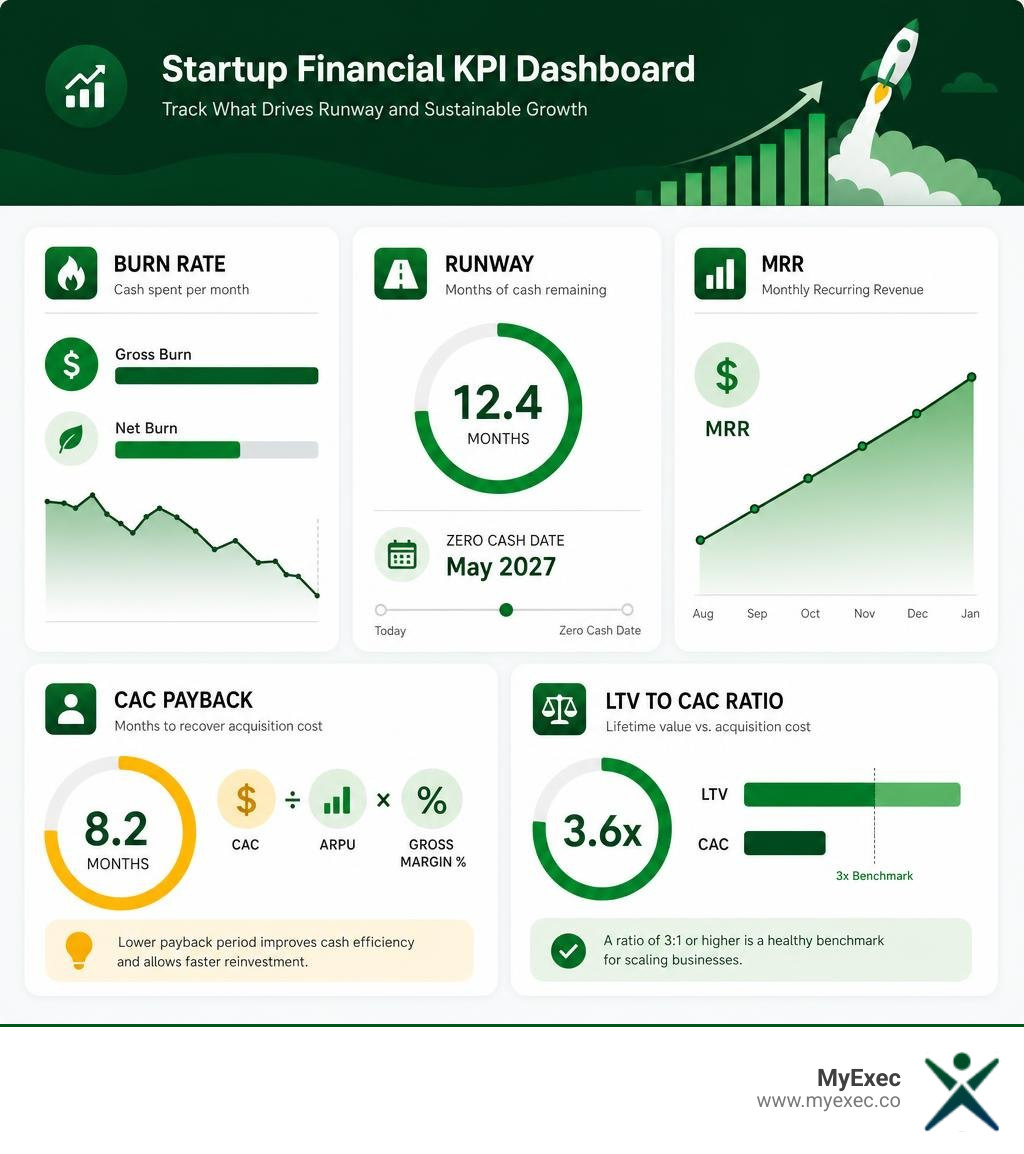
- Gross Burn Rate: The total cash spent by the organization each month across operating expenses, payroll, and capital purchases. This number helps founders understand the company’s true spending pace before revenue offsets are considered. If gross burn rises faster than planned, leadership can identify which cost categories are expanding and decide whether that spending still supports the company’s growth priorities.
- Net Burn Rate: Total monthly cash drain calculated as Gross Burn minus collected cash revenues. Net burn shows how much cash the business is actually consuming each month after customer collections. Tracking it consistently helps founders see whether revenue growth is meaningfully reducing cash usage or whether expenses are still outpacing the company’s ability to fund itself.
- Cash Runway: The total available cash balance divided by current net burn rate, expressed in months:
\[ \text{Cash Runway (Months)} = \frac{\text{Total Available Cash}}{\text{Monthly Net Burn}} \]Runway turns burn rate into a practical decision-making tool by showing how much time the company has before it needs more capital, lower expenses, or higher collections. Founders should review runway under multiple scenarios because a small change in sales velocity, hiring pace, or payment timing can materially change the available decision window.
- Zero Cash Date: The exact projected calendar date when bank balances reach zero without additional capital inputs. This date makes the runway discussion concrete and easier to communicate to executives, investors, and department leaders. It also helps management work backward from a real deadline when timing fundraising, cost reductions, or revenue acceleration plans.
- Monthly Recurring Revenue (MRR): Contracted, predictable revenue generated each month. MRR is especially useful for subscription businesses because it separates recurring revenue momentum from one-time implementation fees, setup charges, or non-repeatable sales. When paired with churn, expansion, and new bookings, it gives leaders a clearer view of whether the revenue base is becoming more durable.
- Customer Acquisition Cost (CAC) Payback: The number of months required for a customer to generate sufficient gross margin to repay the cost of acquiring them:
\[ \text{CAC Payback (Months)} = \frac{\text{CAC}}{\text{ARPU} \times \text{Gross Margin \%}} \]CAC payback helps founders evaluate whether sales and marketing spend is creating efficient growth or tying up cash for too long. A shorter payback period generally gives the company more flexibility to reinvest, while a longer payback period may require tighter spending controls, better targeting, or pricing changes.
- LTV to CAC Ratio: The lifetime value of a customer divided by the total acquisition cost. A healthy benchmark for scaling businesses is maintaining a ratio of 3:1 or higher. This ratio helps leadership compare the long-term value created by customer acquisition against the cost of winning that business. It should be interpreted alongside payback period and retention because a strong-looking ratio can still create cash pressure if customers take too long to repay acquisition costs.
When to Transition Beyond Spreadsheets to FP&A Software
Early-stage companies can run financial planning inside Google Sheets or Microsoft Excel straight through Seed and early Series A stages. Spreadsheets provide unmatched flexibility during early iteration phases.
However, relying entirely on static spreadsheets creates friction as companies scale past $5M in revenue. Red flags that signal it is time to upgrade your tech stack include:
- Version control issues caused by multiple department leaders editing files simultaneously.
- Manual copy-paste errors when pulling financial data out of QuickBooks or Xero.
- Spending days tracking down formula errors across broken cell links.
- Difficulty running fast scenario updates during board meetings.
Before purchasing specialized planning software, make sure your team has a clear system owner. Purchasing dedicated platforms without assigning a finance lead to manage them leads to unused, expensive software. In early growth stages, automating your historical data collection into clear BI reporting dashboards offers far more value than buying complex planning tools too soon.
Extending Runway Through Cash Flow Management and Scenario Planning
Managing cash runway effectively requires looking beyond standard P&L accrual accounting. Cash entering the bank account rarely matches when revenue appears on an income statement. Timing differences around customer payments, vendor invoices, and prepaid annual contracts frequently create cash surprises.
To prevent cash shortfalls, implement a rolling 13-week cash flow model alongside your long-term monthly forecast. A 13-week liquidity forecast tracks short-term bank balances line-by-line, capturing exact collection schedules and payout timing.
Cash optimization tactics for extending runway include:
- Managing Deferred Revenue Risks: Collecting prepaid annual software subscriptions improves immediate bank balances. However, founders must remember that cash covers operational deliverables over the full 12-month period. Spending upfront annual cash too quickly creates severe budget shortfalls later in the year.
- Aligning Payables and Receivables: Negotiate 30- to 60-day payment terms with vendors while offering small incentives for clients who pay invoices early.
- Staging Milestone-Based Hires: Avoid making major hires all at once based on optimistic annual growth plans. Tie high-salaried hiring choices directly to clear operational revenue triggers.
Key Pitfalls in Startup FP&A and How to Avoid Them
Early-stage financial planning often suffers from avoidable operational missteps. Review the checklist below to keep your planning process accurate and useful:
- Overengineering the Model: Building complex, multi-tab financial models packed with nested formulas creates fragile systems. If explaining your financial model takes more than five minutes, it is too complex. Simple, direct models build higher executive trust.
- Ignoring Historical Actuals: Building financial projections strictly on optimistic forward growth assumptions without reviewing past performance leads to unrealistic plans. Always cross-check future growth targets against your trailing 3-, 6-, and 12-month historical averages.
- Delayed Accounting Close Cadence: Running forward-looking analyses using financial data that is 45 days old limits your ability to act. Establish a strict monthly close workflow so accounting records close within two weeks of month-end.
- Static Annual Budgeting: Treating an annual budget as an unchangeable plan fails in fast-moving market environments. Upgrade your process by running rolling monthly reforecasts to adjust operational spending dynamically.
- Failure to Model Alternate Realities: Building only one version of the plan leaves leaders exposed when assumptions change. Use sensitivity and scenario analysis to test how changes in sales velocity, churn, pricing, hiring pace, or funding timing affect runway, cash flow, and investment capacity.
Testing your operating assumptions against changing market conditions is critical for long-term survival. For actionable advice on setting up defensive financial projections, see our guide on forecasting financial statements.
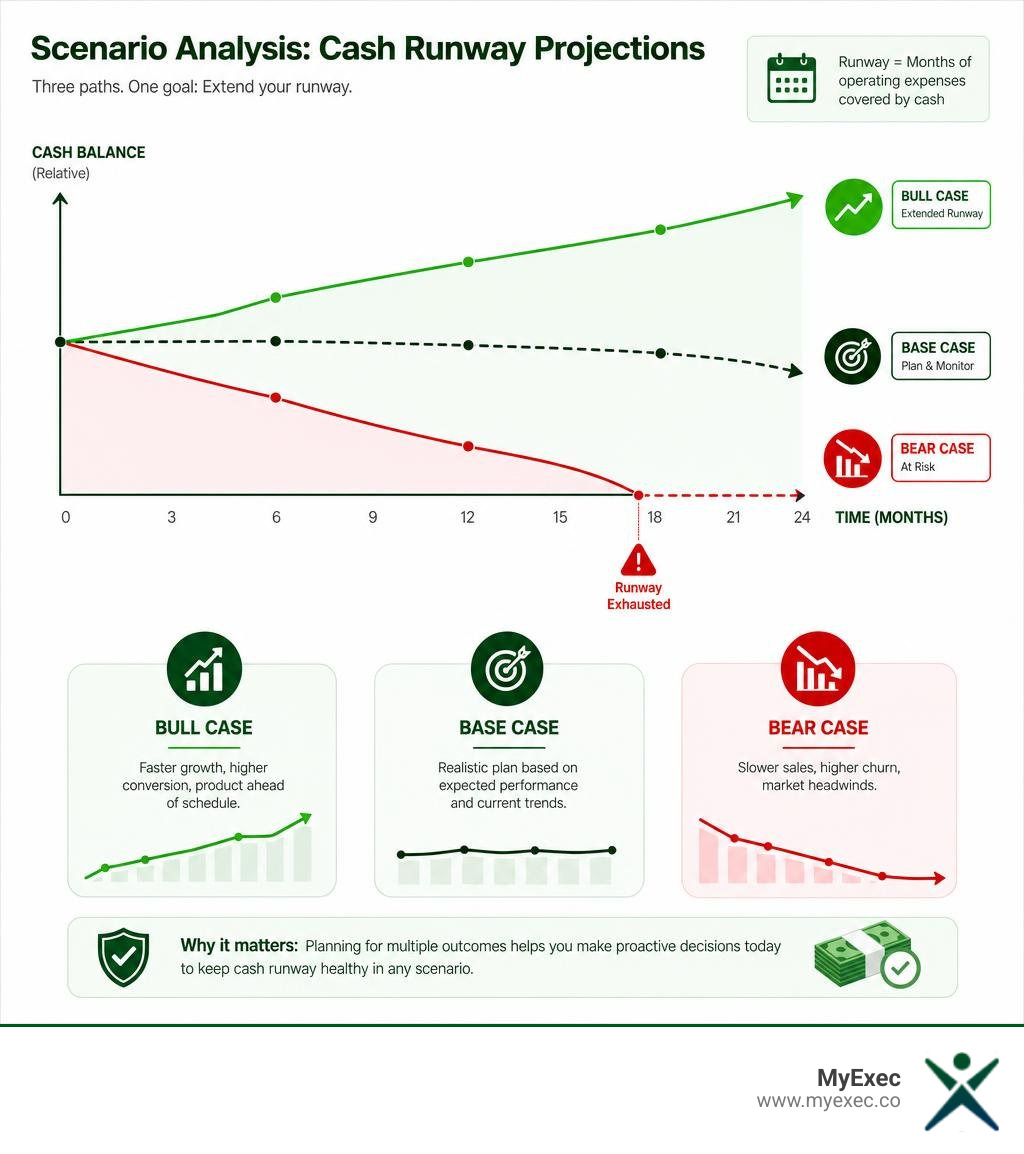
Scenario modeling helps leadership build clear contingency plans before challenges arise. Models should contain three main operating cases:
- Base Case: The primary budget built on realistic operational performance targets and expected customer acquisition curves.
- Bull Case: An aggressive upside scenario where customer acquisition accelerates, conversion rates expand, and product releases hit market ahead of schedule.
- Bear Case: A stress-test scenario assuming sales pipeline velocity drops by 30-50%, churn increases, and market conditions slow customer adoption.
Maintaining a live Bear Case scenario shows founders exactly which non-essential hires and marketing programs must be paused to keep cash runway above six months if revenue slows down.
How FP&A Powers Fundraising, Investor Communication, and Stage-by-Stage Growth
Fundraising success depends heavily on proving operating control and capital efficiency to potential investors. During equity funding rounds, prospective investors evaluate dynamic financial models to see how effectively management deploys capital.
A fully linked three-statement financial model demonstrates that leadership understands operational cash drivers. Sending organized financial decks, clear use-of-funds breakdowns, and well-supported unit economics signals high operational maturity, helping founders close funding rounds faster and on better terms.
Regular monthly variance reviews also improve investor relationships post-close. Delivering accurate investor updates on a reliable monthly rhythm builds strong board confidence. Founders interested in improving their board updates can review our walkthrough on drafting a clear executive summary.
Evolving FP&A for Startups from Seed to Series A and Beyond
Financial planning processes must evolve alongside company maturity:
- Pre-Seed / Bootstrapped: The focus centers on cash visibility, tracking gross burn rate, and maintaining a simple runway model managed directly by founders. At this stage, the goal is not complex forecasting. It is creating enough financial discipline to understand how long current cash will last and what spending decisions could shorten or extend that timeline.
- Seed Stage: Founders transition to flexible spreadsheets, updating driver-based revenue inputs, payroll assumptions, and rolling 12-month cash targets monthly. The model should begin connecting operating activity to financial outcomes, such as how sales pipeline, conversion rates, hiring plans, and customer retention affect cash needs. This gives leadership a stronger basis for deciding when to hire, when to increase marketing spend, and when to start planning the next fundraise.
- Series A Stage: Financial complexity expands as headcount and departmental budgets grow. The company automates actuals tracking through cloud accounting setups and typically brings in fractional financial leadership to handle dynamic scenario planning. At this point, leaders need a more formal planning rhythm that ties departmental budgets, KPI scorecards, and board reporting into one operating view. To understand what stage-appropriate leadership looks like, explore our guide on the role of a growth stage CFO.
- Series B and Beyond: Dedicated strategic finance teams implement centralized planning platforms, institutional board reporting, and detailed multi-entity capital planning systems. Planning becomes more cross-functional, with finance partnering closely with sales, operations, product, and executive leadership to test investment tradeoffs. The focus shifts from basic runway protection to capital allocation, margin improvement, and scaling the finance infrastructure without slowing decision-making.
Frequently Asked Questions About FP&A for Startups
What is the minimum viable FP&A stack for a pre-seed or seed startup?
For early-stage companies, a simple stack includes modern cloud accounting software (like QuickBooks Online or Xero), automated bank feeds, and a well-structured driver-based model built in Google Sheets or Excel. Advanced automated platforms are unnecessary until financial reporting complexity starts taking significant focus away from the founder.
When should a founder hire their first full-time finance team member?
It depends on what “finance team member” means. A startup may need full-time bookkeeping or accounting support earlier if transaction volume, billing, payroll, reconciliations, or compliance work becomes too much for the founder or outside bookkeeper to manage cleanly. A full-time strategic finance or FP&A hire usually comes later, often when departmental budgets, revenue forecasting, investor reporting, and cash planning become complex enough to justify dedicated internal ownership. Before that point, many early teams use fractional finance support so they can get planning and analysis capability without hiring a full-time senior finance role too soon.
How often should an early-stage startup update its FP&A model?
Plan updates should follow a rolling monthly cadence immediately after prior-month accounting books close. However, if available cash runway drops below six months, management should track bank balances and short-term cash flows on a weekly rhythm.
Conclusion
Building out FP&A for startups transforms financial management from a backward-looking compliance chore into a strategic growth tool. By maintaining a clean driver-based model, focusing on core burn metrics, running scenario planning, and setting a consistent monthly rhythm, founders protect their cash runway while building strong credibility with board members and investors. Directional clarity and fast decision-making will always be more valuable to an early-stage company than false formula precision.
At MyExec, we deliver fractional CFO and FP&A services designed specifically for growing U.S. businesses between $5M and $50M in revenue that have outgrown founder-led finance. Our flexible, scalable support model gives leadership access to everything from tactical analyst modeling to senior CFO strategy without the overhead of expensive full-time retainers.
Our team brings deep operational experience gained across businesses ranging from a few million dollars in revenue up to roughly $2B, serving private equity portfolio companies, closely held businesses, nonprofits, and publicly traded entities. Additionally, with a Certified Valuation Analyst (CVA) on staff, we provide the technical depth required to support complex capital raises, dynamic scenario planning, and corporate valuations.
Ready to take control of your financial planning and extend your growth runway? Explore our Fractional CFO Consulting services, read through our comprehensive Strategic Finance Guide, or schedule a strategic review with our team.