

How do buyers value growth?
The short answer
Buyers pay for growth that is consistent, profitable and likely to continue without the owner. The business growth metrics they check first are revenue growth over three to five years, whether margins held, where the growth came from, and whether a credible plan supports what comes next. Steady, profitable growth beats a fast year with thin margins.
Almost every owner we talk to wants to know whether growth will show up in what the business is worth. It usually does. But buyers don't take the growth rate on your income statement at face value. They use a handful of business growth metrics to see what kind of growth it is, how much of it turned into profit, and whether it will keep going after you step back.
This guide walks through the business growth metrics buyers look at first, how they treat past growth versus projected growth, the kinds of growth that can actually lower value, and how to present your growth so it gets full credit. There's a short self-check further down so you can see how your own numbers read.
Which business growth metrics do buyers look at first?
When a buyer, an investor or a valuation professional looks at a growing company, they're trying to answer one question: how much of this growth can we count on? These are the most important growth metrics they use to answer it, and the same business growth indicators you can track yourself.
| Metric | How to calculate it | What a buyer reads from it |
|---|---|---|
| Revenue growth rate | Compound annual growth over three to five years | How fast the business has really grown, smoothed for one good or bad year |
| Consistency | Each year's growth next to the others | Whether growth is repeatable or came in one burst |
| Gross margin trend | Gross profit as a share of revenue, first year vs latest year | Whether the company grew without giving away price or taking on costly work |
| EBITDA margin trend | EBITDA as a share of revenue over the same years | Whether growth is reaching the bottom line, which is what most buyers price |
| Sources of growth | Split growth into new customers, existing customers and price | How durable each piece is and what it would take to repeat it |
| Customer retention | Share of last year's revenue that came back this year | Whether the company is growing on a stable base or replacing lost customers |
| Customer concentration | Largest customer and top five customers as a share of revenue | Whether growth depends on one or two relationships |
Revenue growth rate over three to five years
Buyers look at the compound rate over several years. One strong year can come from a big project or a price change that won't repeat. Three to five years shows the real trend, and it's the first number most buyers write down.
Consistency of growth year to year
A company that grows 12%, 14% and 13% tells a different story than one that grows 40%, 2% and 25%, even if the averages are close. Steady growth is easier to forecast, and a buyer will pay more for a forecast they believe.
Gross margin and EBITDA margin as the company grew
This is where most of the value gets decided. If margins held or improved while revenue grew, the growth is producing profit. If margins slipped, the buyer will ask whether the company bought its growth with discounts, extra labor or lower-quality work. Most buyers of owner-led companies price the business on earnings, so growth that never reaches EBITDA doesn't get much credit.
Where the growth came from: new customers, existing customers, price
Each source tells a buyer something different. Growth from existing customers buying more says the company delivers. New customer growth says the sales engine works. Price increases that stuck say the company has pricing power. A buyer wants to see the mix, because it tells them what they'd need to keep doing to repeat it. Revenue that recurs under contract or subscription carries extra weight, which we cover in our post on recurring revenue.
Customer retention and concentration as growth adds customers
Growth on top of a stable customer base is worth more than growth that replaces customers who left. And if most of the growth came from one large account, the buyer sees risk along with the upside. Our guide to customer concentration explains how that gets priced.
Two companies, same revenue, different value
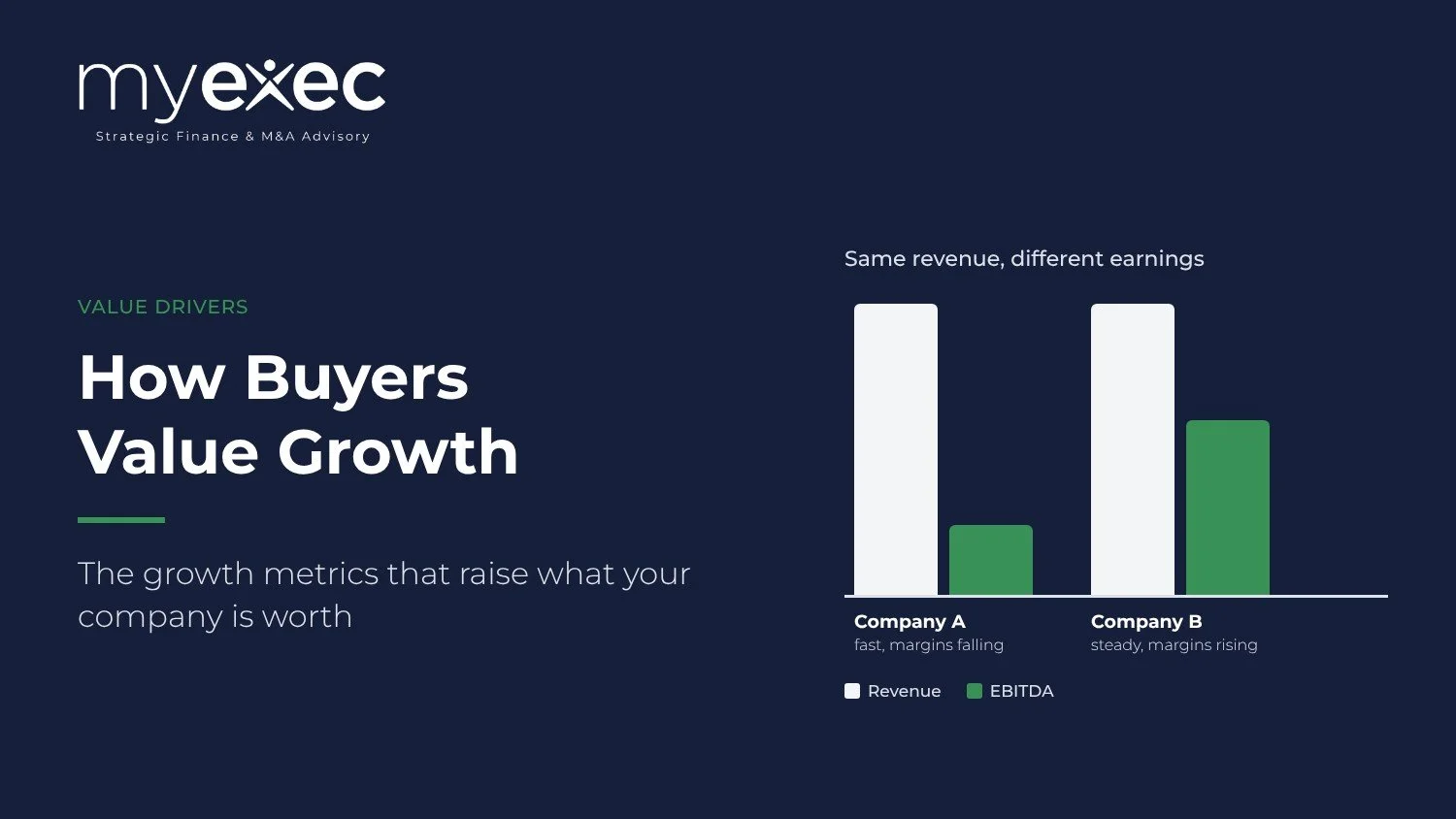
Here's a hypothetical example. Two companies both finished last year at $15 million in revenue. On the surface, Company A looks more exciting.
| Company A | Company B | |
|---|---|---|
| Revenue, Year 1 to Year 3 | $8.0M to $15.0M | $11.0M to $15.0M |
| Compound annual growth | About 37% | About 17% |
| Gross margin | 36% falling to 29% | 35% rising to 37% |
| EBITDA margin | 12% falling to 6% | 12% rising to 15% |
| Year 3 EBITDA | $0.90M | $2.25M |
| Where growth came from | Two large new accounts won on price | Existing customers, new customers and a price increase that held |
Company A doubled its size in two years, and that's real work. But a buyer will price it on $900,000 of earnings, ask how much of the growth depends on two accounts won on price, and wonder whether margins will keep sliding. Company B grew at less than half the rate, kept its customers, raised prices successfully and ended with $2.25 million of EBITDA. Most buyers will value Company B higher, and many will apply a better multiple to it as well, because its growth looks repeatable.
Past growth versus projected growth: what buyers will and won't credit
Buyers pay for what has happened, and they give partial credit for what you say will happen. Your history sets the base. Your projections can lift the price, but only to the extent the buyer believes them.
A projection earns credit when it's built from drivers the buyer can test (customers, volume, price, capacity), when the leadership team owns it, and when the company has a track record of hitting its plans. A projection that shows a sharp jump right after the sale, with no change in how the business operates, mostly gets discounted. If you're building that plan now, our guide to a strategic financial plan covers how to turn a growth goal into numbers your team can run.
We recently ran an exercise with one of our client companies to work out what it would take to grow revenue 20% next year. We set targets by channel and ran several scenarios to find the levers that mattered most, then put a base case next to a stretch case. When buyers test whether growth will continue, they run a similar analysis. Companies that have already done that work, understand it, and can show results against it have a much easier conversation.
What kind of growth can lower value?
Not all growth helps. Some of it actually makes a buyer more cautious.
- Growth bought with margin. Discounts, low-priced contracts or extra labor to win volume show up as falling gross margin. The buyer sees more risk and lower earnings.
- Growth that depends on the owner. If the owner personally brings in and keeps the new business, a buyer has to ask what happens when the owner steps away. Our post on growth that depends on the owner covers how that affects price.
- Growth that strains cash. Fast growth ties up cash in receivables and inventory. If the company is stretching its credit line to fund it, the buyer will adjust for the working capital and the debt. Our guide to working capital in a business sale explains how that adjustment works at closing.
- Growth concentrated in one customer. A big new account can be a great win and still raise concentration risk.
- One-time growth. A large project, a short-term contract or a competitor's temporary trouble can make one year look better than the trend.
Check your growth: a quick self-check
Put in your own numbers to see how a buyer is likely to read your growth. The defaults are a hypothetical $15 million company.
Growth quality self-check
| What a buyer sees | Your numbers |
|---|---|
| Compound annual growth | |
| Growth by year | |
| Gross margin trend |
Enter your numbers to see how a buyer is likely to read your growth.
This is a quick read on growth only. Our free business valuation calculator puts growth together with margins, customer mix and owner dependence for an estimate of value.
How does growth show up in a valuation?
Growth affects value in two ways. First, it raises the earnings the buyer is pricing. Second, when growth is steady, profitable and likely to continue, it can earn a better multiple on those earnings. The two compound: a company that grew its EBITDA and convinced the buyer the growth will continue gets credit on both.
The reverse is also true. If growth came with falling margins, more concentration or heavy owner involvement, the buyer may apply a lower multiple to earnings that are already thinner than they'd be otherwise. That's why two companies at the same revenue can end up far apart on price. If you want to see how your numbers come together, our free business valuation calculator scores growth alongside the other factors buyers weigh.
How should you measure and present your growth?
Owners who get full credit for their growth usually have the story on one page before anyone asks. Here's what goes on it:
- Revenue, gross margin and EBITDA for each of the last three to five years, with the compound growth rate.
- Growth split into existing customers, new customers and price, by year.
- Customer retention and your largest customers' share of revenue, showing how they changed as you grew.
- One-time items called out separately, so the buyer sees the underlying trend.
- The plan for the next three years, built from drivers, with the actual results against last year's plan.
Start tracking these monthly now, even if a sale is years away. They're also the measures that tell you whether the business is getting more valuable as it grows, which is worth knowing whether or not you ever sell.
Frequently asked questions
Does faster revenue growth always mean a higher valuation?
No. Buyers price most owner-led companies on earnings, so growth only helps value when it reaches the bottom line and looks likely to continue. A company growing fast with falling margins or heavy customer concentration can be worth less than a slower company with rising margins and a stable customer base. Steady, profitable, repeatable growth is what earns the best price.
How many years of growth do buyers look at?
Most buyers look at three to five years of history, plus the current year to date. Three years shows whether growth is a trend or a single good year. Five years shows how the company held up through a slower stretch. Buyers will also compare the most recent twelve months with the prior twelve to see whether growth is speeding up or slowing down.
Do buyers pay for projected growth or only past growth?
They pay mostly for past growth and give partial credit for projected growth. A projection earns more credit when it's built from measurable drivers, owned by the leadership team, and backed by a record of hitting past plans. A forecast that jumps right after the sale with no change in how the business runs is usually discounted heavily.
Is growth from price increases worth as much as growth from new customers?
Both count, and buyers read them differently. Price increases that held without losing customers show pricing power, which buyers like. Growth from new customers shows the sales engine works, and growth from existing customers buying more shows they value what you deliver. A healthy mix of all three is the most convincing sign that growth will continue.
What growth metrics should I track each month?
Track revenue and its growth over the same month last year, gross margin, EBITDA margin, revenue from existing versus new customers, customer retention, and your largest customers' share of revenue. Review them with your leadership team each month next to your plan. Those few measures tell you whether growth is building value, and they're the ones a buyer will ask for.
See what your growth is worth
Our free valuation calculator takes about a minute and shows how your growth, margins and customer mix come together in an estimate of value. Choose the Advanced tab for the full Know Your Number report, which scores each factor a buyer weighs.
Want to talk through your numbers? Book a valuation consultation with our team.