

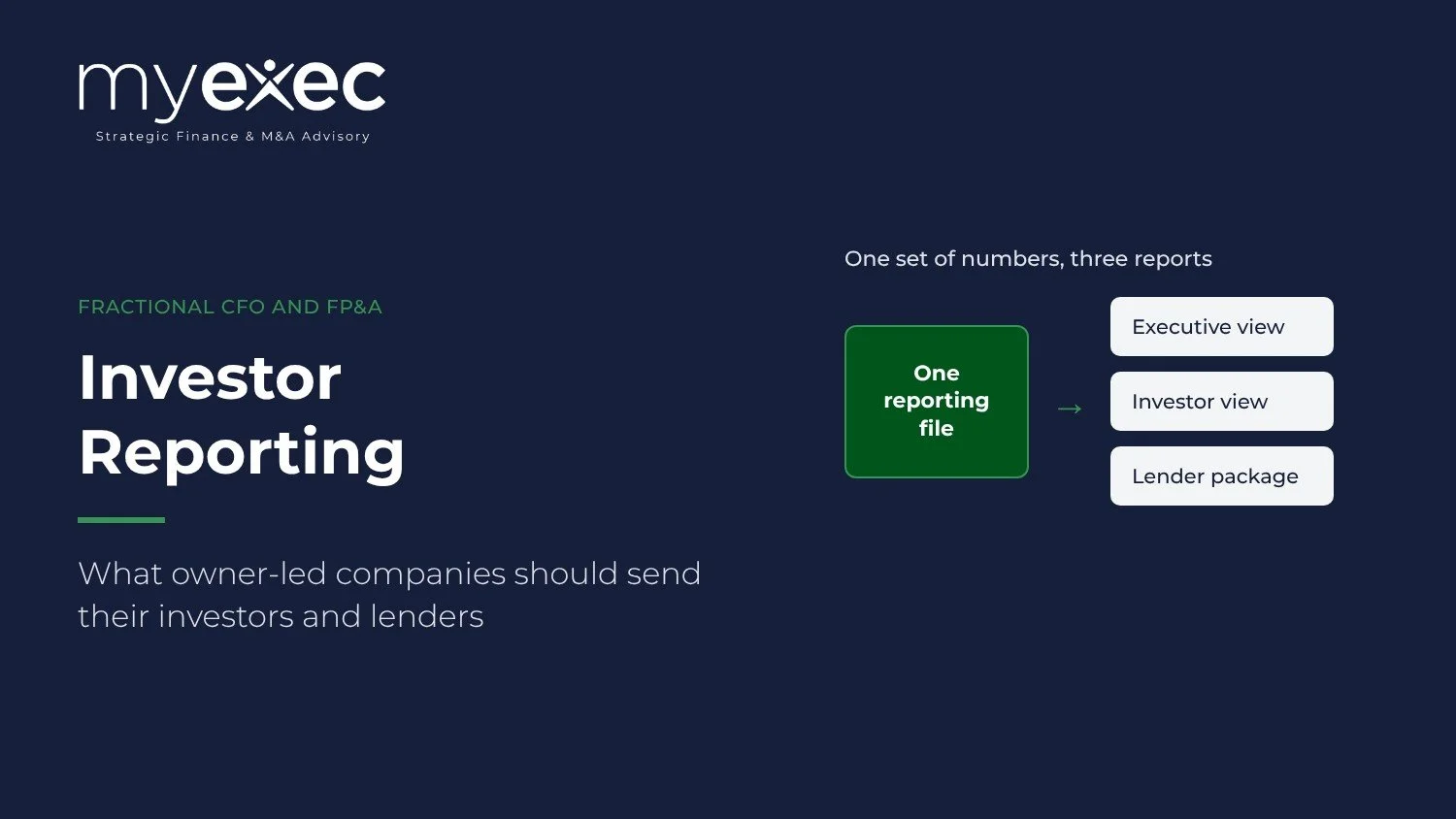
What is investor reporting?
The short answer
Investor reporting gives outside investors and lenders the same core pages every period: a summary of results against budget, the three financial statements, the few operating measures that drive the business, and coverage of debt service or investor returns. Most owner-led companies report quarterly to investors and monthly or quarterly to lenders.
Most of what you'll find on investor reporting for private companies is written for venture-backed startups: burn rate, runway and the next funding round. That's a different world from an owner-led company with $5 million to $50 million in revenue that brought in a minority partner, a family office, preferred equity or a bank with reporting covenants.
Those investors want something more practical. They want to know the business is on plan, that cash is covering what they're owed, and that management sees problems early. This guide covers who you're reporting to, what to include in an investor report, how lender reporting differs, how often to send it, how to report a miss, and how to build a process so it takes hours each quarter instead of days. There's a report builder further down that gives you a page list for your own mix of investors.
Who you're reporting to and what each cares about
Before you design the report, be clear about who reads it. Each type of outside capital is looking for something slightly different.
- Minority equity investors care about growth, profit and what their stake is worth. They want to see the plan and whether you're hitting it.
- Preferred equity holders care first about whether the company is generating enough cash to pay their preferred return, and then about the plan.
- Family offices and outside board members usually want the full picture with a short narrative: results, risks and the decisions coming up.
- Lenders care about repayment. They want covenant calculations, debt service coverage, and often a borrowing base, on the schedule set in the loan agreement.
If you brought in capital recently, the choice between debt or equity for growth also shaped what you now owe each group in reporting. The investment and loan agreements set what must be reported and when, so start there, and have your attorney confirm what they require.
What should an investor report include?
A good quarterly investor report is usually eight to twelve pages. Here's the template we start from, page by page.
| Page | What goes on it |
|---|---|
| 1. Summary | Results against budget and prior year in five or six lines, the outlook for the rest of the year, and the two or three decisions management is working on |
| 2. Key figures | Revenue, gross margin, EBITDA, free cash flow and cash on hand, for the quarter and year to date |
| 3. Income statement | Actual vs budget vs prior year, with short notes on the largest differences |
| 4. Balance sheet | Current quarter vs prior quarter end and prior year end |
| 5. Cash flow | Operating cash flow, capital spending, debt payments and distributions |
| 6. Operating measures | The five to eight drivers that explain results, such as customers, locations, average ticket, utilization or backlog |
| 7. Coverage | Debt service coverage, covenant headroom and preferred return coverage, as they apply |
| 8. Risks and actions | The few risks management is watching and what it is doing about each |
| 9. Outlook | The updated forecast for the year against the original budget |
A one-page summary: results, outlook, key decisions
Most investors read the first page carefully and skim the rest. So the summary has to stand on its own: how the quarter went against plan, why, what you expect for the year, and what you're deciding. Our guide to writing a board paper executive summary works well for this page too.
Financial statements against budget and prior year
Show each statement with three columns: actual, budget and prior year. Explain the differences that matter in a sentence or two, right on the page. Investors shouldn't have to call you to understand why a number moved.
The operating measures that drive results
Pick the five to eight measures your leadership team already runs the business on and report the same ones every quarter. If you change a definition, say so and restate the history. Consistency is what lets an investor see trends.
Cash, debt and return coverage
This is the page that matters most to preferred holders and lenders. Show free cash flow for the period, what was paid out (debt service, preferred return, distributions) and the coverage ratio. If coverage is getting tight, say so early.
Risks and what management is doing about them
List the few risks you're actually watching: a large customer renewal, input costs, a key hire, a location that's behind plan. For each, give the action and the timeline. Investors trust a company that names its risks before they show up in the numbers.
A hypothetical example: preferred equity in a multi-location company
Here's a hypothetical example. A 30-location service company raised $12 million of preferred equity with a 10% preferred return, so it owes its preferred holders $1.2 million a year. Each quarter, its investor report shows location-level results, company free cash flow and preferred return coverage.
| Hypothetical, full year | Budget | Actual |
|---|---|---|
| Revenue | $24.0M | $23.1M |
| Location EBITDA | $5.4M | $5.0M |
| Corporate overhead | $1.8M | $1.8M |
| Capital spending | $0.9M | $0.8M |
| Free cash flow | $2.7M | $2.4M |
| Preferred return owed | $1.2M | $1.2M |
| Coverage | 2.25x | 2.0x |
The company missed its revenue plan by about 4%, and the report says so on page one. It also shows that four locations opened later than planned, that the existing locations were on budget, and that free cash flow still covered the preferred return twice over. That's the whole story in three sentences, and the investors don't need a call to understand it.
This is close to work we're doing right now. We're building monthly reporting in two views from the same files, one for the executive team and one for investors, and the budget runs all the way down to free cash flow and coverage of the preferred return owed to outside equity.
How is a lender reporting package different?
Lender reporting overlaps with investor reporting, but it has a different job. A lender wants proof that the loan is safe and that you're meeting the covenants. The loan agreement spells out what goes in the package and when it's due. If you're still lining up financing, our post on what banks look for covers the lender's view going in.
| Investor report | Lender package | |
|---|---|---|
| Audience | Equity holders, preferred holders, outside board | The bank or credit fund |
| Typical frequency | Quarterly, with an annual review | Monthly or quarterly, as the loan agreement sets |
| Typical contents | Summary, statements vs budget, operating measures, coverage, risks, outlook | Financial statements, covenant calculations, compliance certificate, borrowing base if required |
| What triggers questions | Misses against plan, falling coverage, surprises | Covenant headroom shrinking, late delivery, changes in collateral |
Timing matters more with lenders right now. After October's inflation report, futures markets priced a Federal Reserve rate increase at the December 9 meeting as a near certainty (CME FedWatch showed 100% odds on Nov 10, as reported by CFO Dive). That's a market expectation, and it may not happen. But if your line or term loan floats, higher interest will tighten debt service coverage, and lenders will be reading that page closely in 2027.
Build your report: page list by investor type
Tick the kinds of outside capital you have. The builder gives you a combined page list and a reporting schedule you can start from.
Investor report builder
Your investment and loan agreements set what is actually required, so check this list against them with your attorney. Our free strategic finance guide covers the reporting tools we build.
How often should you report, and how fast?
For most owner-led companies, quarterly is the right rhythm for investors, with a fuller annual review that includes the next year's budget. Lenders get whatever the loan agreement says, often monthly or quarterly with annual statements. Some preferred holders ask for monthly key figures, which is easy to provide if you're already producing an executive view each month.
Speed matters as much as frequency. To illustrate, a quarterly report that arrives three weeks after quarter end tells investors the finance function is in control, while one that arrives after seven weeks makes them wonder. The exact timing will vary by company, but the point holds: the sooner and more reliably the report arrives, the more confidence investors have in the numbers. Pick a delivery date you can hit every time, put it in writing, and keep it.
How should you report results that miss the plan?
Every company has a quarter that misses. How you report it matters more than the miss itself. State it plainly on the first page. Explain why in a sentence or two, separating what was timing from what was a real change. Then show the plan: what management is doing, when you expect to see results, and how the full-year forecast has changed.
Investors understand that misses happen. Business doesn't always go according to plan, and they know that. What they don't want is to be surprised. Many of them have resources, tools and networks they can bring to a problem, but only if they hear about it while there's still time to do something. Being upfront and showing how you're addressing the issue is the most productive way to handle it.
Building a repeatable reporting process
The companies that report well don't work harder at quarter end. They set up the process once.
- One data source. Investor reporting comes from the same numbers the leadership team uses each month, so there's one version of the truth.
- A fixed template. Same pages, same order, same definitions every quarter. Change it only with a note.
- A close calendar. The books close by a set day each month, and the report is due a set number of days after quarter end.
- Built-in commentary. Department leaders explain their own variances each month, so the quarterly narrative is mostly written already.
- A review step. The CEO reads the full report before it goes out and signs off on the summary page.
The visual side matters too. Many investors now ask for an investor reporting dashboard alongside the quarterly report: the key figures, coverage and operating measures on one page that updates each month. Our post on financial reporting dashboards shows layouts that work well for it.
Frequently asked questions
How often should we report to our investors?
Quarterly works for most owner-led companies, with a fuller annual review that includes next year's budget. Your investment agreement may set the schedule, so check it first. Some preferred holders ask for monthly key figures, which is easy if you already produce a monthly executive view. Whatever you choose, deliver on the same timeline every period so investors know when to expect it.
What is the difference between an investor report and a lender compliance package?
An investor report tells the full story: results against plan, operating measures, coverage, risks and outlook. A lender package proves the loan is safe. It usually includes financial statements, covenant calculations, a signed compliance certificate and sometimes a borrowing base, on the schedule set by the loan agreement. Both should come from the same numbers so the figures always agree.
Should we share our budget with investors?
Usually yes, at least at the summary level. Investors can only judge results against a plan they've seen, and sharing the budget sets clear expectations for the year. Many companies share the annual budget once, then report actual against it each quarter along with an updated forecast. Check your investment agreement, since some require you to deliver the budget by a set date.
How do we report bad news to investors?
Put it on the first page, state it plainly, and explain the cause in a sentence or two. Then show what management is doing about it and how the full-year forecast changed. Investors know things don't always go to plan. They want to hear early, while there's still time to help, and many have resources and networks they can bring to the problem.
Who should prepare the investor report?
Finance prepares it, and the CEO owns it. A controller or finance lead pulls the numbers and drafts the pages, department leaders explain their own variances, and the CEO reviews and signs off on the summary. Many owner-led companies use a fractional CFO or an outsourced FP&A group to set up the templates and run the process each quarter, so it stays consistent.
Build your reporting with MyExec
We set up investor and lender reporting for owner-led companies using a proven playbook: one set of numbers, a fixed template, and a close calendar your team can hit every quarter. If you'd like scalable strategic finance leadership to build and run your reporting, we'd be glad to help.
Have a report due soon? Talk with our team about getting it set up.