

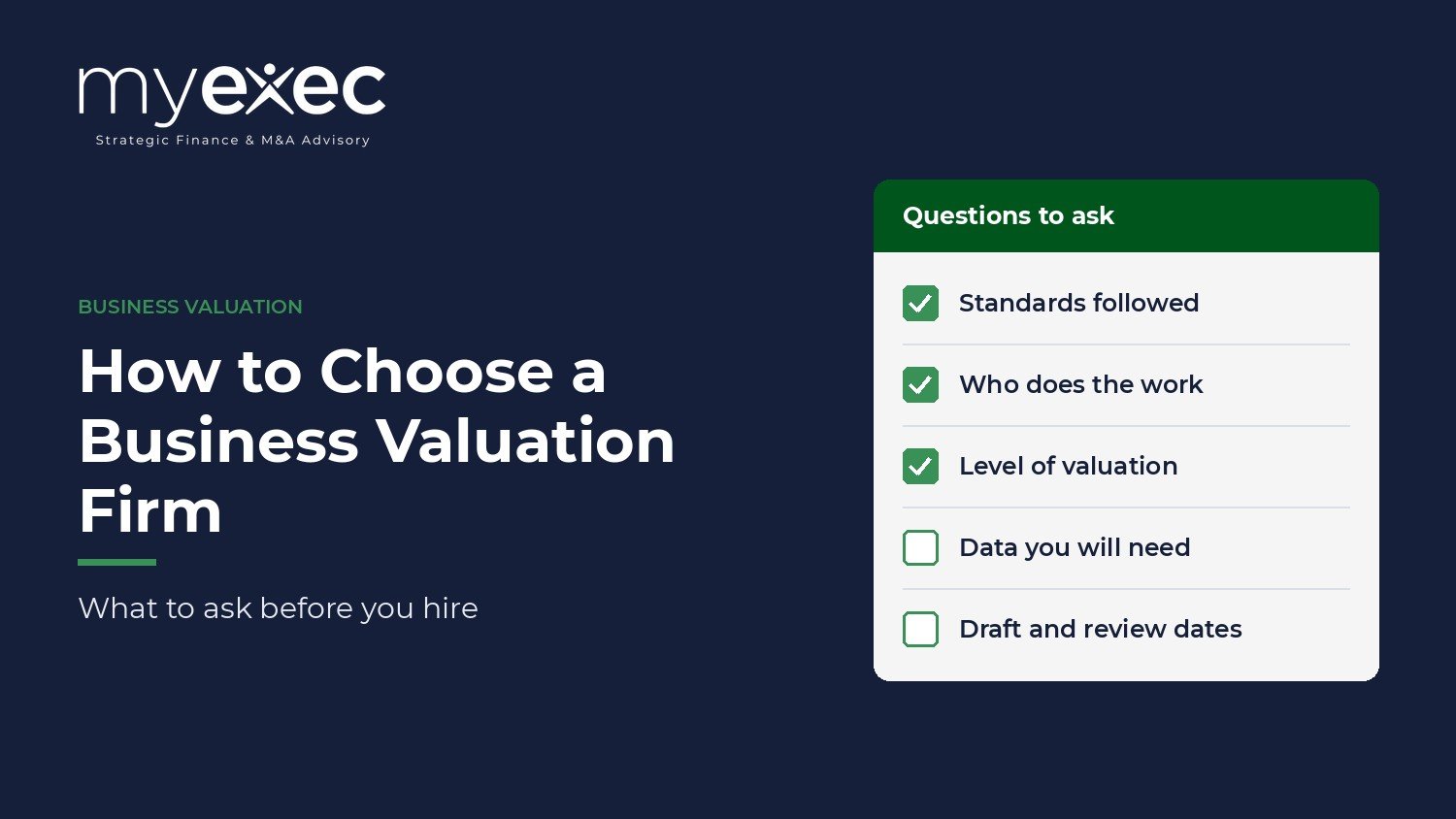
How to choose a business valuation firm
The short answer
Choose a business valuation firm by matching it to the purpose of the valuation. Look for experience with companies your size and in your industry, work performed to recognized professional standards, a clear scope and level of valuation, a defined process and timeline, and a report you can explain to a buyer, partner or lender.
Most owners hire a business valuator once or twice in a whole career, so there isn't much practice to draw on. On their websites, most business valuation services sound alike. The differences show up in the first conversation: what they ask you, what they say they'll need, and whether they can tell you plainly what you'll get and when.
This guide covers what to look for, the questions to ask, what the business valuation process looks like from the inside, and how a calculator, a broker's opinion of value and a formal valuation compare.
Start with the purpose of the valuation
The purpose decides almost everything else: the standard of value, the level of work, the valuation date, and who reads the report. A valuation for a sale has to hold up when a buyer's advisors go through it line by line. One for a partner transition usually follows the buy-sell agreement. One for planning can be lighter, because the main reader is you.
Some owners get a valuation as a baseline and update it every year, so they can see whether the year's work moved the number. If that's the plan, read what an annual business valuation involves first, because you'll want a firm you can work with every year.
A few purposes call for a different kind of specialist. If the valuation is for a lender's loan requirement, litigation, a divorce, or estate and gift tax filings, ask your attorney or CPA to recommend a firm that does that work regularly. Each has its own rules.
What to look for in a valuation firm
Experience with companies like yours
A $12 million distributor and a $12 million software company get valued very differently. Ask how many companies of your size and type the firm has valued, and for what purposes. You're listening for whether they understand how your industry makes money and what buyers in it look at.
Professional standards and qualifications
Valuation work is performed to professional standards set by the recognized valuation organizations, covering independence, documentation and what the report discloses. Ask which standards the work follows, and expect the report to name them. Ask what credentials the team holds and who reviews the work before it reaches you.
Independence is part of the same question. The valuator's job is to reach a number that holds up, whatever it turns out to be, so ask how the firm handles a result the owner didn't expect.
A clear scope and level of valuation
Professional standards recognize different levels of engagement. In a calculation of value, you and the valuator agree on the approaches up front and the work is more limited. In a conclusion of value, the valuator does all the work they judge necessary and reaches an independent opinion. A good business valuation company recommends a level based on your purpose, and tells you why, before any numbers are run.
The level drives the effort, and the effort drives the price, so it's the first thing to pin down when you compare proposals. Our post on what a business valuation costs covers how scope and price connect. Each proposal should state the purpose, level, valuation date and what's included.
A defined process and timeline
Ask the firm to walk you through its business valuation process step by step: what they'll ask for, when they'll interview you, when you'll see a draft, and when the report is final. A firm with a defined process can answer that in a couple of minutes. Get the dates in the proposal.
A report you can use and explain
You'll hand the report to a buyer, a partner or your advisors, so you need to understand it well enough to stand behind it. Ask to see a sample report with the identifying details removed, and ask whether they'll walk you through the draft before it's final. Our guide to what a professional valuation report includes covers each section and what readers check first.
Questions to ask before you hire
Take these into the first call with each firm. The answers make proposals much easier to compare.
Questions to ask a business appraiser
Check each one off as you ask it. The note under each is what a clear answer covers.
Check off each question as you ask it.
Want to hear how we'd answer them? Book a free 30-minute valuation consultation.
What the valuation process looks like
Whoever you hire, the work follows roughly the same six steps. The first two decide how smoothly the rest goes.
The step to ask every firm about is the review meeting. That's where you see the estimate and the reasoning before anything is final, and raise anything that's wrong or missing. The data request comes right after the engagement letter, and a typical one, in general terms, looks like this:
- Three years of financial statements and tax returns
- Current year results to date
- A debt schedule: lenders, balances and terms
- A summary of revenue by customer
- Ownership documents, such as the operating or shareholder agreement and any buy-sell agreement
- Owner compensation, and any one-time or personal expenses run through the business
That's the sequence we follow in our own valuation work. We scope the purpose and the level of valuation before any numbers are run, send a structured data request at the start, and walk the owner through the estimate in a review meeting before anything is final. A recent estimate of value for a trades company preparing to sell ran exactly that way. The owner saw the estimate and the reasoning before the report was done, so the questions a buyer was likely to ask got answered in the report itself.
Broker opinions of value, calculators and formal valuations: what each is for
These three get mixed up, and each one has its place.
| Option | Purpose | Depth | Typical use |
|---|---|---|---|
| Free calculator estimate | A quick range, to see roughly where you stand | Your own inputs and published market data; no review of your records | Early thinking, and deciding whether a formal valuation is worth doing now |
| Broker's opinion of value | A view of what the market may pay, often to help set an asking range | Recent sales and the broker's market experience; scope varies by broker | Preparing to list, and testing price expectations with someone who sells businesses |
| Formal valuation | An opinion of value for a defined purpose and date that others can rely on | Data request, management interview, normalized earnings and the approaches that fit, documented in a written report | Sale preparation, partner transitions, buy-sell agreements, succession and planning |
Many owners use all three at different points. Starting with our free business valuation calculator is a sensible first step, as long as you know what a valuation calculator can and cannot tell you. When someone else is going to rely on the number, that's the point to bring in a formal valuation.
Frequently asked questions
What qualifications should a business valuation professional have?
Look for training and experience in business valuation itself, a record of valuing companies of your size and type, and work performed to recognized professional standards that the report names. Ask what credentials the team holds, who reviews the work before it's final, and how the firm stays independent of the outcome.
What is the difference between a broker's opinion of value and a business valuation?
A broker's opinion of value is an estimate from a business broker or M&A advisor, usually built from recent sales and market experience and often used to help set an asking range. A business valuation is a written report prepared to professional standards, with a defined purpose, scope and valuation date, that other people can rely on. Both are useful, and they answer different questions.
How long does a business valuation take?
It depends on the level of valuation, the size and complexity of the company, and how quickly the documents and answers come in. Ask any firm for a date for the draft and the review meeting, counted from when your data is in, and get it in the proposal. Our business valuations page lists typical timing for each level we offer.
What information will the valuation firm ask for?
Expect a structured data request at the start: three years of financial statements and tax returns, current year results, a debt schedule, a summary of revenue by customer, and ownership documents such as the operating or shareholder agreement. Most firms also ask about owner pay, one-time expenses and key contracts, then interview the owner and key managers.
Should my CPA do my business valuation?
Your CPA may be a good choice, and many CPA firms have valuation professionals on staff. Ask the same questions you'd ask anyone: what standards the work follows, what credentials the team holds, and how often they value companies like yours for your purpose. Your CPA is also a good person to recommend a valuation specialist, and should stay involved for the tax side either way.
Talk with our valuation professionals
Our valuation professionals prepare opinions of value for owners planning a sale, a partner transition, a succession or a baseline. Every fixed-price business valuation we do is performed to NACVA professional standards, scoped to your purpose before we start, and walked through with you in a review meeting before it's final. The first conversation is free, and we'll tell you which level fits.
Not ready to talk yet? Start with the free calculator on the same page for a range to bring to the first call.