What's Inside a Professional Business Valuation Report?

Anatomy of a Professional Business Valuation Report
When you flip open a professional business valuation report, you're looking at a legal and economic narrative. The report sets out the scope of work, the effective valuation date, and the economic backdrop of the company. It defines the operational boundaries of the business and clarifies whether the entity is evaluated under a going-concern premise or an orderly liquidation premise.
Every section builds a foundation for the next. The document moves from high-level corporate history to micro-level ledger adjustments, then through mathematical models, and finally to a single defensible number. Understanding how to value a business requires looking past high-level revenue figures to examine how each operational moving part translates into sustainable cash flow.
Relying on informal rules of thumb or quick digital estimates often creates blind spots. While automated tools can give a preliminary snapshot, discovering the true gap between automated tools and formal appraisals highlights why institutional buyers and commercial lenders require full, certified reports.
Standard of Value and Engagement Scope in a Professional Business Valuation
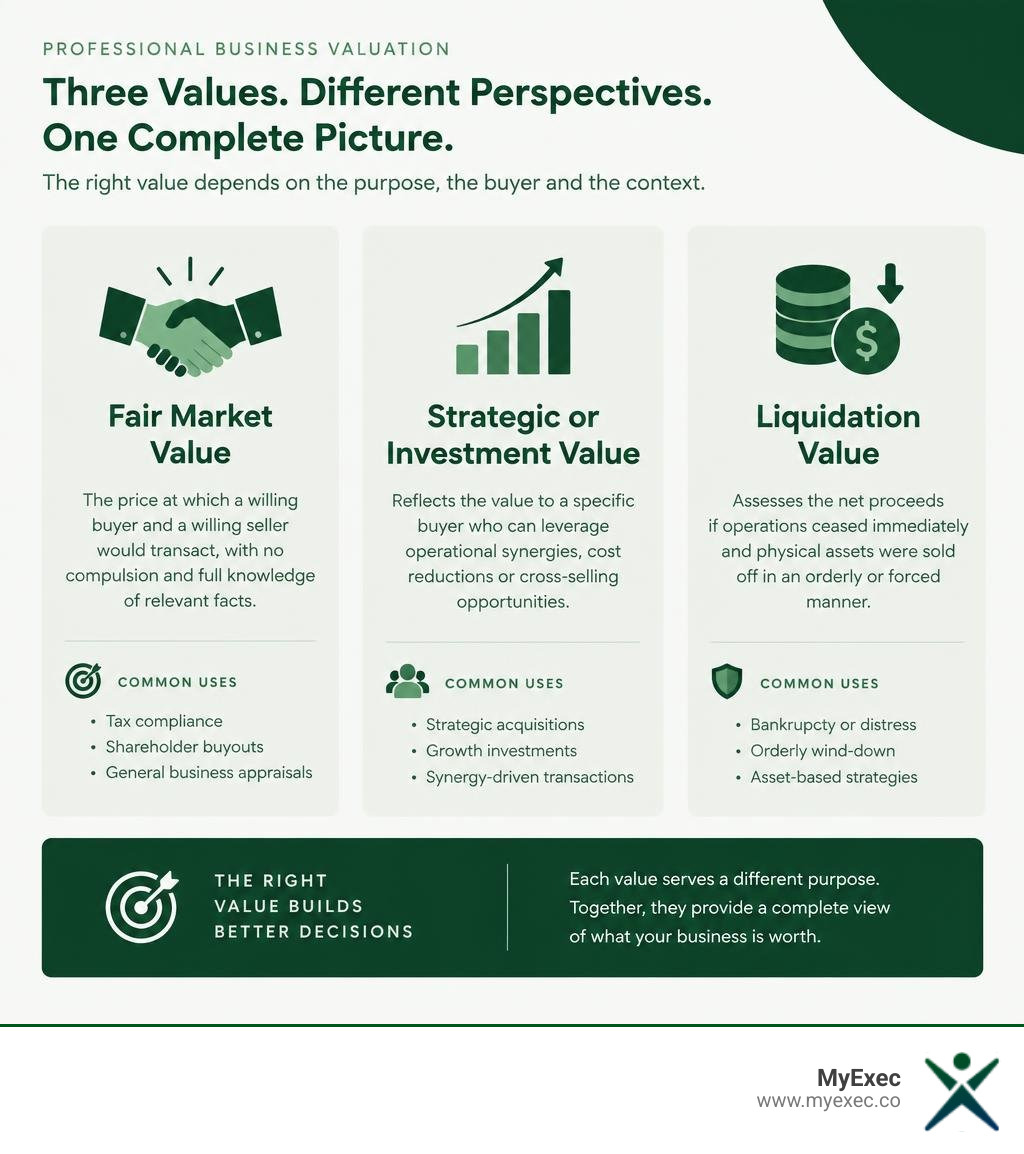
The standard of value establishes the legal and economic definition under which the company is appraised. The most common standard is fair market value. Under Revenue Ruling 59-60, fair market value is defined as the price at which property would change hands between a willing buyer and a willing seller, neither being under any compulsion to buy or sell and both having reasonable knowledge of relevant facts.
Different contexts demand different standards:
- Fair Market Value: Used in tax compliance, shareholder buyouts, and general business appraisals. It assumes a hypothetical, arm's-length buyer and seller without special synergies.
- Strategic or Investment Value: Reflects the value to a specific buyer who can leverage operational synergies, cost reductions, or cross-selling opportunities.
- Liquidation Value: Assesses the net proceeds if operations ceased immediately and physical assets were sold off in an orderly or forced manner.
The engagement scope explicitly identifies the intended users of the report, such as business owners, potential acquirers, or commercial loan underwriters. For institutions assessing regulatory compliance and credibility, verifying credentials through professional valuation frameworks like the AICPA ABV framework confirms the appraiser adheres to strict professional standards.
Normalizing Financial Statements and Discretionary Adjustments

A company's tax returns and historical profit and loss statements are designed to minimize taxable income, not to display ongoing economic earnings power. Appraisers recast these statements by performing normalization adjustments.
Normalization removes non-recurring, discretionary, and non-operating income and expenses. This process reveals the true earning capacity of the business under standard commercial management. Common adjustments include:
- Owner Compensation Benchmarking: Replacing the owner's actual salary, bonuses, and distributions with the fair market cost of hiring a third-party replacement executive.
- Discretionary Perks: Removing personal vehicle leases, non-essential travel, club memberships, and family cell phone plans run through the business.
- Non-Recurring Events: Adding back one-time legal fees from a settled dispute, facility moving costs, or severance packages.
- Facility Rent Normalization: Adjusting rent paid to a related-party property entity up or down to match prevailing commercial real estate market rates.
Buyers spend considerable time examining this schedule during diligence. Every dollar added back to earnings multiplies through the final valuation. When evaluating an acquisition, scrutinizing earnings quality in buy-side transactions helps ensure that reported earnings reflect recurring cash flow rather than temporary accounting adjustments.
The Three Valuation Approaches and Weighting Methodologies
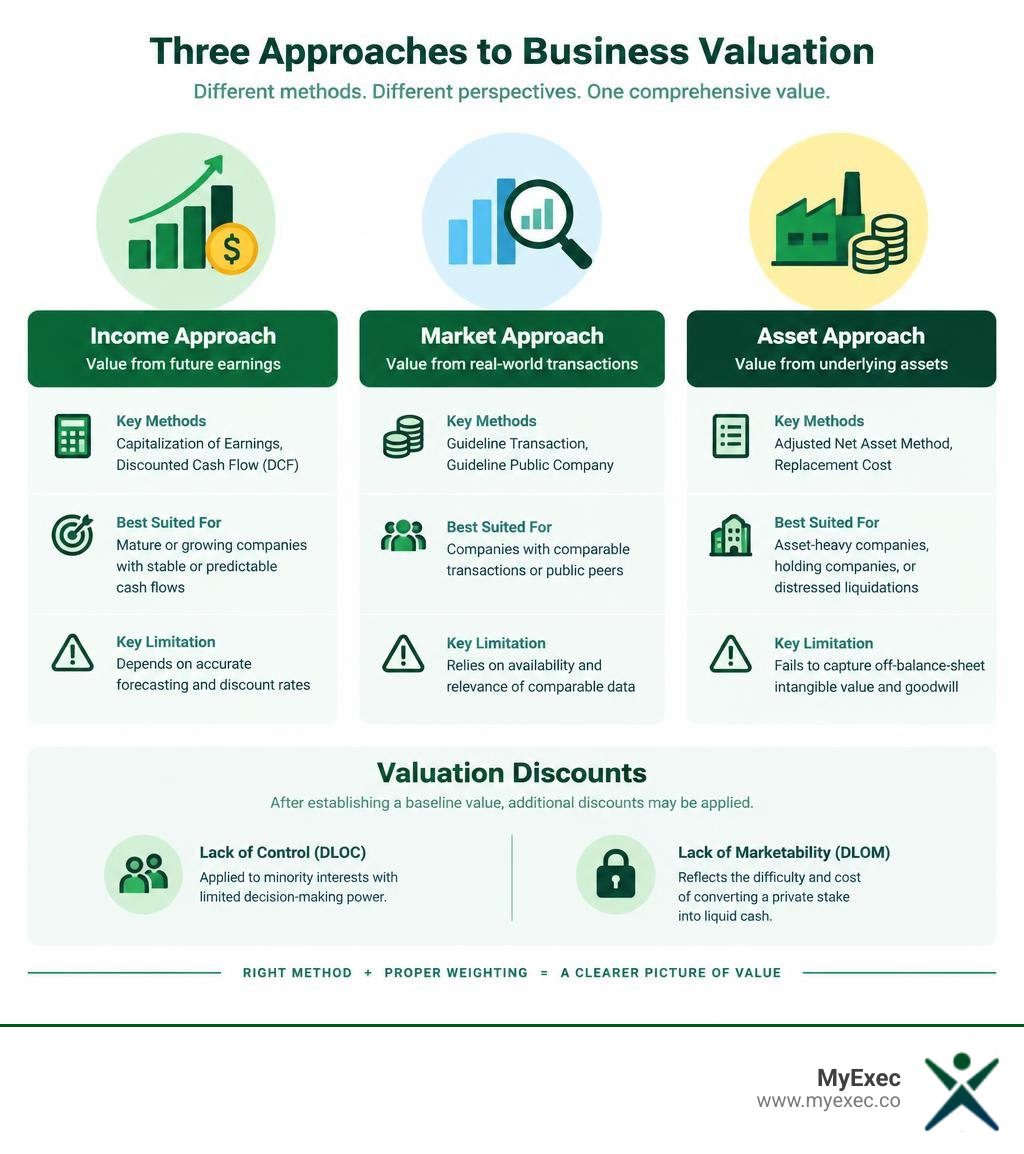
Credentialed appraisers evaluate a company using three foundational valuation approaches: the income approach, the market approach, and the asset-based approach. Each method views the company through a different economic lens.
| Valuation Approach | Primary Methodologies | Best Application | Primary Buyer Scrutiny Point |
|---|---|---|---|
| Income Approach | Discounted Cash Flow (DCF), Capitalization of Earnings | Companies with stable, predictable, or high-growth operating cash flows | Aggressive revenue growth projections and low discount rate assumptions |
| Market Approach | Guideline Public Company (GPC), Guideline Transaction (M&A Comps) | Businesses with sufficient transactional data and direct industry comparables | Comparability of peer companies regarding scale, margins, and geography |
| Asset-Based Approach | Adjusted Net Asset Method, Replacement Cost | Asset-heavy companies, holding companies, or distressed liquidations | Failure to capture off-balance-sheet intangible value and goodwill |
Professional valuations don't pick an approach out of a hat. The report details the strengths and weaknesses of each method for the specific business, outlining the weighting rationale used to synthesize the final range. Scope, industry, and corporate structure directly impact how much a professional business valuation costs.
Income, Market, and Asset Approaches in a Professional Business Valuation
The Income Approach quantifies the present value of future economic benefits generated by the company. The Capitalization of Earnings method divides a single normalized base earnings figure by a capitalization rate, making it well-suited for mature companies with stable, predictable operations.
For growing or dynamic companies, the Discounted Cash Flow (DCF) model forecasts future discrete cash flows across three to five years, adding a terminal value and discounting everything back to the present using a weighted average cost of capital (WACC).
The Market Approach benchmarks the business against real-world market transactions. The Guideline Transaction Method analyzes closed private M&A deals in similar SIC/NAICS codes, while the Guideline Public Company method analyzes trading multiples of publicly traded peers with appropriate size and risk discounts. When reviewing valuation multiples, analyzing prior transaction EBITDA multiples provides a realistic baseline for current middle-market pricing.
The Asset-Based Approach recasts the balance sheet by adjusting every asset and liability to its current fair market value. While standard for real estate holding entities or capital-heavy manufacturing firms with low operating earnings, it doesn't capture the full value of profitable service or software firms whose primary value lies in human capital, brand reputation, and recurring customer contracts.
Applying Valuation Discounts: Lack of Marketability and Control
Once an initial baseline value is established, the appraiser determines whether specific entity-level or shareholder-level discounts are required.
- Discount for Lack of Control (DLOC): Applied when valuing a minority interest that lacks the power to direct company operations, set executive pay, declare distributions, or force a sale.
- Discount for Lack of Marketability (DLOM): Reflects the difficulty and cost of converting a private equity stake into liquid cash compared to publicly traded equities.
Appraisers rely on empirical studies to defend DLOM conclusions, such as restricted stock studies and pre-IPO transaction data. Qualitative risks directly influence these adjustments. Operational vulnerabilities like key-person dependency, supplier instability, or high revenue vulnerability are critical factors. For instance, assessing customer concentration risks is essential, as having a large percentage of revenue tied to a few accounts introduces material risk that drives up required rates of return and discount percentages.
Synthesizing the Conclusion of Value Through a Buyer's Lens

The conclusion of value isn't a simple arithmetic average of the models. It represents a qualitative and mathematical reconciliation based on the reliability of the underlying inputs. An experienced buyer reads the conclusion by deconstructing each bridge step from enterprise value to equity value.
Enterprise value measures the total operating value of the business core. Converting that into equity value, the amount distributed to shareholders, requires precise balance sheet adjustments on a cash-free, debt-free basis. Ensuring all historical accounting schedules and balance sheet line items are fully vetted is part of preparing companies for M&A financial readiness.
Reconciliation of Value and Key Diligence Vulnerabilities
When an acquirer reviews the reconciliation schedule, they focus on specific financial bridging items:
- Funded Debt Deductions: Line-of-credit balances, term loans, equipment notes, and shareholder loans that must be paid off at closing.
- Cash Adjustments: Adding back true excess cash while separating necessary operational cash.
- Working Capital Peg: Establishing a normalized target for net working capital. If actual working capital delivered at closing is lower than the target peg, the purchase price decreases dollar-for-dollar.
- Forecast Plausibility: Stress-testing forward-looking cash flow projections against historical performance to confirm realistic growth rates.
Buyers look for discrepancies between historical baseline margins and aggressive hockey-stick projections that lack operational support.
The Role of Credentialed Appraisers and Defensible Reporting Standards
A valuation report must be defensible under intense scrutiny. Qualified appraisers holding designations like the Certified Valuation Analyst (CVA) follow standards established by organizations like the National Association of Certified Valuators and Analysts (NACVA) or the Uniform Standards of Professional Appraisal Practice (USPAP).
These standards govern documentation depth, analytical rigor, and appraiser independence. A credentialed report provides essential protection across various legal and commercial situations:
- Buy-Sell Agreement Triggers: Preventing partner disputes by using predefined, uniform valuation methodologies.
- Commercial Lending Files: Meeting SBA standard operating procedures and credit committee requirements for acquisition financing.
- Litigation and Marital Dissolution: Providing testimony and documentation that withstands cross-examination in court.
- Estate and Gift Tax Compliance: Meeting IRS adequate disclosure requirements for estate tax filings, working alongside estate planning attorneys and tax CPAs.
Frequently Asked Questions About Business Valuation Reports
Why do buyers and lenders scrutinize normalization add-backs?
Buyers and credit underwriters scrutinize add-backs because unverified adjustments artificially inflate cash flow and operating margins. If an owner claims personal travel, non-essential vehicle expenses, or above-market family salaries as add-backs without clear documentation, underwriters won't accept those adjustments. Unsubstantiated add-backs directly lower the borrowing capacity of the business and increase perceived transaction risk.
What's the difference between a calculation of value and a formal valuation report?
A Calculation of Value engagement allows the business owner and appraiser to agree on specific valuation approaches and limited procedures. It produces an estimated value without requiring all comprehensive analyses.
A formal Valuation Report requires the appraiser to independently evaluate all three approaches, perform exhaustive industry and risk analyses, and synthesize a fully defensible conclusion of value that complies with NACVA and USPAP reporting standards.
How often should private business owners update their valuation report?
Private middle-market companies should consider updating their business appraisal annually or whenever a major strategic pivot occurs. Regular updates track value creation over time, keep partner buy-sell agreements properly funded, and ensure the company remains transaction-ready. Reviewing the benefits of annual valuation updates helps management teams align strategic roadmaps with corporate equity targets.
Conclusion
Understanding what goes into a credentialed valuation report allows you to view your business through the objective eyes of an institutional acquirer, lender, or partner. Reading the document as a buyer does, rigorously questioning add-backs, verifying discount rates, and validating forward projections, helps you protect your enterprise value and address operational risks before entering a transaction.
Our team features a Certified Valuation Analyst (CVA) on staff, bringing credentialed insight to every analysis. We've built dynamic three-statement financial models for mergers, acquisitions, and new product launches, while executing margin optimization and sensitivity analysis that help leadership teams improve cash flow and build enterprise value. We also deliver capital allocation guidance, rolling 13-month P&L forecasts, cash flow projections, and KPI scorecards tracking metrics like customer acquisition cost, average revenue per customer, and net revenue retention, alongside improvements to monthly reporting speed.
We use a full-stack finance approach designed to support your company as it scales until hiring a full-time CFO makes sense. When that milestone arrives, we'll help you define the role, select the right candidate, and transition leadership.
To evaluate your company's equity value or prepare for future transaction opportunities, explore requesting certified business valuation services from MyExec to build a clear, defensible foundation for your financial roadmap.