
The short answer
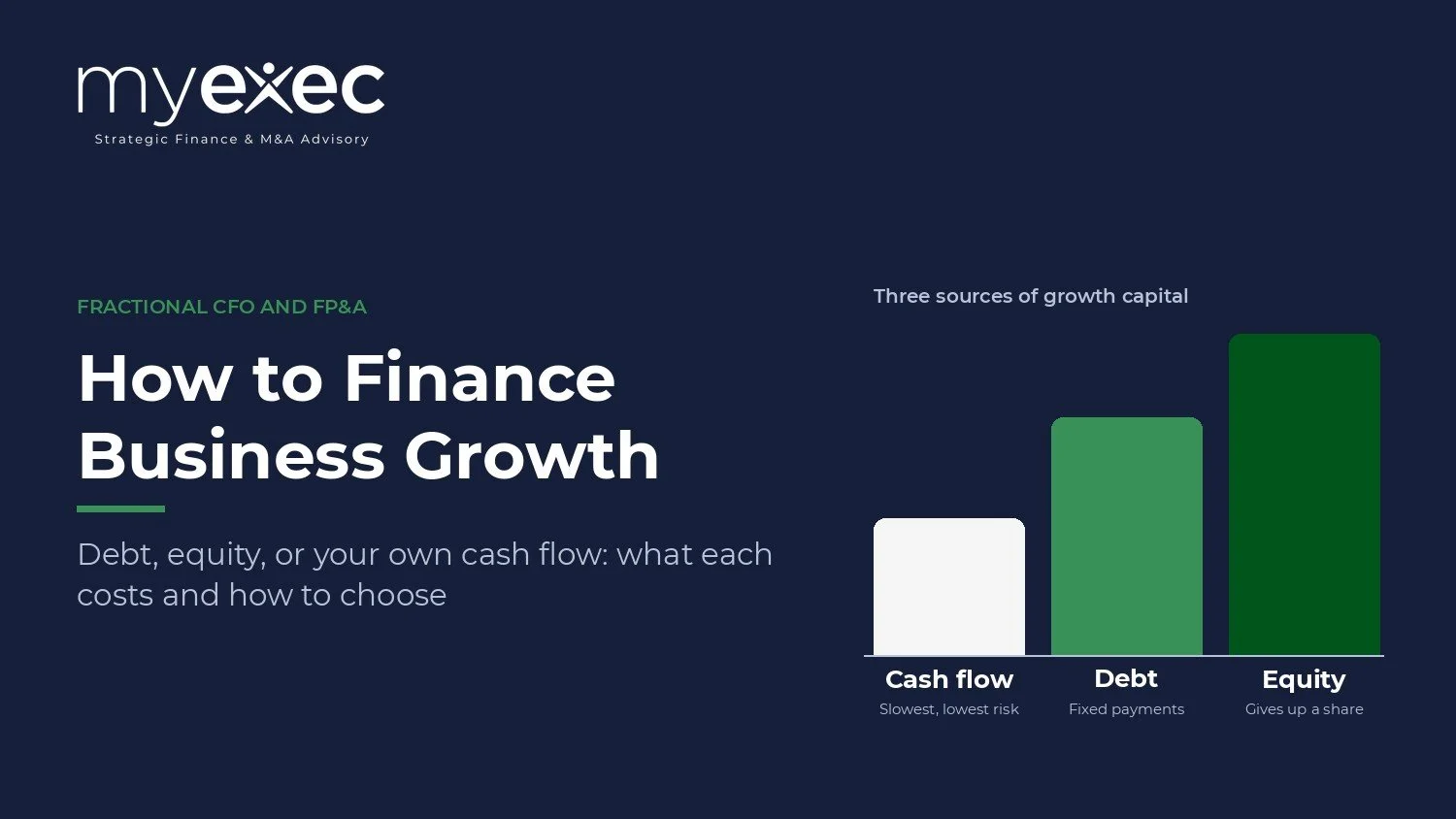
Owner-led companies finance growth from three sources: their own cash flow, debt, and outside equity. Cash flow is the least risky and the slowest. Debt keeps ownership intact but adds fixed payments. Equity brings capital and a partner but gives up a share of the company. The right mix depends on the size of the move, how predictable your cash flow is, and how much control you want to keep.
Most owners we work with don't struggle with the growth idea. They know they want the second location, the new line, the bigger facility or the competitor down the road. Where they get stuck is how to pay for it, and the question usually arrives late, after the lease is drafted or the seller has named a price. That's backwards. How to finance business growth is a decision that follows the plan, so the forecast comes first and the financing comes out of it.
This guide compares the three sources on cost, risk and control, works through a hypothetical $2 million expansion funded three ways, shows what a quarter-point rate move does to the interest bill, and ends with the checklist a lender or investor will work from.
How to finance business growth
Every financing strategy comes down to a trade between three things: what the money costs, how much risk it adds to the business, and how much control you keep. Here's how the main sources compare.
| Source | Cost | Risk to the business | Control | Speed | Best fit |
|---|---|---|---|---|---|
| Your own cash flow | No interest; the cost is time and the cash you can't use elsewhere | Lowest, as long as you keep a reserve | All yours | Slowest; limited to what the business throws off | Moves you can phase, or that are small next to annual cash flow |
| Bank debt (lines and term loans) | Interest at a base rate plus a spread, and fees | Fixed payments and covenants, due in good years and bad | You keep ownership; the lender sets reporting and limits | Weeks to a few months | Steady cash flow and assets or earnings the bank can lend against |
| Other lenders (asset-based, subordinated, seller notes) | Higher than bank debt | More debt on the same cash flow | Ownership kept; tighter terms are common | Varies | Filling the gap between what a bank will lend and what the move costs |
| Outside equity (investors, partners) | No payments, but a share of every future dollar of profit and sale value | Lowest pressure on cash flow | Shared; investors expect a say and an exit | Usually the slowest to arrange | Large moves the cash flow can't carry as debt, or when a partner brings more than money |
Most companies end up using more than one, so the debt vs equity financing question is usually about the mix. The plan tells you which row the next move belongs in.
Funding growth from cash flow
Funding your business from its own profit is the cheapest capital you have. There's no lender to answer to and nobody to share the upside with. The limit is pace. If the business keeps $600,000 a year for growth after tax and distributions, a $2 million project is more than three years away unless you phase it.
That's why the first real question is how much of your profit stays in the business. The choice between reinvesting profits or taking distributions sets how fast you can grow on your own money. Two cautions: don't spend the reserve the business needs to get through a bad quarter, and don't count the cash before the forecast shows when it actually arrives.
Debt: lines, term loans and other lenders
Debt is the most common way owner-led companies fund a larger move, because it keeps ownership intact. The type of debt should match the use. A revolving line of credit rises and falls with receivables and inventory, so it's built for the cycle; our guide to funding the working capital growth needs covers that side. A term loan pays for something long-lived, like a build-out, equipment or an acquisition, and is repaid over several years.
Beyond the bank, there are asset-based lenders, subordinated lenders who sit behind the bank at a higher rate, government-guaranteed programs such as SBA loans, and, in acquisitions, a note to the seller. Each costs more or asks more than conventional bank debt, so they usually fill a gap rather than lead.
What debt costs when rates move
Most business loans are priced off a base rate. Lines usually float with the prime rate, and term loans are either floating or fixed at closing. On a floating loan, every move in the base rate goes straight into your interest bill. Here's the effect on the $2 million, seven-year term loan from the example below, at illustrative rates.
| Illustrative rate (hypothetical) | Year-one interest | Annual payment | Interest over 7 years |
|---|---|---|---|
| 7.75% | $147,157 | $371,087 | $597,608 |
| 8.00% (the example) | $151,974 | $374,069 | $618,484 |
| 8.25% | $156,795 | $377,065 | $639,458 |
| 8.50% | $161,619 | $380,076 | $660,530 |
A quarter point adds about $4,800 to year-one interest and about $21,000 over the life of the loan. That won't break a good project, but it raises the bar the project has to clear, and on a tight plan a point or two of rate is the difference between comfortable and thin.
How much debt the business can carry
Lenders answer this with debt service coverage: annual EBITDA divided by all the principal and interest owed that year. At 2.0x, the business earns twice what it owes; at 1.0x, nothing is left for a bad month. The minimum is set in your loan agreement, and the useful number is how far earnings can fall before you'd hit it, with the new loan included and in a downside year. Our guide to what banks look for before lending covers coverage, the other ratios banks test and the covenants that follow from them.
Outside equity: investors, partners and what they expect
Equity means selling part of the company for cash, to a private investor, a family office, a fund taking a minority stake, or a strategic partner. There are no payments and no bank covenants, which is why equity can fund a move the cash flow couldn't carry as debt. The investor takes more risk than a lender, so they expect a higher return and a clear way to get their money back: a sale, a recapitalization, or a buyout of their stake.
Dilution and control
The share you give up depends on what the company is agreed to be worth before the money goes in. If you and an investor agree the business is worth $9 million and they put in $2 million, the company is worth $11 million afterward and they own 18.2% of it. That's 18.2% of every distribution and every dollar at a future sale, for as long as they hold it.
Control is the part owners underestimate. Even a minority investor usually asks for a board seat, approval over big decisions such as new debt or a sale, and regular reporting. The terms around preferences, voting and exit rights matter as much as the percentage, so bring your attorney in early, and your CPA on the tax side of the structure.
What investors will ask to see
An investor's diligence looks a lot like a buyer's: clean historical financials, a forecast they can test, a view of what the business is worth, a clear use of funds, and a management team that doesn't depend on one person. We help owners answer investor questions during equity raises, and the questions keep coming back to the same three things: how the forecast was built, what happens in the downside, and how the investor gets paid back.
A worked example: one $2 million expansion, three ways
The figures are hypothetical and rounded, and none of them is market data. A company with $15 million of revenue and $1.5 million of EBITDA pays $500,000 a year on its existing loans. It plans a $2 million expansion, a second location expected to add about $400,000 of EBITDA a year once it's running. After tax and the owner's distributions, the business keeps about $600,000 a year for growth. For the equity route, the owner and an investor agree the company is worth $9 million before the investment.
| Hypothetical | Cash flow over time | Term loan (7 years, 8%) | Minority equity |
|---|---|---|---|
| When the expansion can start | In about 3.3 years | When the loan closes | When the investment closes |
| Year-one interest | $0 | About $152,000 | $0 |
| New annual loan payments | $0 | About $374,000 | $0 |
| Coverage of all loan payments | 3.00x | 1.72x before the new location earns anything | 3.00x |
| Ownership given up | None | None | 18.2% |
| The real cost | Three years of waiting: about $1.3M of the new location's EBITDA pushed out | About $618,000 of interest over seven years, and fixed payments through any downturn | 18.2% of every future distribution and sale dollar; at a future value of $14M, that's about $2.5M |
Read it as a set of trade-offs. The cash route costs nothing on paper, but three years of waiting is about $1.3 million of the new location's earnings pushed out, and the site may not be there in three years. The loan starts the clock now and keeps the company yours. Coverage of 1.72x is healthy, and if the lender's minimum were 1.25x (an illustrative figure; your term sheet sets the real one), EBITDA could fall about $407,000, or 27%, before the covenant is at risk. The equity route starts now with no payments at all, and it's the most expensive of the three if the business does well, because the investor shares in all of it.
For this company, with steady earnings and room above its coverage minimum, the loan is likely the strongest answer, possibly paired with some of its own cash. A company with lumpier earnings, or a move three times this size, could land elsewhere. Run your own numbers below.
Growth financing calculator
Enter the amount, a rate, a term and your EBITDA to compare the three routes.
This is a planning estimate. The real answer comes from a monthly forecast with the move built in. Our strategic finance guide covers how we build one.
Mixing sources for larger moves such as acquisitions
Bigger moves rarely sit in one row of the table. In the example, if the company put in $1 million of its own cash and borrowed the other $1 million, the new payments would drop to about $187,000 a year and coverage would sit at 2.18x, with no ownership given up. That kind of blend is common, and lenders like seeing the owner's own money in the project.
Acquisitions are where the layers stack up most. A typical structure for a company this size might combine the buyer's cash, a bank term loan sized to what the combined cash flow can carry, a note to the seller for part of the price, and sometimes equity from an investor or a stake the seller keeps. Each layer changes the risk for the others, and the structure has tax and legal consequences, so your CPA and attorney belong in it from the first draft.
How tighter bank credit and higher rates change the decision
Two things moved this fall that matter for financing for companies this size. First, banks got more careful with smaller borrowers. In the Federal Reserve's October 2026 Senior Loan Officer Opinion Survey, published November 2, a net 5.1% of banks tightened standards for business loans to firms with annual sales under $50 million, up from 1.8% in July. Standards for larger firms were basically unchanged, and banks reported weaker loan demand from firms of all sizes. That's the size range this post is written for.
Second, rates may go up again. The Fed held its target range at 3.75% to 4.00% on October 28, 2026, and the prime rate is 7.00% (Federal Reserve data via FRED). After the October jobs report, CME FedWatch put the odds of a quarter-point increase at the December 9 meeting at about 77% (InvestmentNews, November 6, 2026). That's a market expectation, and the Fed hasn't decided. If it happens, prime would likely follow to 7.25%.
For a growth decision, that means three things. Price floating debt at today's rate and a quarter to a half point higher, and see if the project still clears. Expect more lender questions, so allow more time and bring a better package. And give the cash and equity routes a fair look, because their gap with debt narrows as rates rise. None of this says wait. It says build the rate into the plan.
Build the financing case before you ask
The financing decision follows the plan. Before you talk to a lender or an investor, you want a strategic financial plan that shows what the move costs, when the cash goes out, when it comes back, and how much the existing business can fund on its own. The gap between those two numbers is the financing need, and the plan puts a date on it.
Right now we're building a 2027 budget for a multi-location company we work with whose investors expect a set return. The budget runs all the way down to free cash flow and to coverage of that return before any new location is added. Only then does the next site go in, with its own capital and funding line. You can't choose the source of capital until you know what the existing business leaves over.
- Forecast the business as it runs today. Monthly, for at least the next 12 to 24 months, through the balance sheet and cash flow.
- Add the move as its own layer. The spend, the ramp, the working capital it ties up, and what it earns once it's running.
- Build the capital plan. What the business funds from cash flow, what it keeps in reserve, and the gap.
- Run the scenarios. A slower ramp, a lower margin, a higher rate. Check coverage and cash in each.
- Then pick the mix. The plan will usually point at it, and you'll walk in with the case already made.
Here's what a lender or investor will ask for. Check what you have ready.
The one-page financing checklist
Check the items you have ready today.
Frequently asked questions
Is debt or equity cheaper for a growing company?
Debt is usually cheaper if the business does well. You pay interest for a set period and keep all the upside. Equity has no payments, but the investor shares in every future dollar of profit and sale value, so its real cost grows with your success. Equity can be the better choice when cash flow is too uneven to carry fixed payments safely.
How much debt can my company safely carry?
Start with debt service coverage: annual EBITDA divided by all the principal and interest due that year. Calculate it with the new loan included, then again in a downside year with lower earnings and a higher rate. The safe amount is the one that stays comfortably above the minimum in your loan agreement in both cases, with room left for a bad quarter.
What do I give up when I bring in an equity investor?
A share of ownership, which means a share of every distribution and of the proceeds when the company is sold. Most investors also want some control: a board seat, approval over major decisions such as new debt or a sale, regular reporting, and a path to get their money back. Have your attorney review the terms, because preferences and exit rights matter as much as the percentage.
Can I combine debt and equity to fund an acquisition?
Yes, and most acquisitions at this size use more than one source. A common structure combines the buyer's own cash, a bank term loan sized to the combined cash flow, a note to the seller, and sometimes investor equity or a stake the seller keeps. Each layer changes the risk for the others, and the structure has tax and legal consequences your CPA and attorney should review.
How do rising interest rates change the choice?
Higher rates raise the cost of debt, so a project funded with a loan has to earn more to be worth doing. That makes cash flow and equity look relatively better than they did. Price any floating-rate debt at today's rate and a quarter to a half point higher, and check that coverage and cash still hold. A plan that works either way is ready.
Plan your growth capital with MyExec
We run the same playbook every time: forecast the business as it runs today, add the growth move as its own layer, size the gap, and test the funding mix against a downside before anyone signs a term sheet. It's scalable strategic finance leadership for owners of $5M to $50M companies, and it means you walk into the lender or investor meeting with the case already made.
Not sure your finance function can carry a plan like this? Take the free Strategic Finance Assessment in about five minutes.