How to Decide Whether to Reinvest Profits vs Take Distributions
Why Is the Reinvestment vs. Distribution Decision Critical for Growing Businesses?

For U.S. businesses in the $5M to $50M revenue range, capital allocation is no longer a simple checkbook decision. When your business was in its infancy, managing cash was straightforward. If there was money in the bank at the end of the month, you either used it to pay immediate bills or you pulled it out to cover your personal living expenses.
As you scale past the $5M mark, you outgrow founder-led finance. The business becomes a complex corporate entity with its own working capital requirements, debt obligations, and growth opportunities. At this stage, capital allocation becomes your most powerful strategic lever. Every dollar your business generates represents a choice. You can leave that dollar inside the company to compound its value, or you can distribute it to the owners to build personal wealth.
This choice is critical because it forces you to balance two competing financial forces:
- Compounding Business Value: Keeping cash inside the business allows you to fund high-ROI growth initiatives without relying on expensive outside debt or diluting your equity.
- Personal Wealth Diversification: Extracting profits allows you to build a personal financial safety net outside of your company, reducing your family's exposure to business-specific risks.
If you reinvest 100% of your profits, you might build a highly valuable enterprise, but you also keep almost all of your personal net worth tied up in a single, illiquid asset. If you distribute too much cash, you risk starving your business of the fuel it needs to scale, leaving you vulnerable to more aggressive competitors.

What Is the Difference Between Reinvesting Profits and Taking Distributions?
To make an informed decision, you must understand the operational definitions and mechanics of both options.
Reinvesting profits means allocating your retained earnings back into your business operations. This is not the same as letting cash sit idle in a low-yield business checking account. True reinvestment means actively deploying capital into growth-focused assets and initiatives. Examples include:
- Hiring key leadership team members or specialized staff
- Upgrading your technology stack and software systems
- Purchasing inventory in bulk to secure better margins
- Funding research and development for new product lines
- Acquiring equipment or expanding physical facilities
Taking distributions means extracting cash from the business to pay the owners or shareholders. This cash leaves the business ecosystem entirely. Depending on your legal structure, these payments are classified as S-Corp distributions, LLC partner draws, or C-Corp dividends. Once distributed, this money is typically used for personal lifestyle needs or invested in external assets like stocks, bonds, and real estate.
The fundamental trade-off is immediate personal liquidity versus long-term business compounding.
This decision is rarely purely analytical. Psychological and behavioral factors play a massive role. Many founders suffer from burnout after years of taking minimal salaries and feeding every spare dollar back into the business. For these owners, taking a distribution is a psychological necessity that makes the stress of business ownership sustainable. Conversely, some owners treat their business as a personal ATM, pulling out cash to fund a luxury lifestyle at the expense of the company's long-term health.
Balancing these mindsets is one of the most critical strategic decisions every growth-minded founder must make to build both a healthy business and personal financial security. To do this effectively, you must have a clear handle on your profit and loss management so you know exactly how much profit is actually available for allocation.
What are the tax implications of reinvesting profits versus taking distributions?
Tax strategy must be integrated with your capital allocation decisions because how your profits are taxed depends heavily on your corporate entity structure.
For pass-through entities, which include S-Corporations, LLCs, and Partnerships, the IRS taxes business profits at the individual owner level. This means you pay personal income tax on your share of the net business income, regardless of whether you leave that money inside the business or distribute it to your personal bank account. Reinvesting the profits does not shield pass-through income from taxes.
However, if your business is structured as an S-Corp, you must comply with strict IRS rules regarding owner compensation. You are required to pay yourself a reasonable salary, which is subject to payroll taxes, before you can take tax-free distributions.
Reinvesting profits can sometimes defer or reduce your immediate personal tax liabilities through strategic deductions. For example, if you reinvest profits by purchasing qualifying equipment, you can often use Section 179 depreciation to write off the full purchase price in year one, reducing your taxable net income.
If you operate as a C-Corporation, you face double taxation. The business pays corporate income tax on its earnings. If you reinvest those earnings, no further tax is owed. But if you distribute those profits to shareholders as dividends, those individuals must pay personal taxes on that income. In taxable personal accounts, taking distributions always triggers an immediate tax event, whereas keeping capital working inside a pass-through entity under strategic reinvestment can optimize your overall tax footprint.
How Do You Determine If Your Business Is in a Growth Phase or a Mature Phase?
Your position in the business lifecycle should dictate your capital allocation strategy.
The Growth Phase: In this stage, your business has abundant high-return opportunities. You are actively expanding your market share, building out your team, and increasing your operational capacity. The demand for your product or service is strong, and every dollar you reinvest yields significant returns. If your internal initiatives are consistently generating returns of 20%, 30%, or even 40% on your capital, your business is firmly in a growth phase.
The Mature Phase: In this stage, your business has stable cash flow and consistent profitability, but your growth has plateaued. High-yield reinvestment opportunities are limited. If you hire another salesperson or buy another piece of equipment, it will not dramatically increase your revenue. You have reached a point of diminishing returns.
To determine where your business stands, you must run a detailed profitability analysis to see if your margins and return metrics support further expansion or if they are beginning to flatten.
Stage-based allocation benchmarks
While every business is unique, we can look at broad, non-specific ranges as helpful benchmarks for profit allocation based on your stage:
- Growth Phase: Early-stage or high-growth businesses should reinvest 70% to 90% of their profits. When your internal opportunities are generating 30% to 50%+ returns, keeping capital in the business is the fastest way to build massive enterprise value.
- Scale and Optimization Phase: As your business matures and revenue climbs, you typically adopt a balanced approach, reinvesting 40% to 60% of profits and distributing the rest to manage risk.
- Mature Phase: When reinvestment opportunities are thin, mature businesses should distribute 60% to 80% of their profits, allowing owners to build diversified personal wealth outside the company.
| Business Phase | Primary Characteristics | Typical ROIC Range | Recommended Reinvestment Rate | Recommended Distribution Rate |
|---|---|---|---|---|
| Growth Phase | High-return opportunities, team expansion, capacity building | 20% to 40%+ | 70% to 90% | 10% to 30% |
| Mature Phase | Stable cash flow, consistent profitability, growth plateaus | 10% to 15% | 20% to 40% | 60% to 80% |
How Do You Calculate the Return on Reinvested Capital (ROIC) in Your Business?
To make objective capital allocation decisions, you must treat your business as an investment portfolio. This means comparing your internal business returns against the returns you could get in the public markets.
Traditional external investments, such as stocks, bonds, and real estate, typically generate average returns of 7% to 9% over long periods. Since 1926, dividends alone have made up about 4 percentage points of the equity market's 10% average annualized return. If your business can consistently generate 20%, 30%, or 40% returns on the capital you put back into it, your business is your highest-yielding asset.
To measure this, you need to calculate your Return on Reinvested Capital (ROIC). The basic formula is:
$$\text{ROIC} = \frac{\text{Net Operating Profit After Tax (NOPAT)}}{\text{Invested Capital}}$$
Invested Capital represents the total amount of debt and equity tied up in your business operations.
You can also apply a marginal ROI analysis to evaluate specific growth opportunities. For example, if you hire a new salesperson for $120,000, and they generate $800,000 in new revenue at a 30% profit margin, that salesperson is generating $240,000 in net profit. That is a 200% return on your $120,000 investment.
Tracking these metrics over time is a core part of establishing your business performance metrics to guide your strategic decisions.
The risk of diminishing returns on reinvestment
You cannot assume that because reinvestment worked in the past, it will always work. Reinvestment must slow down or stop when your metrics show it is no longer driving proportional growth.
If your unit economics are poor, blindly throwing more money at marketing or hiring will only lead to capital waste. You might grow your top-line revenue, but your profitability will erode.
This is why you must monitor your unit economics over several quarters. If you notice your customer acquisition cost (CAC) is rising while your customer lifetime value (LTV) is shrinking, you are hitting a growth curve plateau. That is a clear signal to scale back reinvestment and increase your distributions.
When Does It Make Sense to Prioritize Personal Wealth Diversification Over Business Reinvestment?
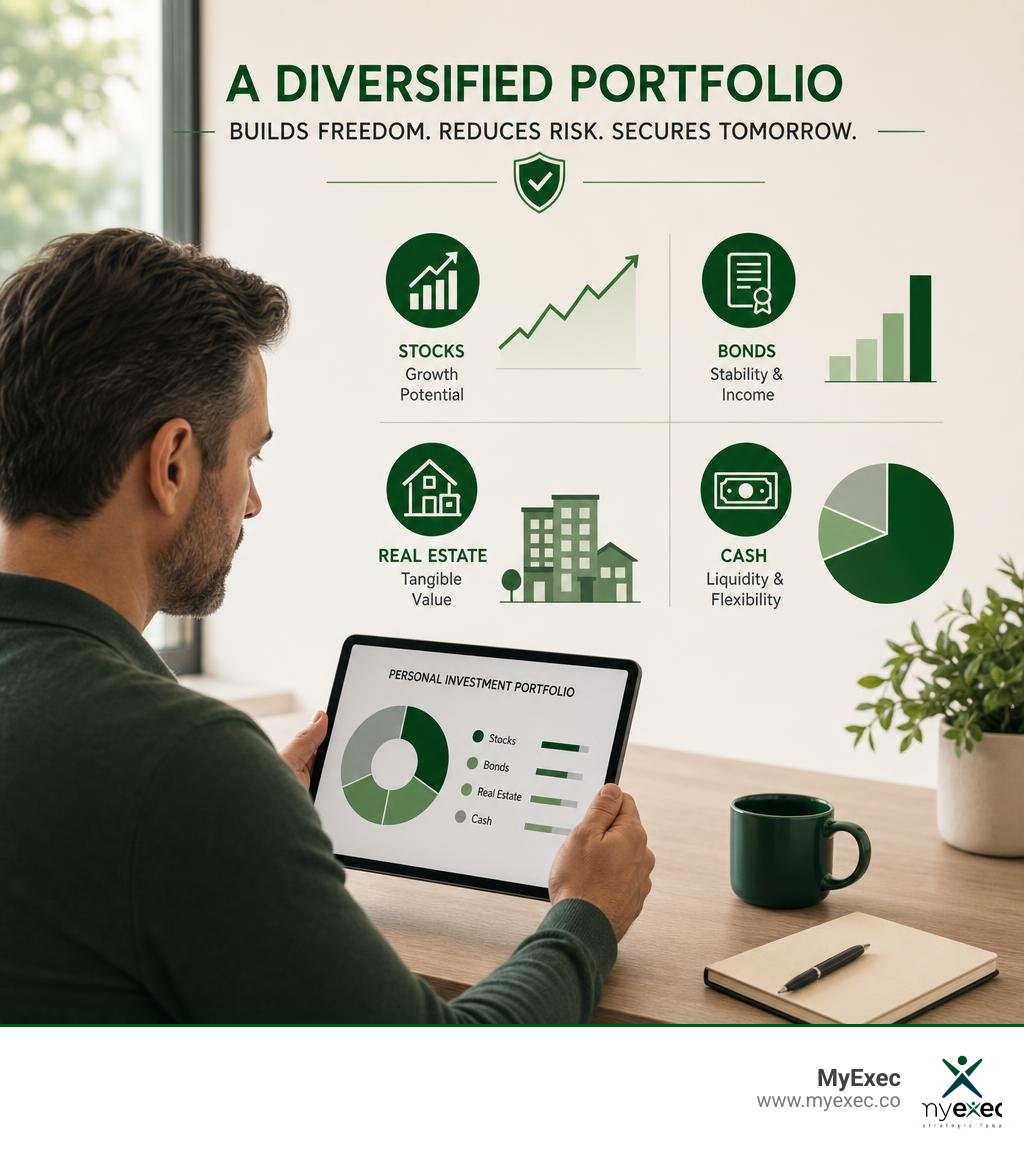
Many founders fall into the trap of keeping 98% of their net worth tied up in their business. This is extreme concentration risk. If your industry faces a sudden disruption, or if your business hits a major operational crisis, your entire life savings could vanish overnight.
Taking regular distributions to build a diversified personal portfolio of stocks, bonds, and real estate is a critical risk-mitigation strategy.
Paradoxically, building personal financial security can actually reduce your business risk. When you are not worried about how you will pay your personal mortgage or fund your children's college education, you become much more comfortable taking bold, calculated risks within your business. You can make long-term strategic moves rather than short-term decisions driven by personal cash needs.
It also prevents founder burnout. Knowing you are building wealth outside the business gives you peace of mind.
This is why we recommend using a structured reinvestment vs. distribution cash allocation framework to balance these competing needs.
The risks of over-reinvesting or over-distributing
Let's look at the dangers of going too far in either direction.
Risks of over-reinvesting:
- Starving your personal runway and risking personal financial distress
- Founder burnout from working long hours without personal financial reward
- Capital inefficiency, where you throw money at low-return projects just because the cash is there
- A severe lack of liquidity if the business faces a sudden downturn
Risks of over-distributing:
- Starving your growth engine and letting competitors take your market share
- Relying too heavily on high-interest debt or lines of credit to fund routine operations
- Violating bank debt covenants that restrict distributions based on your leverage or liquidity ratios
- Constantly dealing with tight cash flow and operating with zero margin for error
How Do Owner Distributions Affect Business Valuation and Future Exit Opportunities?
How you allocate your profits today directly impacts what your business will be worth when you decide to sell.
Reinvesting in your infrastructure, brand equity, and key leadership team is the primary driver of business valuation. Acquirers do not want to buy a business that is entirely dependent on the founder. They want to buy an institutionalized system that can run without you.
Let's look at the math of compounding. A business that reinvests 70% of its profits and achieves a 25% annual growth rate can easily be worth upwards of $3,000,000 after five years. In contrast, a peer business that only reinvests 10% of its profits and grows at a modest 5% rate might only be worth around $550,000 over the same period.
However, timing is everything. If you plan to exit the business in the next 12 to 24 months, aggressive reinvestment can actually work against you. Reinvestment costs are expensed on your P&L, which temporarily depresses your EBITDA. Since business valuations are typically based on a multiple of EBITDA, heavy spending right before a sale can lower your final exit price.
Buyers also look for clean, structured distribution histories. They want to see that the business has strong working capital reserves and is not being drained to fund a luxury lifestyle.
If you are planning an exit, you need a professional team to help you model these scenarios and prepare your business valuations for the market.
How Can You Create a Balanced Distribution Policy Using Cash Flow Forecasting?
One of the most common mistakes business owners make is looking at their P&L statement, seeing a healthy profit, and immediately writing themselves a distribution check.
Profit does not equal cash. You can show $400,000 in net profit on your P&L but still have zero cash in the bank. Why? Because your cash might be tied up in slow-paying accounts receivable, unsold inventory, or debt principal payments that do not show up on your profit and loss statement.
To avoid starving your business, you must use a 12-month rolling cash flow forecast. This tool projects your cash inflows and outflows based on your sales pipeline, payment terms, and upcoming expenses. It tells you exactly how much cash you can safely distribute without hurting your operations.
We generally recommend maintaining an operating capital reserve of 3 to 6 months of operating expenses before taking any major distributions. This is where forecasting financial statements becomes an invaluable tool for strategic planning.

Steps to establish a formal distribution policy
To take the emotion and guesswork out of capital allocation, you should establish a formal, structured distribution policy. Here are the steps to do it:
- Define minimum cash reserves and working capital targets: Determine the exact dollar amount your business needs to keep in the bank to cover operations, debt obligations, and seasonal dips.
- Establish a regular review cadence: Instead of taking random draws, review your cash position quarterly or semi-annually.
- Set clear profit margin targets: Create a policy where a fixed percentage of net profit is allocated to reinvestment, a fixed percentage is distributed to owners, and the rest goes into your cash reserves.
- Ensure compliance: Verify that your planned distributions do not violate any bank debt covenants and that you are meeting IRS reasonable salary requirements.
Frequently Asked Questions About Reinvesting Profits vs. Taking Distributions?
Do I pay taxes on reinvested business profits?
Yes, if your business is structured as a pass-through entity like an S-Corp, LLC, or Partnership. In these structures, the owners pay personal income tax on their share of the business's net profits, regardless of whether those profits are distributed as cash or reinvested back into the company.
C-Corporations operate differently. The corporation pays corporate tax on its profits. If the profits are retained and reinvested, the owners do not pay personal tax on them. Personal tax is only triggered when the C-Corp distributes dividends to its shareholders, resulting in double taxation.
How much cash should I keep in my business before taking distributions?
We recommend keeping at least 3 to 6 months of operating expenses in the business as an emergency cash buffer. You should adjust this reserve based on your revenue volatility, your industry risk, your debt obligations, and your upcoming capital expenditure needs. If your revenue is highly seasonal or volatile, you may want to maintain a larger cushion.
Can taking distributions help me manage business risk?
Yes. Extracting profits to build diversified personal wealth outside the business is an excellent risk-management tool. It reduces your overall financial exposure to a single asset. If your business faces a sudden market shift or operational crisis, your family's financial security remains protected because your wealth is spread across diversified assets like stocks, bonds, and real estate.
How Can MyExec Help You Navigate the Reinvestment vs. Distribution Decision?
Making capital allocation decisions without professional guidance is incredibly risky. That is where we come in.
MyExec provides high-value, strategic fractional CFO and FP&A services for growing U.S. businesses in the $5M to $50M revenue range. We help businesses that are outgrowing founder-led finance and need senior financial leadership without the cost of a full-time hire.
Our support model is completely flexible and scalable. Depending on your current needs, complexity, and growth stage, you might need analyst-level support, senior CFO leadership, or a mix of both. We scale our services up or down as your business evolves.
Our team has worked across a wide range of companies, from those with a few million in revenue to large enterprises generating roughly $2B. Our experience spans nonprofits, private equity owned businesses, closely held companies, and publicly traded entities.
We can help you:
- Build 12-month rolling cash flow forecasts to determine safe distribution levels
- Calculate your actual Return on Reinvested Capital (ROIC)
- Design custom KPIs and business performance metrics
- Establish a formal, tax-efficient distribution policy
- Model future valuations to prepare your business for a successful exit
Our ultimate goal is to help you grow your business to the point where a full-time CFO makes sense. When that day comes, we will help you define the role, find the right person, and transition our responsibilities cleanly.
To learn more about how we can support your growth, visit our MyExec services page and schedule a strategy call with our team today.