

The short answer
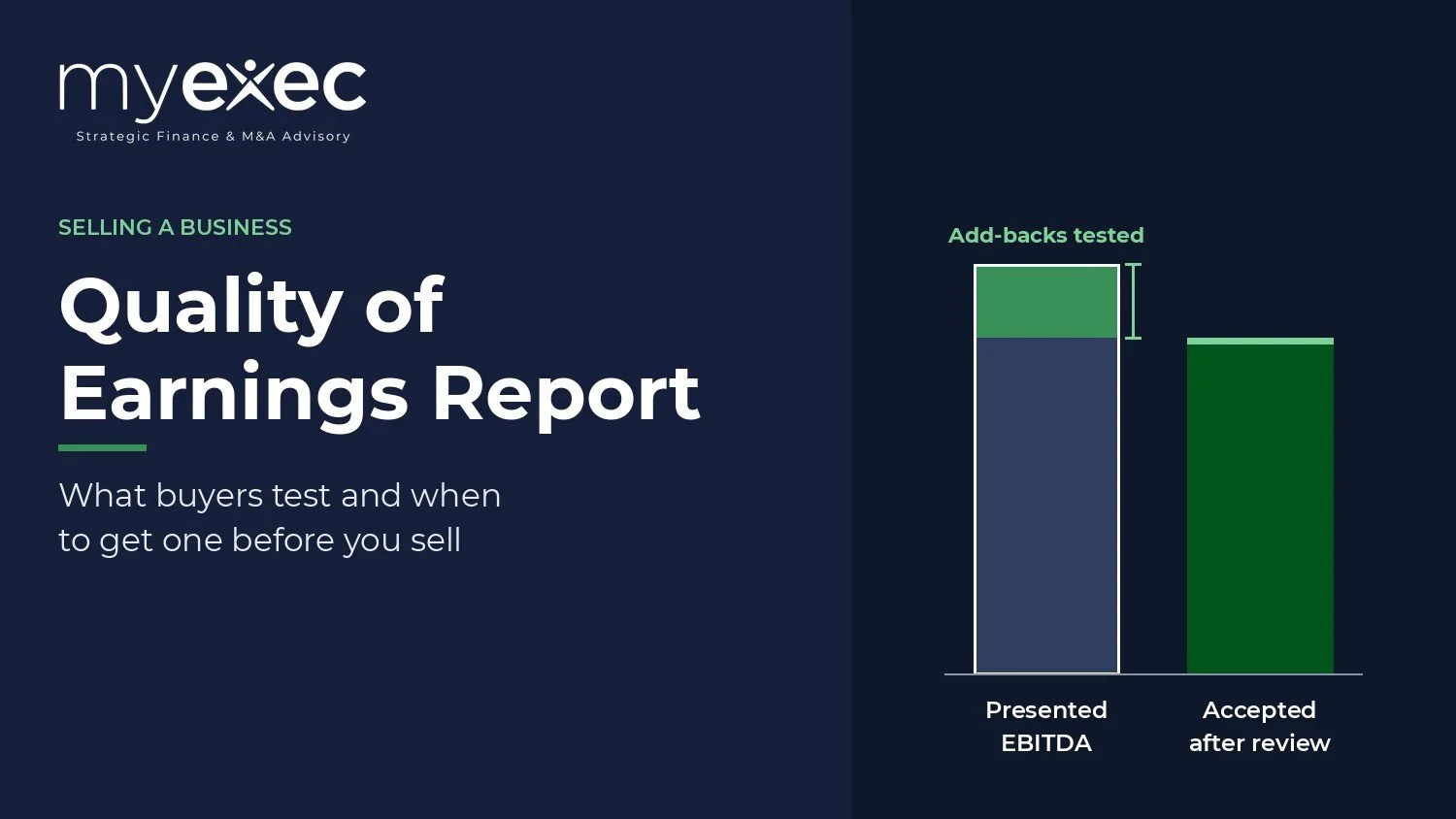
A quality of earnings report tests whether a company's reported earnings, usually adjusted EBITDA, are accurate, repeatable and supported by the records. Buyers commission one after a letter of intent to confirm the number they priced. Owners can commission their own first, so the earnings hold up before a buyer starts testing them.
If you're a year or two from a sale, or you've got a letter of intent on the way, you've probably heard "quality of earnings" from your CPA, your attorney or a buyer. It matters more to your price than most owners expect, because buyers pay a multiple of earnings. Every dollar of adjusted EBITDA the review doesn't accept comes off the price several times over.
This guide covers what the review tests, how it compares with an audit, when a sell-side report is worth doing, and how to get your numbers ready, with a worked example and a calculator you can run on your own figures. For the bigger picture, see how we approach selling your business with MyExec.
What is a quality of earnings report?
A quality of earnings report, often called a QoE report, is a financial analysis of what the business really earns on a normal, ongoing basis. The team doing it rebuilds EBITDA month by month from the general ledger, then tests every adjustment you've made to get to adjusted EBITDA: owner expenses, one-time costs, above-market pay and anything else you've added back.
The question behind every page is simple. Would a new owner, running the business the way it runs today, earn this number next year? Most reports also include a proof of cash that ties revenue to bank deposits, a working capital analysis and a list of debt-like items, because those change what you take home at closing.
What a quality of earnings review tests
Adjusted EBITDA and each add-back
Adjusted EBITDA is the number most buyers price, so it gets the closest look. Each add-back is tested against three questions: did it happen, is it supported, and will it stop once you're gone? A one-time lawsuit settlement with invoices behind it usually holds. A "one-time" recruiting cost that shows up every year usually doesn't.
Every add-back needs support a buyer can verify: an invoice, a contract, a payroll record. Owner pay gets special attention, because the buyer has to replace you with someone paid at market rates. Our guide to valuing a business on EBITDA walks through how the adjusted number becomes a value.
Revenue quality: recurring, repeat and one-time revenue, and customer concentration
Buyers pay more for revenue that's likely to come back. The review splits revenue into recurring revenue under contract, repeat revenue from customers who keep buying, and one-time project revenue, and checks how revenue is recognized on long jobs and deposits. It also measures how much comes from the top customer, the top five and the top ten. A big customer with no contract, whose relationship runs through you personally, is something a buyer will price.
Margins and cost trends
Reviewers look at gross margin by month, by service line and by location, and ask why it moved. A margin jump in the last six months will get questions about whether it came from a price increase customers have accepted or from costs that slipped into next year. They also look for costs a new owner will have to add, like a role the owner covers without pay or maintenance that's been put off.
Net working capital and the peg
Most deals assume the business comes with a normal level of receivables, inventory and payables. The purchase agreement sets a target, often called the peg, usually from a trailing monthly average, and the price moves up or down at closing depending on where actual working capital lands. The review builds the monthly history behind that target, and a peg set from a few unusually high months can cost a seller real money. Our guide to the working capital target covers how it's set.
Debt and debt-like items
In most deals the buyer pays for the business free of debt, so anything that behaves like debt reduces what you receive. Beyond loans, that can include customer deposits for work not yet done, earned but unpaid bonuses, accrued vacation and past-due taxes. The review lists them. How each is treated is written into the purchase agreement, which is a conversation for your attorney and CPA.
Quality of earnings versus an audit
The two get mixed up because accountants do both and both start from your financial statements. They answer different questions.
| Quality of earnings review | Audit | |
|---|---|---|
| Purpose | Test whether earnings are accurate, repeatable and supported, for a transaction | Give an opinion on whether the financial statements are fairly presented under accounting standards |
| Who orders it | The buyer after a letter of intent, or the owner before going to market | The company, often because a lender, investor or board requires it |
| What it covers | Adjusted EBITDA and each add-back, revenue quality, margins, monthly trends, working capital and debt-like items | The balance sheet, income statement, cash flows and disclosures for the fiscal year |
| What it produces | A report with adjusted EBITDA, the support for each adjustment, a working capital analysis and a list of issues | An audit opinion attached to the year's financial statements |
Reviewed or audited statements from your CPA make a quality of earnings review faster, because the reviewer starts from records that have already been tested. The buyer still orders its own review, because it's asking a different question.
Buy-side and sell-side reports: who orders each and why
A buy-side report is ordered and paid for by the buyer after the letter of intent is signed, usually during exclusivity. It confirms the earnings the buyer priced and looks for anything that should change the price or terms, and the buyer's lender often relies on it. You'll get the questions. You usually won't see the report.
A sell-side quality of earnings is ordered and paid for by the owner before going to market, usually prepared by an outside accounting or transaction advisory team. You see what a buyer will see, fix what can be fixed, and go to market with an adjusted EBITDA that's already been tested. Buyers still do their own work, but a tested starting point tends to narrow the discussion to a few items.
Either way, the numbers in your marketing materials have to tie to the numbers the review tests. If the teaser shows $3.0 million of adjusted EBITDA, the buyer's reviewer starts from $3.0 million and works back to the ledger. In a current sell-side process with a services company we're advising, every figure in the teaser and confidential information memorandum has to hold up once buyers start their review, so each one ties back to the monthly financials before anything goes out.
When a sell-side quality of earnings is worth it
Not every company this size needs one. It earns its keep when parts of the earnings story are things a buyer could reasonably question.
Signals that favor a sell-side report:
- Add-backs that are large compared with EBITDA, especially owner expenses and one-time costs.
- Financial statements prepared mainly for tax purposes, which are built for a different job than a buyer's review.
- A recent acquisition, new location, large new customer or margin jump that buyers will want explained.
- Revenue recognition that takes judgment, such as long projects or deposits.
- A process aimed at private equity buyers, where you want the number settled before exclusivity.
Signals that clean monthly financials may be enough for now:
- A few small, well-documented add-backs.
- Monthly closes done on time, with reviewed or audited year-end statements.
- A sale more than a year or two out, where the better first step is getting monthly reporting right.
Our guide to preparing your business for sale covers the full sequence.
How to prepare your numbers before anyone tests them
Most of what makes a review go well is done months before it starts. In our valuation and sell-side work, we prepare estimates of value for owners getting ready to go to market, and the add-backs and margin story an owner presents early are the same items a buyer's team tests later. Whether it's a trades company preparing to sell or a services company we're advising, those two topics come up first with us and again with the buyer.
What to gather before a review
Check what you already have ready.
Then read your own numbers the way a buyer would. For each add-back, ask whether you could show the support to a stranger in five minutes. Where the support is thin, build it or take the add-back out before a buyer sees it. Our guide to M&A-ready financials covers the reporting side.
What happens when the review finds a different number
Here's how the arithmetic plays out for a hypothetical services company that presents $3.0 million of adjusted EBITDA: $2.4 million reported plus $600,000 of add-backs.
| Add-back (hypothetical) | Presented | Accepted |
|---|---|---|
| Owner pay above a market salary A replacement manager costs more than the owner assumed | $200,000 | $120,000 |
| Lawsuit settlement and legal fees One-time, with invoices and the settlement agreement | $150,000 | $150,000 |
| Personal expenses through the business Receipts support only part of it | $90,000 | $50,000 |
| "One-time" recruiting costs The same cost appears in each of the last three years | $80,000 | $0 |
| Price increase not yet in the results Not yet earned, so it isn't in the trailing twelve months | $80,000 | $0 |
| Adjusted EBITDA $2.4 million reported plus accepted add-backs | $3,000,000 | $2,720,000 |
We use 7.0x here only to show the arithmetic. It matches the average purchase price multiple GF Data reported for the private equity-backed deals it tracked in Q2 2026, across all industries and deal sizes combined (GF Data via ACG, August 27, 2026). At 7.0x, $3.0 million of adjusted EBITDA implies $21.0 million. At $2.72 million, the same multiple implies $19.04 million. The $280,000 the review didn't accept costs $1.96 million of price.
What a disallowed add-back costs
Enter your own figures. The multiple is yours to choose; 7.0x is filled in only as an example.
Enter your figures to see the effect on price.
When the buyer's number comes in lower, it usually goes one of four ways:
- The buyer asks to lower the price, often by the disallowed amount times the multiple it priced.
- Part of the price moves into an earnout, a holdback or a seller note tied to results after closing.
- The working capital target or debt-like items change, which moves what you receive at closing.
- You answer with support and some items come back. This is where preparation pays.
The strongest answer is support you already have, produced the day it's asked for. How the purchase agreement handles any change is a question for your attorney, and the tax effect of a different structure is one for your CPA.
Frequently asked questions
What is the difference between a quality of earnings report and an audit?
An audit gives an opinion on whether your financial statements are fairly presented under accounting standards, and the company usually orders it for a lender, investor or board. A quality of earnings report tests whether earnings, usually adjusted EBITDA, are accurate, repeatable and supported, for a transaction. Audited statements make the review faster, and the buyer still runs its own review.
Who pays for a quality of earnings report?
Whoever orders it. The buyer pays for a buy-side report done after the letter of intent, and the buyer's lender often relies on it. The owner pays for a sell-side report done before going to market. Some deals include an agreement to share specific diligence costs; that's a negotiated term your attorney can advise on.
How long does a quality of earnings review take?
It depends on the scope, the size and complexity of the company, and how quickly records and answers come back. Clean monthly closes, a supported add-back schedule and a monthly working capital history ready on day one shorten it. Ask the firm doing the work for its timeline, and expect a buyer's review to run inside the exclusivity period of the letter of intent.
What happens if the buyer's quality of earnings finds lower EBITDA?
The buyer will usually ask to lower the price, move part of it into an earnout, holdback or seller note, or change the working capital target. You can answer with support for the items in question, and well-documented items often come back. Your M&A advisor handles the negotiation, and your attorney and CPA advise on how any change is written and taxed.
Do I need a sell-side quality of earnings for a $5M to $50M company?
Not always. A sell-side report tends to pay off when add-backs are large, the financials were prepared mainly for tax, there's been a recent acquisition or margin change, or you expect experienced private equity buyers. If the add-backs are few and documented and the monthly closes are clean, solid monthly financials and a tested estimate of value may be enough for now.
Test your numbers with MyExec
Before a buyer tests your earnings, it helps to know what they'll find. We run the same playbook on every engagement: our valuation professionals build an opinion of value from your financials, test each add-back and the margin story the way a buyer's team will, and show you the value at the adjusted EBITDA a buyer is likely to accept. Our valuation work is performed to NACVA professional standards.
We work alongside your CPA and attorney throughout, so the numbers you take to market are numbers your whole team stands behind.
Not ready to talk yet? Our free Sale Readiness Assessment scores the areas buyers test first in about five minutes.