

What are business value drivers?
The short answer
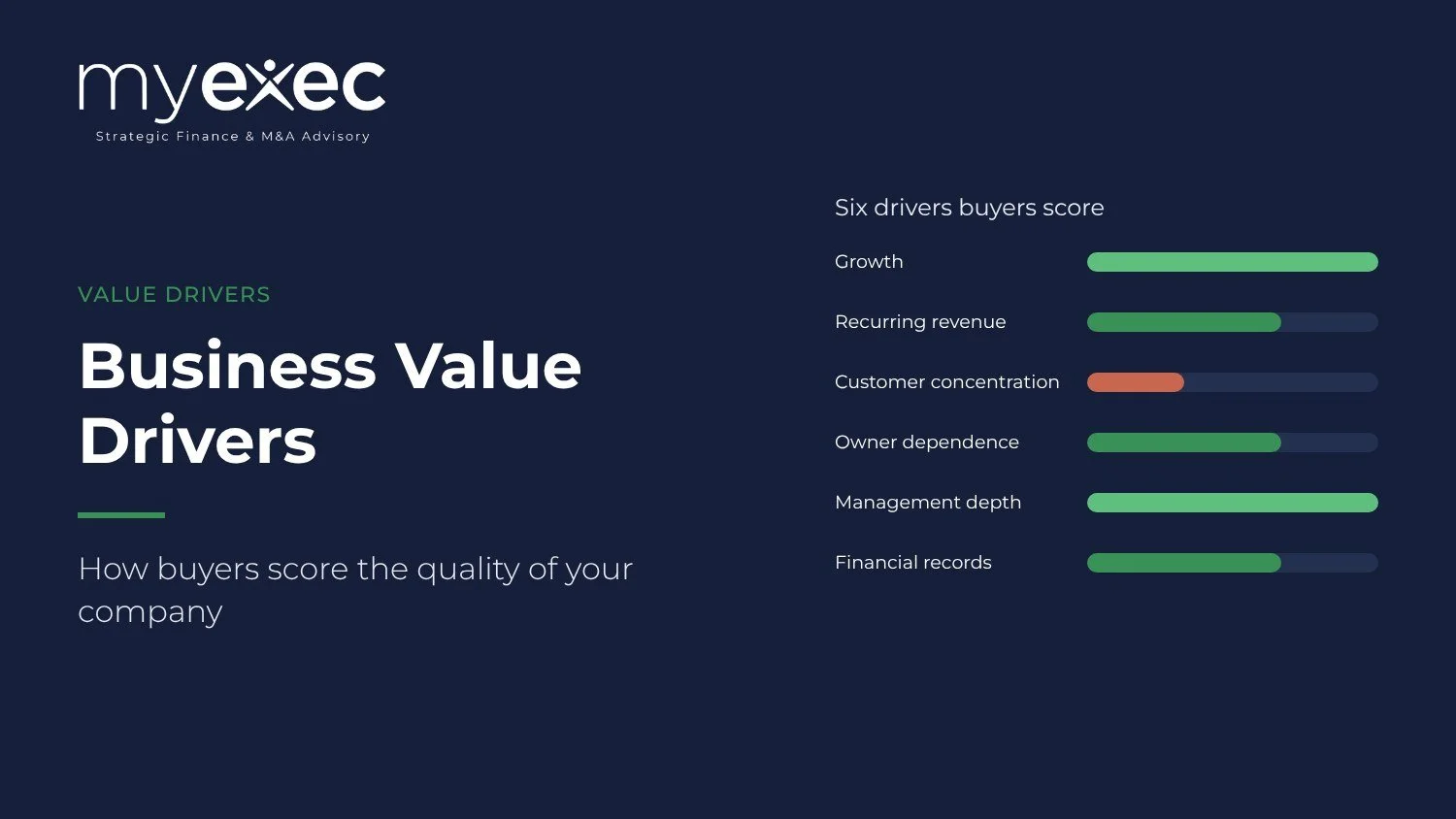
Business value drivers are the qualities that make a buyer pay more for the same earnings. Buyers look hardest at six of them: growth, recurring revenue, customer concentration, owner dependence, management depth and the quality of your financial records. Strong scores support a higher multiple. Weak ones lower it, or change how the deal is structured.
Two companies can earn the same EBITDA and still sell for very different prices. The difference usually comes down to a handful of business value drivers: how predictable the revenue is, how spread out the customers are, how much of the business runs through the owner, and whether the numbers hold up when a buyer checks them.
This guide is the starting point for our series on value drivers. It explains what each driver is, how buyers test it, and how they turn what they find into a price. There's a scorecard further down so you can rate your own company on all six, and each section links to a deeper article on that driver.
How do value drivers change what a company is worth?
For most owner-led companies, value comes down to two numbers multiplied together: the earnings a buyer believes the business will keep producing, and the multiple the buyer is willing to pay for those earnings. Value drivers act on both, but mostly on the multiple.
The multiple is really a measure of risk. When a buyer sees steady growth, a wide customer base and a team that runs the business without the owner, the future earnings look more certain, so the buyer will pay more for each dollar of them. When the buyer sees one customer at a third of revenue, an owner who holds every key relationship, or books that don't tie to the tax returns, the same earnings look less certain and the multiple comes down.
Two drivers also reach the earnings side. Growth raises the earnings being priced. Records quality decides which earnings the buyer accepts: if add-backs can't be supported or the books don't reconcile, the buyer prices a smaller number. That's why a weak score on records can cost more than it looks like it should.
Which value drivers do buyers score?
These are the six value drivers that matter most for owner-led companies with $5 million to $50 million in revenue. They're the same six our free business valuation calculator scores, and they line up with what buyers dig into during diligence.
| Value driver | A strong position | A weak position | What a buyer asks for to test it |
|---|---|---|---|
| Growth | Steady growth over three to five years with margins holding | Flat or uneven revenue, or growth bought with lower margins | Three to five years of revenue and margin, growth by source, the plan |
| Recurring revenue | Most revenue under contract, subscription or repeat orders, with low churn | Every year starts from zero, mostly one-time projects | Contracts, renewal history, revenue by customer by year |
| Customer concentration | No customer above about a tenth of revenue | One customer at a quarter of revenue or more | Revenue and gross profit by customer, contract terms, tenure |
| Owner dependence | The business could run for a year without the owner | The owner holds key customers, pricing and decisions | Org chart, who owns each customer relationship, how decisions get made |
| Management depth | A team that runs sales, operations and finance and plans to stay | Managers who carry out the owner's decisions | Each manager's role, tenure and track record, retention plans |
| Financial records quality | Monthly closes, statements that reconcile to tax returns and bank accounts | Year-end only books, mixed personal expenses, add-backs without support | Monthly financials, tax returns, bank statements, add-back support |
Growth
Buyers pay for growth that is consistent, profitable and likely to continue after the sale. They look at three to five years of revenue and margin, where the growth came from, and whether a plan the team owns supports the next few years. Our article on how buyers value growth covers the metrics in detail.
Recurring revenue
Revenue that comes back each year without being resold is easier to forecast, so buyers trust it more. Service agreements, maintenance contracts and long-term supply relationships all count. Retention matters as much as the label. Read more about recurring revenue and how buyers test it.
Customer concentration
When one or two customers make up a large share of revenue, losing either one would change the business. Buyers price that risk, sometimes through a lower multiple and sometimes through deal terms that tie part of the price to the customer staying. Our guide to customer concentration explains how it gets priced, and a follow-up article will cover how to reduce it before a sale.
Owner dependence
If the owner is the top salesperson, the main contact for key customers and the person who makes every pricing call, a buyer has to ask what happens when the owner steps back. The more the business runs through you, the more the buyer discounts. Our article on owner dependence covers how to measure it and how to reduce it.
Management depth
Management depth is the other side of owner dependence. Buyers want to see leaders who run their part of the business, own their numbers and intend to stay. A team that already makes decisions without the owner is one of the clearest signals that earnings will hold after the sale.
Financial records quality
Poor records cost real money. They shrink the earnings a buyer accepts, slow diligence and give the buyer reasons to lower the price late in the process. Monthly closes and statements that reconcile to the tax returns and bank accounts are what buyers look for first.
How do buyers turn value drivers into a view of risk?
A buyer doesn't take your word for any of this. Each driver gets tested during diligence, and the requests tell you what they're scoring.
In a sell-side process we're running now, buyers asked for three years of monthly financials, the full equipment list and the tenure of every employee before going further. Each request tests a value driver. Monthly financials test records quality and the consistency of growth. The equipment list tests what it will cost to keep the business running. Employee tenure tests whether the team is stable enough to stay through a change in ownership.
What the buyer finds shows up in three places: the multiple they offer, the earnings they apply it to, and the deal terms. A weak driver that can't be fixed in time often gets handled through structure, such as part of the price paid later if a large customer stays. Strong drivers give you more cash at closing and fewer conditions.
Same earnings, different price: an example
Here's a hypothetical example. Two distribution companies each earn $3 million of EBITDA on similar revenue. The difference is in how they score on the value drivers.
| Value driver | Company A | Company B |
|---|---|---|
| Growth | Steady, margins holding | Steady, margins holding |
| Recurring revenue | Mostly repeat orders | Mostly repeat orders |
| Customer concentration | Largest customer 35% of revenue | Largest customer 9% of revenue |
| Owner dependence | Owner handles the top ten accounts | Sales manager handles key accounts |
| Management depth | Managers carry out the owner's decisions | Team runs sales, operations and finance |
| Financial records | Year-end statements, several add-backs | Monthly closes that reconcile |
On paper they earn the same. A buyer looking at Company A sees one customer who could take away a third of revenue, an owner whose relationships may not transfer, and earnings that need work to verify. Most buyers would offer Company A a lower multiple, and many would tie part of the price to the large customer staying. Company B would likely draw more buyers, a better multiple and more cash at closing. The value drivers explain the gap.
How do you score your company?
Rate your company on each driver. Be honest; the point is to see where a buyer would push. Your results update as you go.
Value driver scorecard
Rate each driver to see your profile.
This is a quick read on quality only. Our free business valuation calculator puts these answers together with your revenue, earnings and industry for an estimate of value.
Which value driver should you work on first?
Start with the driver that is weakest and most visible in diligence. A buyer will find concentration, owner dependence and messy records within the first few weeks, and each one gives them a reason to lower the price or add conditions. Those are usually the first three to fix.
Some fixes are quick and some take years. Getting the books to a monthly close that reconciles can happen in a few months. Moving customer relationships off the owner, building a management team and reducing concentration usually take two to three years, which is why the best time to start is well before you plan to sell. Our list of ways to make your business more valuable has the practical steps.
We run the same playbook with every owner who asks this question: score the six drivers, put a rough dollar effect on the weakest two, and build a plan the leadership team owns, with progress reviewed each month alongside the financials.
Frequently asked questions
What are the most important value drivers in a business?
For owner-led companies with $5 million to $50 million in revenue, the six that matter most are growth, recurring revenue, customer concentration, owner dependence, management depth and financial records quality. Growth and customer concentration tend to carry the most weight with buyers, but a serious weakness in any one of the six can lower the price or change the deal terms.
How do value drivers affect the multiple a buyer pays?
The multiple reflects how certain the buyer is that earnings will continue. Strong value drivers make future earnings look more certain, so the buyer pays more for each dollar of them. Weak drivers add risk, which lowers the multiple or moves part of the price into terms paid later, such as an earnout tied to a key customer staying.
Can I improve my value drivers in a year?
Some, yes. Records quality can improve within a few months, and a written plan with monthly tracking can be in place within a quarter. Reducing customer concentration, building management depth and moving relationships off the owner usually take two to three years. Starting now gives you a better story even if every fix isn't finished by the time you sell.
Do value drivers matter if I am not planning to sell?
Yes. The same qualities that raise value also make the business easier to run, finance and hand off. A company with a strong team, a broad customer base and clean monthly numbers gives the owner more time, more options with lenders and more flexibility if an unexpected offer or a health issue forces a decision sooner than planned.
How do I find out where my company scores?
Start with the scorecard above for a quick read. For an estimate that combines these factors with your revenue, earnings and industry, use our free valuation calculator and choose the Advanced estimate for the full Estimate of Value report. If you need a formal valuation, our valuation professionals can walk through each driver with you.
See your score
Our free valuation calculator scores the same six value drivers and shows how they come together in an estimate of value. Choose the Advanced estimate for the full Estimate of Value report, with a score for each factor a buyer weighs.
Want to talk through your drivers? Book a valuation consultation with our team.