

How do you reduce customer concentration?
The short answer
Reduce customer concentration on two tracks. Grow revenue from the rest of the customer base so the largest accounts become a smaller share, and make the large accounts less risky with longer contracts, more relationships and more than one service line. Start two to three years before a sale and track the share every month.
If one or two customers make up a large share of your revenue, you already know it's a risk. Our article on how customer concentration affects value explains how buyers price it. This one is about what to do: how to reduce customer concentration in the years before a sale, how long it takes, and how to present whatever concentration is left.
Concentration is one of the six business value drivers buyers score, and it's one of the first things they look at. Our free valuation calculator scores it too.
How should you measure customer concentration?
Measure it the way a buyer will. One number isn't enough. A buyer wants to see the share, the trend and what sits behind the biggest relationships.
| Measure | How to calculate it | What a buyer reads from it |
|---|---|---|
| Largest customer share | Revenue from your biggest customer divided by total revenue | How much of the business one decision could take away |
| Top five share | Revenue from your five biggest customers divided by total revenue | Whether the risk sits in one account or a small group |
| Share of gross profit | Gross profit from the largest customers divided by total gross profit | Whether the big account is also where the margin is, or a low-margin volume account |
| Trend over three years | The same shares for each of the last three years | Whether concentration is getting better or worse |
| Tenure and contract term | Years with each large customer and time left on any contract | How likely the relationship is to last through a change in ownership |
We put a page like this in front of leadership every month. In monthly reporting for a manufacturer we work with, the top 15 customers and the largest open opportunities sit in the package each month, and customers are grouped by product line so the team can see where growth is coming from. That habit is what lets an owner show a buyer a trend instead of a single number.
Track one: grow the rest of the customer base
The most reliable way to reduce customer concentration is to make the rest of the business bigger. Your largest customer can keep growing too. What matters is that everything else grows faster.
Pick the next ten accounts to grow
Look at the customers ranked roughly 2 through 15. Most companies have a handful of mid-sized customers who buy one or two things and could buy more. A named plan for each, with an owner on your team and a target for the year, usually moves the numbers faster than chasing new logos.
Win new customers in the same segment, then an adjacent one
Your largest customer is proof that you can serve that kind of company well. Use that track record to win others like it. Once that's working, look at an adjacent segment or region where the same capabilities apply.
Track two: make the large accounts less risky
You won't always get the big customer below the level a buyer prefers. You can still make the relationship look much safer.
Contracts and terms
A multi-year agreement, an evergreen contract with a long notice period, or a supply agreement with volume commitments all give a buyer something to underwrite. Revenue under contract reads as contracted and recurring revenue, which is worth more than revenue that depends on the next purchase order. Contract terms are for your attorney to draft and review.
More relationships than the owner's
If you are the only person the customer calls, the relationship may not transfer. Build contacts at several levels: your operations lead with theirs, your finance team with their accounts payable, your account manager with their buyers. That reduces both concentration risk and relationships that depend on the owner.
More than one product or service line
A customer that buys three things from you is harder to lose than one that buys one. Adding a second service line for a large customer can raise revenue from them while making the relationship stickier.
What not to do
- Don't turn away profitable work to hit a percentage. Shrinking your best customer lowers earnings, and buyers price earnings first.
- Don't discount the big account to keep it. Falling margin on your largest customer makes the risk look worse.
- Don't wait until the year of the sale. A one-year improvement looks like a blip. Three years looks like a trend.
How long does it take? A worked example
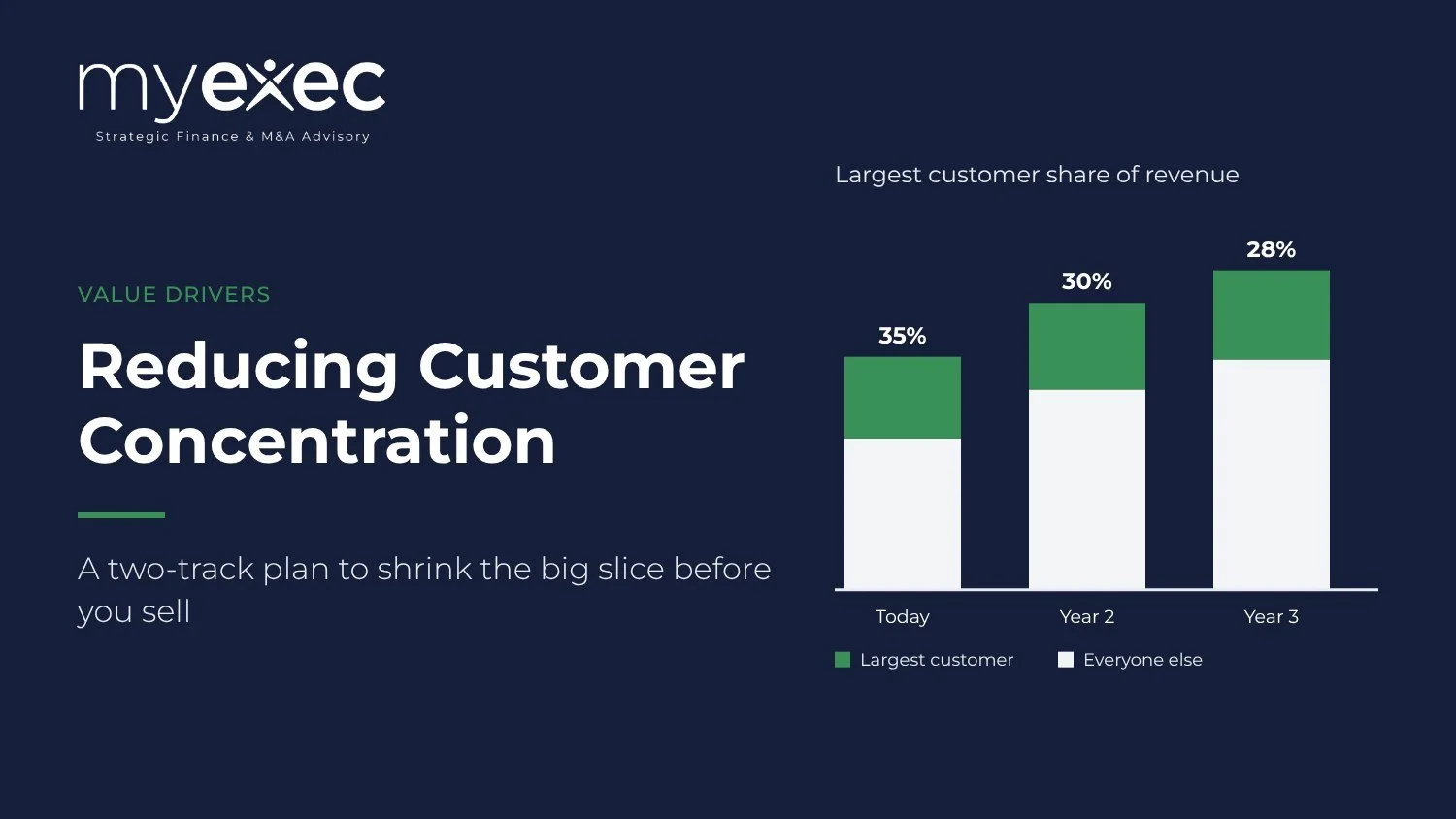
Here's a hypothetical example. A $20 million company gets $7 million, or 35% of revenue, from its largest customer. The owner plans to sell in three years. The plan grows the largest customer at 3% a year, mostly by adding a second service line, and grows the rest of the base at 15% a year by working the next ten accounts and adding customers in the same segment.
After three years, revenue is about $27.4 million and the largest customer is about 28% of it. That's still a large customer, but the trend is clear, the customer is on a multi-year agreement and buys two service lines, and three people on the team manage the relationship. A buyer will see a risk that is shrinking and well managed, which is a very different conversation from a single account at more than a third of revenue with the owner as the only contact.
Try your own numbers below. Most owners find that getting a large share down meaningfully takes two to three years of the rest of the business growing well ahead of the big account.
Concentration path calculator
| Year | Total revenue | Largest customer share |
|---|
Enter your numbers to see the path.
An illustration only. Growth rarely arrives in a straight line, so revisit the plan each quarter against actual results.
How should you explain the concentration that remains?
Most owners will still have a large customer when they sell. A buyer will ask the same questions every time, so have the answers ready:
- How long the customer has been with you, and the revenue and gross profit from them each year.
- What the contract says about term, renewal and notice, with a copy ready for diligence.
- Who on your team manages the relationship, besides you.
- What you sell them today, and what else they could buy.
- The three-year trend in their share of revenue, and the plan behind it.
Buyers sometimes handle remaining concentration through deal terms, for example paying part of the price later if the customer stays. The cleaner your answers to these five points, the less of the price tends to depend on those terms. The other value drivers buyers weigh alongside this one are in our guide to business value drivers.
Frequently asked questions
What percentage of revenue from one customer is too much?
There isn't one cutoff, and it varies by industry. As a general rule, buyers start asking questions when one customer passes about a tenth of revenue, and they price real risk once a single customer reaches a quarter or more. Contract terms, tenure and the depth of the relationship can make a high share less of a concern.
How long does it take to reduce customer concentration?
Usually two to three years to show a convincing trend. The share falls only as fast as the rest of the business outgrows the large account, so it depends on your growth rate. Making the large account less risky, with longer contracts and more relationships, can happen faster and is worth starting at the same time.
Should I turn down work from my largest customer?
Generally no. Buyers price earnings first, so shrinking profitable revenue to improve a percentage usually lowers value. The better path is to grow the rest of the base faster and make the large relationship more secure. The exception is low-margin work that ties up capacity you could use to win other customers at better margins.
Do long-term contracts make concentration less of a problem?
They help. A multi-year agreement or a long notice period gives a buyer something concrete to rely on, which lowers the risk they price. Buyers will still look at what happens when the contract ends, so pair contracts with deeper relationships and more than one service line. Your attorney should draft and review the contract terms themselves.
How do buyers handle concentration in a deal?
Through price, terms or both. A buyer may offer a lower multiple, or keep the price and tie part of it to the large customer staying for a period after closing. Strong answers on tenure, contracts and relationships, plus a falling trend in the customer's share, give you more cash at closing and fewer conditions.
See how concentration affects your number
Our free valuation calculator scores customer concentration alongside the other value drivers buyers weigh. Choose the Advanced estimate for the full Estimate of Value report and see how your answer moves the estimate.
Planning a sale in the next few years? We can help you build the plan and track it each month.