Fractional CFO Firms: How to Compare Them Before You Sign
Core Evaluation Criteria for Modern Fractional CFO Services

Choosing between fractional CFO firms requires looking beyond impressive bios. Most firms present polished proposals, but their underlying operating models differ. Understanding how a firm structures its team, approaches transaction support, and covers the six dimensions of a strategic finance function will help you determine the right fit for your business stage.
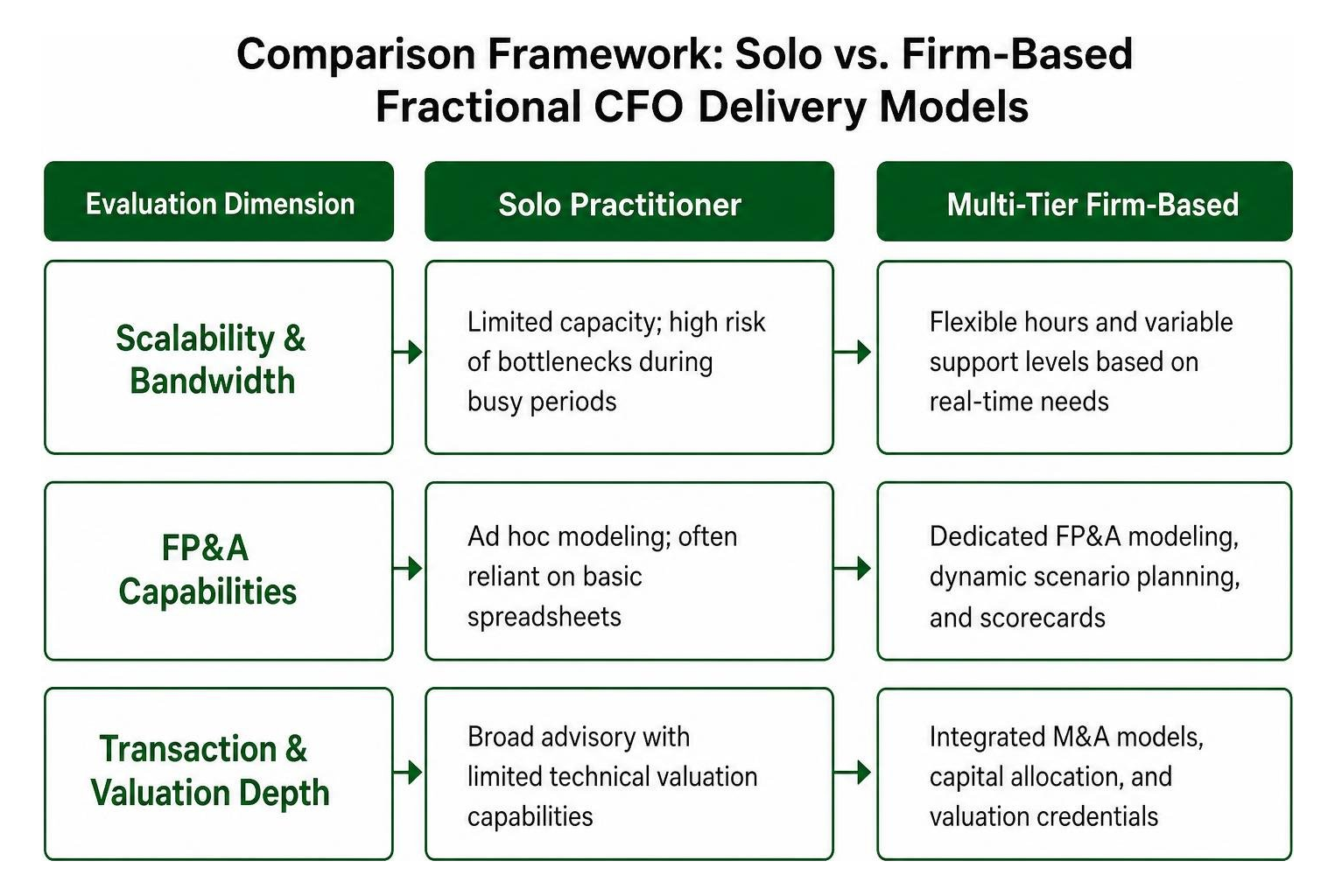
| Evaluation Criteria | Solo Practitioner | Multi-Tier Fractional Firm |
|---|---|---|
| Team Architecture | Direct, high-touch engagement with a single senior executive | Senior CFO guidance paired with analytical and controller support |
| Scalability & Bandwidth | High personal attention with fixed individual capacity limits | Flexible hours and variable support levels across team tiers |
| FP&A Capabilities | Direct executive modeling tailored to specific leadership questions | Dedicated analyst modeling, dynamic scenario planning, and scorecards |
| Transaction & Valuation Depth | Broad advisory well suited for standard transactions and board guidance | Integrated M&A models, capital allocation, and valuation credentials |
Solo Practitioners vs. Multi-Tier Fractional CFO Services
Solo practitioners provide direct access to an experienced finance executive without managing layered agency relationships. For businesses that already have capable internal accounting staff and primarily require high-level strategic advisory, a solo CFO offers focused counsel. The main consideration is individual bandwidth. When complex data reconciliation or sudden transaction workloads emerge, a single practitioner must divide their time between high-level guidance and hands-on spreadsheet tasks.
Multi-tier fractional CFO services distribute tasks across senior financial leaders, controllers, and analysts. In this structure, controllers and analysts handle data hygiene and reporting assembly, while your fractional CFO focuses on capital strategy, unit economics, and board presentations. This division allows the firm to scale analytical support up or down during complex audit preparation or tight fundraising timelines, though it involves managing workflows across multiple external team members.
Sector Nuance and Capital Allocation Track Record
Every sector has distinct unit economics and operational rhythms. A manufacturing business needs inventory forecasting and disciplined working capital management to avoid cash crunches during heavy production cycles. A recurring-revenue technology firm needs clear visibility into renewal rates, customer acquisition costs, and cohort analysis.
When evaluating growth-stage financial leadership, look for firms with a demonstrated track record in capital allocation and margin optimization. Capable teams help improve enterprise value through disciplined planning, cash forecasting, and dynamic scenario modeling. Experienced providers understand how to structure debt, evaluate capital expenditures, and build integrated three-statement models for new product launches and mergers and acquisitions. They provide advanced analysis, decision support, and margin optimization for complex growth phases, helping leadership identify which product lines generate true cash profit versus those that merely inflate top-line revenue.
How to Assess Operating Models, Fee Structures, and Offboarding
A transparent operating model creates alignment from day one. Before signing an agreement for fractional CFO engagements, review the firm's immediate deliverables, fee transparency, and offboarding procedures. You need to know exactly who is responsible for each output and how changes in project scope will impact your monthly spend.
First 90 Days: Expected Milestones from Fractional CFO Services
A reliable provider will establish quick wins while building long-term financial infrastructure. In our practice, we focus on immediate clarity. We've implemented cash flow forecasts and rolling 13-month P&L forecasts for clients to give leadership visibility over upcoming cash cycles. This structure keeps management ahead of payroll obligations, inventory orders, and debt servicing requirements.
During the first 90 days of following a strategic finance implementation, expect your partner to deliver:
- A rolling 13-month P&L forecast integrated with operational drivers and revenue assumptions
- Dynamic cash flow forecasts and liquidity stress tests that protect against sudden downturns
- Critical KPI scorecards tracking customer acquisition cost, average revenue per customer, and net revenue retention
- Concrete workflow adjustments to improve monthly reporting quality and speed
- An audit of your chart of accounts to ensure expenses are categorized for clear managerial decision-making
Engagement Terms, Pricing Models, and Clean Exit Clauses
Review how the provider structures their scope. Many firms offer fixed monthly retainers based on expected deliverables, while others use variable hourly billing. Fixed retainers offer predictable costs, provided the scope of work is clearly defined. Hourly models can work for brief advisory projects, but they often lead to unpredictable invoices during month-end close or budgeting seasons.
A strong firm also plans for its eventual replacement. If your business grows from $10 million to $40 million, you will eventually need an in-house executive. Ask how the firm handles knowledge transfer. Effective strategic finance consulting includes documenting models, setting up clean workflows, and helping you define the job description for your future full-time hire. A quality partner never holds your financial models or passwords hostage when you are ready to build an internal department.
First-Call Vetting: Essential Questions and Red Flags for Mid-Market Buyers
Your initial discovery call gives you a clear window into how a prospective firm operates. Use this conversation to assess technical depth, operating philosophy, and working style by pairing targeted questions with the answers that should raise immediate concern.

High-Impact Questions and Concerning Answers to Watch For
Before deciding, assess your strategic finance readiness and ask firm leaders these direct questions:
- Who specifically will be building and maintaining our financial models?
- What should worry you: Vague answers like "our core analysts" without named personnel. If you can't meet the dedicated analysts and senior CFOs handling your account, your work may be passed to whoever has unbilled hours that week.
- How do you handle capital allocation, banking relationships, and debt covenants?
- What should worry you: If their experience stops at basic compliance and tax filings rather than proactive leverage planning. A concerning answer is when a firm can't explain how they calculate fixed charge coverage ratios, model covenant headroom, or manage lender communication during volatile quarters.
- Can you share how scenario planning changed a past client's outcome?
- What should worry you: If they offer static PDF summaries instead of dynamic sensitivity models with adjustable operational drivers. Effective partners perform sensitivity and scenario analysis that helps leadership make better decisions and improve cash flow and value over time. You can review examples of this work across our client case studies. If a firm can't detail how changing sales cycles or pricing assumptions impacted previous client decisions, they won't provide forward-looking strategic value.
- How do you translate complex projections into operational guidance for non-finance managers?
- What should worry you: Heavy reliance on accounting jargon without actionable dashboards or clear unit economics. Strategic finance only works when department heads understand their budget targets and how their daily choices drive bottom-line margin.
Warning Signs and Misaligned Incentives to Watch For
Beyond individual responses, watch out for these broader red flags during initial conversations:
- Generic deliverable templates: Be cautious if a firm insists on forcing your business into rigid, cookie-cutter templates that ignore your business model and operational drivers.
- Overemphasis on historical tax forms: If a firm focuses entirely on past compliance rather than forward-looking FP&A, they're operating as a bookkeeping service rather than a strategic finance partner.
- Resistance to clean offboarding: If a provider hesitates to document models or clarify how they will transition responsibilities to a permanent hire down the road, they may be trying to lock you into permanent dependency.
Frequently Asked Questions About Fractional CFO Firms
What is the average monthly investment for a mid-market fractional CFO firm?
Engagements are typically structured as monthly retainers tailored to your operational complexity, transaction frequency, and reporting needs. For mid-market companies generating between $5M and $50M in annual revenue, retainers generally range from a few thousand dollars per month for foundational FP&A support to higher tiers for extensive transaction and controller oversight. This structure provides access to high-level strategic finance leadership and analyst support at a fraction of the cost of hiring a full-time executive team.
How do fractional firms integrate with existing internal bookkeepers and ERP systems?
A fractional finance firm works alongside your existing bookkeepers and controllers rather than replacing them. They connect directly with your general ledger, accounting software, and operational databases to standardize the chart of accounts, improve the speed of the month-end close, and build forward-looking forecasts. This collaboration allows your internal accounting staff to focus on daily transaction execution while the fractional team focuses on strategic planning and analysis.
At what revenue stage should a company transition to a full-time in-house CFO?
Companies often make the transition when their revenue approaches $50 million, or when complex transaction volumes, international operations, and daily administrative demands require a dedicated executive on site every day. A good fractional partner helps facilitate this transition by assisting with role definition, sourcing candidates, and onboarding your permanent finance leader.
Conclusion: Selecting the Right Strategic Finance Partner
With annual budget planning underway, navigating higher borrowing costs following the September 2026 Fed increase requires rigorous financial visibility. Choosing a finance partner with the right mix of operational depth and analytical capacity helps protect liquidity and guide capital decisions.
At MyExec, we deliver flexible, scalable fractional CFO and FP&A services. Our support scales from analyst-level financial modeling to senior CFO guidance based on your operational stage. We've worked across companies ranging from a few million in revenue to roughly $2B, including nonprofits, private equity-owned, closely held, and publicly traded companies. We also have a CVA (Certified Valuation Analyst) on staff to assist with valuation analysis. MyExec is not a CPA firm and does not give tax advice. Our focus remains firmly on strategic finance.
Ready to bring clarity to your financial planning? Contact our team today to discuss how our strategic finance team can support your growth.